Tracking Turtles in the South China Sea
Chu Sheng-hung / photos courtesy of Cheng Yi-chun / tr. by Robert Taylor
July 1995


Early one summer's morning, a new recruit detailed to patrol the beach comes rushing back to the guard post and reports breathlessly to his squad leader: "There are lots of new tank tracks on the beach, perhaps the enemy has landed during the night. But I followed the tracks and there's no sign of anything. What should we do?"
The squad leader asks: "Are the tracks crisscross or parallel?" The rookie replies that the tracks cross each other. With a blase wave of his hand the squad leader calmly tells him: "There's nothing to worry about! Next time don't go taking turtles for tanks!"
This joke about green turtles is well-known on Taiping Island, the major island of the Spratly archipelago in the South China Sea.
1995 is the "Year of Sea Turtles in the Western Pacific." All countries in whose territorial waters sea turtles are found are stepping up research into these creatures. The ROC began programs four years ago, and last year it created refuge sites for nesting green turtles on Wang-an Island in the Penghu Islands. Last year too, Associate Professor Cheng Yi-chun of National Taiwan Ocean University carried out research on Wang-an Island which included attaching radio transmitters to two green turtles (Chelonia mydas) and tracking their movements over the course of two months using a satellite positioning system. Professor Cheng has already announced the results of this work internationally for the information of research institutes in other countries.
1990 data put the number of sea turtles in the South China Sea at some 50,000. To survey the distribution and numbers of green turtles in the area, in July of last year Cheng Yi-chun went to the Pratas Islands, and in April of this year, after applying through the Council of Agriculture to the Ministry of National Defense, he hitched a ride on a navy supply ship to Taiping Island in the Spratlys.
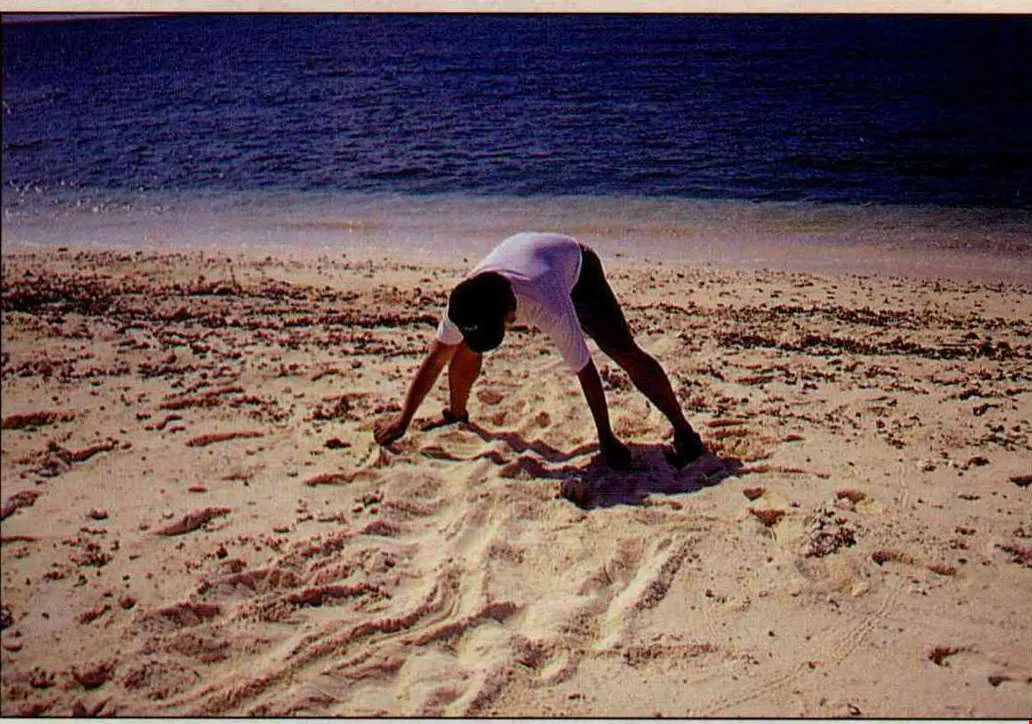
The first thing Cheng Yi-chun did after arriving on Taiping Island was to find and measure the old "tank tracks" left by green turtles.
The turtle pilots
After the supply ship set out from Tso-ying Naval Base in Kaohsiung, it spent several days bobbing across the sea before reaching Taiping Island. Although the unchanging ocean scene is one of beauty, after a time it begins to pall on one. But fortunately on the ship Cheng could listen to some navy legends about green turtles, and this helped relieve the tedium of the voyage.
The sailors recounted how, in the days before the ships had high-quality navigation equipment, a supply ship approaching Taiping Island was caught in a fog. Visibility was so poor that the ship was unable to find the nearby island, which has an average elevation of only 3.8 meters above sea level. But then a sailor on the slow-moving vessel caught sight of sea turtles swimming along. The captain ordered the crew to steer in the direction the turtles were swimming, and in this way they really did find Taiping Island. Because of this special relationship, the navy specially protects the sea turtles on the island.
Supply operations have always been intimately affected by the weather, but in the past there were no advanced meteorological facilities on Taiping Island, so there was always a complete lack of information about atmospheric conditions in the surrounding area. But recently, at the request of international organizations, the Directorate General of Telecommunications set up a weather balloon station on the island to monitor the upper atmosphere. To ensure that the data gathered is valid and accurate, the directorate also shipped a generator to the island to supply the equipment with electricity at a stable voltage. As well as being useful to ships at sea, the data supplied by this weather station is also of great help in understanding green turtles' adaptation to climatic conditions.
Taiping Island is close to the Doldrums (the belt of calms and light winds in equatorial oceans) and it has a hot, humid climate. The temperature in April is around 40●C during the day and 30●C at night. Everyone goes around in nothing but shorts. Although there are 38 air conditioning units on the island, they are all installed in offices, rooms housing important instruments, and the commander's sleeping quarters. The other officers and men have to make do with electric fans. But because the power generator is often overloaded and the air conditioning units and wiring are old and dilapidated, the power goes off several times a day.
Rumor has it that in past years, the forces stationed on the island used to amuse themselves by digging up green turtle eggs to make tonic wine. But since conservation ideas have become generally accepted, this practice has not been heard of any more.
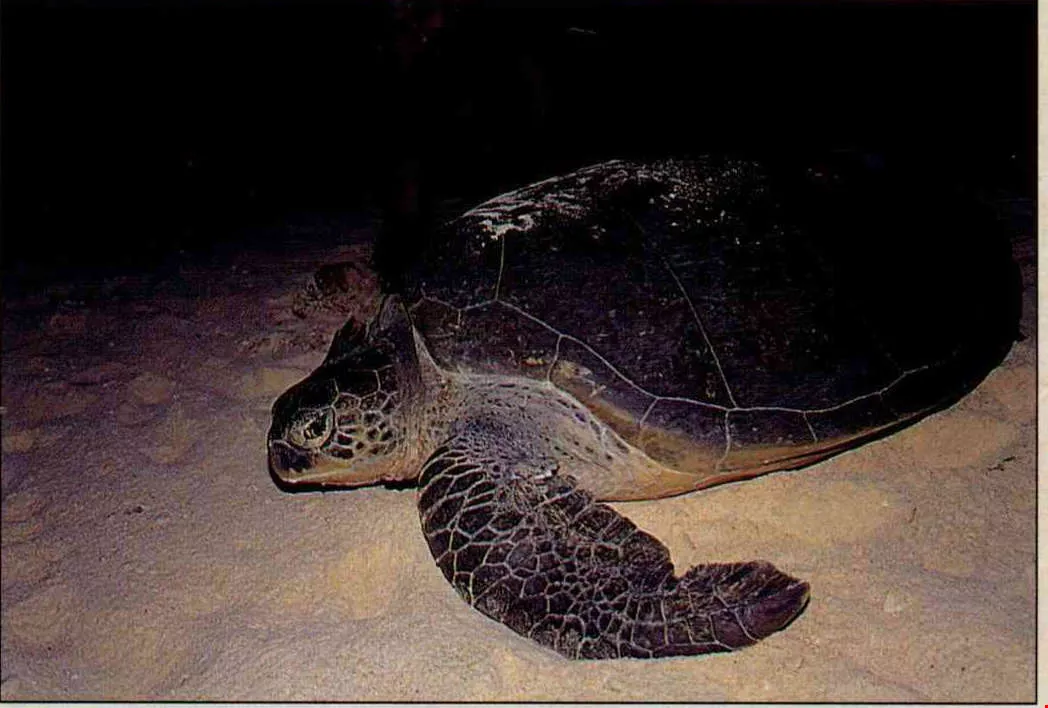
Once a green turtle has completed her mission of laying eggs, she hurries to return to the sea before dawn.
Protecting the natural environment
Like other islands in the South China Sea, Taiping Island is a coral reef. The island is not large, but as it has drinkable fresh water and occupies a strategic position, ROC forces have always maintained a presence there.
After Cheng Yi-chun arrived, he first made a survey of all the island's beaches, and found many traces of turtles coming ashore to lay eggs. There were both old and new tracks, showing that the turtles had landed to lay their eggs over a long period of time. Their landing points were mainly concentrated along the beaches in the southeast of the island.
After measuring the older tracks, Cheng gave out a questionnaire to 16 officers and men who had already been stationed on the island for almost a year. From their replies he discovered that green turtles come ashore to lay eggs on Taiping Island throughout the year. with the largest numbers appearing in July, August and September. The same turtle may come ashore and lay eggs several times in the same area. On average, each of the men had seen turtles more than eight times during each of the preceding three months. Cheng believes this may be related to the fact that the local natural environment has not suffered large-scale degradation.
As for the total number of times the 16 servicemen surveyed had seen green turtles in their almost a year of service on the island, the figures ranged from five to 60, but the majority reported seeing them around 30 times.
The reason why green turtles appear most frequently on the island's southeast coast is partly that the beaches there are comparatively well preserved and have very few buildings, and also that this area, being outside the zone where the forces stationed on the island are usually active, has retained relatively large tracts of virgin tropical forest.
The defenses built by the military sometimes hinder the turtles coming ashore to lay eggs, or even endanger their lives. Wire fences run all the way round the island above the high-water line, and trenches have been dug there too. According to Cheng Yi-chun's interviews with garrison members, when turtles crawl further from the shore and approach these defenses they are sometimes caught under the wire so that they can move neither forward nor back, or they may fall into the trenches. Because the turtles helped the marines in the past, one of the unwritten rules of Taiping Island is never to kill turtles. The garrison's daily patrols now keep a special watch for turtles caught in the defenses. If they see any turtles in trouble, they have to help them return to the sea, and report and record the incident.
Exploitation of the island's natural resources has also indirectly affected the green turtle's survival. Taiping Island has a layer of guano suitable for use as industrial phosphate. During World WarII, when the island was occupied by the Japanese, a Japanese company mined guano there. The Japanese also changed the name of the Spratly Islands (called the Nansha--"South Sand"--Islands in Chinese) to the "Shinnan Islands" ("New Southern Islands"). A stele inscribed with this name still stands on the Taiping Island, but the Japanese text below the name has been plastered over.
After the ROC government relocated to Taiwan, the Vocational Assistance Commission for Retired Servicemen (VACRS) also mined guano on Taiping Island, but the mining operations affected the quality of the island's drinking water. Taiping Island is surrounded by the sea, and one might think that its only source of fresh water would be rainwater, such as the afternoon showers in summer and the rain brought by typhoons. But in fact the island's underground water is of a quality good enough for drinking, for the layer of guano acts as a natural filtration system which removes the salt from seawater. Before the VACRS stopped mining guano, the water pumped up from underground was becoming severely saline, and had almost become unfit for drinking. It was only after guano extraction stopped that the water quality gradually stabilized again. The end of mining activities also meant that apart from the military, there was no more disturbance on the island, and the green turtles began to appear there more often.

This abandoned pier has become a perch for seabirds.
Lucky enough to see turtles
At the beginning of this trip, Cheng Yi-chun's luck was poor: for the first three nights he didn't catch sight of a single green turtle. Perhaps this was because it was not the season when turtles come ashore to lay eggs most often.
On the afternoon of the fourth day, the duty commander said: "Those with nothing to do go on board now." But Cheng Yi-chun told him that his work was done at night, and if he went on board so soon he would lose an opportunity, so the officer agreed to let him stay. In the last night of waiting, Cheng finally saw two green turtles. One of them came ashore and laid eggs, while the other could not find a suitable spot, and returned to the water without laying. Cheng Yi-chun also brought back tissue samples from both these turtles to send to America for genetic analysis.
In fact, to survey all the green turtle populations in the South China Sea is no easy task, because currently many countries claim sovereignty over the area and many of them occupy various islands in the Spratlys. Under present conditions, researchers can only hope to achieve anything if they can find channels through which to bring together the various individual studies. Otherwise, people can only pursue their own ideas, with no way to integrate their work.
But, says Cheng Yi-chun, if the various countries could create refuge sites for nesting turtles on all the Spratly Islands, "we could do some proper research into sea turtles' behavior and also reduce tension in the area."
[Picture Caption]
p.52
Coconut palms, sandy beaches, the setting sun.... Taiping Island, with its unmistakable south sea atmosphere, has its own special ecosystem.
p.53
The first thing Cheng Yi-chun did after arriving on Taiping Island was to find and measure the old "tank tracks" left by green turtles.
p.53
Once a green turtle has completed her mission of laying eggs, she hurries to return to the sea before dawn.
p.54
This abandoned pier has become a perch for seabirds.
p.55
When the Japanese occupied Taiping Island they renamed the Spratlys the "Shinnan Islands."
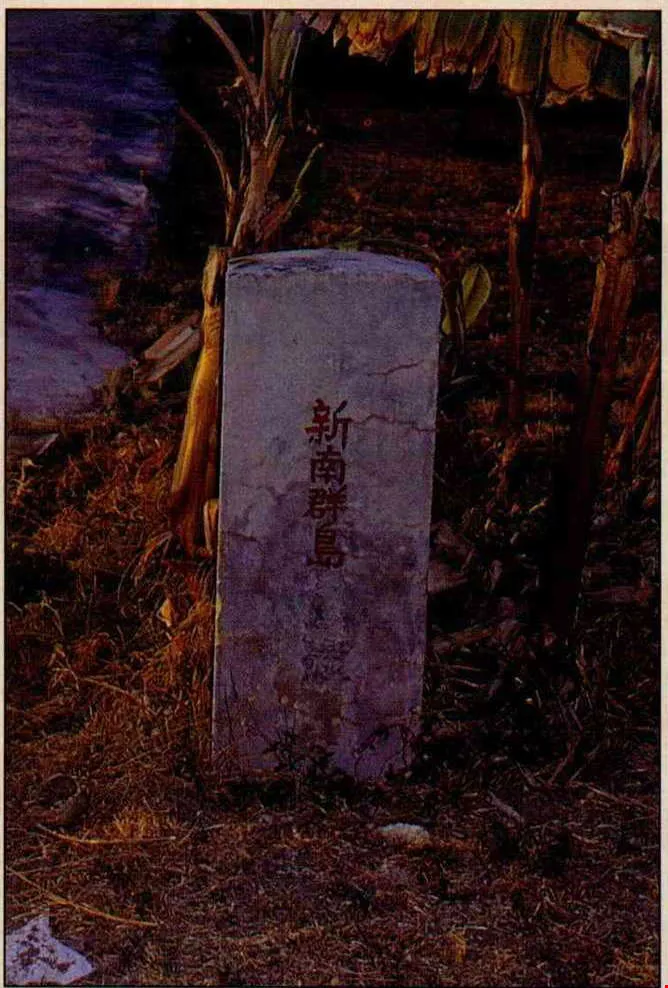
When the Japanese occupied Taiping Island they renamed the Spratlys the "Shinnan Islands.".
@List.JPG?w=522&h=410&mode=crop&format=webp&quality=80)


