Healing the Mountain:Hsu Jui-ming and the Lichia Forest Road
Tsai Wen-ting / photos Wang Meng-hsiao / tr. by Paul Frank
May 2007


When Hsu Jui-ming retired from a 17-year navy career to return to the place of his childhood, Mt. Tamalakao in Taitung County, he found that the green forests he remembered had been cut down to make way for areca palm plantations. To heal the scarred mountain, he began to plant trees, and soon thereafter opened an eco-farm. Since then, Hsu has planted countless trees on the land as well as in people's hearts.
Lichia Forest Road is located on Mt. Tamalakao, Tai-an Village, Peinan Township, Taitung County. It is home to more than 140 species of fern, 20 species of firefly, and the rare orange-belly tree frog (Rhacophorus aurantiventris). It is also an important nesting site for the fairy pitta bird (Pitta nympha). Thanks to the hard work of the Lichia Forest Road Association (LFRA), in recent years the area has become a popular destination for environmental tourism.
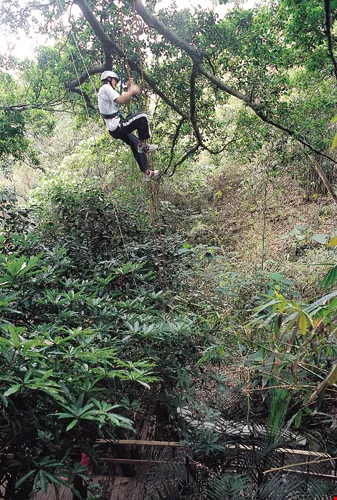
A simple rope harness enables visitors to enjoy the natural environment of Lichia Forest Road from the tree canopy.
The forest road
As you enter the forest road, there is a fence on one side that separates the road from a public cemetery. A vine of birthwort (Aristolochia) and Taiwan elder (Sambucus formosana) has been planted along the fence to induce various kinds of butterflies, including the precious golden birdwing (Troides aeacus), to lay their eggs on it. An ordinary fence has been converted into a colorful butterfly hedge.
In the spring and fall, visitors walking along the two-kilometer walkway under the cool shade of giant makino bamboos see fireflies of various species rising from the lush grass with their wingborne lamps, as if to invite them to commune with the mountain spirits.
Chen Shih-chi, chieftain of the Puyuma Aboriginal village of Tamalakao, was our guide. Before entering the mountain trail, we stopped at a clearing and placed offerings of betel nuts, wine and meat on a rock, and lit up a cigarette to announce our coming to the spirits of the mountain and let the Creator of All Things get a small smell and a taste of us, which was all it needed to protect us. This simple and solemn ceremony, known as palisi, awakens people's respect for the natural environment.
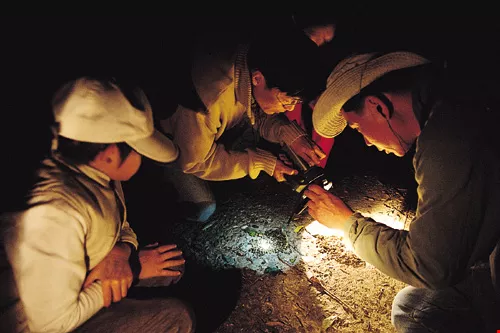
At night on the forest road, frog calls seem to come from every direction, but listen carefully and you will discover many frogs hiding in the thick grass.
A farm without pets
Halfway up the mountain, five kilometers up a winding trail, we arrived at Taiping Farm, where we were greeted by Hsu Jui-ming, farm manager, heart and soul of the effort to revive the mountain forest, and founder of LFRA.
Born in 1967, Hsu has a pale, clear complexion and dresses neatly. He bears the nickname "The Man Who Plants Trees." Seven years ago, despite his parents' vehement objections, he quit the navy although it was a steady, well paid career and he was only eight years from a generous lifelong pension. His reason was that he no longer wanted to be posted for long periods on Taiwan's outlying islands, where he would not be able to see his children grow up.
Wit the full support of his wife, who is a teacher, Hsu moved with her and their two sons back to his native Taitung, to set up a farm on land owned by his family. But he found that the dense mountain forest he remembered from his childhood had been cut down long ago and the last traces of the animals that had lived in this habitat were gradually disappearing.
To become a professional farmer, Hsu quickly read everything about farming he could lay his hands on. At the same time he worked as an environmental tour guide in two national parks. His experience and conversations with people in the leisure industry sparked a simple idea: to recreate the natural environment of his youth. Hsu said to himself, "If I get the forest road to look the way it once did, the birds and animals are bound to come back!" Exchanging his gun and compass for a hoe, he increased the land under irrigation and proceeded to plant hydrophytes, flowers, plants, and trees over a wide area.
Hsu Jui-ming recognized that reintroducing species demanded biotechnical expertise he did not have. But he also figured that as long as he restored the habitat to its original state, species that were naturally adapted to it would return.
"It wasn't rocket science. As long as I learned from the virgin forest right by the farm, I was on the right track," recalls Hsu.
The Taiping Farm concept is to have no fenced-in animals, flagship species, or fruit trees (fruit picking is a popular photo op for tourists). Instead, the farm makes every effort to be environmentally conscious and recycles kitchen waste and wastewater.
"By piling these dried leaves under this tree, we enable fireflies to lay their eggs here. Isn't that how it works in the forest?" Hsu's aim is to create an environmentally friendly eco-farm where visitors will get to know nature. "There are animal farms and fruit farms where tourists can pick their own fruit. Neither corresponds to my idea of an ecological farm," he explains.
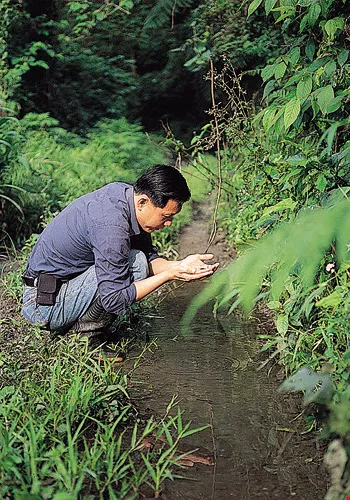
After heavy rains, tadpoles gather in pools by the roadside. Nature teems with new life, and we can only watch in wonder.
Adventures in the natural world
Taiping Farm is located more than 500 meters above sea level and affords a splendid view of the Pacific Ocean and Green Island. When Hsu Jui-ming leads forest road tours, he tells children to pick up any dry twig that they like. He himself then picks up a stick with holes eaten into it, holds it to his ear and says: "This came off a cherry blossom tree. Listen carefully. There are insects living in there!"
After each child has chosen a twig, they drill into it from the thicker end, insert a pencil lead, and make a point using shears and then a craft knife, to create a unique-looking pencil.
Alternatively, they can take a pretty leaf, put it in a piece of cloth, and pound it repeatedly to extract the sap and produce a beautiful handkerchief with a leaf-shaped pattern. Children also follow Hsu into the forest to look for animal tracks. A plaster cast of the animal's footprint makes a perfect souvenir. Or using a simple pulley and rope, they can hoist themselves two or three meters to the tree canopy and observe birds, bees, and ants hiding and foraging.
Taiping Farm's captivating approach to ecotourism has won it the support of many visitors and has gradually allowed Hsu Jui-ming to get the farm on a sufficiently steady footing to support his family.
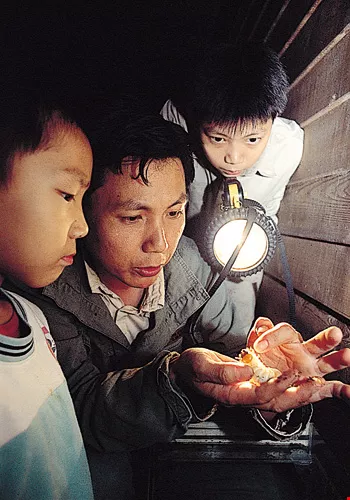
Hsu Jui-ming shows the grubs to his two sons.
A frog haven
Hsu did not start out with the intention of running a theme farm; he simply did his best to build a natural environment. But soon after the area began to recover, he noticed large numbers of Japanese tree frogs (Buergeria japonicus) as well as a few Moltrecht's tree frogs (Rhacophorus moltrechti) and brown tree frogs (Polypedates megacephalus). Estimating there were more than 200 frogs on the 1.5-hectare farm, he was inspired to launch a reintroduction project.
The project had barely gotten underway when another idea germinated in his mind: to study the orange-belly tree frog, about which research data was very hard to obtain, and turn Lichia Forest Road into a haven for this rare species.
The orange-belly tree frog, which was discovered in 1994, is found only in Taiwan, in virgin forests below 1500 meters. Of the five species of green tree frog in Taiwan, the orange-belly tree frog is the one about whose way of life the least is known. Frequent sightings and several studies conducted by herpetologists indicate that the Lichia Forest Road has already become the frog's most important habitat. But more research is needed before definite conclusions can be drawn.
Hsu Jui-min's nickname for the orange-belly tree frogs is "tangerines." In 2001 he began to focus on finding these other-worldly animals, but he was unsure where their habitat was, and traversed the length and breadth of the farm without finding a single specimen. One night in May 2005, as he was doing a routine ecological survey in the forest, he heard an orange-belly tree frog call. It was an exhilarating sound.
After that first encounter, Hsu used sonar location and tracking methods he had learned in the navy to try to find the frogs. He would go out at night and play recordings of their calls to entice the frogs to respond. He also got two of his farm workers to help him triangulate the frogs' hiding places by listening to their calls from three different locations. Hsu's navy training has given him an uncanny ability to find frogs. He can readily track an orange-belly tree frog even in broad daylight.
According to Hsu's observations, unlike most frog species, which live in bodies of water or streams and remain in the tadpole stage from two to three months, orange-belly tree frogs like to live in holes in fallen tree trunks and remain tadpoles for more than a year. When spring turns to summer, the frogs gradually come down from the five-to-six-meter-high canopy to a level 1.5 meters above the forest floor and begin emitting mating calls. They make their way back to the canopy at the end of fall. Hsu uses a six-meter ladder to find frogs and observe their behavior in the canopy.
Hsu spent half a year looking for tree frogs. After he had collected a rich store of information on how to capture and raise them, he began to reintroduce them on the farm. But he discovered that when he released recently matured frogs they would succumb to pollution as soon as they went beyond the parameters of the farm. Notes Hsu, "Even if I turn the farm into a picture of good health, it's just an isolated Eden."
His experience with the frogs has given Hsu a deeper understanding of the meaning of "ecology." He says, "If we only reintroduce a bunch of frogs we'll just be building a zoo. What would be the point of that?" Inspired by the "ecological island" concept, in 2002 he founded and became the chairman of LFRA and now devotes all his energy to the ecological restoration of Lichia Forest Road.
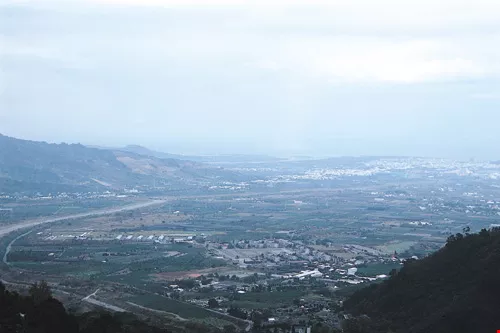
Hsu Jui-ming's Taiping Farm affords a spectacular view of the Pacific Ocean and Green Island.
Fighting over water
As far as the local farmers were concerned, every additional household on the mountain made a fair distribution of water resources more difficult. To them, Hsu Jui-ming was just a pipsqueak who had come to steal their water. Neighbors who did not understand what Hsu was trying to accomplish often sabotaged his water pipes, forcing him to rush to repair the damage almost every day. On one occasion, a neighbor drilled a big hole in a feeder pipe one meter below ground and covered it to leave no trace above ground. This sabotage naturally made Hsu furious, but he realized that because water resources were limited in the area he would have to respond wisely to resolve the dispute.
Hsu persuaded a group of local residents to go with him to the county government to demand the appropriation of public funds for an irrigation reservoir in the mountain area. They obtained funding for the building project, solving the local water shortage once and for all. The experience broke down his neighbors' preconceived notions about him. Everyone made their land available free of charge to build an irrigation system that is now shared by all. Sharing private land for mutual benefit has helped to erode old dog-eat-dog attitudes.
Thanks to his management skills, Hsu Jui-ming gradually became the driving force behind the community's efforts to obtain public funds. One of his initiatives was a community forum where local residents in need of funds could pitch their ideas to experts invited to give advice. Thus, the final Lichia Forest Road project was discussed, voted on, and approved by everybody concerned. It also turned out to be a natural way for the residents to embrace the concept of community empowerment.
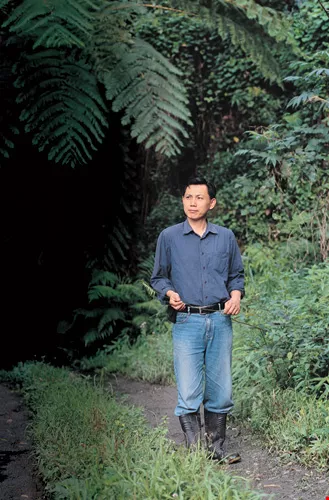
Hsu Jui-ming gave up a steady navy career to return to his old home, Taitung, where he is restoring his land its former pristine ecological state.
Life and ecology
Hsu Jui-ming is modest about these achievements. He says that he did not take a personal lead in everything; all he did was to organize the LFRA, which attracted numerous academics and residents concerned about preserving the mountain forests. Once they put their heads together, they were able to come up with quite a few excellent ideas and plans.
As a result of his experience working with neighbors to demand equitable access to water resources and the insights he has gained from scientists and academics, Hsu has come to think that ecological conservation must involve people, or else it will remain an uphill struggle.
A few years ago, a prolonged slump in the plum market caused the value of plum orchards to fall so much that farmers along the forest road stopped spraying pesticide on their trees and let them grow wild. By happy accident, several organic orchards were created in this way. More surprisingly, fairy pitta birds were drawn to the orchards and began to build nests in the forest.
But a number of farmers, unwilling to keep losing money, decided to cut down their plum trees and to plant more profitable atemoyas instead. This triggered a battle to preserve the fairy pittas' habitat.
Just as he had done during the water dispute, Hsu tried to find a way that was mutually beneficial to the plum farmers and fairy pittas. In a brainstorming session, LFRA members decided to launch an appeal with the slogan "Healthy Plum Trees make Healthy Fairy Pitta Birds" and to organize plum picking and candied crisp plum making activities for tourists. They also started a mail-order business to enable people outside the area to support the fairy pittas' breeding habitat. It was a model win-win situation for environmental protection and organic farming.
Kuo Ching-po and his family grow bamboo shoots in addition to plums. When the shoots emerge, they cover them with wood shavings to protect them from overexposure to the sun, which would turn them fibrous and bitter. This is an ideal organic breeding ground unicorn beetle colonies.
Children like to play with unicorn beetles, but "when farmers see the beetle grubs, they usually dig them all up and chuck them on the road hoping they'll end up as road kill." In fact, the grubs are not only harmless, they are actually beneficial because they eat the wood shavings and fertilize the soil.
At the suggestion of Hsu Jui-ming and a number of ecologists, the Kuo family now plans to convert an abandoned pigsty into an eco-classroom featuring beetle larvae--yet another object lesson in the happy coexistence of ecology and agricultural life. Thanks to these examples, local residents have come to realize that there may well be more of a future in ecotourism than in hunting, and that organic produce is not only healthier but potentially also more profitable. Many of them have joined the LFRA and have become spokespeople for the environment in their own right.
"My cherished hope is not just to plant trees in the ground but even more so in the hearts of the people of my community. The more tree planters we have, the stronger we will be," says Hsu Jui-ming.
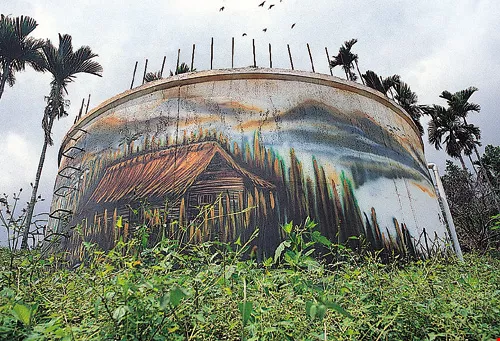
Faced with a water shortage, local residents made their land available to build a public irrigation system that now benefits everyone.
"The Man Who Plants Trees"
How did Hsu Jui-ming earn the nickname "The Man Who Plants Trees"? Hsu explains with a smile that because he was born in a mountainous forest area in Taitung County, nature was always part of his life. "I did not start out wanting to save the environment. I just felt it was terribly sad that there were hardly any trees left here. So I started planting trees."
Every time he was transferred to a new navy post in Su-ao, Kinmen, or Makung, Hsu planted trees and flowers. Hsu says, only half in jest, "I wasn't able to plant trees on ships, but whenever we were transferred to a new base, I planted trees there."
On returning home, Hsu found that for almost a century going back to the days of Japanese rule, large swathes of woodland had been cut bare, particularly on low-lying land along the forest road that had been leased to local residents. He talked the landowners into letting him plant trees on both sides of the road and resolved to become a "tree planter" in his native township. Having planted almost 300 trees over the years, Hsu says, "Better to leave my children a forest than land or money!"
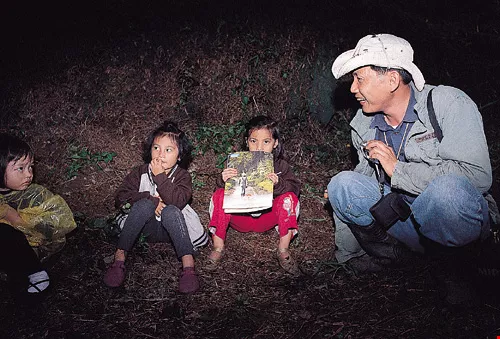
In addition to caring for the mountain forest, Hsu Jui-ming and his partners have started a tribal study center where local Aboriginal children can study and be tutored after school.
A tribal study center
Once several of his forest restoration projects were underway, Hsu Jui-ming increasingly turned his attention to the most important element in the local environment: mankind. He noticed that local Aboriginal children had no place to go to after school. Seeing families with both parents working outside the home and grandparents unable to help with homework, Hsu began pitching the idea of starting a tribal study center.
After chewing over the idea for a while, one night Hsu pulled out from his address book the names of a few teachers and friends he thought might be able to help, and began typing away on the computer: "The long-awaited tribal study center is finally about to be opened. Thanks to Community Council chairman Chang Chih, we have obtained a room for the children and some computer equipment. The Taiping Barracks commander has also promised to send us a recruit with college experience to coach the children in Mandarin, math, and English every Monday to Thursday afternoon. The only trouble is that now that the study center bookshelves have been dusted, we have nothing to put on them...."
The purpose of Hsu's email was to ask the public to donate books. Chou Ju, a professor of environmental education at National Taiwan Normal University and a long-time supporter of the LFRA, replied that same evening and forwarded Hsu's email all over Taiwan.
It was a busy night for everyone concerned about Aboriginal children's education. Hsu's email message made the rounds like wildfire, and within a couple of days the LFRA had received some 670 books and magazines.
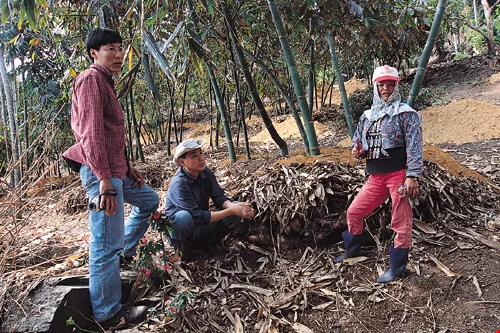
Organic bamboo shoot growers have discovered hundreds of unicorn beetle grubs on their farm.
Networking
To get more children onboard, Hsu got the kids who had already joined to form two lines and walk around the community shouting slogans, beating drums, and visiting every family with schoolchildren. Children got their friends to join, and brothers their sisters. By the time they got back, 23 children had joined the study center. Children come to the center to do their homework after school, and when they have finished it, they can curl up on a sofa with any book they like. More than 30 kids currently use the facility every day.
Newly appointed LFRA chairman Chen Ta-mu notes, "The environmental movement is in urgent need of people like Hsu Jui-ming, with his firm grasp of management principles and keen understanding of how to integrate resources."
One of Hsu's plans for the tribal study center to is get the army to contribute more of its resources to the local Aboriginal community. To promote Lichia Forest Road to the outside world, with government funding he has set up an attractive website with rich content (www.treehome.org.tw). He also organizes conservation vacations--a concept that has become increasingly popular in recent years--to invite working people to get away from the rat race for a few days and contribute to society by doing voluntary environmental work at the same time. Following an Internet appeal, last summer the LFRA enlisted 18 volunteers from all over Taiwan to build an eco-pond made of stones near the forest road.
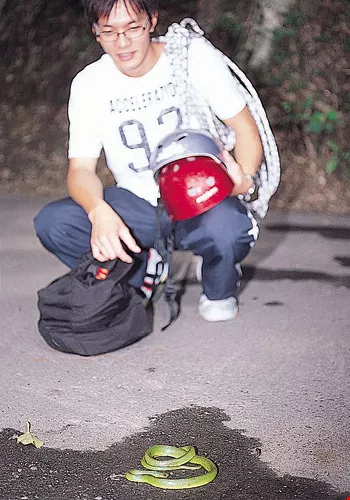
No need to be afraid: it's not a poisonous green tree viper! Coiled nonpoisonous green snakes are a frequent sight on Lichia Forest Road.
A small corner of paradise
When I visited Taiping Farm early one morning, the chirping of Chinese bulbuls, thrushes, and black-browed barbets filled the mountain valley. Above the 13-kilometer point of the forest road lies the Taiwan Macaque Reserve, which is not just home to macaques but also to crested serpent eagles and bamboo partridges, as well as rare Swinhoe's pheasants, squirrels, and hares. Occasionally, visitors can catch a glimpse of bigger animals from the forest, such as wild boar, Formosan barking deer, and mountain goats.
Several varieties of peach and plum grown by local farmers turn the forest road into a wonderland of flowers and fruits around the year: in January and February cherry blossoms and plum blossoms burst into bloom; in March peach blossoms and apricot flowers vie for attention; in April and May, plump juicy plums are ripe for the picking; and in November and December, Formosan sweetgum trees drape the forest in red.
When you gaze at the tree-clad mountain from a distance, Taiping Farm looks like a small boat in a sea of green. A man who plants trees lives in that boat, and the trees he has planted on the mountain and in people's hearts have turned Lichia Forest Road into a small corner of paradise.
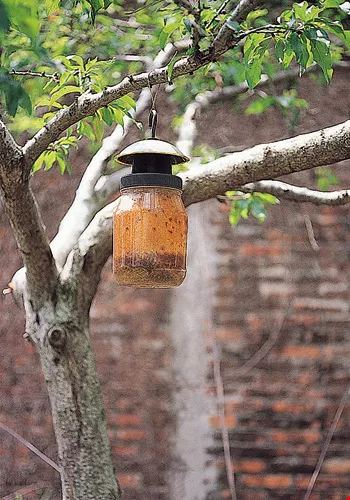
In this organic plum orchard, pheromones are used to lure and trap insect pests.
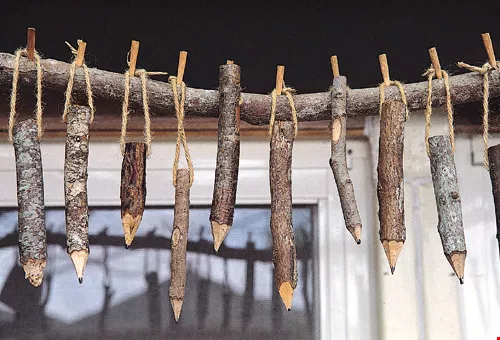
A twig picked off the forest floor can be crafted into a unique-looking pencil.


@List.jpg?w=522&h=410&mode=crop&format=webp&quality=80)


