The Highest Office in the Land - The Yushan Weather Station
Cheng Yuan-ching / photos Cheng Yuan-ching / tr. by Phil Newell
March 1993


The photo at left is of the Yushan Weather Station circa 1955(photo courtesy of Kuan Your-chuan)
Looking about from the Main Peak of Yushan, 3,952 meters above sea level, you suddenly discover that there is a small reddish-orange structure on the top of North Peak; in front of he little hut are solar panels one after the other, shining brilliantly amidst the surrounding summits. This is none other than the "highest" office in the land, the Central Weather Bureau's Yushan Weather Station, 3,850 meters above sea level.
Even though it's planted intrusively atop North Peak, most mountaineers don't mind a bit.
In fact, the purpose of the Yushan Weather Station is quite simple: to collect data on high altitude weather patterns for use in forecasting. Though the purpose can be stated so simply, it hasn't been at all easy keeping this highest office in the land where it is.
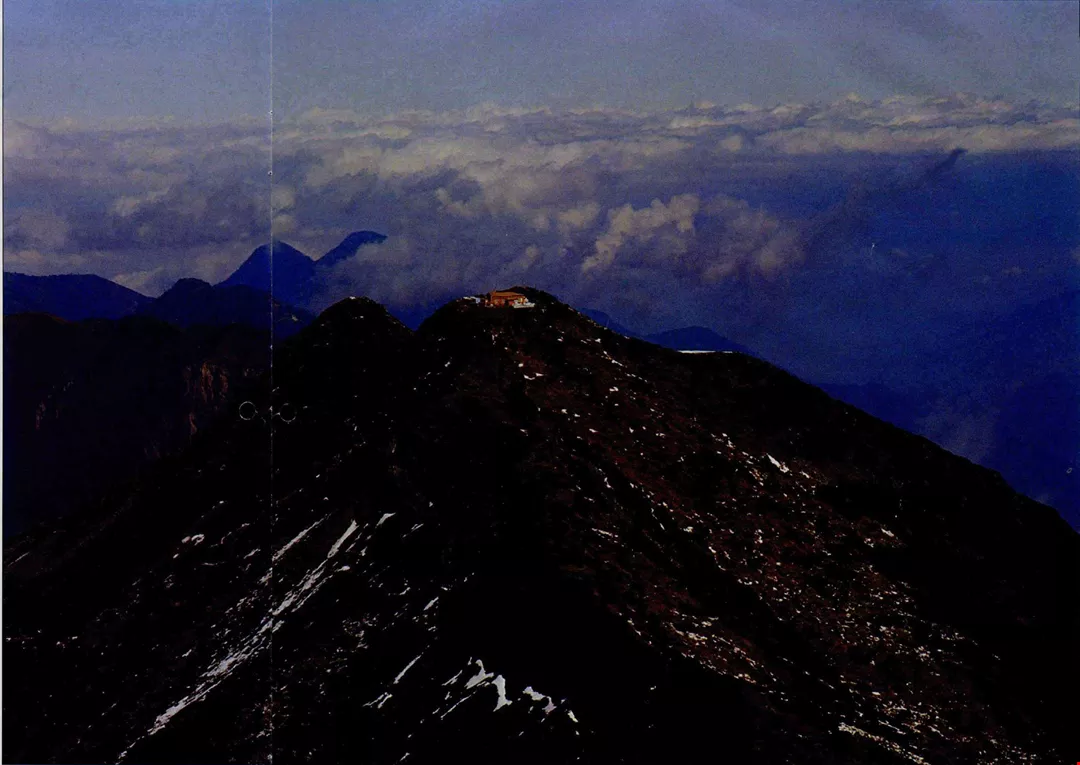
The Yushan Weather Station is the "highest office in the land.".
Nearer my God to Thee:
The Yushan Weather Station was set up as early as September,1943, in the Japanese Occupation era; at that time it had seven or eight staff and fourteen workers, with shifts of three months each. Out of consideration for the harsh living conditions there, their facilities were made as complete as possible. Five buildings were built on the south face of North Peak, along with complete sanitary, bathing, and cooking facilities. Outside there was a firewood area and an outdoor activities area. But still workers continually resigned because they could not adapt.
Although the existing buildings have been refurbished several times, the main pillars and many of the beams are still left over from the Occupation. A large one-story wooden building the size of a basketball court is divided into several rooms: they are used as a work room, a computer room, a bedroom, a washroom, and a toilet. Sheet metal has been specially added to the roof to protect against wicked storms and winter snow.
Outside of this off-the-track-office, there is a small space of 20 square meters set off by dwarf shrubs. A variety of sophisticated instruments for measuring wind velocity, precipitation, temperature, and sunlight are arrayed in a regular pattern in this area. Although their functions vary, they all share the task of accurately recording the weather on North Peak with the aim of long-term collection and analysis of weather data.
Staff go outside once every three hours to take readings from these instruments, except for the period from 9:00 PM to 5:00 AM. Some of the data has to be immediately transmitted by wireless to the Alishan Weather Station, and from there to the Central Weather Bureau, for use in forecasting. And on the first of each month, when shifts change, all of the data is sent first to Alishan and then the CWB for collating the statistics. Like the personnel at all CWB stations, those at Yushan must work long hours because of the need to record the data. In order to balance work time with recreation, they have evolved a unique scheduling system.
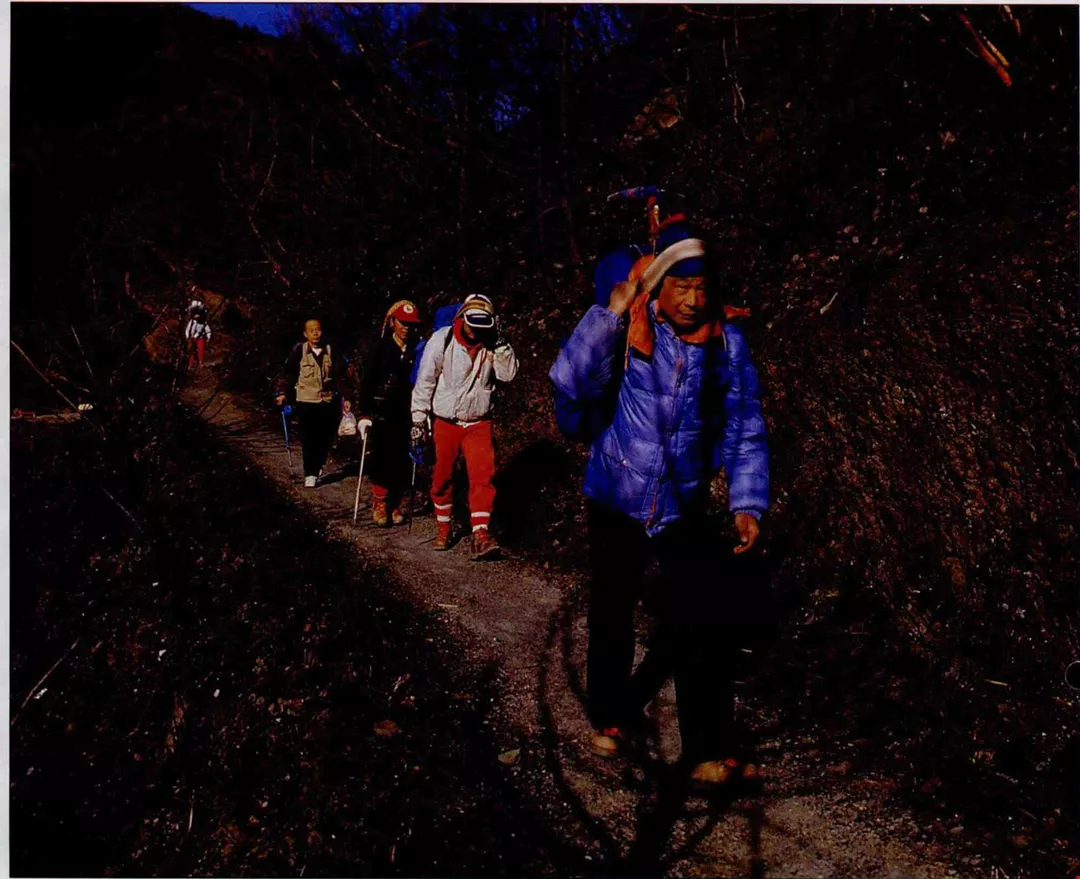
Each shift change it is necessary to carry 30-40 kilograms of food and necessities up the mountain; the workers have already trained their bodies to get used to it.
A special branch:
At most weather stations the personnel work one day, then have two days off. In remote locations or small islands, it might be one week on and two weeks off. For this most elevated of assignments, because it takes at least two days (each way) to get from home to office, the system is even more special.
Chen Ting-hsiang director of the Yushan Station, who also oversees the Alishan Weather Station, explains that besides the director and one technician, the station has three staff and four workers who must rotate at Yushan. The staff members, which is to say technical personnel, work for one month and then rest for two. They are responsible for observing and recording relevant weather data. The assistants handle routine tasks plus clean-up and cooking; they are half a month on, half a month off.
In fact, to speak truthfully, the hours are not bad at all. It's just that the location is lousy. Just think about having to climb such a precipice--even if you ignore the danger of the journey, there's not a sign of life up there, daily necessities are all hard to get, and there's even less for leisure. Who would want to deal with all that? Fortunately there is an NT$14,000 bonus for mountain duty, which has to have some attraction. Even still, in the past they've had to transfer people from other stations because no one was willing to go up.
The shifts change on the first of every month, while the workers change on the 1st and 15th. It's something like the changing of the guard. Those preparing to go up to North Peak gather at Alishan, with the staff coming two days early to take care of paperwork and the assistants arriving the night before setting off. They start off from the Tatachia Pass entrance to the mountain trails in the early morning. If it's the snow season, they spend a night at the Paiwan Villa and then head up to North Peak.
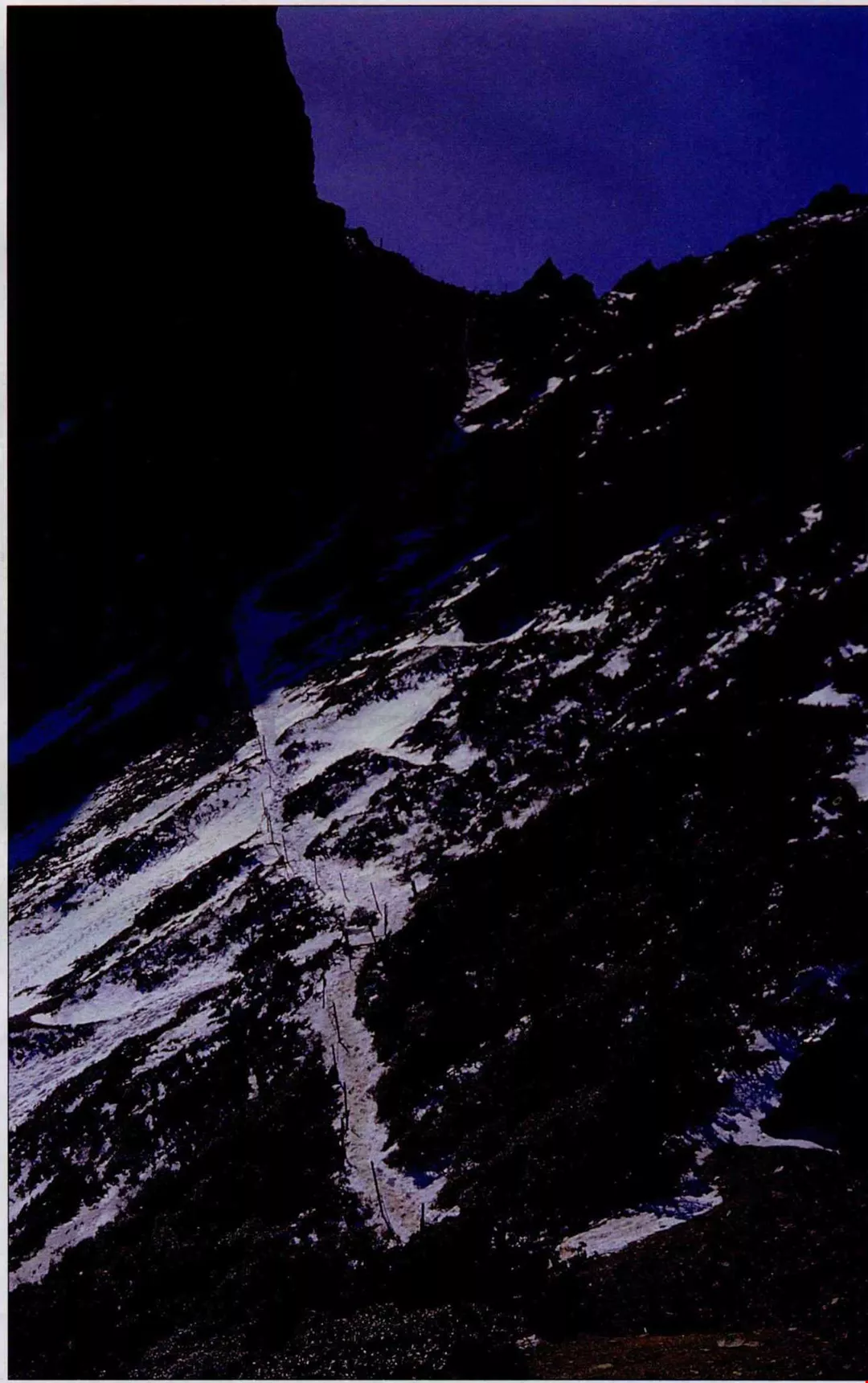
The rocky slope on the north side of the Main Peak of Yushan is windy and has heavy accumulations of snow, making it the most difficult and hazardous stretch.
Rough road:
No matter what their mood in climbing North Peak, although things aren't so extreme as "laughing in the face of death," still the road from Alishan to the "office" has many dangerous moments because it goes through the mountains, and is more dangerous still in the snowy season.
Now retired, Kuan You-chuan, director of the Yushan station from 1951-1964. recalls that in his time of service there was a technician named Wu Ching-chu, who insisted on going down for a shift change while cooped up during the snowy season. Tragically, just after passing by the north slope of Yushan, he fell l,500 meters to his death.
Current director Chen Ting-hsiang has also had the experience of having a colleague injured. Once, when he was 27, he and two workers headed off to North Peak to go to work. As they trudged across the snow and ice, Chien Wen-tsung, a worker from Alishan, fell from the north slope of the Main Peak; his right thigh was cut open 10 centimeters, a very serious wound.
Chen Ting-hsiang hurried down into the gorge, and after making him a rudimentary tourniquet, discovered that there was no way he was going to be able to carry the taller and heavier Chien up to North Peak. Because he had run into a contingent of seven Japanese mountaineers climbing up, and figured they would come and help, he first climbed up to the North Peak Weather Station and notified Alishan by wireless asking them to send a rescue team. As expected, shortly thereafter Chien was brought up by the Japanese team, which left behind a large batch of medication and then made its way back down to Tungpu through Patungkuan.
The rescue team arrived from Alishan at dusk the day after, and the following day carried Chien down the mountains to the hospital for treatment.
In hopes of securing safe passage during shift changes, the staff at North Peak once put up a statue of Matsu in one corner of the office, making offerings and burning incense at appropriate times. When technician LeeTai-chun was transferred to North Peak in 1981, upon assessing the situation he put up the money to hire a goldsmith to make a golden Matsu statue, which was welcomed to North Peak at Mid-Autumn Festival of 1982. When liu-ho-tsai gambling was popular, there was even somebody who heard about this and wanted to come up the mountain to seek divine guidance in selecting numbers, but Lee nixed that idea.
After the measuring devices began to be automated, it seemed like the office didn't really have enough space. In 1989 he moved the Matsu statue down the mountain and to his home.
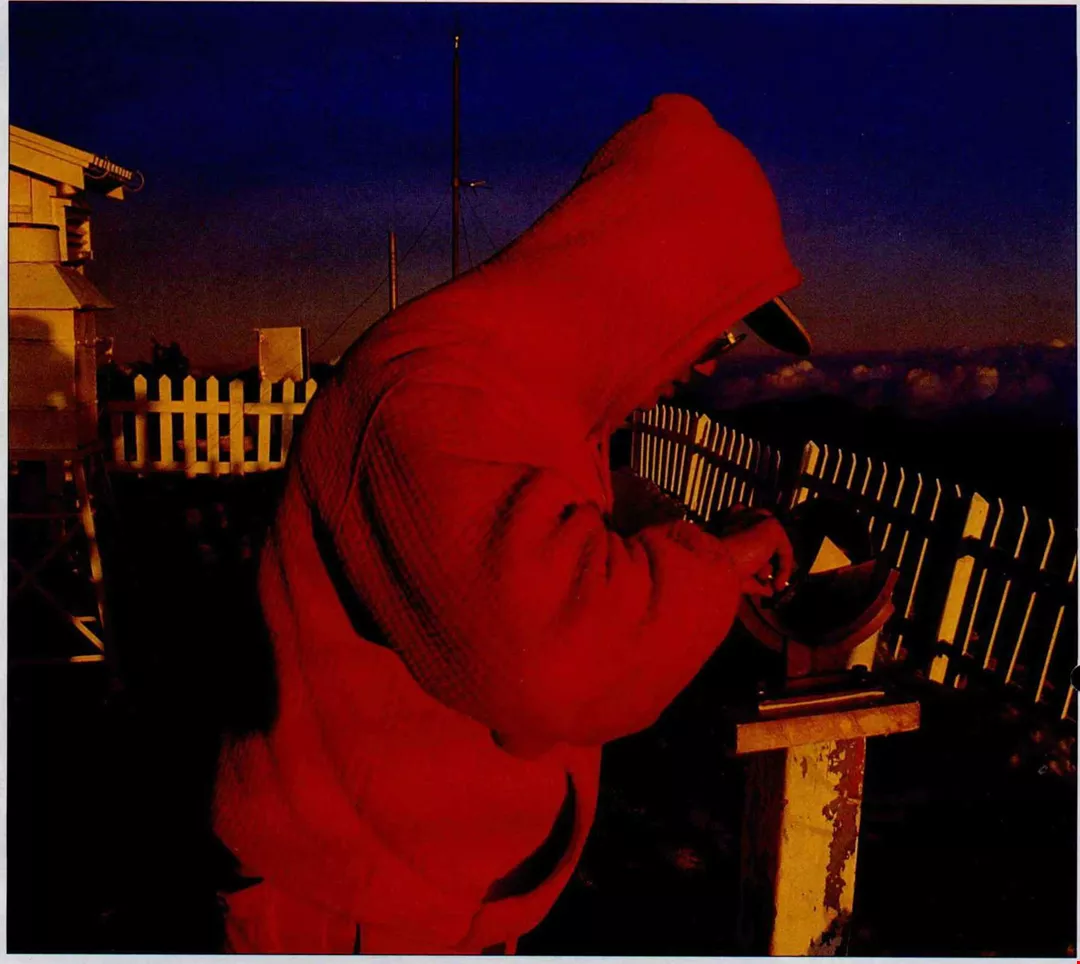
Checking the instruments and recording the weather data constitutes the routine daily work of the staff.
It's OK to have too much, never to have to little:
After a tough one or two day journey up the mountain from Alishan to North Peak, you have to rely on yourselves for every matter large and small.
There are a lot of little daily inconveniences for the staff at North Peak. The most obvious is that there are no shops, so that "you have cash but can't buy anything." And any of the products needed for daily living can only be brought up on the first and 15th of the month.
All kinds of office supplies and essentials like pencils, glue, toothpaste, or shampoo can only be replenished twice a month. The North Peak staff first notify Chen Ting-hsiang of what they'll need by wireless; then he buys the stuff ahead of time and sends it up with the next shift.
In terms of food, although there's a new supply of fresh fruit and vegetables and fish every couple of weeks when the workers change shifts, these don't last long. Maybe you might think that temperatures are so low in the winter that food could be preserved for a long time. Chen Wen-chien explains that this would be true at lower altitudes, but that the temperature at North Peak is too low, often below zero celsius. Thus all the vegetables freeze, and the frozen vegetables cannot be cooked, but only made into soup.
Thus in the winter, they have to rely on canned foods for long periods of time. No wonder Chen Wen-chien complains that "I've eaten so much canned food my face is beginning to look like a can!" Sometimes they live for a whole day on one tin.
Fortunately there's no shortage of rice or fuel in the winter. Director Chen Ting-hsiang has figured everything out so that at the end of October or the beginning of November they employ porters to carry three hundred kilos of rice and seven tanks of gas up to the station so that there won't be any shortage when it starts to snow. "It's OK to have too much, never to have to little," states Chen. If snow closes the mountains. at least the staff will still be able to eat.
For those who smoke or chew betel nuts, this is also a fixed priority. Otherwise, when they've smoked up their cigarettes or finished off their betel nuts, they have no place to buy more.
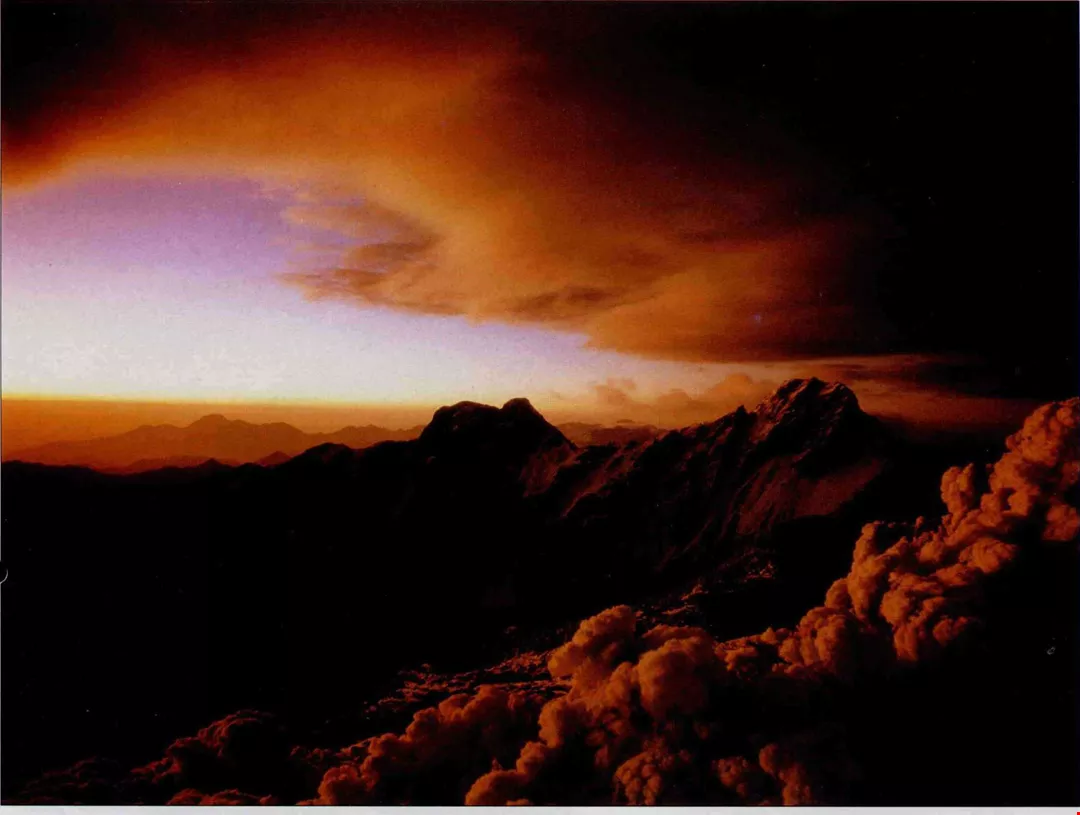
Topographic factors mean that one can see different climatic conditions on North Peak. (photo by Lee Tai-chun)
Peak electrical use:
For an ordinary person, fuel and electricity are two irreplaceable sources of energy, of which there's no shortage down in the plains. But for the people of North Peak, things have only improved in the past couple of years.
In terms of electricity, Chen Ting-hsiang remembers that in the past they used a diesel generator. Most of the electricity was reserved for wireless communication and for the instruments. They only used electric lights from 6:00-8:00 PM; otherwise they had to light candles. Because the precious fuel had to be carted up the mountain on someone's back, it had to be conserved.
In days gone by, they would collect withered wood in the area of the station to use as fuel for warmth or cooking. Since getting natural gas and a stove, cooking fuel is no longer a problem. It's just that the 30-kilogram gas tanks still have to be hauled up by human labor, and the wages alone come to NT$5000.
In order to improve the living environment and increase mechanization of the instruments, in 1989 the Ministry of Transportation and Communications commissioned the Industrial Technology Research Institute to devise and install solar-powered electrical and water heating systems on North Peak.
One year later, a military helicopter assisted the CWB to carry the 27,000 kilos of equipment to the peak and install the two sets. One of the sets of equipment turns solar power into electricity and then stores it in a rechargeable battery with a 10,000-watt capacity. This battery capacity is enough to maintain electrical power for three days in the absence of sunlight. The other set is a 600-liter capacity solar-powered water heater, which can provide water for indoor heating, warming of equipment, and bathing.
These facilities were completed in September 1991, giving the staff a better living environment.
Besides electricity, water is another precious resource up on North Peak. All water, for bathing and drinking, depends on precipitation.
From the Japanese Occupation to the present, the weather station has always had rainwater catching equipment. But the water tanks have often been destroyed by heavy rains or cracked by the freezing temperatures, so they constantly needed repair. Today there are two water accumulation devices. Besides several water tubs made of concrete set just to the right of the huts, there are about 20 big plastic barrels to store rainwater. If there is no precipitation for some time, the accumulated water can last for probably three months.
In the past the water would freeze up in the winter, and would have to be melted. The solar powered heater saves time and effort, and you can get hot running water just by turning on the tap.
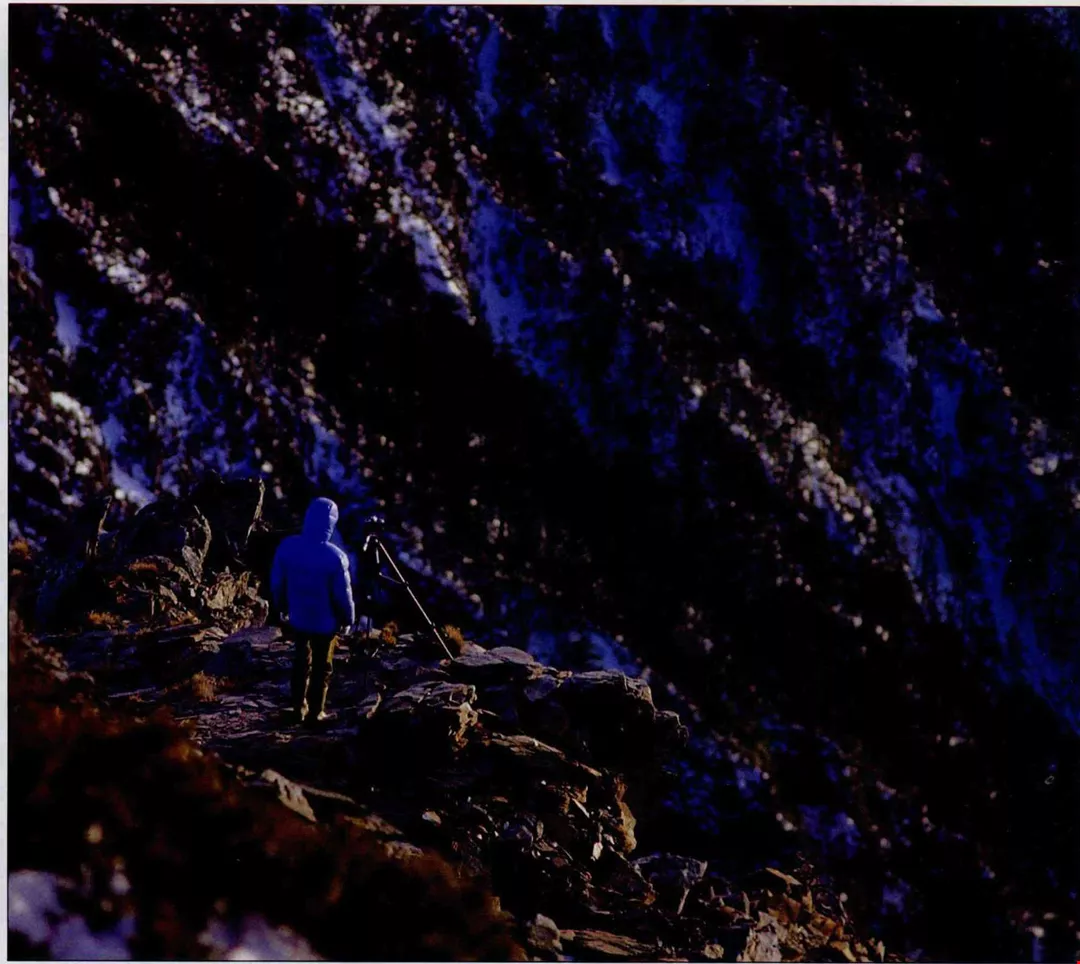
Using free time to do photography can relieve the monotony.
Charged atmosphere:
Originally the point of going up the mountain was to collect meteorological data. It wasn't expected that the weather itself would make life even harder, and even be life-threatening.
For example, the air is thin and air pressure low on the mountain. It takes about twice as much effort to do outdoor tasks like clearing away snow as it would on the plains. The advantage is that the days are longer, and lung capacity is increased. The air is very dry at the top, and it is necessary to drink water constantly to maintain body moisture. Also the ultraviolet rays are strong, and it is necessary to apply oil and other preservatives. But even if you are careful, it's hard to save your skin from getting cracked and sunburned; after even a few days on the mountain, everyone's face gets deep red.
In terms of ordinary weather conditions, what the workers fear most is snow and lightning.
When it snows heavily, it covers the entire weather station. It is necessary to wear protective eyeglasses when it snows, or one will become snow-blind. When the temperature drops too low, wounds do not heal easily; once Chen Wen-chien was hurt, and the injury did not heal until after he had come down the mountain on a shift change.
At the beginning of 1983, the snow had accumulated to quite a depth, and then there was an electrical storm. While Kang Ming-shan was wearing the headset and sending data through the wireless, a bolt of lightning travelled along the lightning rod to the wireless cable and struck Kang, who immediately collapsed to the floor in pain.
After receiving the rescue call, Lee Tai-chun and Chung Kuo-hsiung, without full equipment, spent the whole night going up the mountain. They didn't expect that they themselves would get lost; they reached North Peak only at 8:00 the following morning. Without even taking the time to change their socks, they and another assistant, Wu Hsiung-wu, carried Kang down the mountain for treatment. Kang Ming-shan's right eye and the whole right side of his body were seriously injured; fortunately it was not fatal, and today he serves in the Chiayi Weather Station.
Because they are located at the peak of the mountain, the Yushan station has installed many lightning rods, which look from a distance like little flagpoles.
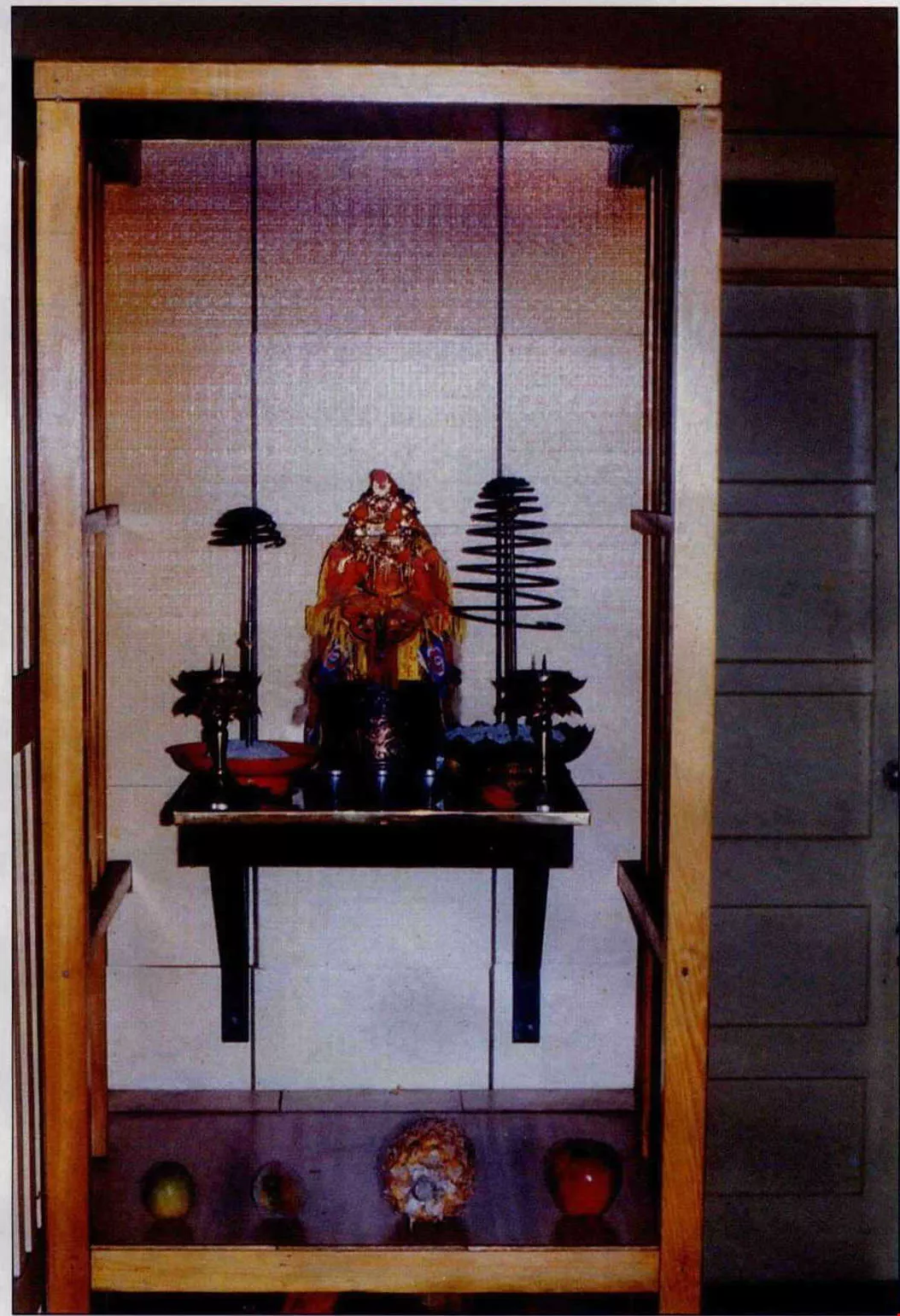
This Matsu statue was at North Peak for eight years, but has been since moved to technician Lee Tai-chun's house. (photo courtesy of Lee Tai-chun)
Boredom and more boredom:
What does it feel like to live on the top? Technician Chen Wen-chien says: "boredom, and more boredom." Boredom is their greatest enemy.
Just imagine every day having to face frozen instruments and a huge sheaf of forms over a long period--could you be anything but bored? No wonder that time someone insisted on going down for a shift change despite the bad weather.
Some folks might think that the mountain scenery would be beautiful, which might relieve a bit of the monotony. In fact, there are no distinct seasons on the mountain, and there are almost no visible changes on any given shift. From December of any year to April the following year, before the snow melts, everywhere you look is just a blanket of white, with nothing scenic worth mentioning.
"No matter how beautiful the setting, everyone gets sick of it after a while. Whether there's along period of clear skies so you can see forever, or dense clouds, or constant rain, all of them are virtually intolerable," says worker Shih Wen-hsiung.
Besides work, how do they break the monotony? The best recreation early on was to listen to the radio. About 1960, they added a dry-battery black-and-white TV to North Peak; when there was enough electricity, they also got a color set, and now they have a 20" color Sony with a video recorder.
Besides watching TV or listening to broadcasts, each individual has his own pastimes. Lee Tai-chun has picked photography. He says that using free time to take photos is easy. On the one hand, it uses up a lot of time, and on the other, if the product looks good, there is a sense of accomplishment. He enters competitions when he gets just what he's looking for and has won a silver medal from the Chiayi Mountaineering Association photography association.
When Tsai Ching-yen, then head of the CWB, climbed North Peak to make an inspection in 1990 and saw how beautiful the scenery is, he suggested taking some photos for a calender. Naturally this duty fell to Lee Tai-chun, and last year's CWB calender consisted mostly of his work. Now each time his shift comes he has to carry 30-40 kilos of photography gear up the mountain, but he doesn't tire of the hobby.
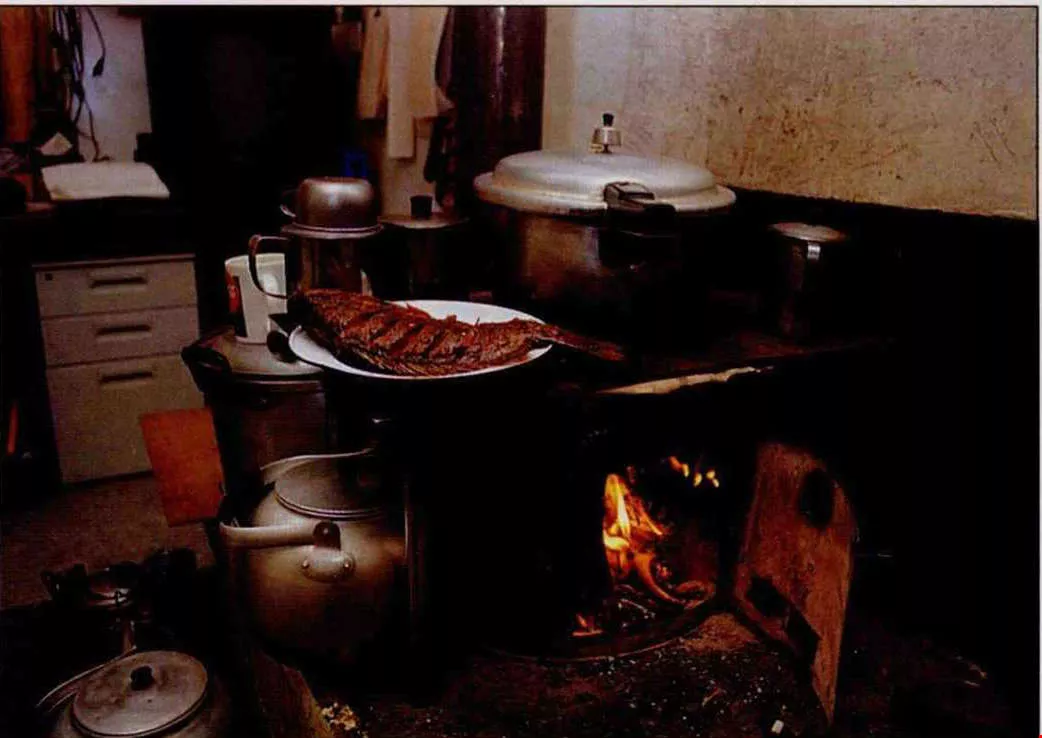
The stove where water is boiled is a focal part of life for the staff.
Sky blue:
To work on North Peak, besides the danger involved, it is also necessary to be away from home for extended periods, so there's too little time to devote to the wife and kids. "For the money, you can't worry too much, you just have to continue working. When I'm old and can't climb anymore, then I'll ask for a transfer," says Shih Wen-hsiung.
To ease some of the pain of separation, Shih, a Bunun person from the town of Tungpu, has bought a set of walkie-talkies. Each night at a fixed time he calls his wife and child; because the distance is not too great, the line is quite clear.
Regarding this problem, Lee Tai-chun is different from the others. He stays at North Peak so that he will be close to and can take better care of his father. Because all of the children in the family have gone elsewhere to work, his aging dad doesn't have anyone around to look after him, so although he long ago had a chance to transfer out of North Peak, Lee chooses to remain.
Although the Yushan Weather Station is situated in an elevated place, there is little room for activities. And because the weather data must be sent out according to a fixed schedule, there's even less opportunity to indulge in laziness. It really is a very difficult job. So the next time you climbers have a chance to ascend to North Peak, maybe you could drop in for a chat and give them a pat on the back.
[Picture Caption]
p.21
The Yushan Weather Station is the "highest office in the land."
p.20
The photo at left is of the Yushan Weather Station circa 1955(photo courtesy of Kuan Your-chuan)
p.22
Each shift change it is necessary to carry 30-40 kilograms of food and necessities up the mountain; the workers have already trained their bodies to get used to it.
p.23
The rocky slope on the north side of the Main Peak of Yushan is windy and has heavy accumulations of snow, making it the most difficult and hazardous stretch.
p.24
Checking the instruments and recording the weather data constitutes the routine daily work of the staff.
p.25
Topographic factors mean that one can see different climatic conditions on North Peak. (photo by Lee Tai-chun)
p.26
Using free time to do photography can relieve the monotony.
p.27
This Matsu statue was at North Peak for eight years, but has been since moved to technician Lee Tai-chun's house. (photo courtesy of Lee Tai-chun)
p.27
The stove where water is boiled is a focal part of life for the staff.
p.28
The solar power system means electricity is no longer a worry at the Yushan Weather Station.
p.29
Precipitation is the source of North Peak's water.
p.31
North Peak might be a "step up" in one's career, but there's not much room to move around. The snowy season, which lasts nearly half the year, makes life even harder. (photo by Lee Tai-chun)
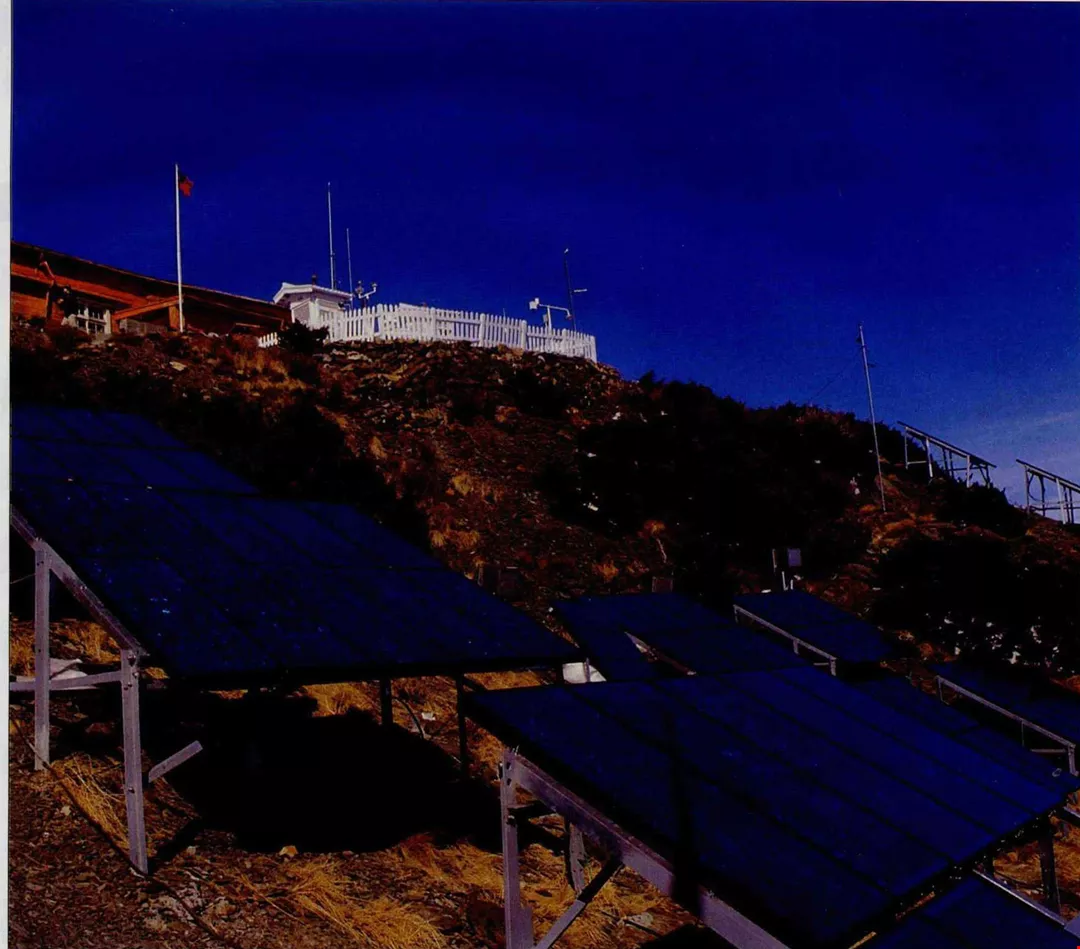
The solar power system means electricity is no longer a worry at the Yushan Weather Station.
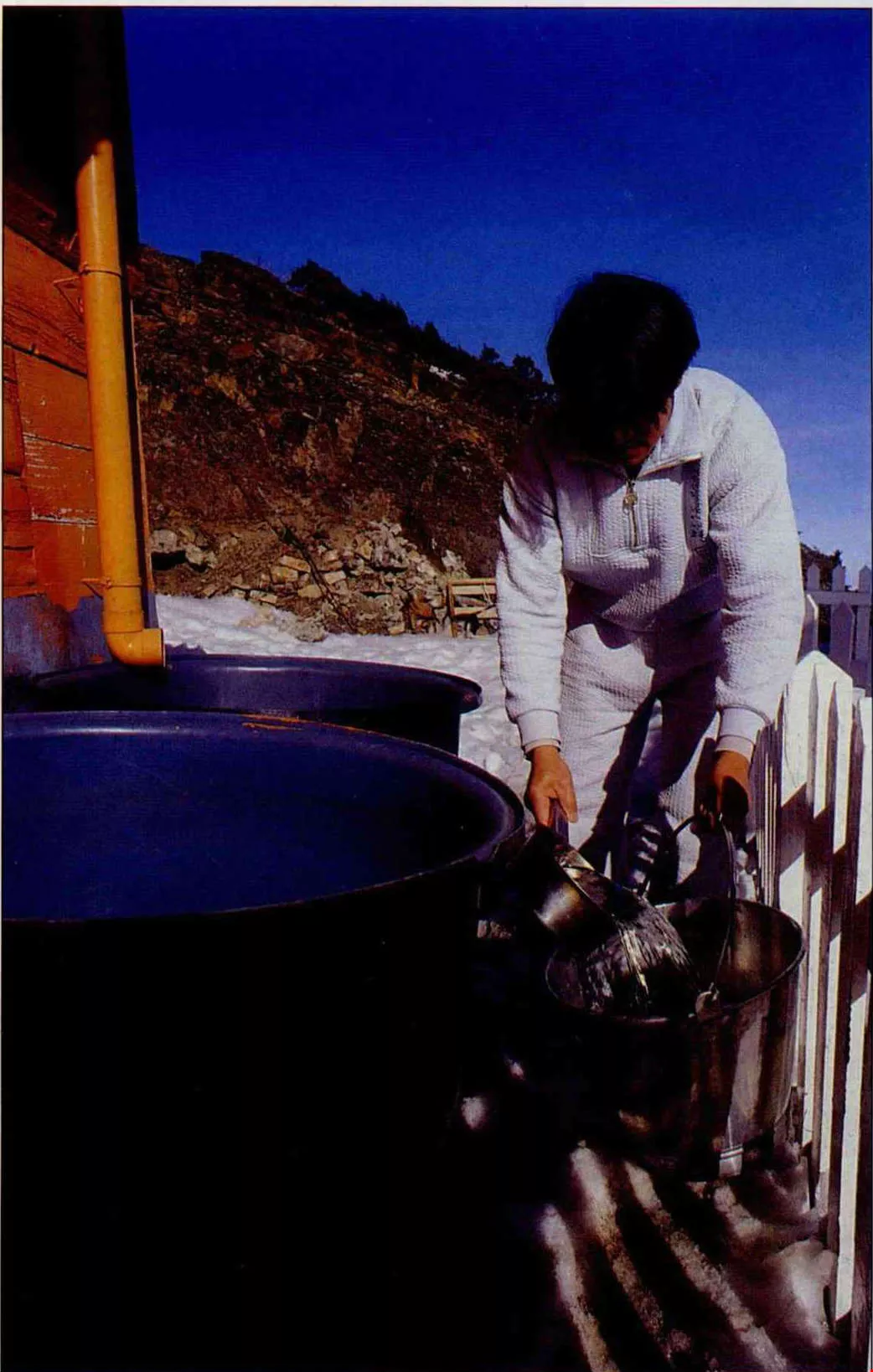
Precipitation is the source of North Peak's water.
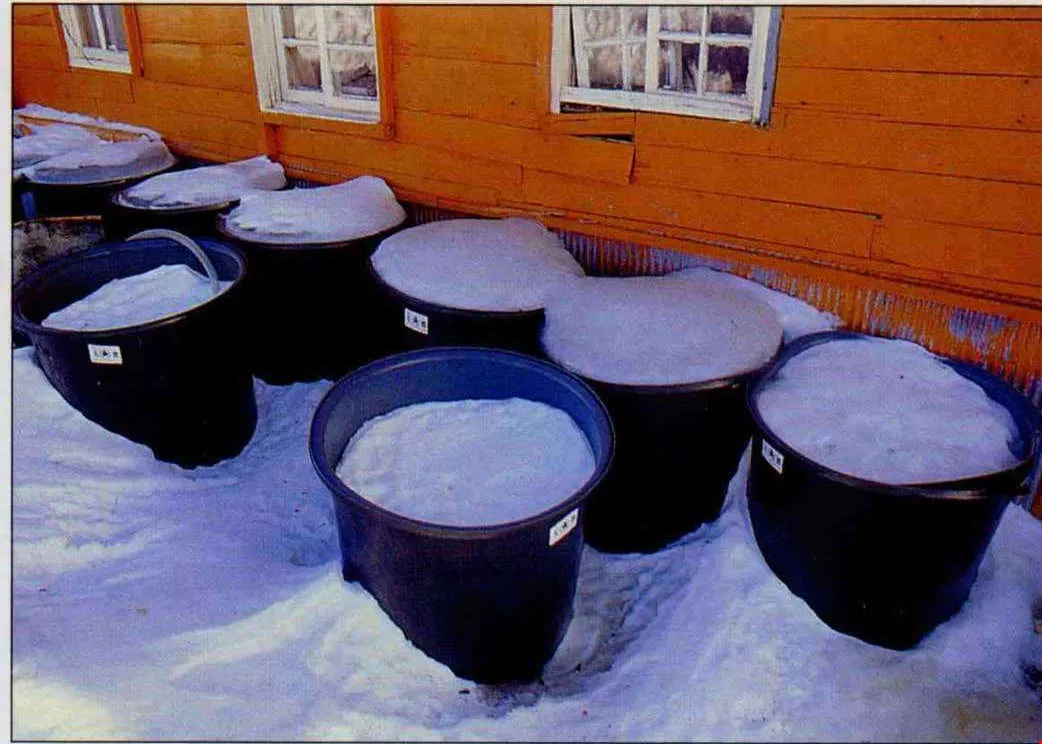
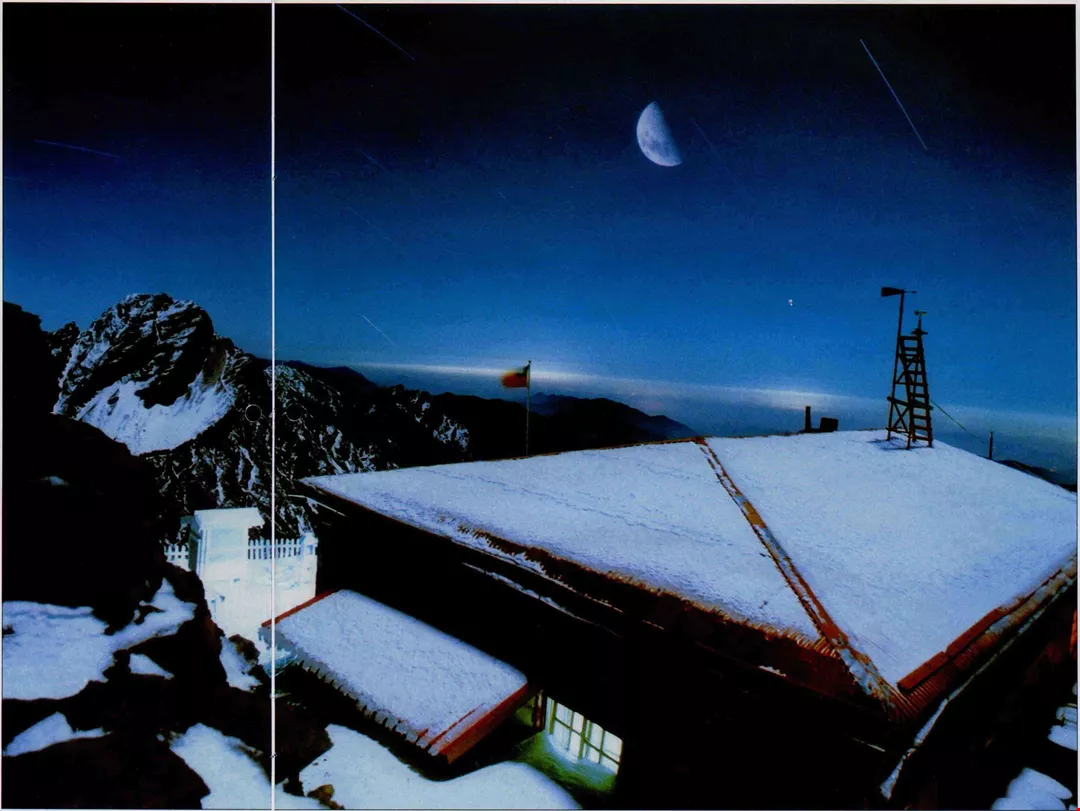
North Peak might be a "step up" in one's career, but there's not much room to move around. The snowy season, which lasts nearly half the year, makes life even harder. (photo by Lee Tai-chun)

@List.jpg?w=522&h=410&mode=crop&format=webp&quality=80)

_DSC2938@List.jpg?w=522&h=410&mode=crop&format=webp&quality=80)


