Religious Art at Its Best--Paoan Temple's Chingcheng Jiao Ceremony
Tsai Wen-ting / photos Chuang Kun-ju / tr. by Jonathan Barnard
August 2003


After seven years and NT$260 mil-lion worth of renovations, Paoan Temple in the Talungtung neighborhood of Taipei held a chingcheng jiao ceremony to celebrate the completion of its restoration. A folk arts festival that began at the same time went on for over two months and included performances of such rarely seen ancient rites and rituals as guohuo (fire-walking), fire lions, water lanterns, pudu (universal deliverance) and the Chung Kuei Dance. Renowned performance troupes and elite opera groups from around the island were invited to perform. It was great folk gathering, a once-in-a-lifetime opportunity for "experts to hone their craft and laymen to enjoy the fun and excitement."
Talungtung, Mengchia, and Tataocheng are the three oldest neighborhoods in Taipei, and Talungtung's Paoan Temple, Mengchia's Chingshan Temple and Tataocheng's Hsiahai City God Temple, all of which have origins in the early history of Taipei, are sacred grounds and repositories for traditional rituals and folk performances.
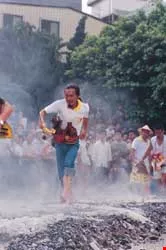
Metropolitan Taipei's only fire-walking ceremony attracted members of the public to walk the hot walk themselves. Those who tread over the coals barefoot reputedly attain a state of peace and spiritually cleanse their bodies. (photo by Hsueh Chi-kuang)
Surname operas start
The 15th day of the third lunar month is Emperor Paosheng's birthday, and on that day every year the Paoan Temple holds a grand procession and a folk arts festival in honor of the deity and in collaboration with the local community. Beginning on the fifth day of the third lunar month, the residents of Talungtung put on the so-called "surname operas" for 24 days. These are operas staged in turn by various surname associations for the pleasure of the deities. Paoan Temple's surname operas have a history dating back at least to the Japanese colonial era (1895-1945) and possibly to the late Qing dynasty. Every year on Paosheng's birthday, the surname associations in Talungtung sponsor the opera performances according to the following order: Chang, Cheng, Huang, Tsai, Tu, other surnames in the community, Lien, Cheng, Wang, Chou, Lin, Li, Yang, Yeh, Hsu and Wu. The richest man in the area is a Chang, and so Chang goes first. Because Emperor Paosheng's surname was Wu, Wu goes last, in keeping with traditional Chinese conceptions of modesty.
As tradition dictates, this year the various surname associations sponsored the operas in turn. To celebrate the completion of restoration work, the Paoan Temple went out of its way to ask experts to choose the best troupes. The Holo Taiwanese Opera Troupe opened the festival with a performance of The Butcher Mandarin. Liao Chiung-chih's Southern Heritage Traditional Taiwanese Singing Drama Troupe, Tang Mei-yun Taiwanese Opera, the Hangyang Peikuan Opera Company, the Minghua Yuan Taiwanese Opera Troupe, the I Wan Jan Puppet Theater and the Hsiao Hsi Yuan Troupe followed with performances of their own. There were even rare performances by students from National Taiwan University's Taiwanese Opera Society, the Department of Taiwanese Opera at National Taiwan Junior College of Performing Arts, and the Department of Theater of Taipei National University of the Arts. "What joy!" an old lady who came to see the performances every day said. "Every year around the Emperor Paosheng's birthday, there are more good operas than it's possible to see."
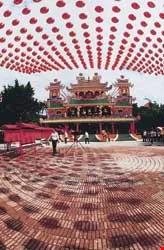
After refurbishing a temple, it is necessary to hold a ceremony to "settle the dragon" (appease the local land dragon deity that was disturbed by construction work). A dragon made from rice is a key part of the ritual. (photo by Yang Chien )
Reappearance of fire lions
The surname operas fostered a festive air, and these were followed by the parade on the afternoon prior to the deity's birthday. Great performance troupes such as the Sung Chiang Battle Array from Neimen Rural Township of Kaohsiung County, the Flower-Drum Dance from Dabu village of Yunlin County, the Twelve Babysitters from Tainan County and many others opened the eyes of people in northern Taiwan to their performance skills.
That night a "fire lion spectacle" unique to Paoan Temple was held. Like the fireworks "battle" in Yenshui Township of Tainan County, it is held to ward off evil spirits and drive away pestilence. This year the Paoan Temple researched how traditional "fire lions" used to be made in the mainland and crafted a pair of nine-foot-tall auspicious lions that were filled with thousands of fireworks. At 7 p.m., when the parade had returned to the temple and the local Golden Lion Troupe had put on a festive show, the fire lions on the high platform were lit. Suddenly, colorful fireworks shot out like swarming bees, zipping hither and zapping thither and brightening Taipei's night sky.
On Emperor Paosheng's birthday (which this year fell on April 16 on the modern calendar), a solemn birthday ceremony was held in the main hall of the temple, while the guohuo (fire-walking) ritual was held in the plaza in front of the temple. As the sole surviving guohuo ritual in Taipei metropolis, it attracted numerous photographers and researchers of folk customs.
Following Emperor Paosheng's wishes, the temple staff first cleared the ceremonial site, laid bundles of fragrant wood on the ground, and then piled a large amount of coals on top. When the coal turned red, the staff then piled on another layer of coals. Next they used iron pipes to spread the coal back and forth until finally it resembled a ten-meter-long fire dragon. When the auspicious hour arrived, the staff first sprinkled a layer of salt to lower the temperature of the coals. Then the temple's high priest, Li Chi-chang, was the first to run over the fire dragon, followed by barefoot teenage mediums, the palanquin, and the temple faithful. After being cleansed by the coal fire, people obtained peace and the god increased its power. Many also waited to pick up the burned out coal. Reputedly, those who bathe in water mixed with the coal ash will be blessed with peace.
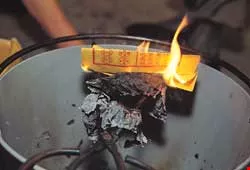
Led by the head priest, members of the public walked back and forth in the temple plaza 12 times, all the while burning "changing luck" money (right). It is supposed to wipe away all 36 kinds of sins committed in one's current and past lives.
Restored to its old glory
This series of birthday ceremonies and folk activities was just the start of the Paoan Temple folk arts festival. In the two months that followed, there were many other religious and artistic activities. Apart from the medicinal herb exhibition and the free clinics (Paosheng is, after all, the god of medicine), there was also a photo exhibition ("The Beauty of Paoan Temple") by master photographer Ko Hsi-chieh, as well as seminars on religious ceremonies, a guided tour to the art of altars, and folk arts and crafts workshops designed for the 3-day chingcheng jiao that began on June 13th. These varied activities were aimed at giving people deeper understanding into the inner meaning of religious culture.
Built in 1742, the seventh year of the Qing Emperor Qianlong's rule, the Paoan Temple was first restored in 1920 during the Japanese era. After seventy some years of the temple's exposure to termite infestations and the humid climate, its second major restoration began in 1995. Unlike most temples, which have employed tile and concrete for a speedy reconstruction, the Paoan Temple used good materials and hired skilled artisans. A grade-two historical site, the temple was restored in a slow and careful manner. Taiwan cypress was used for the structure, and all the utilities (including the plumbing, electric lines, and lines for sprinklers) were buried underground. Experts from Japan and Australia were hired to protect the wood structure from pests and humidity and to help restore the murals. After spending NT$260 million of the temple's own money and seven years of "restoring the old to look old," the work was finished last year. Now the Paoan Temple is a model of historical restoration.
According to folk customs, after the completion of a temple renovation and a period of rest, a grand chingcheng jiao is essential to resettle the dragon god of the land who was disturbed by the work. Only then can it count as being truly finished.
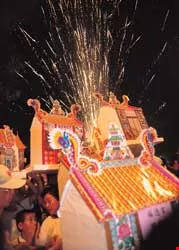
The house-shaped water lanterns light the way for ghosts in the water, leading them ashore to enjoy a feast that people have prepared for them.
A very sacred moment
Jiaos are the most impressive, solemn and grand of all the Daoist ceremonies held in Taiwan. They can be traced back a long way. A passage in the Suishu (The History of the Sui Dynasty) reads: "At night, under the starry sky, lay out wine, meat, cake and money to offer the King of Heaven, Taiyi, and the deities of the five planets (Venus, Jupiter, Mercury, Mars and Saturn), as well as a written report to present to the deities. This ceremony is called jiao." After studying historical documents, Liu Chih-wan, a veteran scholar of Taiwan folk customs, pointed out that jiao is a kind of "grand public ceremony in which to fulfill a vow." To Daoist priests who spend their lives studying ceremonies, it is a great honor to attend a great jiao ceremony once in a lifetime.
In Taiwan, there are different names for different jiaos according to when and why they are held. For example, in the south, one often sees the King's Boat Jiao (which is held to send off Wang Yeh, the god of pestilence), as well as the peace jiao (held to pray for peace), or the water jiao and fire jiao, (which are held to pray for people who died in fires or drowned). Among those, a chingcheng jiao, the celebration of a newly finished or newly restored temple, is considered the most important. Most jiaos extend for a period consisting of an odd number of days, such as a one-day jiao, a three-day jiao, five-day jiao, seven-day jiao or the so-called luotian da jiao, which goes on for 49 days.
In Taiwan, temples have always been the religious centers of communities. Among all kinds of temple fairs and religious festivals, the chingcheng jiao is something that only happens once in a long while, and naturally it is something of great importance in the local community. This is especially the case at the Paoan Temple, which went through a major reconstruction that lasted seven years. The local community naturally feels that it should turn the celebration into a great event.
On June 12, the day before the chingcheng three-day jiao to mark the Paoan's restoration, the temple already looked totally transformed. In the area around the Yuanshan MRT station, many of the street entrances had temporary ceremonial arches constructed and every household hung out festive red lanterns and banners, marking out clearly the range of the temple's authority. "It's an acknowledgment of territory that transcends geography to explicate a refuge, both abstract and concrete, that blends history and religious belief," explains Lee Fong-mao, a researcher at Academia Sinica's Institute of Chinese Literature and Philosophy and a Daoist priest who has a deep understanding of Daoist ceremonies. "This is what it meant by 'territory' in the expression 'Peace within the whole territory.'"
Within this territory, one enters the center of the universe passing bamboo poles on which lanterns are hung, and then differently decorated outer and inner altars. On this occasion, the inner altars of Paoan Temple were constructed within the main hall. Starting from the night before the ceremony began until its completion, the temple was closed for three days and people were not allowed to enter so that the hall could be kept clean for a successful ceremony. Therefore, many who are knowledgeable about this sort of thing went inside to have a look before the ceremony started.
As soon as you crossed the threshold, you saw "a dome made of yellow fabric to represent the sky and a square, high platform to represent the earth," explain the Daoist priests Li Chi-chang and Li Yu-kun, who were in charge of the ceremony. On one side of the inner altar stood the Sanching altar, which enshrined the Sanching Taotsu (the three highest Daoist deities). In front of it was another altar where the chingcheng jiao ceremony was performed and where people and the gods communicated. On the other side of the inner altar was the Sanchieh altar, which enshrined images of the sky, earth and water emperors. Around the Sanching altar hung scrolls representing the Daoist pantheon according to their heavenly ranks, giving the temple an otherworldly ceremonial atmosphere.
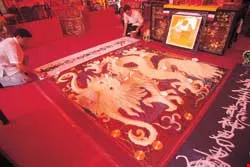
After refurbishing a temple, it is necessary to hold a ceremony to "settle the dragon" (appease the local land dragon deity that was disturbed by construction work). A dragon made from rice is a key part of the ritual. (photo by Yang Chien )
Renewal of the Little Cosmos
On the ground in front of the Sanching altar was laid a straw mat with a bagua pattern. The Daoist priest Li Chi-chang used white rice to form a dragon on the mat, with eggs as its eyes, two large bowls as its mouth and nose, rolled-up paper spirit money as its ears and horns, and sticks of fragrant wood as its whiskers. What's more, the Paoan Temple especially forged 108 heavy gold coins to be the scales of the dragon. This rice dragon, which is full of folk colors, represents the dragon god of the land that resides in the foundation of the temple.
Chinese believe that building or reconstructing a temple disturbs the pulse of the dragon where the temple sits, thus disturbing the order of this little universe. Therefore, completion of the physical construction means only putting right the temple's hardware. A ritual to "settle the dragon and drive away the tiger" is still necessary to resettle the dragon god that guards the foundation of the temple and to drive away the deleterious tiger. These goals are accomplished by shooting a peachwood bow and willow arrows toward the five directions, thus reestablishing the order of the universe.
What's more, it is necessary to bring the people and Heaven (nature) back to a state of harmony: "Before the ceremony it is essential to 'seal off the mountains and water,' which means prohibiting any exploitation of nature, whether by hunting, fishing or farming," explains Lee Fong-mao. Therefore, anyone who participates in the ceremony has to strictly observe fasting. Apart from the prohibition on killing living things, one is not allowed to wear animal products either. This religious ceremony holds within it many of the subtleties in the Chinese relationship between man and nature.
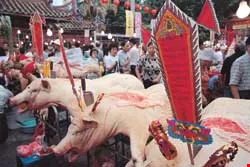
Laying out big tables on which to put whole pigs and goats, the residents in the area presented these major offerings in the hope that the Lord of Heaven would bless the whole area with peace.
Blending traditions
After the ritual of "settling the dragon and driving away the tiger," the reconstruction of the Paoan Temple was officially complete. At 5 a.m. on June 13, to the accompaniment of sonorous beiguan music, priests at the temple began to make a report to Heaven about the jiao, explaining the reasons for it and its scheduled itinerary. For three days running, from early in the morning to late at night, the sound of festive beiguan music with suona horns and gongs, as well as the loud and clear chanting of the Daoist priests, drifted from the main hall.
Since the public was not allowed to witness the ritual that took place at the inner altar, the five outer altars left the biggest impression. Since jiao altars are only used in jiao ceremonies and are therefore temporary, they are usually rentals. Yet the Paoan Temple asked professor Li Chien-lang, an expert on traditional Chinese architecture, to design its own outer altars for the ceremony.
Situated across from the temple, the main altar (the Yuhuang altar) of the five outer altars was fifty meters long and forty meters high. Its square bell tower and bamboo windows were in the style of the Paoan Temple in Tongan, Fujian. The northern Peiti altar that enshrined Emperor Hsuantien had the double-eaved roof and attic of northern palace architecture. The Tienshih altar in the east imitated the Southern Fujian Zhangzhou-style of the Kaichang Shengwang Temple, with a pagoda and rainbow bridge as its defining feature. The western Fute Altar mimicked the Hakka's Yimin Temple. And the southern Kuanyin Altar was designed in the style of the Lungshan Temple, which is a classic example of southern Fujian Quanzhou architecture. Rather than make up a completely new form of jiao altars, Li Chien-lang adopted the idea of blending architectural styles of the different early immigrant Han Chinese groups in Taiwan. This gave a deeper meaning to Paoan Temple's jiao altars. Because space in the city is limited, the Tienshih, Peiti, Kuanyin and Fute altars, which were supposed to be situated at the four sides of the community, were instead placed in the Yuanshan Park 300 meters away from the temple. "I dare not say that it will never be done like that again," laughed Li Chien-lang, "but it certainly has never been done like that before."
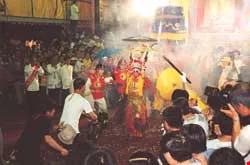
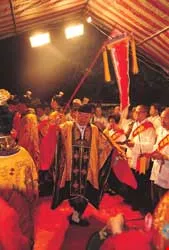
The Chung Kuei Dance, which only men perform, is imbued with the heavy religious atmosphere of an exorcism. Its purpose is to send the ghosts, whose bellies are now sated, back to the Underworld.
Don't neglect the ghosts
On the third day of the three-day chingcheng jiao came the highlights of the ceremony: Worship of the Lord of Heaven in the morning, the pudu ceremony in the evening, and the Chung Kuei Dance to end the event; all were open to the public.
On this day, Talung Street and Chiuchuan Street next to the temple were chockablock with pudu ceremony offerings brought by devotees. Tens of thousands of people packed the area around the temple. Tall green bamboo poles of various lengths that held up lanterns swayed in the winds. Among these, the ones with green banners and sky lanterns were called the sky poles, and the ones with yellow earth banners and ghost-calling lanterns were called earth poles. The purpose of these light poles was to ask the deities above to grace the altars and to offer the souls of ghosts a chance to come listen to the sutras and enjoy the offerings.
It is said that every additional foot of a lantern pole extends the calls to ghosts an extra three li (Chinese mile, equal to about half a kilometer). This time, the poles of Paoan Temple were as tall as 80 feet, which meant that they would be able to invite the lonely ghosts within 240 li in all directions to come and enjoy the feast. While the light poles are high, the offerings for the pudu have to be plentiful so the ghosts will not grow angry at having to fight with other ghosts for food or at going hungry.
The temple also offered classes on how to make water lanterns. Afterwards, people who had made lanterns followed the traditional route to the waterside that deities take when they go out on inspection. There, on the water at dusk, these delicate house-shaped lanterns were like homes keeping a light on so that the poor lost souls in the water could find their way back to them.
Li Chien-lang, an expert in traditional Chinese architecture, was asked to design the altars for the chingcheng jiao. He blended architectural elements from various groups of early Han Chinese settlers. This Yuhuang altar is in the style of a Southern Fujianese-style Paoan Temple. (photo by Chang Chin-weng)
Unseen offerings
At four o'clock in the afternoon, yang turns into yin. At this moment, the head Daoist priest led the participants in the jiao ceremony in the cleansing ritual along the offering tables for the pudu. Six huge pigs weighing over 1000 Taiwanese catties (about 600 kg) each were laid beside the other offerings, eliciting the same response over and over again from city kids who have had little opportunity to witness temple fairs: "Is that a real pig?" Killing a big boar to offer to the Lord of Heaven is a way to present the best and most beautiful of earth's bounty to the highest and most revered god above. Employing this ancient rite with its offerings of whole pigs, whole goats and whole chickens just shows how important the jiao ceremony was to the residents of Talungtung.
The kansheng on the offering tables also attracted people to stop and look. Kansheng are painted animals models (including lions, giraffes, eels, conches, or sea turtles) made of poultry, fish or flour dough; they are only for display and not for consumption.
"The model of King Wenwang in 'Wenwang Dragging a Cart' is made of a chicken's body! These two rabbits' torsos are made of pig's stomach, their long ears of dry squids and their eyes of longans," said one onlooker. "Aren't they cute!" People perused these intriguing kansheng and tried to figure out how they were made. Chefs specialized in fruit carvings made use of Taiwan's abundant and colorful fruits to make designs that contained stories or themes, which also gave people pleasant surprises. A work of kansheng named the "Naughty Family" used a coconut to make a Totoro, a red apple to make a Hello Kitty and avocados to make the Penguin Family. These got kids to point their fingers gleefully.
Weng Sung-yuan played on the characteristics of southern Taiwan in designing kansheng from the Ta Kuanyin Temple and Hsingchi Temple of Tainan city. He used smoked milkfish as scales to create a 30-foot-long silver dragon, and mushrooms to create a Godzilla. Both were extremely unusual.
These kansheng, which caused people to salivate and murmur in admiration, are certain to have pleased those of the spirit world too. However, there are good ghosts and there are bad ghosts, and lest the bad ghosts bully the good ghosts and snatch all the offerings for themselves, a statue of the King of Ghosts, Tashihyeh, was erected behind the offerings to supervise. This six-foot-tall deity is quite vicious looking, and he sticks out a very long tongue. Originally, the King of Ghosts was evil, and he only turned good after being tamed by Kuan Yin, the Goddess of Mercy. Therefore, there always sits a small Kuan Yin statue on the head of Tashihyeh. It provides for a very vivid contrast.
The dead were treated as if they were living. Apart from the delicious offerings, on either side of the Tashihyeh were two houses made of paper called the Hanlinsuo (the National Academy) and the Tonggueisuo (the gathering house), which respectively provided places for scholar ghosts and common ghosts to rest. What's more, there was a "Sutra Clothes Mountain" upon which clothes, combs, washing basins and other items that the ghosts would need were laid out daily. And sparkling gold, silver and money mountains were provided to let the good brethren leave the festivities with something extra in their ghostly pockets. It was a very thoughtful gesture. "A jiao ceremony presents the best chance to enjoy traditional paper handicrafts," says Hsien Tsung-jung, a part time lecturer in traditional handicrafts at National Taiwan University of Arts. "Particularly for the statues of guardian deities on horseback, such as the four field marshals Wen, Kang, Ma, and Chao, the artisans have to use their imaginations to create these very delicate and detailed statues."
Once in a century
The Chung Kuei Dance ritual was held on the last night of the ceremony. After 9:00 the atmosphere shifted suddenly from festive to solemn, and the Daoist priests started to chant out spells while holding charms and sprinkling salted rice and holy water to cleanse the ceremonial site. On the stage, a group of men performed a half-hour-long exorcism ritual, in which the character Chung Kuei was not allowed to talk. Instead he employed his body gestures and eyes to vividly convey the progress of driving away and defeating the evil spirits, as well as clearing out a road upon which to send the ghosts back to the underworld.
The Paoan Temple has always enjoyed the reputation as a temple of culture among all the temples in Taiwan. It pays special attention to the integration of the arts and culture with religion. During this jiao ceremony, the largest held in Taiwan for the last 85 years, the theatrical groups, performance troupes and priests chosen all represented the very best of the era. With temples in Taiwan becoming increasingly gaudy and the activities held within them increasingly vainglorious and empty, Lee Fong-mao, a researcher of the Institute of Chinese Literature and Philosophy at the Academia Sinica, praised the chingcheng jiao of the Paoan Temple as truly a refined temple fair. From the golden-scaled rice dragon, to the paper statues, to the designs of the altars, all showed the vitality and creativity of folk arts.
People who missed the grand gathering of Paoan Temple's chingcheng jiao ceremony now must content themselves with experiencing it through media reports. It might be another century before there is a similar chingcheng jiao ceremony.

@List.jpg?w=522&h=410&mode=crop&format=webp&quality=80)


