Have Paint, Will Travel--Lee Shi-chi's "Chiaroscuro" Career
Anna Wang / photos Jimmy Lin / tr. by David Mayer
December 2001


It's not easy to describe the painter Lee Shi-chi, for there are simply far too many facets to the man and his work.
He is one of the founding fathers of the Ton-Fan Group and the Modern Printmaking Association, the first great movement of contemporary painters in Taiwan, and among his contemporaries he is one of the few who remains active today as an artist, continuing to seek innovation, continuing to evolve with the times.
At the same time, he has worked all his life in his capacity as an individual artist to promote contemporary Taiwanese art both at home and abroad. To this end, he has organized countless solo and joint exhibits, talked his good friend and printmaker Chu Wei-pai into opening an art gallery, introduced to Taiwan's art community the works of such expatriate painters as Charng Yuh and Chao Wu-chi, and done many other things to inject renewed life into Taiwan's arts scene.
Lee was born and raised on the front-line island of Kinmen, the conflict between the Kuomintang and the Communist Party caused him tremendous suffering during his youth. After mainland China's massive artillery assault upon Kinmen in 1958, he ended up moving to Taiwan, where he went on to help write an instrumental chapter in the history of contemporary Taiwanese art.
After a career that has included exhibits in dozens of cities all over the world, including Taipei, Hong Kong, Tokyo, Seoul, Bangkok, New York, Los Angeles, San Francisco, Hamburg, Madrid, Shanghai, Hangzhou, and Qingdao, Lee finally returned after nearly half a century to his native Kinmen to put on an exhibit. The event caused quite a stir in the arts community and attracted many famous cultural figures, including Chu Ge, Lu Yao-tung, Yu Tien-tsung, Shang Chin, Hsin Yu, Kuan Kuan, Hsiao Chiung-jui, Ku Chung-kuang, Huang Kuang-nan, Huang Tsai-lang, Lin Man-li, Ni Tsai-chin, and Shih Jui-yuan.
Because of Lee's status as a Kinmen native, and because of the decades he has spent traveling about mainland China promoting cross-strait arts exchange and searching for "Chinese" elements for his art, the second half of the seminar on his works was carried out on the PRC side in the city of Xiamen. After two days in Kinmen, everyone moved on to Xiamen to continue the seminar with a large contingent of mainland Chinese scholars and art critics, including Xu Jiang, Liu Denghan, Peng De, Shui Zhongtian, and Pi Daojian. When the participants boarded the ferry and completed the short hop to Xiamen, it constituted the first cultural exchange between Kinmen and the PRC under the newly established "three mini-links." It was very gratifying to see the artistic occasion carried off without the slightest hint of political overtones.
Although the seminar was held in early November, the weather in Kinmen was still warm and sunny, with a sky so blue you could practically reach up and squeeze the water out of it. Scattered here and there amidst newly constructed five-story apartment blocks were traditional southern Fujian-style homes, with their rounded roof ridges and flying eaves. If it weren't for the camouflaged bunkers scattered all over the island, one might well have forgotten that the area once reeked of gunpowder and was stationed with 100,000 troops.
Lee himself would certainly not have forgotten, however. While he was excited and proud to be holding an exhibit in Kinmen after over 40 years away, the bloody tragedy of his youth will remain forever seared into his memory.
At the opening ceremony for Lee's exhibit, Kinmen-born author Yang Shu-ching told how proud the people of Kinmen were that an internationally famous painter of Lee's stature had come from their midst. The event was attended by Lee's elementary school classmate Yen Chung-cheng (today the governor of the ROC's Fukien Provincial Government), Kinmen County Commissioner Chen Shui-tsai (who had worked hard to arrange the event), and many other notable figures from Kinmen and Taiwan. The poet Kuan Kuan recited a poem written especially for the occasion by Shang Chin. Everyone there was deeply moved by the beautiful combination of Lee's paintings and the poem.
This was the first time that the Kinmen authorities had ever held an exhibit and seminar focusing on the works of a living artist. The deeply moved Lee Shi-chi said, "I had many unhappy experiences growing up on Kinmen, but it is precisely because I am from Kinmen that I've been able to receive so much support and encouragement."
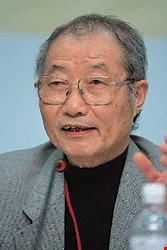
Chu Wei-pai (painter)
Lee Shi-chi was born in 1938 in Peishan Village, on the northern part of Kinmen Island in the area called Kuningtou, which would later became famous for the Battle of Kuningtou. His family had been locally prominent for generations. His great-grandfather had passed the first-degree imperial examinations, and the family later became active in commerce and opened the largest department store on Kinmen. When Lee was small, his parents were quite well off. China was then at war with Japan, and Kinmen was under Japanese occupation. Because Lee's father didn't want his children to receive a Japanese-style education, young Lee received a classical Confucian education at a private school. That is where he achieved his deep mastery of classical Chinese literature and his abiding identification with traditional Chinese values.
The Kuomintang was defeated by the Communists and fled the mainland for Taiwan in 1949. The Communists pursued the KMT as far as Kinmen, but there the pursuers were stopped in their tracks at the Battle of Kuningtou. Taiwan, Penghu, Kinmen, and Matsu were saved from the Communists, but the Lee home was left in ruins. The family took refuge in the home of Lee's maternal grandparents. All of a sudden they were penniless.
Nonetheless, bad luck was not yet through with them. Four years later, a military deserter, still armed, entered the Lee home and took Lee's older sister hostage. In the chaos, he shot and killed the girl and her grandmother. Trapped, the soldier set a fire to kill himself. Outside the door, dozens of soldiers in pursuit watched as the criminal killed and burned, with none coming to help. Lee and his two infant brothers watched as their sister and grandmother were killed, and the old home in which they had taken refuge go down in flames, leaving them permanently affected. All of Lee's works have had a deep element of inescapable sadness, and give one the feeling of being overtaken inexorably by fate.
Lee was only 15 or 16 at the time of this second great tragedy for his family, which struck a staggering blow to his parents. But life must go on. The resilient people of Kinmen toughed it out through years of warfare, and the extraordinarily talented Lee matured all the faster as a painter due to the circumstances of his life. He was already famous around Kinmen by the time he had reached high school.
Shang Chin, a famous poet who served as a critic at the seminar, and who regards Lee's work as "color agitation," recalls that over 40 years ago when he was a soldier in Kinmen, he heard people saying that there was a talented young painter in Kinmen Middle School. So, with some of his comrades, he went to see the paintings, and met Lee who, though at that time still a child, became a friend for life.
Because he was especially good at painting portraits, Lee was recommended by his school principal for special admission to Taipei Teachers College, bypassing the normal examination system. Lee was the first student from Taipei Teachers College ever to put on an exhibition of his paintings while still in school. Lee's graduation coincided with the 1958 artillery duels on the offshore islands, so he was unable to return to Kinmen to teach. Thus he remained in Taipei, which allowed him to develop and to accomplish so much in the painting world.
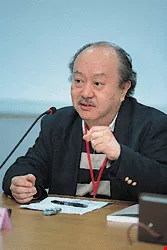
Shih Jui-jen (exhibit curator)
The seminar, entitled "History, Origin, Lee Shi-chi: The Academic Seminar of Lee Shi-chi's Creation Prospect," focused on his more than 40 years of work in Taiwan, accounting for several major phases in his career, and his role as an active promoter of art. The seminar participants discussed, analyzed, and explored his motivations, energy sources, elements, forms, language, expression, and influence. Meanwhile, Lee Shi-chi hopes that through his return home, his exhibition, this conference, and other activities, he can promote modern art in Kinmen. He aims to bring in works by major international artists, so that historic Kinmen can catch up with contemporary trends.
What can we say about the accomplishments of the multifaceted Lee Shi-chi? First you have to look at his works. In papers presented at the meeting, experts including Yu Tien-tsung, an important figure from the "native literature" movement in Taiwan in the 1970s, and Liu Denghan, a well-known art historian from mainland China, pointed out that Lee has gone through numerous stages and transformations. Lee first gained acclaim in the late 1950s with semi-abstract works depicting dilapidated scenes of faded glory, featuring architectural elements to set the tone. In these works he used a coarse, brusque style to create a feeling of loss. This was the first attempt by Lee to usher Chinese elements into Western artistic form. This series of works won him several international awards and established his position as an important contemporary painter
In the 1960s he attracted notice once again by producing a series of prints on parachute silk, expressing himself in an abstract manner, without relying on form at all. Serving in the army at that time, it was handy for him to gather parachute silk, which he experimented with by pounding and twisting, creating very striking patterns.
In the late '60s, influenced by pop and op art, he created the "Orientation," "Square and Round," and "Gambling Pieces" series, featuring outsized Chinese dominoes, mahjong pieces, and dice affixed in various states of array (or disarray!) on giant boards. This marriage of folk art with the avant garde was both stunning and humorous at the same time. "Square and Round," which has a very op art look to it, contains clear hints of the author's grounding in Chinese cosmology, with a yin-yang cycle of reincarnation involving the earth and sky. By that time Lee had woven his Eastern and Western ideas together in such a fine-grained mix that there was no telling the one from the other.
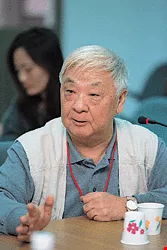
Chu Wei-pai (painter)
In the early '70s, his "Mourning the Moon" serigraph series was seen as the beginning of the second phase of his career. A sometimes-strong, sometimes-soft brush style took over from the coarse lines and geometric shapes of his earlier period. The "Large Calligraphy" series, executed with an airbrush, featured a combination of fascinating colors with an agile calligraphic style. The colorful Chinese characters set against a jet-black night sky are reminiscent of the fireworks of a traditional Chinese festival. The mood is very joyful. The "Large Calligraphy" represented a new level of maturity for Lee in terms of refinement and attention to detail. This phase of his career lasted for nearly 20 years and culminated with the "Critical Point" series, after which he lost his creative direction.
But in the 1990s Lee, who had always been very adept in the use of media, introduced lacquer into his work and produced the "Passage to Solitary Darkness," "Post-Orientation," and "Re-Orientation" series. Interestingly, although he has consistently used traditional Chinese elements throughout his career, over the years he has gradually relied more and more on the techniques of Western art to express himself. Lee admits that tradition, history, and China are his roots, and no matter how many changes there may be he can never depart from his blood line and the deepest memories of his soul. This is the milieu in which he grew up, the culture that nurtured him, and the powerful source of his creativity.
Yu Tien-tsung noted the beautiful way in which Lee has taken opposition and turned it into balance and harmony. Liu Denghan declared himself to be especially moved by Lee's grasp of the language of Oriental tone and special national characteristics, and his increasingly abstract, themeless richness of expression. Chu Ge noted that he strongly encouraged Lee to use the traditional Chinese medium of ink, because ink by nature is best suited to express abstract ideas. Lee, having never before painted a traditional ink painting, has proved even more capable than most of transcending concrete forms to let the ink freely play out in a way that characterizes his most recent series of compositions, "Language of Ink."
Another major contribution of Lee's to the world of art has been his promotion of modern painting. Hsiao Chiung-jui, a veteran art critic and currently director of the bureau of culture in Tainan, presented a brilliantly written paper on "Lee Shi-chi and the Age of the Gallery in Taiwan Fine Arts." He described how, in the 12-year period from the break in US-Taiwan relations in 1978 until 1990, Lee devoted himself to gallery management. He held more than 160 exhibitions, providing the link between the fading "painting society" phase of the late 1970s and the "art museum" phase of the mid to late 1980s, thereby creating "the freshest and most eye-catching axis of development of modern art in Taiwan."
Speaking of Lee's opening of a gallery, conference participants all wanted to have their say, especially Lee's partner Chu Wei-pai. He remembers how the two of them courageously opened their gallery in a small space of only 65 square meters, sponsoring a number of exhibitions of prints, oils, and other modern works. They also invited Ting Hsiung-chuan, Hsia Yang, Chao Wu-chi, Han Hsiang-ning, and many other famous artists who had lived abroad for a number of years to show their works, creating quite a stir at the time, and launching the trend of overseas artists returning home to lend inspiration to the local painting scene.
After Lee went to Hong Kong to teach, the gallery eventually faded away. Thereafter, he managed three other galleries, either in partnership with others or as manager hired by the gallery owner. He continued to focus on new artists, and also introduced work from Southeast Asia and "visual poetry" done in cooperation with poets. After the lifting of martial law, his own San Yuan Se Gallery was the earliest to introduce mainland artists to Taiwan, and was a very hot place. Nevertheless, Lee, who remained determined to focus on modern art concepts, could not withstand the intense competition of the gallery movement of the late 1980s. A small gallery like his could not be commercially viable with such practices as signing contracts and buying paintings beforehand. Seeing a number of his friends from those early days "stolen away" by other galleries, he began to feel restricted by the gallery. Thus in early 1990, in the most flourishing phase for galleries in Taiwan, he closed San Yuan Se Gallery and re-dedicated himself to his own art. This period, as Lee says, was the darkest of his artistic life. He had taken the "Large Calligraphy" series about as far as he could, and didn't know where he would find his next idea. But later, in mainland China, he was very moved when he saw lacquerware from the Chu culture of ancient China, so he decided to use lacquer in his paintings. At first, however, the works he produced were dark and moody, like his own feelings at the time.
However, the life of the person who constantly changes is richer, for the changes build character. He eventually found his way out of his dark mood. In combination with traditional Chinese cultural elements like the seven-piece puzzle, plaques, and verse couplets, he produced a series of fun and vigorous works in the "Post-Orientation" and "Re-Orientation" series that fascinated viewers with a subtle dialogue between tradition and modernity.
Despite this gathering of experts from both sides of the Taiwan Strait, no one could make a definitive judgment about Lee Shi-chi, because no one knows what he might come up with next. Only two things can be said for sure, noted Ni Tsai-chin, chairman of the graduate institute of fine arts at Fokuang University. Firstly, Lee Shi-chi, this man who has been intimately involved with modern art for the last 40 years, has a profound love of traditional vocabulary. Secondly, Kinmen, caught between the two sides of the Taiwan Strait, is where Lee has his roots. Lee Shi-chi is a microcosm of the development of art in Taiwan, but the ever-changing Lee always lives in the moment, and will never become history.
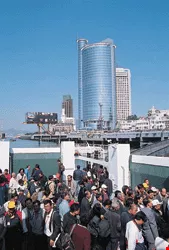
The artists and scholars attending the November conference in Kinmen departed by ferry from Liaoluo Harbor to continue the conference in Xiamen. It was the first voyage by a group of artists traveling directly from Kinmen to the PRC.
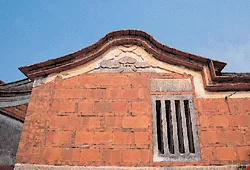
Tradition and ethnic identity have always been the source of Lee Shi-chi's inspiration as an artist. Shown here is the rounded roof ridge of a traditional Kinmen-style residence.
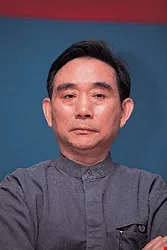
Chien Chih-hsin (former chairman, China Times Weekly)
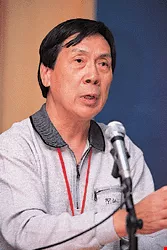
Chu Wei-pai (painter)
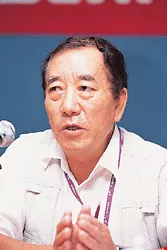
Shih Jui-jen (exhibit curator)
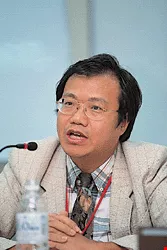
Chu Wei-pai (painter)
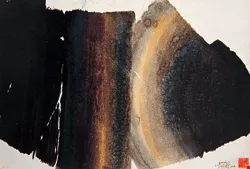
The "Inktalk" series of 2001 has infused traditional inkwash painting with new life.
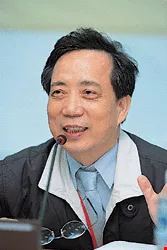
Shih Jui-jen (exhibit curator)
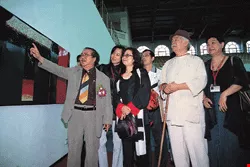
Lee Shi-chi couldn't hide his excitement upon returning to his native Kinmen for the first time in over 40 years to put on an exhibition. Many artists from Taiwan made a special trip to Kinmen to show their support for Lee. Shown here are Lee, Ku Yueh, Li Chi-mao, and Chang Kuang-cheng, with the painter Pan Li-hung in the rear.
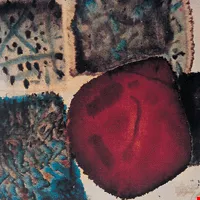
Lee executed his "Memory of the Far" series in the 1990s, juxtaposing the "shiny new" with the "rustic old." The watercolor base is covered with a coat of varnish, giving these works a strong feeling of depth.
Chien Chih-hsin (former chairman, China Times Weekly)
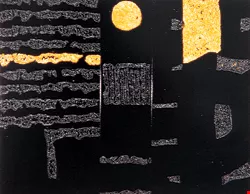
"Re-Orientation," 1998. The idea of "orientation" is an important concept in the work of Lee Shi-chi, and it forms the basis of the strong sense of identification with Chinese ethnicity, culture, and traditions that shows through so clearly in "Post-Orientation" and "Re-Orientation."
Chu Wei-pai (painter)
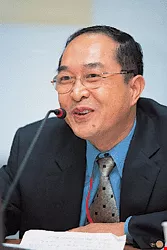
Shih Jui-jen (exhibit curator)
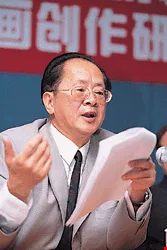
Chien Chih-hsin (former chairman, China Times Weekly)
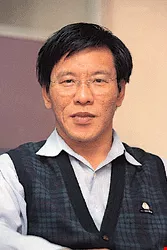
Shih Jui-jen (exhibit curator)
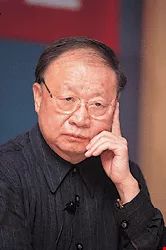
Chien Chih-hsin (former chairman, China Times Weekly)
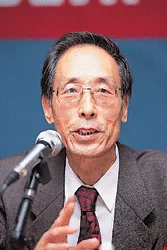
Chien Chih-hsin (former chairman, China Times Weekly)
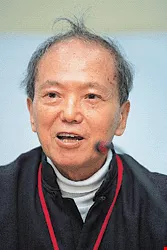
Shih Jui-jen (exhibit curator)
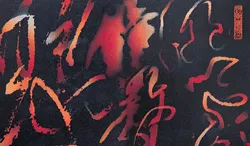
In the "Large Calligraphy" series, the exuberant cursive script of Huai Su is spray-painted into Lee's works. In creating these paintings, Lee was reminded of the way he often played as a boy in Kinmen, lighting a stick of incense and waving the glowing tip in the pitch-black night.
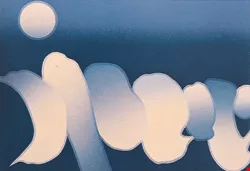
In "Mourning the Moon," a series of serigraphs executed in the early 1970s using the brush techniques of Chinese calligraphy, Lee and his wife Ku Yueh express their dismay at the lunar landing and the puncturing of ancient myths. Lee's serigraphs were put on exhibit along with the poetry of Ku Yueh.
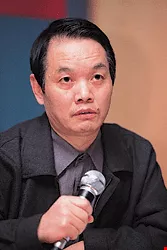
Chien Chih-hsin (former chairman, China Times Weekly)
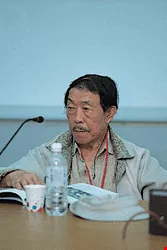
Chu Wei-pai (painter)
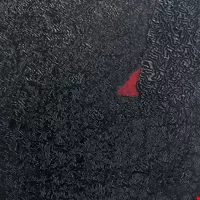
The 1993 "Post-Orientation" series features a touch of red against a jet-black background. The shock of brilliant red riding atop layer after layer of black paint makes for a startlingly beautiful contrast and feeling of tension.

@List.jpg?w=522&h=410&mode=crop&format=webp&quality=80)


