Eslite: Lighting a Candle for Book Lovers
Kate Yang / photos Tsai Chih-yang / tr. by Scott Williams
September 2004


The 24-hour Eslite bookshop on Taipei's Tunhua South Road is the pride and joy of many Taiwanese, and a tourist destination for visitors from Hong Kong and Japan, who flock here to admire the elegance of the space and absorb the store's overtly cultured air. Yet there are also those who despise Eslite as an "intentional expression of bourgeois superiority."
But whether enthusiast or detractor, none can deny that Eslite has changed the face of bookselling in Taiwan.
At Eslite's recent 15th birthday party, company chairman Robert Wu breathed a sigh of relief. "This year," he told partygoers, "we've finally gotten our income onto a more reasonable footing." Outsiders had been dubious of Eslite's diverse product line, thinking that over-commercialization had cost the company its identity as a "cultured" bookseller, but when the company's book division finally turned a small profit last year, it brought a rare smile to Wu's face.
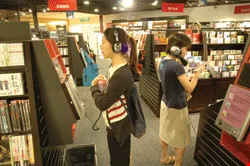
In addition to selling books, Eslite operates coffee shops and retails high-end department store items and audio-visual products. Such scope has led some to charge that Eslite has become over-commercialized and is ignoring its core bookselling business. The photos show the Tunhua Eslite's B2 music and video sales floor.
A respect for books
Eslite may have gotten its start as small, independent retailer of books on art and architecture, but over the last 15 years it has grown into a chain of 49 stores that span all of Taiwan. And it's still growing.
Lee Yuh-hwa, Eslite's assistant manager of public relations, has been with Eslite for many years and seen its growth at first hand. She says that entering an Eslite has always been a humbling experience, like walking into a quiet and magical place.
Eslite patrons are well aware that there is nothing flashy about the company's employees. They go about their jobs very quietly and tend to avoid makeup. Customers often mistakenly believe that the lack of makeup is a company policy, but the fact of the matter is that Eslite's employees are themselves booklovers who are there just for the books.
According to Lee, employees "adopt" an area of interest from among the sections into which the stores are divided-literature, the arts, etc. They also learn how to take shipments and shelve books. She remarks that many senior employees are unwilling to take management positions because they prefer to remain on the sales floor where the books are right at hand. Lee says that it is this shared love of books that gives Eslite's employees their sense of being part of one big family. She notes that even those whose sense of fashion might be a little extreme come across as "good kids," which she attributes to shared values and Eslite's corporate culture.

Taiwanese are justly proud of the 24-hour Eslite on Tunhua South Road, which has become something of a tourist destination for visitors from Hong Kong and Japan.
Bookstore or department store?
Eslite's flagship Tunhua South Road store is the company's biggest moneymaker. Its book division alone generates sales of more than NT$40 million a month, more than any other bookstore in Asia in terms of sales, and among the top three or four in the world.
But things haven't always been so rosy. Eslite experienced a financial crisis in 2002 that had observers wondering whether such a high-end bookseller was viable in the Taiwan market. Although the arts community breathed a sigh of relief when the company returned to profitability last year, many question whether the company has become too commercial.
Take the Tunhua store, for example. The first floor, the ground floor, and the first basement are devoted to sales of clothing, accessories and knick-knacks of all kinds. The second basement includes a music store, a coffee shop and a gallery. Book sales are limited to the second floor. And there's nary a book in sight at the company's two stores in Taipei's Hsimenting area.
Eslite has four business divisions-a cultural division, a department-store division, a retailing division, and a food and beverage division. (In fact, Robert Wu began his career in this last industry.) Lee admits that in the past Eslite relied on leasing floor space to other retailers to boost revenues, but says that last year the bookshops themselves turned a small profit.
Lee thinks that charges of "over-commercialization" are exaggerated, and argues that each Eslite store has a its own character. Each is targeted at the readers who patronize it and matches the character of the area in which it is located.
Eslite's 49 outlets are of several types-independent/free-standing ones like the Tunhua store; "department store" shops located, as the name suggests, inside department stores; "convenience stores," which operate in subway stations; and neighborhood stores like those in Hsimenting and on Nanking East Road. There is even an Eslite in the basement of the Taiwan University Hospital that offers patients and visitors to the hospital a moment's respite.
Perhaps the most unique Eslite of all is the one located in Taoyuan's Far Eastern Department Store, which deals only in cookery books and is fitted out with burners, ovens, counters and even cookware so patrons can give the recipes a try. The Eslites devoted to books on the performing arts located in the National Theater and National Concert Hall, and the film-themed Eslite at the Taipei Spot cinema also represent efforts to cater to the particular interests of readers.

"This year, we've finally gotten our income onto a more reasonable footing," said Eslite founder Robert Wu at the company's 15th anniversary celebration.
24/7
Eslite's most discussed innovation is the 24-hour bookstore. In 1995, the company was preparing to move to a new location and asked its patrons to write or draw a description of their ideal bookstore, one that they'd never before seen in reality. Eslite was quickly inundated with proposals that included a seaside bookstore, a park bookstore, a treehouse bookstore and even a mobile bookstore.
The company's planning department responded by creating a survey aimed at finding out what it was that readers most cared about. A whopping 24% of respondents replied that they'd like to see a 24-hour bookstore.
In those days, about the only businesses that remained open in the middle of the night were entertainment venues and convenience stores, and the company assumed that the suggestion was merely a flight of fancy on the part book-loving night owls. But it duly noted the survey's results and arranged an all-night promotion on the night before its move. Much to the company's surprise, the public came out in such force that traffic control measures were required from start to finish. Lee recalls being shocked by how many people were out roaming the streets in Taipei in the middle of the night. After the move, Eslite began what was to have been a three-month experiment with 24-hour operations, but ended up instituting them on a permanent basis within a few days of the start of the trial period.

Eslite has grown from a small, specialty bookshop into a major chain with a broad product line. The company tailors each shop to its neighborhood, and has become a fixture on Taiwan's cultural landscape. The photo shows the "neighborhood store" located just off of Taipei's Nanking East Road.
Staying home, for now
At Eslite's 15th anniversary bash, many were wondering whether the company had near-term plans to go into mainland China. Those in the know report that Eslite has frequently been approached by mainland businesspeople seeking a variety of potential joint ventures. At the party, however, Wu stated that Eslite would not be opening any mainland stores of its own within the next two years, and would instead continue to watch developments there.
Many observers have expressed disappointment with Wu's decision, fearing that Eslite may have missed its chance in the mainland. Wu, however, disagrees, noting that the reality of the situation is that the mainland still does not permit foreign businesses to own and operate their own bookstores there. Even if a suitable local partner were available, Eslite would not have complete control and would therefore have a harder time ensuring that its mainland venture adhered to its ideals. In Wu's view, the time won't be right for Eslite to move into the mainland until after further liberalization.
Closer to home, Page One's entry into the Taipei market at the start of this year elicited much discussion in Taiwan's cultural circles. Wang Jung-wen, chairman of Yuan-Liou Publishing, was even quoted as saying, "If I were Robert Wu, I'd be worried sick." But Eslite's Lee notes that in the last few years, both Eslite and Kingstone have been steadily expanding, and Page One's effort to squeeze into the market is indicative of healthy competition.
When FNAC first came to Taiwan in the early 1990s, Eslite was genuinely worried and kept close tabs on the situation, even going so far as to track how FNAC was selecting its books. With significant corporate resources to draw on and a product line that extended beyond books and stationery to computers, consumer electronics and audio-visual content, FNAC attacked the local market with all its guns blazing. For a time, its efforts created quite a stir. But then its Taiwan operations were bought by the Shin Kong Group, which folded them into its department store operations. With book sales accounting for only a quarter of FNAC's sales volume and no longer the focus of its business, Eslite was able to breathe easy again.
These days, Eslite is more relaxed. Lee admits that Page One's inventory, as well as its look and feel, strongly resemble those of Eslite. However, experience has taught Eslite that demand for foreign-language works is limited in Taiwan and the company therefore carries only selected volumes. In contrast, Page One stresses comprehensiveness and tends to order a publisher's entire line.
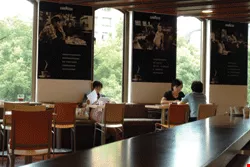
In addition to selling books, Eslite operates coffee shops and retails high-end department store items and audio-visual products. Such scope has led some to charge that Eslite has become over-commercialized and is ignoring its core bookselling business. The photos show the Tunhua Eslite's B2 coffee shop.
A chain store, not a clone store
Lee says that while Page One is an international chain with all the benefits that go with that, it will likely face some difficulties in the local market. She mentions inventories as one issue: "In addition to ordering and selling goods, bookshops have to manage inventories, and having too many books incurs costs." Keeping inventories turning over by attracting different kinds of readers is one of the keys to success in the book trade. "Back in the early days," recalls Lee, "Eslite found itself stuck with huge numbers of foreign-language books in stock. Over time, we refined our business model and learned what we needed to order. We became selective and stopped having to dump books to clear our inventory." Lee points out that it's also important to find ways to entice readers to buy rather than just browse.
"Eslite's greatest challenge," she says, "isn't Page One or some other competitor, but rather how to make sure that as we grow, we have what it takes in terms of quality and quantity to succeed as a chain, but without our stores being clones of each other; and that we innovate and to continue meeting readers' needs."
Eslite has grown steadily over the last 15 years, from its beginnings as a tiny challenger to Kingstone to its present position as a market leader. It has succeeded in winning readers' hearts and turning its bookshops into centers of culture and leisure. Almost inevitably, it seems, Eslite has become part of Taiwan's cultural landscape.

_DSC2938@List.jpg?w=522&h=410&mode=crop&format=webp&quality=80)

@List.jpg?w=522&h=410&mode=crop&format=webp&quality=80)


