It's been a long winter this year on Taiwan. In early March there was even a big snowfall on 2,000-meter-high Mount Lala near Fuhsing Village.
Pressed by cold and hunger, two Formosan black bears followed the mountain road down to Paling, where they came upon a fruit orchard and began eating the fruit. Just then a couple of farmers came by. Although there was no open conflict, the bears' clumsy paws had bent and broken the branches of nearly all the trees, and the farmers were furious. And whether the bears had really gotten much for their clumsy efforts remains a question.
The author Ni K'uang once described what happened when a Manchurian black bear, a relative of the Formosan, stumbled into a corn patch at night. Standing erect, it gathered an ear of corn with its front paws and then held it under its arm. But as it gathered a second ear and tried to put it under its arm, the first ear fell to the ground. The result was that the bear busily spent a whole night wrecking a field of crops and still wound up with just one ear of corn.
This kind of behavior, at once comical and exasperating, typifies the personality of the Formosan black bear. But people who don't understand much about bears still worry about their "threat to Man." As soon as the bears were sighted in Paling, the newspapers were full of articles warning off visitors who might have wanted to go there to see the snow.
The question is, if you really run up face-to-face with a Formosan black bear, what should you do?
A story goes like this: Two friends were walking in the country when one of them saw a bear heading their way a long way off. Without telling his friend he scrambled up the nearest tree. By the time the other man saw the bear it was too late. Thinking quickly he lay down and played dead. The bear came over, sniffed at the "dead man," lost interest, and lumbered away.
After the bear had gone, the man climbed out of the tree and asked his friend what the bear had said to him. "He told me I shouldn't make friends with someone who thinks only of himself in times of danger," the other man replied.
But that's just a story. If you really want to investigate whether you can avoid a bear's attack by playing dead, the experts advise you not to.
The reason is that most bears, including Formosan black bears, are omnivorous animals. Plucking fruit, gathering honey, catching small animals--they can do it all. And they aren't too picky about dead bodies or rotten meat either. A Japanese who investigated the habits of the Formosan bear some 50 years ago once saw "a Formosan black bear eating the uneaten prey left behind by a leopard."
Playing dead when you run up against a Formosan black bear may simply be serving yourself up on a platter.
So how about climbing a tree? This might be OK elsewhere, but it won't work in Taiwan.
The Formosan black bear is lighter and more agile than grizzlies or polar bears. Standing up, it's nearly as tall as a man; it's claws are sharp as knives; and it's quick and sure at climbing trees. One hook with its paws, and somebody hiding up a tree will get torn down like a piece of meat.
So does meeting up with a Formosan black bear mean curtains for sure? It depends on your luck. The Formosan black bear is lazy and lethargic and doesn't like trouble. Unless you give him a reason, he probably won't bother paying attention to you at all.
Black bears don't like to pick fights, some experts say, because they live in the forest and prefer to avoid their enemies by hiding among the trees. They're not like grizzlies, which live on the open plains and are consequently less diffident about getting into scraps.
So if you come up against a Formosan black bear in a tight place, the best thing to do is stand still and don't move. He'll probably just eye you a couple of times and go on his merry way.
But if you can't restrain yourself from trying to make a "preemptive strike," the bear may feel challenged and things aren't likely to be so pleasant.
Aborigines who have had run-ins with them say the Formosan black bear is incredibly strong--one blow of its paw is enough to kill a man. The speed of its attack is also alarming. Experts say that over a short distance bears can run faster than horses.
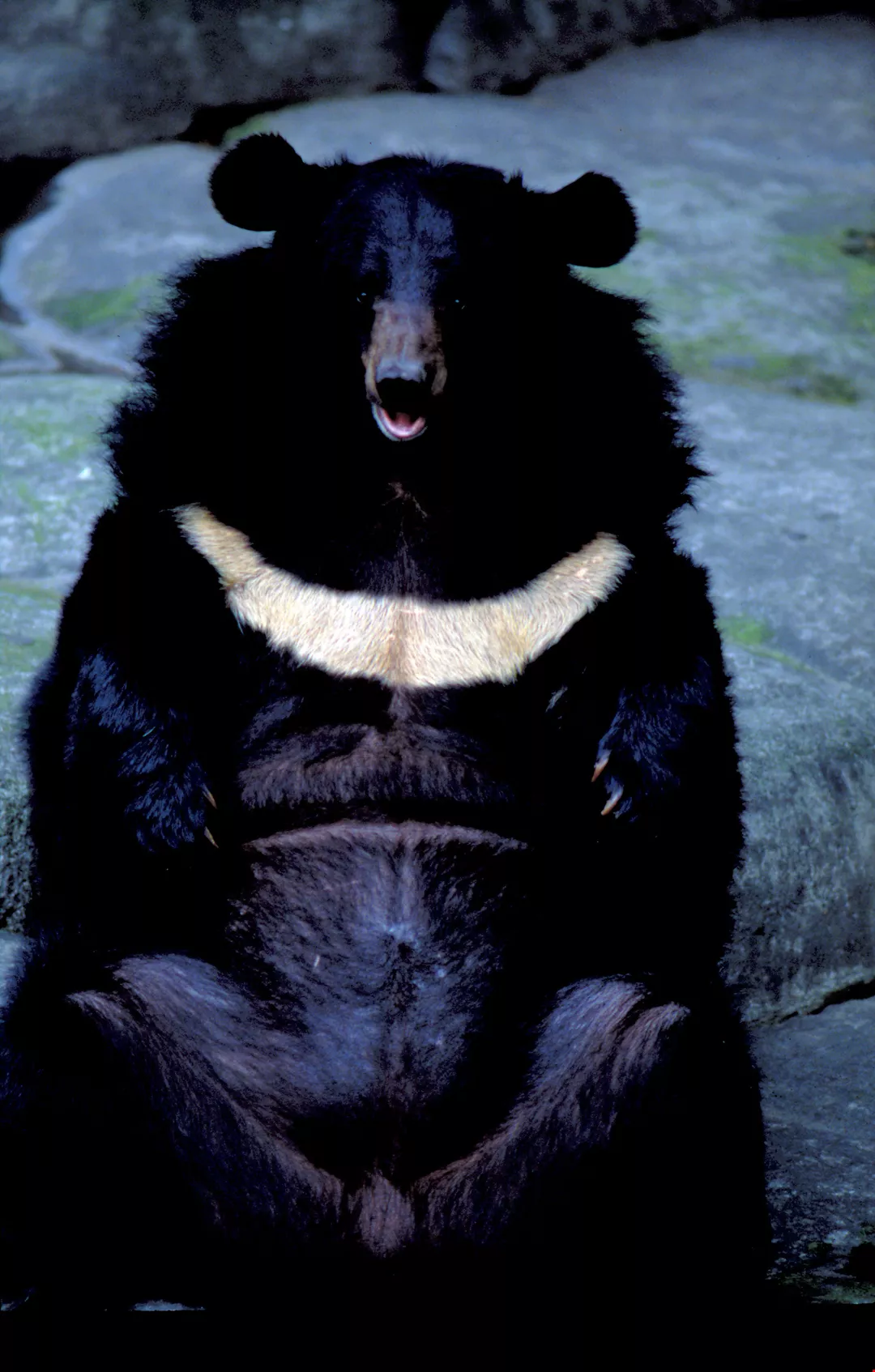
Formosan black bears are seen mostly in the northern and central regions of the Central Mountain Range. Adult bears are one meter high and weigh over 100 kilos. Except for two crescent-shaped white spots on their chests, their bodies are entirely covered with thick black fur. Walking on all fours they look at first glance like hairy black pigs. Compared with pandas and polar bears, they're not particularly cute.
Formosan black bears are usually loners. After mating in the winter, the male goes away and the female gives birth to one to three cubs eight or nine months later. The cubs stay with the mother for a year, or until it comes time for her to mate again, and then go off on their own.
The bears like to sleep in the winter. They find a secluded cave or hollow tree and safely doze off into dreamland for days or weeks at a time.
A bear's hibernation is not like that of a cold-blooded reptile. Their body temperature and metabolism remain normal; if attacked, they'll wake up and fight. And to get a good rest, they've mastered the technique of "anal retention"--they can keep excrement stored up inside until after they've had all the sleep they need.
During hibernation the bears don't need to eat. The 15th-century Chinese Compendium of Materia Medica says: "The bear does not eat food during winter hibernation. If hungry, it licks its paws. Thus the excellence of the bear lies in its paw."
Bear's paw has for ages been considered by the Chinese one of the "eight delicacies." Ni K'uang, who has tried it, says that if it isn't properly prepared, bear's paw tastes as insipid as chewed wax. The flavor's all in the seasoning.
Even more of a letdown is the thought that if the preciousness of bear's paw comes from the bear licking it, isn't eating bear's paw like eating bear spit?





@List.jpg?w=522&h=410&mode=crop&format=webp&quality=80)