

US orchestra conductor Marin Alsop set a precedent in 2013 when she became the first woman to conduct at the Last Night of the Proms since the annual orchestral classic was first held in London 118 years earlier.
And in the Japanese television series Nodame Cantabile, one cannot but notice the similarities between leading man Shinichi Chiaki and Japan’s real-life female conductor Tomomi Nishimoto.
In the male-dominated world of orchestral conducting, the more successful a female conductor is, the more attention she attracts. In Taiwan, as well, we have an outstanding female conductor. Let’s check out her story.
“Mamma mia! You guys could use some ginkgo!”
Orchestra conductor Amy Chang, hard at work in rehearsal, lets go with a favorite pet phrase, implying—in her trademark loud, fast clip—that the musicians are having some mental acuity issues. After this gentle razzing, she talks with each of the musicians in turn to discuss where this one has missed a beat, that one has forgotten to play a certain part in crescendo, and so on.
The more serious types in the orchestra furrow their brows in concentration. Someone with a slightly more relaxed attitude makes a wisecrack about the conductor being a dragon lady. But everybody knows that the quip communicates a very serious message about what is expected of them: self-discipline.
Indeed, Chang demands of lot of herself, and expects the orchestra members to be similarly demanding of themselves.
There are lots of different ways to lead an orchestra. Which way is best, of course, is a matter of opinion. In Chang’s view, it’s best if everyone is sincere, communicative, and respectful of each other.
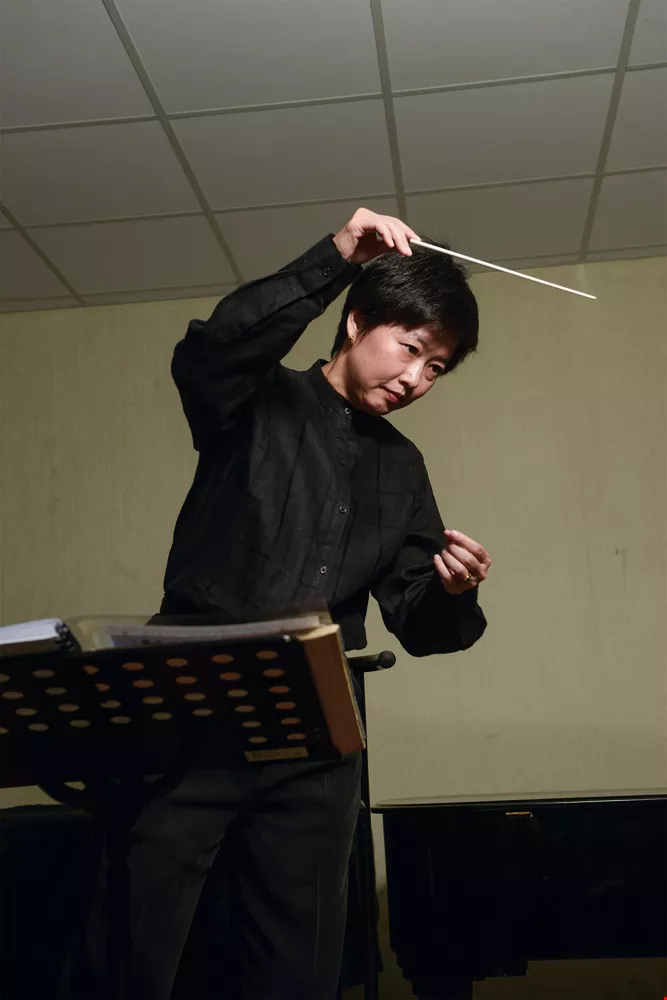
Depending on her mood, Amy Chang can be ebullient or delicate. Her personality shows through in her up-beat, clean conducting style.
Chang, who at 50 looks at least ten years younger than her actual age, is the only prominent female orchestra conductor currently active in Taiwan. The holder of master’s degrees from the University of Southern California in both instrumental conducting and clarinet performance, Chang currently teaches at the University of Taipei and Taipei National University of the Arts. She is also conductor and music director at the Purely Professional Orchestra.
Chang rose to fame while still quite young. At 32, she won the Asia group in the Tokyo International Music Competition for Conductors, and at 35 she took fourth prize at the International Conducting Competition in Barcelona, where she was the only Asian contestant to reach the final round. International judges have praised her style, describing it as crisp, fluid, and deeply musical, while noting also that she works very well with all the musicians and soloists.
She has also served as assistant conductor of the Taiwan Philharmonic and deputy director of the Taipei Chinese Orchestra, and has conducted the National Taiwan Symphony Orchestra and the Evergreen Symphony Orchestra. World-famous performers she’s collaborated with include Vesselin Paraschkevov, former concertmaster of the Vienna Philharmonic Orchestra, violinist Salvatore Accardo, and flautist Peter-Lucas Graf.
At the World Games 2009 opening ceremony in Kaohsiung, she directed an orchestra of over 100 pieces, joining with an Electric-Techno Neon Gods performance troupe and singers from around the world in a show that was possibly the most successful open-air concert in Taiwan in decades.
So how exactly did this petite woman manage to make the big time in the male-dominated world of conducting?
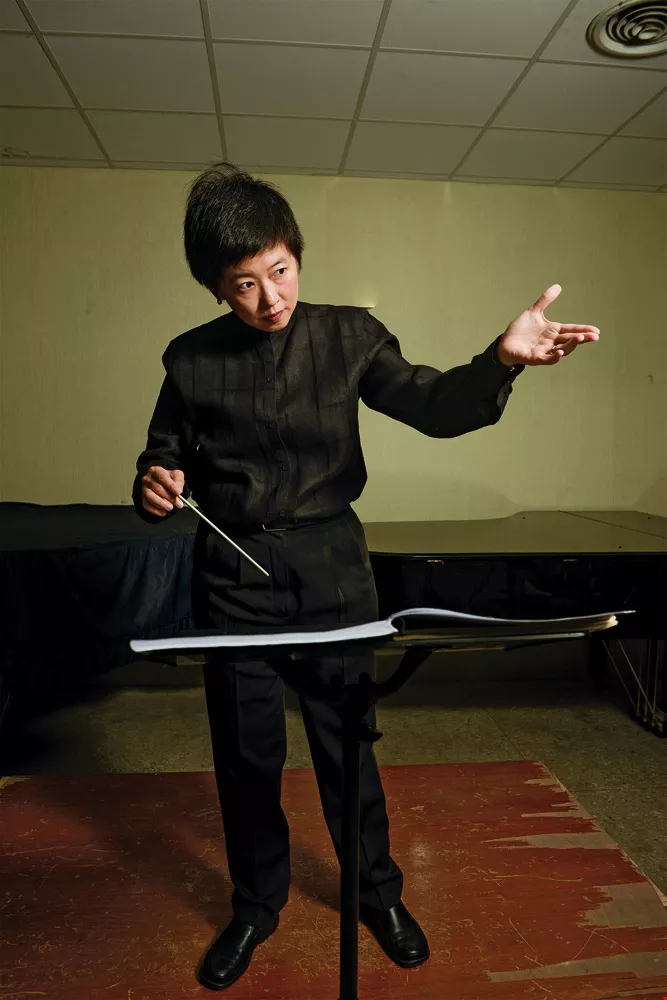
Depending on her mood, Amy Chang can be ebullient or delicate. Her personality shows through in her up-beat, clean conducting style.
Chang first got the idea to become a conductor when, as a young girl, she saw a female conductor up on the podium.
As a student in the special music program at Kuang Jen Catholic Elementary School, she once went with her family to a concert. The conductor was a woman. Though she had her back to the audience the whole time, her total command of the scene made a huge impression on young Amy.
Says Chang: “The person who stands before the orchestra has to be just like that. It’s the only way you can use a baton to communicate with everybody.”
Young Amy’s reaction was immediate: “Wow, a girl can be a conductor, too!” That concert changed the gender roles she had harbored up to that point.
The conductor that day was Helen Quach, the first woman in Taiwan or anywhere in Asia to make an international name for herself in the field. After living many years in Australia, Quach died in July 2013 in Sydney at age 73.
On that day four decades ago, Quach planted a seed in the girl’s mind. Young Amy told her teacher of her desire to become a conductor, and met with enthusiastic support. On the day of her elementary school graduation, Amy conducted for the first time ever, leading a student chorus.
In junior high school, Chang conducted the school choir at numerous contests throughout Taiwan, and the choir won many prizes. “I didn’t make a special study of it. I just imitated my teachers, and came to love conducting as time went by.” In her last year of high school, during a concert at the huge Sun Yat-sen Memorial Hall, she conducted the Kuang Jen Catholic High School orchestra for the first time.
According to Cai Huyu, former Kuang Jen High principal: “Amy was always the one out front, leading the way.” Very early on, Chang showed the leadership qualities required of a conductor.
Chang’s accomplishments garnered her guaranteed admission to Fu Jen Catholic University’s Music Department. After transferring as a second-year student to the National Institute of the Arts (now Taipei National University of the Arts), Chang began formally studying instrumental conducting. As a third-year student she transferred to the University of Southern California, where she majored in clarinet performance. On her own, however, she continued to study conducting with a private teacher.
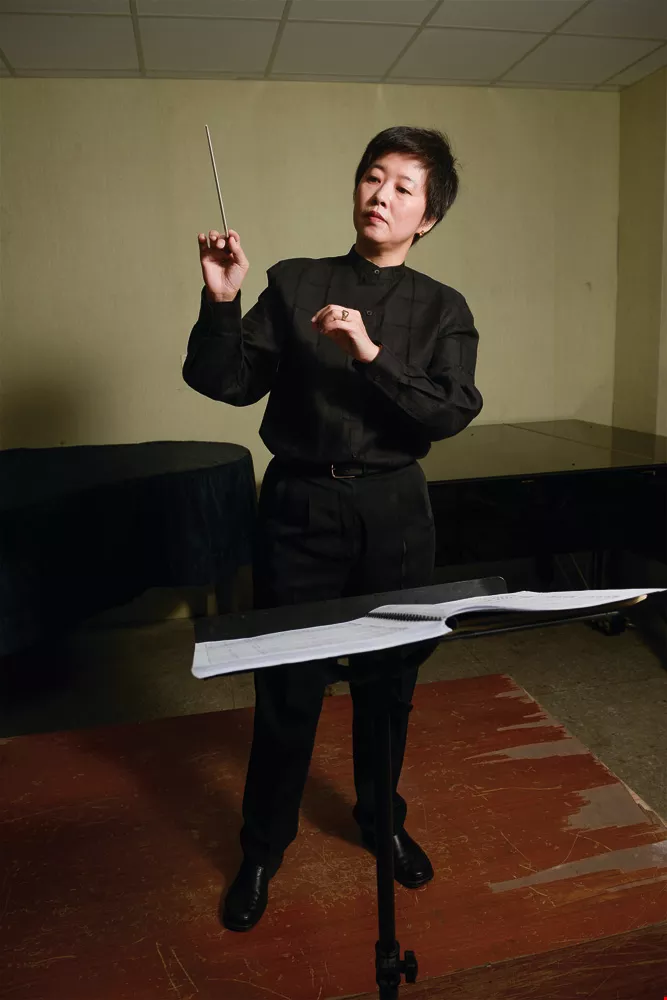
Depending on her mood, Amy Chang can be ebullient or delicate. Her personality shows through in her up-beat, clean conducting style.
After she embarked upon a master’s course in clarinet performance at USC, Chang’s passion for conducting flared up again, and a year later she started on a second master’s, in instrumental conducting. She ended up earning two master’s degrees.
The USC music school only accepts two students per year for its master’s program in conducting, and that year Chang was the only student they accepted. Everyone else in the classes, both instructors and students, were men. From the day of admission to the time she donned cap and gown to graduate, she never saw another woman on campus who studied conducting.
Says Chang: “I was very lucky, but I don’t believe I was accepted into the program just because of my gender.”
After returning to Taiwan, once again she was the only female orchestra conductor on the scene: “I spent no time thinking about gender differences. I just concentrated on a specialty that I really enjoyed and had majored in at school.”
“I relied on technique, ability, and attitude to seize opportunities as they came up, and to develop as a conductor.”
Famed Russian conductor Vasily Petrenko once said that orchestras “react better when they have a man in front of them” and that “when women have families, it becomes difficult to be as dedicated as is demanded in the business.” Chang can only agree with half of Petrenko’s comments. After taking the career path of a conductor, she did indeed come to understand that female musicians opt out of conducting primarily to care for their families.
By way of explanation, she points to her own work schedule. Apart from time spent in rehearsal and performance, over 90% of her other time is spent reading over the full score to get a feel for the work as a whole, understand the interplay between different instruments, and identify where the music builds to a crescendo or retreats into a softer segment. This work requires extreme concentration.
A conductor reading over a score, says Chang, is a lot like a monk withdrawing from human society for an extended period of intense meditation. Each time Chang retreats to her den, it will be at least three hours before she emerges again. No music must be allowed to reach her ears at this time. Every tiny detail must be slowly digested. And prior to a performance, everything must be practiced again and again. She hits a gym every day to jog, ride a stationary bicycle, and do 200 sit-ups to stay in condition for the physically demanding task of conducting.
Conducting is an unattractive career option for women planning to start a family, says Chang, because the job is so much more tiresome and time-consuming than outsiders would ever imagine, and requires a certain basic understanding of every single instrument in the orchestra. At the Julliard School, for example, of the 40-plus students who’ve majored in conducting since 1996, only four have been women.
Conductors can be an odd bunchLeading an orchestra is a lot like leading an army, and when a conductor flies into a rage, the musicians often seethe with resentment. The feeling is captured in an old joke that has long made the rounds in musical circles: “Why did they bury the conductor 20 feet into the earth? Because deep down he was a nice guy!” Jokes aside, however, Chang feels that gender doesn’t necessarily have anything to do with a conductor’s leadership style.
In the US, for example, she has seen a male conductor hurl foul-mouthed curses at a musician for missing a single note, and she has also seen a female conductor adopt a smash-mouth style that left zero room for compromise and closed the door on communication.
In Chang’s view, a competent conductor who behaves with class will be respectful not just toward himself and the audience, but also toward the musicians: “The conductor really does hold strong authority. I snap at people too, but not in a way that really hurts.”
On the topic of a conductor’s physical conducting style, it is generally thought that a male conductor will tend toward the yang, and a female toward the yin. Chang, however, sees no gender connection, and argues that a female conductor can be explosive in her movements, and a male can be quite delicate, depending on what the music itself calls for.
And choice of clothing during a performance? Seen from behind, both male and female conductors wear a suit with long black pants, which gives the impression that a female conductor is lacking in femininity. Why so?
Chang cries foul at this suggestion, and explains that the nature of the job determines the clothing. A conductor’s movements must be clearly defined. Each stroke of the baton is one beat, so a female conductor must wear a pantsuit to ensure that there will be nothing flapping about—such as earrings, loose sleeves, skirt hems, or long hair—to throw musicians off the beat.
Because wardrobe variation is so limited, having a unique personal touch is all the more important. Unlike the bow tie worn by male conductors, Chang ties a silk scarf or silk ribbon into a bow at her collar line. This little detail has become something of a trademark for her.
Style as a reflection of personalityChang is often asked which conductor she likes the best, and she always replies: “There’s lots. Everyone’s got their own special traits.”
The famed German conductor Wilhelm Furtwängler, for example, handled romantic works with incredible aplomb and delicacy; Austria’s Carlos Kleiber did an unforgettable job with operas and waltzes; the Jewish conductor Bruno Walter had a composed and extremely simple style that brought out a weighty feeling in his music; and the Italian conductor Claudio Abbado, who died just this past January, was very passionate and precise.
Each of these male conductors had his own unique characteristics that Chang would like to learn from in order to grow and become better rounded as a conductor.
Some say a conductor’s style is a reflection of personality, and with this Chang agrees. She points out that a conductor’s movements can be clean and firm yet produce music that is gentle and full of feeling, much as she herself likes to do oversized Chinese calligraphy but also to assemble jigsaw puzzles. By turns ebullient and delicate in her daily life, she likes nothing better than to use a baton to turn out music for all to enjoy.

_DSC2938@List.jpg?w=522&h=410&mode=crop&format=webp&quality=80)


