Food Banks
Helping the Needy Live Dignified Lives
Sam Ju / photos Chuang Kung-ju / tr. by Phil Newell
August 2013


The Reverend Philip Chen, the person who introduced US-style food banks into Taiwan, still has a dream: He hopes the government will adopt legislation that liberates all “good Samaritans” by exempting those who donate food in good faith from any criminal or civil liability if something goes wrong and a recipient is harmed. It is better that food that would otherwise be wasted end up in the hands of those who need it, so that no one will have to live in fear of hunger.
In 2012, one out of every six Americans experienced hunger, and the number of people getting assistance from food banks was 46% higher than in 2005. Also in 2012, about 850,000 Canadians required food bank assistance each month. Food banks in the US and Canada provide just-in-time “safety nets” to grab hold of people and pull them up before they fall into desperate poverty.
What about here in Taiwan?
Statistics from the Ministry of the Interior show that there are 614,432 people living in households defined as “low income” or “lower-middle income.” They make up 2.6% of the total population, and they are the chief targets of government relief and social assistance. However, there are another roughly 1.7 million people living below the poverty line, the “near poor,” who do not have access to government social welfare resources.
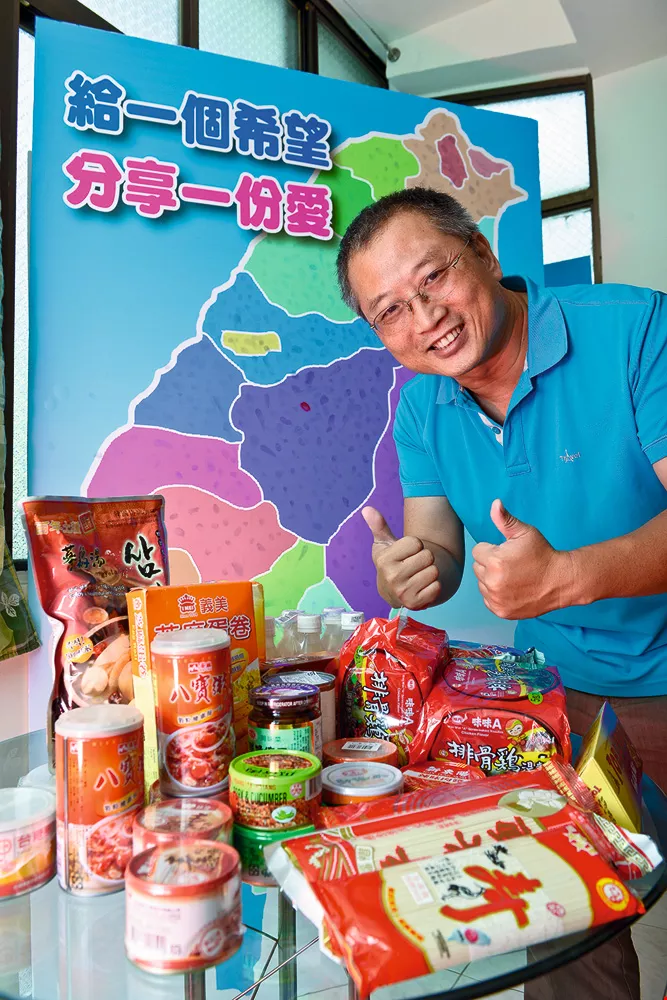
Philip Chen, a Christian minister, has brought the US food bank model into Taiwan and founded the Taiwan People’s Food Bank Association, which is now a member of the Global Foodbanking Network.
Philip Chen is determined to do something about this. Chen was born in Taiwan but moved to the US at age 21 and lived there for more than two decades, becoming a Christian minister. Four years ago he returned to Taiwan and single-handedly founded the “Taiwan People’s Food Bank Association” (TPFBA), which he enrolled in the international non-profit organization “Global Foodbanking Network” as its 24th member.
While in the US, Chen participated as a volunteer in church, community, and state-level food banks, gaining hands-on experience in how they operate and getting a glimpse of how tightly knit and deeply rooted the material relief system is in the US. Then a few years ago, when he found out that there were people in Taiwan whose lives were so hard that they stole food, the thought came to him to import the US approach into Taiwan.
The history of the food bank can be traced back to 1967, when John van Hengel, a Catholic and charity volunteer, founded the first food bank in the world, called St. Mary’s (named after van Hengel’s parish church), in Arizona, USA. Working out of an abandoned building, he stored food “deposited” by donors, which could be “withdrawn” by those in need.
With support from the federal government, in 1975 St. Mary’s branched out to create 18 food banks across America. In 1976 van Hengel left St. Mary’s and founded “Second Harvest,” which eventually became a core element of the organization that in 2008 was renamed “Feeding America,” and is today the largest domestic US food bank network. Van Hengel, meanwhile, had left Second Harvest in 1983 to start the organization that has since evolved into the Global Foodbanking Network. Van Hengel’s leading role in launching all these organizations is remarkable indeed.
Let’s turn back to Taiwan. There are currently more than 20 organizations in the country engaged in charitable food distribution services (not all of which call themselves “food banks”). Some are religious groups or their affiliates, some secular social welfare organizations.
They share no uniform operating model. Some give out food coupons, some collect donations with which they buy food for distribution. But no matter what form they take, they all aim to reduce the burden that food expenditures place on beneficiary households. Families can then apply the money they save to their children’s education, insurance, medical expenses, and the like, so that they are not caught in a vice of conflicting choices.
So where does Philip Chen’s group fit in? The TPFBA is a “material” bank, collecting mainly canned and packaged food for redistribution. It gets more than 90% of its food from donations, most of them products whose expiry date is coming up within a few months.
Chen says that although the TPFBA accepts cash donations, it does not use these to buy any of the kinds of products that are most routinely donated, such as rice, noodles, canned food, and crackers. “The money should be reserved for things that no one donates,” such as crutches for the elderly, eyeglasses, diapers, and sanitary napkins.
“The real spirit of a food bank is not to buy food, but to find food that would have otherwise gone to waste and then distribute it to those who need it,” he explains.
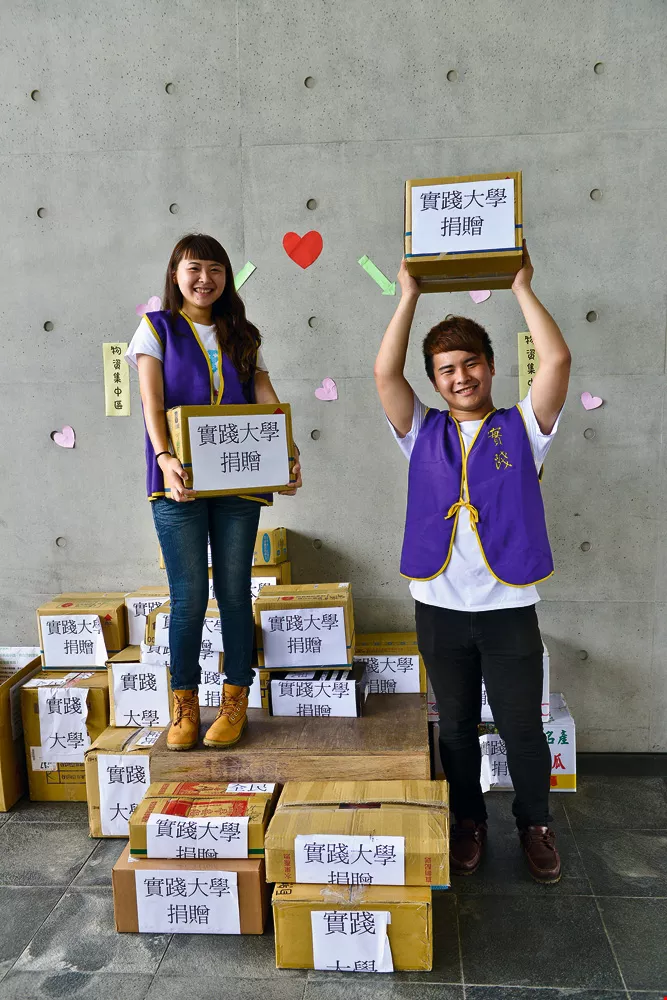
Shih Chien University offers courses related to food bank operations. For World Hunger Day (May 28), some students did a project to collect food items and distribute them to elderly people in the community.
But how much food actually goes to waste in the world?
A study called Global Food: Waste Not, Want Not, released in January of 2013 by the UK’s Institution of Mechanical Engineers, says that 30–50% of the world’s food is wasted in the production and marketing process. That’s the equivalent of 1.2 to 2 billion tons of food being thrown into the rubbish heap without even getting close to a dinner table.
In his book Waste: Uncovering the Global Food Scandal, Tristam Stuart notes that, in proportion to the country’s population, the UK wastes eight times more food than the US, with the consequence that 4 million poor British citizens have no stable access to food.
What’s the situation in Taiwan?
The Taiwan Fund for Children and Families estimated that in 2010 Taiwan wasted 2.75 million tons of food. If all of this could have been donated to charity, it would be enough to satisfy the needs of all 260,000 low-income households for 20 years!
The food bank master plan that Philip Chen envisions includes not only a “central bank” which will handle command and control, but “branches” in every community. Things like bread can be directly delivered to branches, thereby avoiding the losses that occur during shipment.
Recently six international students did volunteer internships at the TPFBA. Li Ziqi, a student from the Hong Kong University of Science and Technology, says that the items at Hong Kong food banks are almost all purchased, so she has learned a lot by being able to participate in a program where actual food is donated and then redistributed.
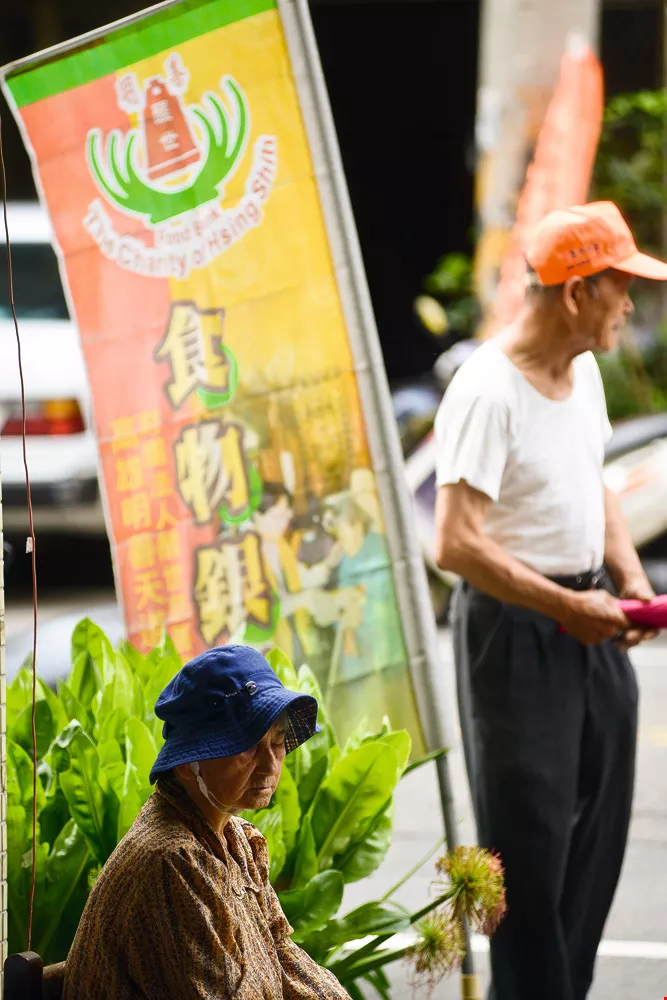
In the post-welfare-state era, food banks uphold the dignity of the economically disadvantaged.
The ideas and models of food banks that Chen brought back from the US are now being taught in schools and applied in student projects.
The Gerontology Research Center (GRC) in the College of Human Ecology at Shih Chien University offers a course in disaster-relief social services and resource utilization, with content that is similar in many ways to the collection, distribution, and command and control mechanisms used in food banks. The course is taught by Mandy Meng-fan Li, assistant professor in the Department of Family Studies and Child Development; she says that students are required to form teams and do practical projects, which have included management of community resources, mapping resource availability and distribution routes, and writing computer programs for a resources information platform.
Figuring out how to get people to donate is a whole field of learning in itself. Six first-year women students in the Department of Family Studies and Child Development taking Li’s class organized a food drive for World Hunger Day. Over a two-week period, they collected nearly 1000 food items, including powdered milk, crackers, and instant noodles. They read each and every label, screened out products past their expiry date, with no expiry date, or with damaged packaging, then delivered the rest to elderly people in need,
Philip Chen, meanwhile, cooperates with National Chiayi University in offering a course on “corporate ethics.” Associate Professor Tung Wei of the NCYU Department of Marketing and Logistics/Transportation relates that this is the first time that ideas like food banks and citizen responsibility have been brought into a business management program in Taiwan. The 120 students in the class spent a month on Chiayi’s streets and in its back alleys to investigate the living conditions of marginalized households, and then approached local shops and businesses for donations of materials.
Corporations are friends, not enemiesCorporations can donate in much larger volume than individuals, and provide a wider variety of products, so they fit better with the needs of food banks. However, because food involves health issues, in Taiwan if a recipient gets sick as a result of eating something from a charity then the donor will usually be held responsible. Therefore, many corporations that might otherwise be inclined to contribute decide it would be wiser not to.
Nonetheless a few companies are trying to do something to dispel this dismal atmosphere: Carrefour (Taiwan) and Kellogg’s (Taiwan) last year donated more than 10,000 boxes of muesli to public assistance, of which 6000 boxes went to the TPFBA. In addition, Carrefour Taiwan has, at various times, donated cornflakes, canned foods, powdered milk, adult diapers, and health foods. Seres Huang, executive officer at the Taiwan Carrefour Cultural and Educational Foundation, says that since the beginning of last year the company has donated NT$8 million in goods.
“The donation of foods that are about to reach expiry date is pretty new to Taiwan,” says TCCEF’s CEO, Winson Wu. “Companies don’t really understand a great deal about food banks, and few firms have had any contact with any.”
But in Europe and North America, many high-volume markets have long had partnership relations with food banks.
For example, as Tristam Stuart points out in his book Waste, in the US the three largest supermarket chains (Kroger, Safeway, and Supervalue) and the two largest hypermarts (Walmart and Target) all have long-term working relationships with food banks and donate tens of thousands of tons of products. In fact, Kroger is one of the founders of Feeding America and has a seat on its board of directors.
The French chain Carrefour has, since 2002, been making donations to the French Federation of Food Banks and also funding freezers and transportation. Carrefour’s annual report states that in 2011 the federation distributed nearly 90,000 metric tons of food, equivalent to 178 million meals, helping 740,000 persons.
Wu says that Carrefour stores in countries other than Taiwan have been cooperating with food banks for 10 years, and Carrefour Taiwan began thinking a couple of years ago about following their example, but they couldn’t find any suitable partners at the time. Then just last year the TPFBA formally became a member of the Global Foodbanking Network, creating the opportunity for the two parties to work together.
However, Winson Wu still worries that if management or process errors by food banks lead to problems with the donated products, donor companies are still likely to be saddled with the blame.
Make “good Samaritans” exempt“For this reason we support the passage of a special food bank law,” says Wu, stressing the importance of legal guarantees, “one that will exempt donor corporations from liability and allow tax deductions for donations, which of course will give businesses a great incentive to contribute.”
Taiwan is more than a decade behind Western countries in terms of food bank legislation. In October of 1996 then-US president Bill Clinton signed a “good Samaritan” food bank law that sets up incentives for individuals and businesses to donate food to non-profit organizations for the benefit of people in urgent need of assistance. The spirit of that law is that, so long as the act of donation is well-intentioned and there is no intent to cause harm, donors will be exempt from criminal or civil liability.
During the last few years, as prices have climbed while salaries have stagnated and there has been no clear turnaround in the unemployment situation, more and more people in Taiwan have been discussing the issue of food banks. Legislators who have taken note of the urgency of the need to adopt a local version of the “good Samaritan” law have held public hearings to get the opinions of groups that are seeking donations of food and other materials.
A draft food bank act, initiated by Democratic Progressive Party legislator Lin Chia-lung and so far co-sponsored by 34 legislators from both governing and opposition parties, has already gone to committee. Main points of the draft include the following: (1) If a problem with a donated item leads to infringement of a third party’s rights, a donor that did not act maliciously and was not grossly negligent will be exempt from both criminal and civil liability. (2) Companies can take tax deductions based on the market value of donated materials. (3) The central government will set up a national food bank information system. (4) Local health bureaus will actively offer food banks their assistance in conducting food hygiene and safety inspections of their products.
In response to advocates of a new law devoted specially to food banks, the Ministry of the Interior, which is the central government agency with jurisdiction over this field, is more inclined toward amending existing laws. Specifically, a new chapter on “payments in kind” could be added to the Public Assistance Act. (The drafting will be taken over by the new Ministry of Health and Welfare after July 23 of 2013.) Ahead of the draft being sent to the Legislative Yuan for deliberation, non-governmental groups are also urging that it should include more incentives for corporations to donate food.
Looking at the example of the US government’s decision in 1975 to give US$50,000 to St. Mary’s to set up 18 food banks nationwide, Philip Chen stresses, “Food banks should be a responsibility of the national government.” The state should provide legislative and financial support, and then can slowly withdraw once the food banks get their operations up to speed. Chen adds that at present the US subsidizes about 5–15% of food bank expenses, with the remainder of the money being raised by the charities themselves.
“Food banks have just taken their first steps in Taiwan,” says Philip Chen, “so this is the time to get all the legislation into place, rather than just make amendments helter-skelter when problems arise.” As Taiwan enters the post-welfare-state age, the poor and marginalized will increasingly need food sources they can depend on in a crunch—and you can take that to the bank.

@List.jpg?w=522&h=410&mode=crop&format=webp&quality=80)


@List.jpg?w=522&h=410&mode=crop&format=webp&quality=80)
@List.jpg?w=522&h=410&mode=crop&format=webp&quality=80)
