Back to the Future: Temples Rediscover a Role in Education
Liu Yingfeng / photos Jimmy Lin / tr. by Phil Newell
May 2014


Traditional temples, which had always just been places for the faithful to come and worship, are being turned into bastions of education and culture, bathed in an atmosphere of learning that can be intellectually stimulating, practical or just for fun. They are centers of faith that are also resurrecting local culture.
The Taijiang branch of Tainan Community University set the precedent back in 2007. Calling for a “return to village temples,” they began working hand in hand with major temples in Tainan’s rural communities to foster education. They are transforming the face of rural communities, which have long been bereft of joie de vivre because virtually all young people have left home to move to the cities.
Today, a three-in-one model of “temple classes” that combines faith, education, and community participation has the promise of bringing tremendous vitality to non-urban community colleges. In Tainan’s Taijiang area alone, 15 rural communities have gotten on board. The original idea came from former journalist Wu Maocheng, who was able to use his interpersonal networking expertise to break down rivalries and differences of opinion between villages.
As an example of what’s happening, when the famous author Hsiao Yeh came to lecture at one local temple, over 2000 people came to hear him. For a rural village, the vibe was as thrilling as a rock concert would be for urban kids!
Early one Wednesday morning, Chaohuang Temple in Haiwei, a village in the Annan District of Tainan City, is permeated by incense smoke. Pious believers come to burn incense and make their devotions, praying for tranquility and wellbeing. The chanting of sutras resonates through the temple’s main hall.
But off to the side of one of the enormous red pillars, in a small library, there are other books: dozens of world classics, such as One Hundred Years of Solitude. They lend a literary gloss to this century-old religious building. And when night falls, we are not only unexpectedly treated to the showing of an artsy documentary in the main courtyard, but even from the hall where the temple deities sit in state—deities who had only ever been treated to traditional religious music (suona woodwind instruments, gongs, cymbals)—the strains of an erhu playing the pop melody Rainy Night Flower come drifting out. At night, the LED signboard in front of Chaohuang proudly flashes the words “Temple Classes” in big, bright orange Chinese characters.
An entirely new model of relocating rural education to temples is unfolding before our very eyes!
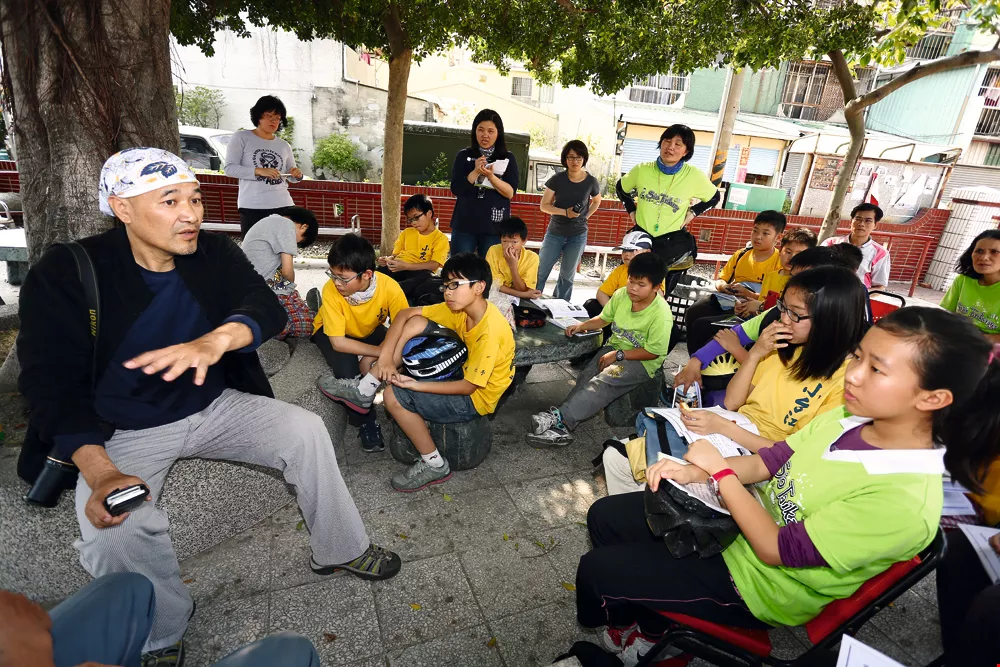
Wu Maocheng, executive director of TCU’s Taijiang branch, holds a class outdoors under a tree, waxing eloquent on the rich local history.
“Temples, which exist in every rural community across Taiwan, are like homegrown NGOs that have been around without fail for more than 400 years,” explains Wu Maocheng, now executive director of the Taijiang branch of Tainan Community University (TCU-T). “In the past, temples were local centers not only of faith, but also of traditional education and community participation.” With his head wrapped in a bandana and his feet shod in sandals, looking every bit the country boy, Wu says in his heartwarmingly authentic coastal Taiwanese, “Therefore they are a natural and perfect fit for the goal of helping community colleges extend their activities into rural villages and small towns.”
When Wu was a reporter, which was more than a decade ago now, when out on assignments he was often struck by the glaring gaps between city and country. He felt particularly acutely the absence of cultural and educational resources in rural Annan District, which many locals still prefer to call by its historical name, Taijiang. Since he was then already moonlighting as a lecturer at TCU, he lobbied the school’s executive director Lin Guanzhou to set up a branch campus in Taijiang.
At that time Wu’s proposal did not get an affirmative nod. It was only in 2007, when he left the media and again pitched his idea to Lin, that the moment had arrived.
Back in 1661, when there was still an enormous natural harbor in Taijiang, this was where Ming Dynasty loyalist Zheng Chenggong came ashore in Taiwan and retook the island from the Dutch, hoping to use it as a base to combat the Qing Dynasty. It’s a very historic area. But as a result of the rerouting of the Zengwen River, the harbor got filled in. However, the soil of this reclaimed land was not suitable for agriculture, so the early residents had to scratch out a bare existence from the sea.
With its small, scattered population and almost complete lack of cultural and educational resources, Taijiang did not exactly look like a promising place to launch an intellectual venture like community college classes. But Wu, who grew up in Haiwei Village in Taijiang, thought to himself that the idea could work if he drew on the help of influential and omnipresent local temples.
Serendipitously, Chaohuang Temple chairman Wu Jinchi was also thinking about promoting education. The two hit it off instantly, and the first-ever model of “temple classes”—community college courses and activities being held in temple precincts—came to fruition in Taijiang.
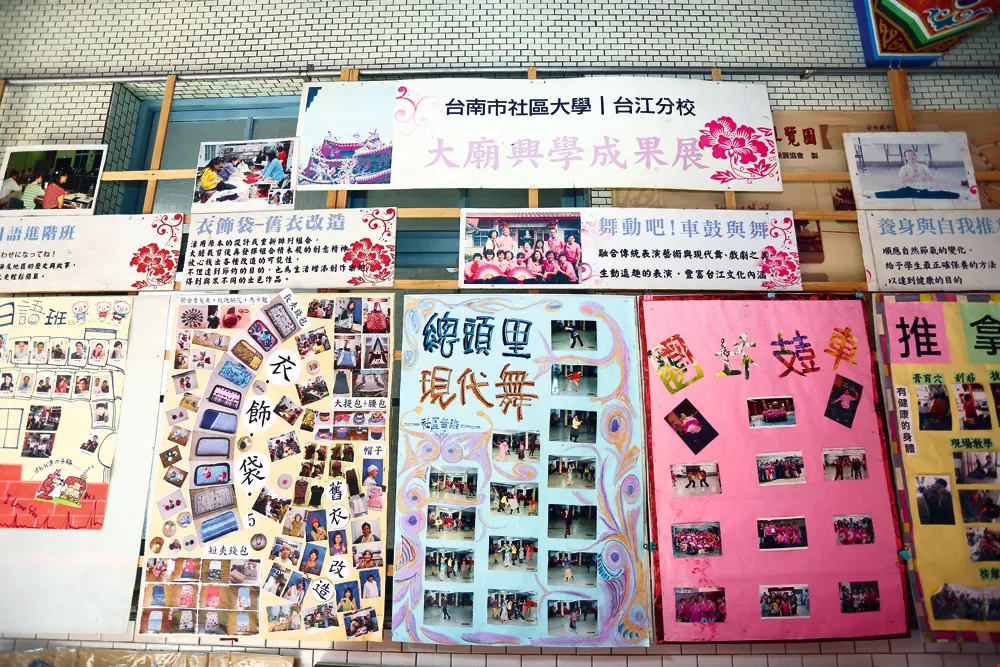
In the seven years since it was founded, the Taijiang branch of Tainan Community University has grown from offering just a few classes to over 40 today, imbuing the village of Haiwei with a sense of fun and practical learning.
When the actual organizational work began, Wu Maocheng insisted that there be genuine give and take between TCU-T and the temple, and that the views of all interested parties be taken into account. In fact, it was decided that Wu Jinchi should take charge of initial curriculum design, with TCU-T stepping back to the “second line” to play a supporting role. Wu Jinchi’s first thought was to choose material that would be attractive to local residents. Before beginning classes, he surveyed the ages of people coming to the temple to worship (mainly elderly), and, incorporating the belief that the main temple god Baosheng Dadi is a deity who answers prayers related to curing the sick, Wu decided to offer a course in herbal medicine.
The response was terrific, and the class was packed. It led in turn to the formation of an herbal medicine club, whose members not only continued studying plant-based remedies but also founded a local “production and marketing group” (PMG) to organically cultivate plants with medicinal properties (for use in aquaculture ponds). The PMG proved to be a real shot in the arm for the local economy.
TCU-T also began promoting cultural activities and fun-filled courses for adults and children that could fit in one way or another with local temple beliefs and, especially, celebratory ceremonies. In this way local people could be brought to renew their familiarity with temple lore and cultural practices. These days, local temple festivals include not only the traditional performance troupes and deities “making the rounds” on their palanquins, but you might even see some belly dancing or hear some erhu tunes. To rural people, there is nothing disrespectful about this kind of fun, and the result is a “Taiwanese-style Mardi Gras” that combines tradition with modernity.
In 2011, TCU-T invited the renowned author Hsiao Yeh to lecture at Chaohuang Temple, and the temple courtyard was jam-packed for the occasion. Wu says that for city folk, who are swimming in lectures, art exhibitions, and the like, having authors make public addresses is routine. But for the people of Taijiang, where cultural events are few and far between, “This was the biggest thing to hit town that anyone could ever remember!”
Community hubAs part of its “community” function, Chaohuang Temple has even “crossed religious borders” to cooperate with the Catholic Tobias Social Welfare Foundation. They are encouraging students in the TCU-T beauty care class to apply what they learn to giving the hard-working moms of mentally challenged children a makeover; it won’t solve their core problems, but they will feel better about themselves and be able to enjoy having someone else pamper them for a change. “In traditional culture and religion, the emphasis was on ‘merit’ earned by doing good individual deeds; now this is being transformed into a broader sense of ‘community service,’” explains Wu Maocheng.
TCU-T has also helped in organizing local Taijiang residents to get involved in river protection and cultural revitalization movements. Wu notes that back in 2004 the government suddenly declared that the National Museum of Taiwan History, which was originally going to be built in Taijiang, would instead be located in Tainan’s Anping District, because—and this was the kicker—the Taijiang area “lacked culture.” Ouch. The notion that they lacked culture was a provocation to the sense of dignity of many local residents, and inspired people to work together. Members of the TCU-T class on “popular customs and culture” and members of the Temple Education Volunteer Team began visiting temples all over the Taijiang area, recording the stories and cultural life of each community, and working collectively to deepen local education. (In the end, the museum was built in Annan District after all.)
In 2004, Wu Maocheng noticed that the Jianan Irrigation Canal had become polluted, so he organized some children from local primary schools to create the “Taijiang River Patrol.” He urged the students to care for their land and environment, and to report pollution conditions in the river whenever they came across any problems. Today, the patrol’s activities have been coordinated with classes at TCU-T to create a river monitoring network.
The number of classes being offered by TCU-T has expanded from single digits in the early days to over 40 at present, and there are also four clubs: the erhu club, a chegu performance troupe, the herbal medicine club, and the aforementioned Temple Education Volunteer Team. The number of students has risen from 40–50 in the first days to 1200, and the project has injected a whole new ambience of refinement and culture into Haiwei.
Franchise modelOver time, 15 major temples in the Taijiang area have joined the program, forming the Temple Education Alliance. “The alliance is like an educational network, with Chaohuang Temple as the headquarters and the other temples as our ‘franchise outlets,’” say Wu Jinchi.
As a result of all this, Taijiang has become a focus of attention for community colleges and local activists all over Taiwan. Representatives of temples in Yilan, Miaoli and Yunlin have made visits to learn about the Taijiang model, and even officials from international NGOs have come here to observe and exchange views.
Wu Maocheng waxes modest about all this success. He says that temples were always multifunctional centers of education, faith, and collective community life, except that somehow this was forgotten as modernity has advanced, and temples even came to be grossly stereotyped as hangouts for unsavory characters. “All we have done here,” he says, “is to restore to temples their pre-existing innate functions.”
Wu believes that the temple-class model can even be extended to address the problem of figuring out ways to attract young people back to rural communities to work. He explains, “Education in Taiwan is structured in such a way that all the incentives are for moving away from villages and small towns. Labor and intelligence gravitate to the cities, but there is no countervailing path laid out that will bring any of those people back home.” If the temple education model can spread and flourish throughout Taiwan, young people will have a reason and an opportunity to come back and do something constructive for their hometowns.
“If the major temples in all of Taiwan’s 319 townships and rural districts can get involved in promoting education,” Wu argues, “a local point of view, unique to each area, will emerge, and the localities will become a source of power that will change Taiwan.” As the torch of temple classes is passed along, a new road is being paved that puts a U-turn in the traditional educational track.


@List.jpg?w=522&h=410&mode=crop&format=webp&quality=80)
@List.jpg?w=522&h=410&mode=crop&format=webp&quality=80)
