Soothing the Savaged Breast:Breast Reconstruction Surgery in Taiwan
Chang Chiung-fang / photos Chin Hung-hao / tr. by Phil Newell
July 2013


In a story that stunned people in all walks of life, the 38-year-old US film star Angelina Jolie, who has a beautiful figure that she can rightly be proud of, voluntarily had a double mastectomy—surgery to remove both her breasts. She did so as a prophylactic measure, because she carries a genetic mutation in the BRCA1 gene that is associated with an 87% chance of breast cancer.
Some have praised her courage, others have called her overly defensive. But leaving aside for the moment considerations of timing and necessity, one fact is certain: one of the most important factors underlying her decision for a preemptive mastectomy is that today techniques of breast reconstruction surgery are highly advanced.
Which brings us around to Taiwan. It is not a widely known fact, but doctors in Taiwan are employing very advanced breast reconstruction techniques, not only using prosthetic material but also transplanting living tissue from the patient’s own body. The option of reconstructive surgery can lift an enormous dark cloud from over a victim of breast cancer, allowing her to live a full and confident life.
At the end of May, a dance troupe organized by the Taiwan Breast Reconstruction Association, having just returned to Taiwan after staging a performance in Beijing, was invited to appear on mainland China’s “China Central Television” (CCTV), performing a spellbinding number in the style of ancient India. You would never guess that every one of the dancers—with their revealing necklines, exposed bellies, well-proportioned figures, and graceful postures—is a long-term survivor of breast cancer. Their reconstructions complete, their surgical scars fading, they face the world with smiles on their faces….
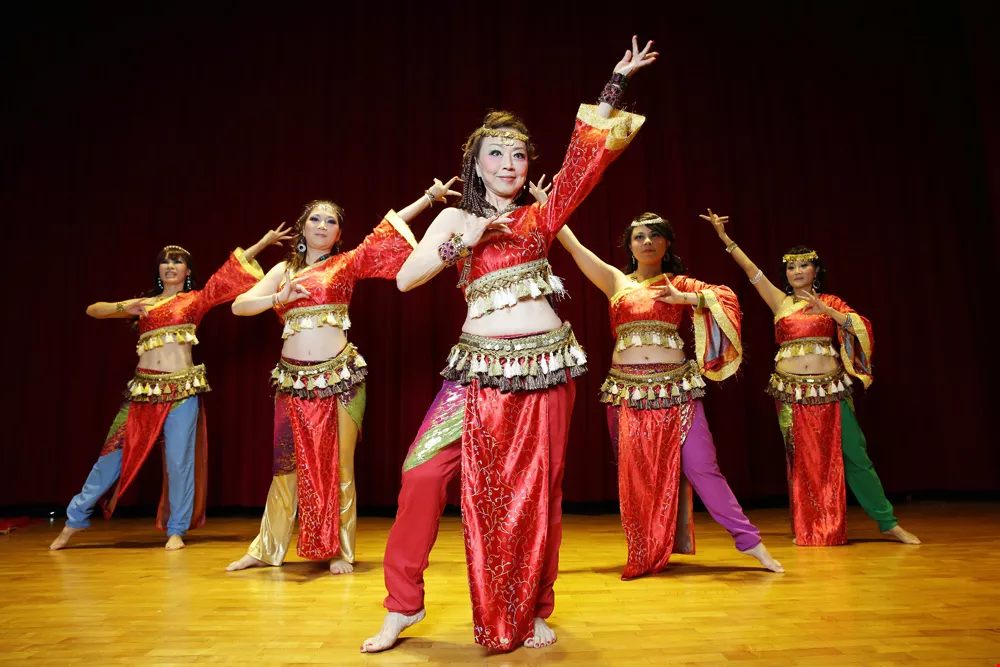
It takes a lot of confidence in one’s appearance to perform on stage in a revealing costume. Luo Lirong, pictured here, still boasts a handsome figure and graceful movements. You’d never guess she is 77 years old.
Breast cancer is the number one form of cancer among women in Taiwan, and in recent years there has been a sharp increase in the number of new cases diagnosed as well as a decline in the average age of victims. According to the Bureau of Health Promotion of the Department of Health, in 2010 the incidence of breast cancer was 63.16 per 100,000 persons. Each year over 14,000 new cases are diagnosed.
The silver lining here is that although breast cancer is the cancer that occurs with the highest frequency in women, it is also the one with the highest survival rate. Today more than 90% of patients live at least five years after being diagnosed. But breast cancer is more tragic than other cancers in that it affects an organ that is visible externally, and when that organ is removed, there is a very negative impact on the person’s appearance. Therefore, even when the patient survives, tremendous damage has been done both physically and psychologically.
When Yang Jie, 38 this year, was diagnosed with breast cancer five years ago and was told she had to have a radical mastectomy, she burst into tears. “I wasn’t crying because I had cancer, I was crying because I was going to lose my breast.” Yang, a beautician by profession, declared, “If I were given a choice as to what cancer to get, I would never ever have chosen breast cancer, because I felt that without my breasts life wasn’t worth living.”
Heartache is an inevitable part of the process that breast cancer patients suffer through.
Luo Lirong, who at 77 still has a handsome figure, wore a prosthetic breast for a decade after having a mastectomy at age 54. “Putting the silicon prosthetic under my dress, no one would ever know that I was missing a breast. But I couldn’t avoid seeing the disfigurement every day in the shower, and it was like having a nail driven into my heart.”
Luo finally underwent reconstructive surgery at age 63. The impetus for doing so, she explains, came when her mother-in-law passed away.
“For the funeral, I brought some clothes to the funeral home for the body to be dressed in. As my mother-in-law was being wheeled out of the freezer, her body fully exposed, I thought to myself that when my day came, with one breast gone I would look undignified,” she says, adding, “I want to go out of this world the same way I came into it.”
“I think every person, somewhere deep in their soul, wants to have an intact shell,” says Lin Wei-chieh, secretary-general of the Taiwan Breast Cancer Alliance. The high survival rate for breast cancer means that once people realize they have a good chance of living a long time, they naturally turn their thoughts to quality of life, and fortunately for people today, breast reconstruction is a viable option.
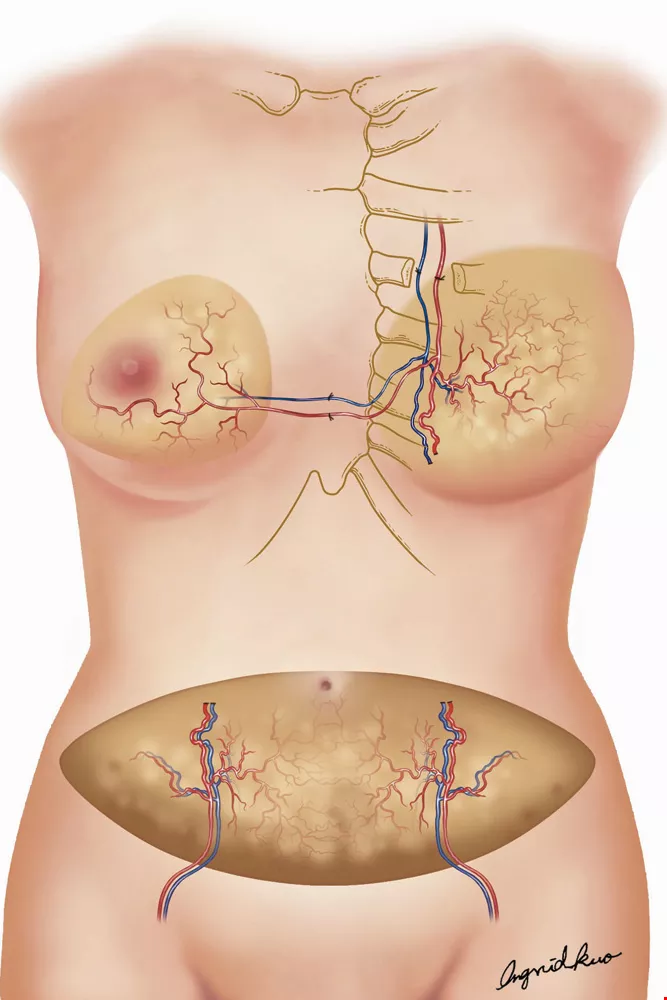
Using the deep inferior epigastric artery perforator (DIEP) flap method, fat and blood vessels are transplanted from the abdomen to the chest.
Mastectomies may be either “partial” or “complete” depending upon a number of factors, including the size and location of the tumor(s), the stage of the illness, and whether or not the cancer has metastasized to the lymph nodes.
Breast reconstruction surgery also is divided into two types: immediate (called “primary” by doctors) and delayed.
The immediate type is done at the same time as the mastectomy. For the patient, this eliminates the trauma the body would suffer from undergoing another surgery, as well as the cost of a second operation. But this type of immediate reconstruction is only possible for people whose cancer is in an early stage (zero, one, or 2A) and who therefore do not need follow-up chemo- or radiation therapy.
For patients in stage 2B or 3, doctors won’t do a reconstruction until the patient has completed follow-up therapy. The reason is that during follow-up therapy there will be shrinkage of 20–50% in both the healthy remaining breast as well as in the reconstructed breast. Doing the reconstruction later ensures that the outcome of the surgery will be stable.
Of course, in days gone by, as National Taiwan University Hospital Breast Center director Tang Yueh-bih points out, there was almost no reconstructive surgery at all, much less the possibility of “immediate reconstruction.” Victims hoped merely to be spared a relapse of the cancer; few indulged in the luxury of worrying about their appearance. But today, many of the survivors from those years are also opting for reconstructive surgery. This is because over the long term, losing a breast takes a severe psychological toll and may also cause spinal deformation because the body is out of balance. Most patients, after surviving several years problem-free without a relapse, begin thinking about breast reconstruction.
With the passage of time, there have been many advances in breast reconstruction techniques. Not only can the reconstructed breast’s appearance be made virtually indistinguishable from a natural one, side effects have also been reduced. Moreover, in cases where only one breast is affected by cancer, it is now even possible to have the surgeon make purely aesthetic adjustments to the unaffected breast “while they happen to be passing through.” Tang Yueh-bih says that only about 10% of women have a breast shape that, proportional to their bodies, would be considered “perfect,” but today patients can kill two birds with one stone.
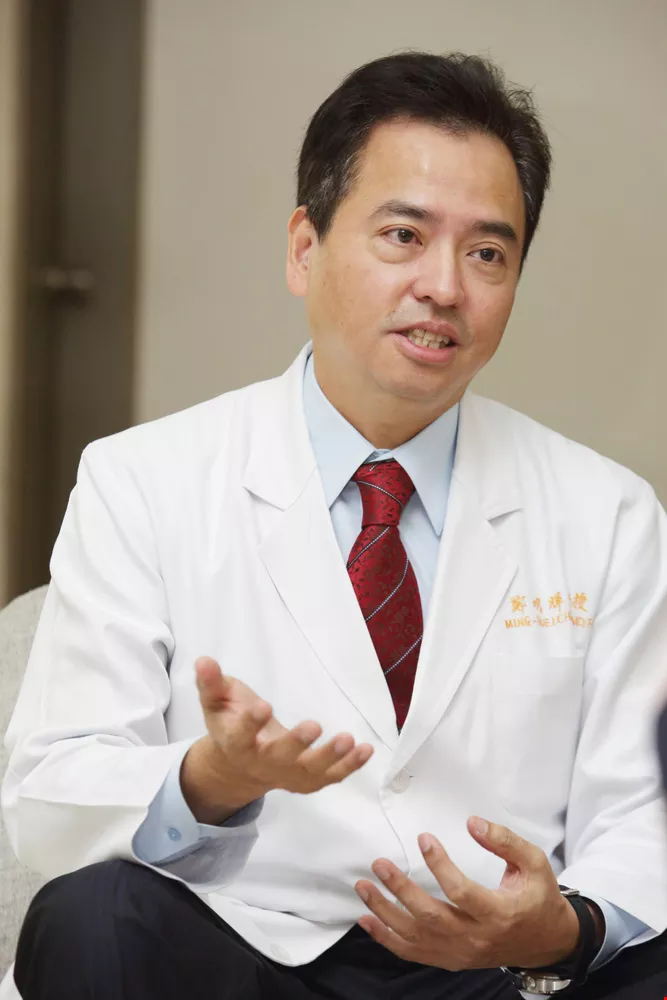
Dr. Cheng Ming-huei of Chang Gung Memorial Hospital in Linkou is a world leader in breast reconstruction techniques.
Breast reconstruction is divided into two types. The first is implantation of prosthetic material. The second is transplantation of tissue from elsewhere in the patient’s body (“autologous tissue”), with several variants depending upon the source of the transplanted tissue. Is any one option better than the others?
“By no means is the same approach suitable for every patient,” says Tang Yueh-bih. Breast reconstruction must take into account the “7S” factors: size, scarring, shape, softness, symmetry, silhouette, and simulation of the nipple-aureole complex. It is necessary to weigh the unique situation of each patient, and design a reconstruction approach tailored to the individual.
Implantation of prosthetic material is the simpler method. It only takes about an hour of surgery to implant a saline water bag or silicone gel. Moreover, this method is cheaper and doesn’t require scarring any other part of the body. But there are quite a few drawbacks as well: possible rupture of the implant, capsular contraction, infection, hematoma, and lacking the texture and flexibility of a natural breast.
As for reconstruction using autologous tissue, the tissue can come from several different places in the body, including the back, buttocks, thigh, or abdomen. Scientific names include the latissimus dorsi flap, pedicle transverse rectus abdominis myocutaneous flap, deep inferior epigastric artery perforator (DIEP) flap, and superior gluteal artery perforator flap. Each source area has different pros and cons.
Early on, autologous tissue transplants were mostly done using the latissimus dorsi, borrowing tissue from the muscle in the back that controls shoulder movement. This technique has always enjoyed a high success rate and rapid patient recovery. But because there is not much excess material in the latissimus dorsi, removing it leaves the patient subject to reduced shoulder mobility, while the reconstructed breast is less soft to the touch and more likely to contract in size due to inadequate blood supply.
Professor Cheng Ming-huei, chief of the Division of Reconstructive Microsurgery in the Department of Plastic and Reconstructive Surgery at Linkou Chang Gung Memorial Hospital, says that at present the method that “entails the fewest costs and offers the greatest returns” is the DIEP flap approach. Cheng, one of the world’s leading breast reconstruction specialists, has published 32 papers on the subject in international journals and conducted nearly 1000 procedures, of which 464 have been done using the DIEP flap method, with a success rate of 98%.
The DIEP flap method entails removing a layer of adipose tissue (fat) roughly 12 x 30 centimeters in size from the abdomen, along with the skin and the blood vessels, and transplanting this material into the chest area. Microsurgical techniques are then used to connect the blood vessels with the intermammary artery, so that the transplanted material survives as living tissue.
Cheng says that it used to be the case that abdominal muscle was transplanted along with the adipose tissue. But this often led to side effects like hernia and weakness in the abdominal region. Today, only the fat is taken, while the muscle is left behind.
It’s especially exciting that the reconstructed breast is “alive.” It has a natural shape and the same feel to the touch as a real breast, and when the nerves grow in after about half a year, there is sensitivity in the breast as well. And as an added bonus, you get a smaller tummy without having to do any dieting or exercise!
It is worth adding here that Cheng has drawn on his tremendous surgical skills to invent his own nipple reconstruction technique. He takes a centimeter of cartilage from the patient’s third rib and inserts it under the skin. About half a year later he then refines it into an upside-down T shape to serve as a nipple. Finally, he injects colors into the skin—using tattooing skills he learned especially for this purpose—to create a natural-looking nipple and aureole.
The third optionBreast reconstruction techniques are getting more sophisticated every day. But still many patients—because of financial considerations, a risk-averse mindset, or fear of pain—are not willing to go through a second reconstructive surgery after the initial mastectomy.
Lin Wei-chieh of the Taiwan Breast Cancer Alliance prefers to wear a prosthetic breast rather than undergo reconstructive surgery. “A lot of doctors skip over the part about how much it hurts,” says Lin. Of course everyone would like to look perfect, but she just doesn’t have the courage to go through the pain of surgery again.
In some cases, where enough of the breast can be saved so that there is no need for a full-scale breast reconstruction, it is possible for the surgeon to do a cosmetic procedure at the same time as removing the tumor, to leave the breast with a reasonably natural appearance after surgery.
Hsieh Chia-ming, head of a task force at Taiwan Adventist Hospital specializing in breast cancer, notes that in the past when doctors were able to remove a tumor while conserving most of the breast, the breast was left misshapen. In recent years he has borrowed techniques previously used for cosmetic breast surgery to shift remaining tissue in the affected breast around so as to leave the individual with a more balanced and more natural appearance. Hsieh has used this procedure in 130 cases in recent years, and patients have expressed a high level of satisfaction.
However, Hsieh reiterates that this method is only for certain types of cases. Candidates must be in the early stages of the disease, with only a single tumor or closely neighboring tumors. Also, the patient must have sufficient breast density, and the tumor(s) cannot amount to more than 20% of the breast tissue by volume. Otherwise the procedure will not be very effective.
The joy of restitutionAccording to a report based on a 2005 survey conducted by the Taiwan Breast Cancer Alliance, more than 90% of respondents were aware that the option to have reconstructive surgery existed. But only about 5.6% had chosen at that point to have the procedure, a much lower percentage than in the US (25–30%). The most important reason is probably that breast reconstruction is not covered by National Health Insurance in Taiwan, so must be paid for out of pocket. Not many people can afford the NT$200–300,000 that the surgery costs.
Cheng Ming-huei says that in the US, breast reconstruction is considered to be part of the treatment of the cancer, and in fact, under a 1998 federal law, insurance coverage is mandatory. In recent years, thanks in part to efforts by the Taiwan Breast Reconstruction Association to promote the procedure, the ratio in Taiwan has been gradually climbing. For example, today over 10% of women admitted to Chang Gung Memorial Hospital for breast cancer treatment opt for reconstructive surgery.
Besides cost, another critical variable is family attitudes. Sometimes families feel that it is unimportant for an older woman to retain this “secondary sexual characteristic.” But Hsieh points out, “No matter how old you get you are still a woman.” Unfortunately children who make treatment decisions on behalf of elderly women rarely can understand what it feels like for their mother, for whom the loss of a breast is “mourned.”
“Family support is very important,” says 46-year-old breast cancer patient Liu Fengyu. For a while after her surgery she was deeply depressed and wouldn’t even go out of the house, until her husband finally told her: “Whatever you think is best, go for it!”
Liu recalls: “The first time I looked in a mirror and saw my reconstructed cleavage, I began to feel happy from somewhere deep inside, and I just couldn’t stop smiling!” Her husband and friends also noticed how upbeat she became after the reconstructive surgery.
Chen Wenjuan, a past director of the Taiwan Breast Reconstruction Association, says that just having reconstruction as an option gives hope to patients, helping them summon up the courage to face a mastectomy, and to cope with all the follow-up treatment. The knowledge that they could be restored to their original appearance is what saves them from being “haunted” by their illness.
Septuagenarian Luo Lirong, in the vanguard of women who have had breast reconstruction surgery, says: “I hope that all women who have lost a breast will one day be able to enjoy the pleasure of ‘restitution’!”


@List.jpg?w=522&h=410&mode=crop&format=webp&quality=80)


