A Beacon for Sustainability:
The National Museum of Marine Science and Technology
Lynn Su / photos by Lin Min-hsuan / tr. by Phil Newell
August 2025
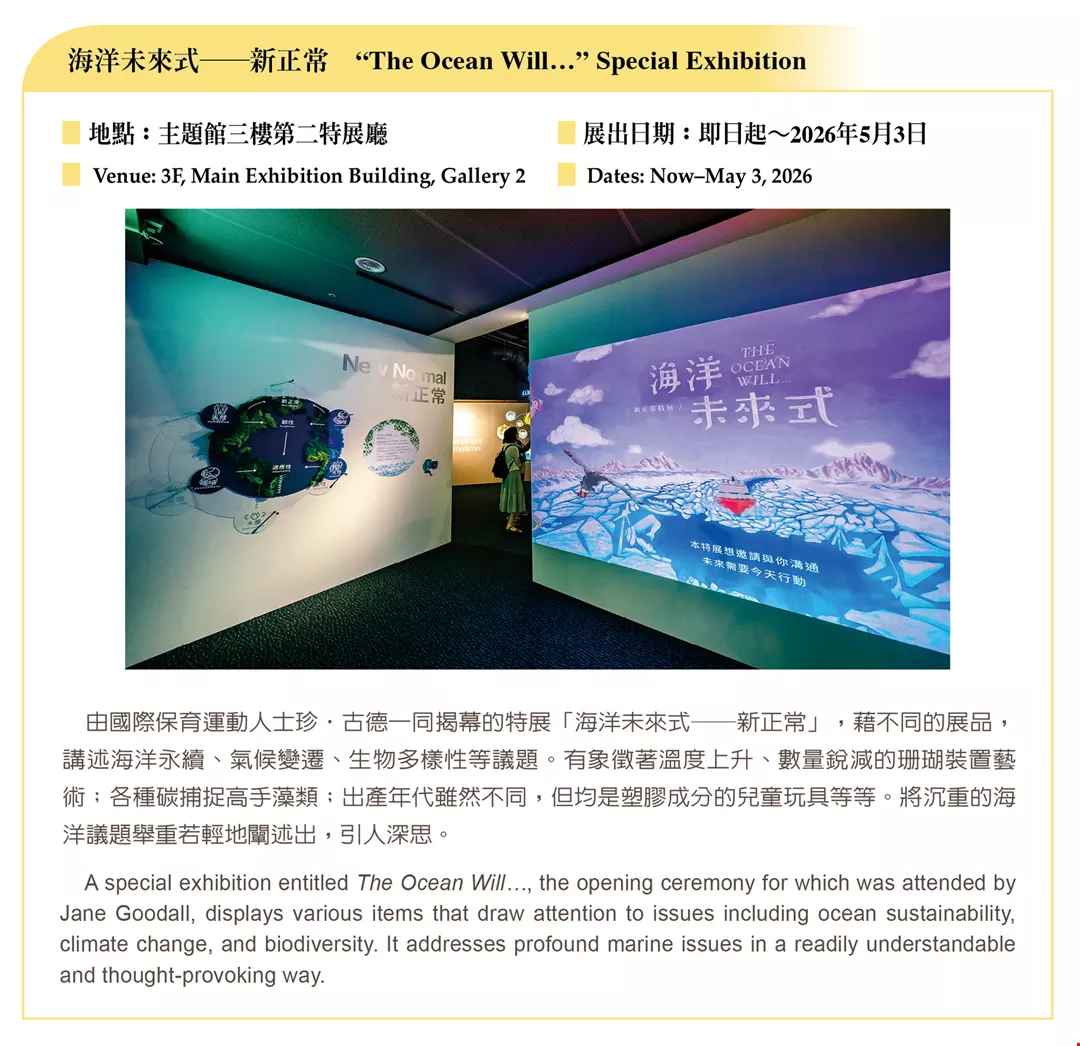
It’s always busy at the National Museum of Marine Science and Technology, located on the coast at Badouzi in Keelung. The NMMST was the first stop made by renowned conservationist Jane Goodall on her most recent visit to Taiwan, and the venue for the premiere of Shipwrecks Taiwan, a documentary directed by Tim Lee.
The museum has always attracted crowds for both its permanent and special exhibitions. Its Senior Learning Center has organized a band of elderly people whose members play jazz on instruments made from marine debris. There is also a team of guides who lead kindergarten children on outdoor learning sessions at the NMMST, using the entire campus as an educational venue.
The nearby outdoor Eco Park, giant nautilus shell, and “flying broomsticks” public art work have become photography hotspots, while the Wanghaixiang Chaojing Bay Conservation Area attracts large groups of divers with its rich undersea ecology.
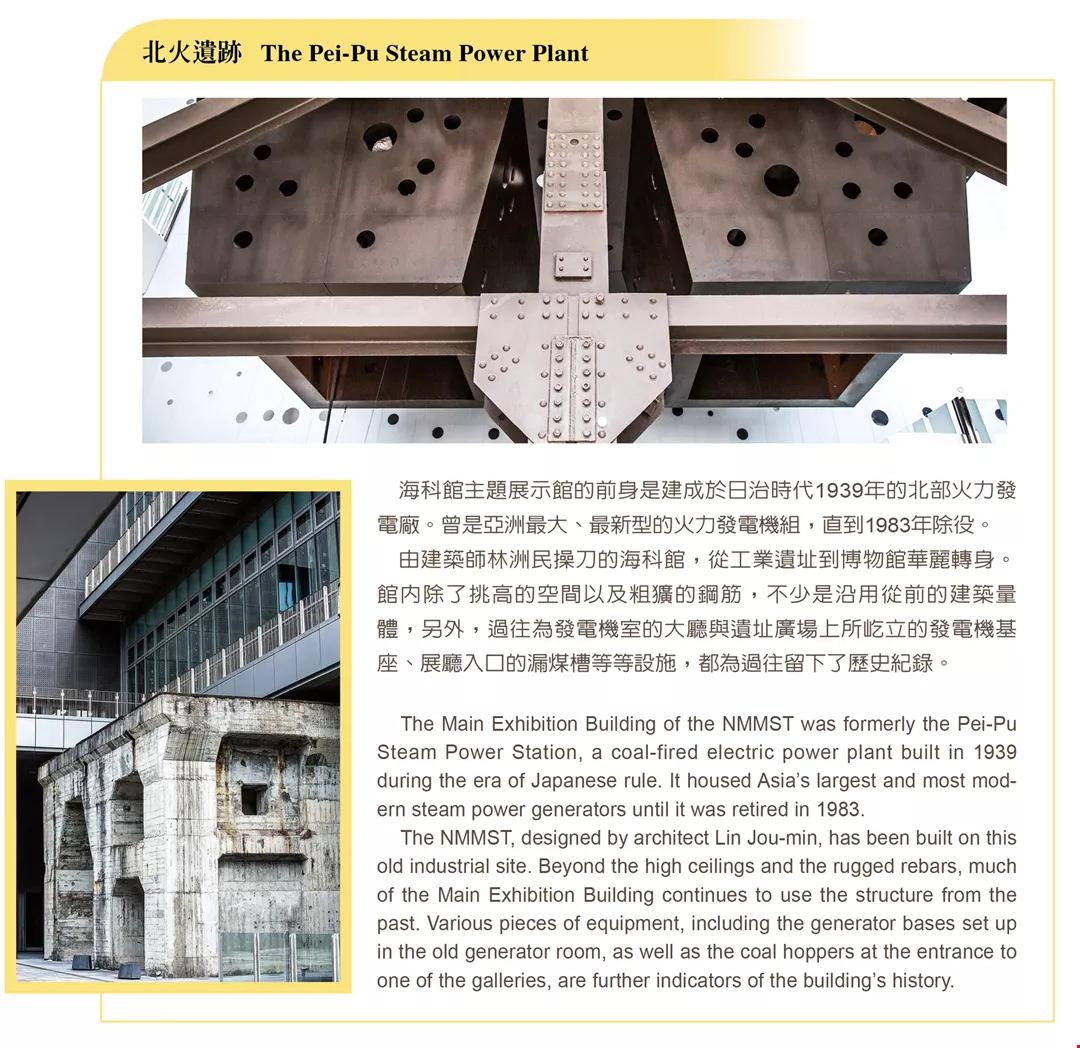
Does anybody remember how before the National Museum of Marine Science and Technology (NMMST) opened at Badouzi, the place was a decrepit fishing village located next to a garbage dump and an abandoned coal-fired power station?
Museum on a trash heap
The starting point of the NMMST was the Chaojing Aquaculture Station, completed in 2003 (the predecessor to today’s Chaojing Ocean Center and the Chaojing Intelligent Ocean aquarium). Shih Tung-wei, head of the NMMST’s Industry–Academy and Cooperation Division, is a veteran figure at the museum, having been involved since the planning stage. He recalls that back in the day the future site of the Chaojing Ocean Center had been a sewage sludge treatment facility.
While holding explanatory meetings about the museum’s construction, the planning team discovered that local people who were forced to coexist with trash had many complaints for the government. Although the museum organizers were working on behalf of the NMMST and had no power over the disposition of the garbage, they decided to do what they could to beautify and greenify the place. Shih says: “This mountain of waste became the site of the museum’s permanent outdoor exhibition, making it an outlier even from a global perspective.”
In addition, besides promoting environmental sustainability, they also recruited diving instructors and volunteers to help clean up the beach and seafloor. Having cleaned up the trash and abandoned fishing nets accumulated over many years, they used artificial breeding to raise and release clownfish and to propagate and transplant coral.
Facing concerns about seepage from the garbage dump leaking into the sea, they used a water intake pipeline remaining from the old sludge treatment facility to draw seawater with which to raise marine creatures and monitor their health over time. Unlike difficult-to-interpret scientific data, this visible evidence “finally put the minds of the local fisherfolk at ease,” says Shih.
Fortunately, to date there has been no negative impact on the survival rate of aquatic life, and numerous sea creatures have lived for more than 20 years. “Every aquarium has its star species, and for us here all those that live for a long time are star species,” says Shih playfully. This outcome has alleviated residents’ concerns and eased tensions between them and the government.
.jpg?w=1080&mode=crop&format=webp&quality=80)
To understand the environmental impact of seepage from the now sealed garbage dump at the site of the NMMST, the museum draws seawater and uses it to raise marine species under long-term observation. The photos show creatures raised at the Chaojing Ocean Center, including a yellow tang fish (at right in the photo below, raised for 22 years so far), clownfish (right), and a pig-nosed turtle (above), the last listed as an endangered species by the IUCN.
.jpg?w=1080&mode=crop&format=webp&quality=80)
Shih Tung-wei, head of the Industry–Academy and Cooperation Division at the National Museum of Marine Science and Technology, has been involved in the museum since the planning stage.
.jpg?w=1080&mode=crop&format=webp&quality=80)
The “flying broomsticks” public art work at the Eco Park has become a popular place for photographs.
A community-centered museum
It is no exaggeration to say that the NMMST, despite being a national-level institution, has been setting down firm roots in the local community since the start. Set between sea and mountains on an outstanding 54-hectare site, the museum is a complex of buildings scattered amongst the community, without walls and interspersed with many private residences. This has become a defining feature of the museum.
When we move on to the Main Exhibition Building to interview museum director Wang Ming-yuan, from his office we can see the nearby Changtanli Fishing Harbor, filled with fishing boats. The Bisha and Badouzi fishing ports are also close at hand. Wang, who only took up his post in March of 2025, already understands well that the close relationship with the local community is a special feature of the NMMST. He was deeply impressed by the fact that, “In my first week in office, I was visited by six neighborhood chiefs from within the museum campus.”
Looking back, during the early planning stage, the NMMST organizers responded to feedback from local people and specially set up a Regional Exploration Building on the campus. Based on the Badouzi community, it introduces local natural and cultural sites.
The most moving aspect of the building is the stories shared by local people in videos. These include personal reminiscences by the Badouzi-born writer Wang Tuoh and a reading by Changtanli fishing boat captain/poet Lin Fuyin of his own verse: “Thinking back… / Golden-green waves in the bay / Lobster and abalone in fray / Fish rise at dawn and dusk / This is what a true fishing village looks like.”
As marine resources have gradually declined, the once-busy fishing villages and even hazardous sites like the abandoned power station and the garbage dump have been transformed into the national-level museum that we can all feel proud of today. The NMMST not only creates jobs locally, it brings together the capabilities of various organizations including National Taiwan Ocean University, fishing harbors, fishermen’s associations, and the Fisheries Research Institute, becoming a focal point of local cohesion.
.jpg?w=1080&mode=crop&format=webp&quality=80)
This year the celebrated conservationist Jane Goodall again visited Taiwan. The NMMST was her first stop after deplaning, and she planted a coral at the Chaojing Coral Conservation Center. (courtesy of NMMST)
.jpg?w=1080&mode=crop&format=webp&quality=80)
NMMST director Wang Ming-yuan, who only recently took office, already has a deep sense of the close relationship between the museum and the surrounding community.


.jpg?w=1080&mode=crop&format=webp&quality=80)
Restoring the “rainforests of the sea”
The Chaojing Intelligent Ocean (i OCEAN) aquarium, formerly part of the Chaojing Ocean Center, is one of the NMMST’s major attractions. In the foyer of i OCEAN, a large screen shows video from the seafloor of the Wanghaixiang Chaojing Bay Conservation Area, welcoming visitors to the undersea world. As we follow the suggested visitors’ route, well-known aquatic creatures—such as shark, stingray, jellyfish, spotted garden eel, clownfish, starfish, sea anemone, and brittle star—appear one by one along the way.
In the Chaojing Ocean Center, located on the first floor of a separate structure, there are tanks of marine life, including many rare species. These include a yellow tang that has been living in captivity here for 22 years; an albino alligator gar, nicknamed the “ghost rocket”; and a pig-nosed turtle, which is listed as endangered by the International Union for Conservation of Nature.
Moreover, in recent years the NMMST has been working with many non-governmental organizations to promote coral restoration. Here at the Chaojing Ocean Center one can see a coral restoration tank sponsored by YangMing Marine Transport Company. Coral reefs are the “rainforests of the sea” and a quarter of all ocean species rely on them for survival. They are essential for ocean sustainability.
Upstairs, there is the Chaojing Coral Conservation Center (CCCC), over 300 square meters in size and funded by the Delta Electronics Foundation. It has been a major focus of cross-disciplinary cooperation in recent years. At present, in keeping with the ecology of Northeastern Taiwan, the CCCC is growing about 3,000 coral fragments of more than ten species including plate corals, massive corals, and branching corals. Set out on their bases, the corals give the appearance of an underwater nursery. When each grows large enough to cover its base, it is ready to be transplanted into the sea.
Whether to see the miraculous transformation of a former “trash mountain” into part of the NMMST campus, or the revival of Wanghaixiang Bay, once choked with marine debris, into a protected area vibrant with life, students and scholars from Taiwan and abroad are welcome to come here to visit and learn.
Shih Tung-wei declares: “Coming here to understand our current environmental situation and how to deal with it in ways that ensure ecological sustainability is a fantastic experience.” Faced with a deteriorating environment, people worldwide need to figure out how to coexist sustainably with nature. In this regard, the NMMST is already leading the way.
.jpg?w=1080&mode=crop&format=webp&quality=80)
Members of the public play music using instruments made of marine debris. (courtesy of NMMST)
.jpg?w=1080&mode=crop&format=webp&quality=80)
The Chaojing Intelligent Ocean (i OCEAN) aquarium is home to many “star” oceanic species including shark, jellyfish, sea anemone, and spotted garden eel.
.jpg?w=1080&mode=crop&format=webp&quality=80)
Badouzi has been transformed by the NMMST, which has also raised the profile of Keelung as a whole.