Kou Chou Ching--Taiwan's Hip-Hop Ambassadors
Chang Shin-lun / photos courtesy of Kou Chou Ching / tr. by Geof Aberhart
November 2006


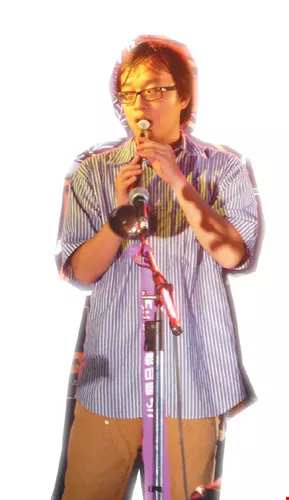
A group of young men clad in baseball caps and oversized T-shirts bob around excit-edly on stage, rapping in a mix of Taiwanese and Hakka, denouncing shoddy workmanship that threatens everyday people; mixed with their Western hip-hop rhythms lie elements of traditional songs, with occasional mournful strains of suona--Chinese oboe--music drifting out across the audience. The band's music is a unique mixture of traditional, modern, local, and foreign.
This is Kou Chou Ching, and it is one of those rare animals in the Taiwanese popular music scene--a hip hop group. Most of their tracks incorporate elements of traditional music, and their lyrics skewer current events to a rapturous response. They are icons for Taiwan's local brand of hip hop.
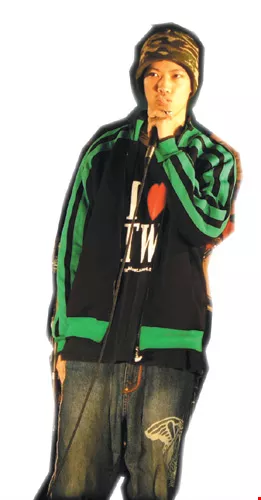
Formed in 2003, Kou Chou Ching is led by fishLIN and Fan Chiang; offstage the two are as quick of mind and word as their beats onstage, and while they may dress in a very Western fashion, they're still traditionalists at heart.
The two, who share writing and lyrical duties, first met during a freestyle rap battle on a basketball court on Taipei's Civic Boulevard. Freestyle battles are exercises in unrestrained improvisational creativity, like the scenes in Eminem's semi-autobiographical film 8 Mile. Generally a DJ first lays down a beat, and then the two competitors clash lyrical swords, occasionally engaging in themed "battles" to sharpen their rapping skills.
These two strangers soon realized they shared similar attitudes to music and decided to form a band, calling it Kou Chou Ching. The name is a pun: on the face of it, it is a reference to the agricultural proverb "plough in spring, weed in summer, harvest in autumn, store in winter," where the "harvest in autumn" in Mandarin is qiuqin. The boys chose to romanize this as "chou ching," adding the word "kou" (kao) in reference to the hacking action involved in harvesting rice, making their band name a paean to the hard work of farmers.
But when pronounced in Taiwanese, the name quickly drops its cultured pretensions, sounding like a particularly vulgar slang term for masturbation. In this name Fan Chiang and fishLIN found a perfect representation of their music's combination of seriousness and irreverence.
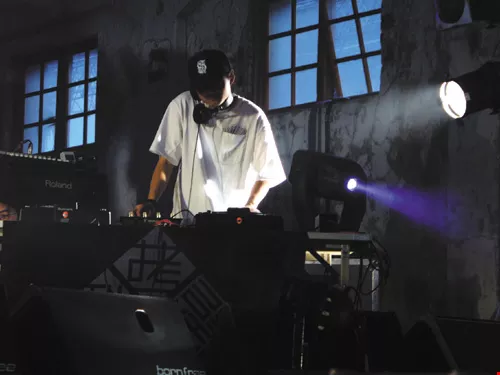
When the band first formed, Fan Chiang and fishLIN were the only two members. Last year they added three new members--DJ j.little, who handles the computers and is the band's turntablist, and Achino and Yobo, who play traditional Chinese instruments--but they only perform as a five-man band for bigger, more formal gigs.
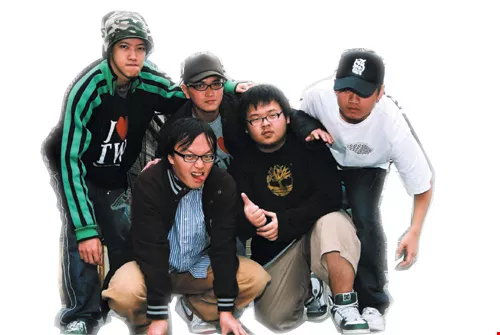
Fusing Western hip hop with Taiwanese traditional music, Kou Chou Ching are vocalists Fan Chiang (back left), fishLIN (back, second from left), instrumentalists Achino (squatting), and Yobo (third from left), and turntablist DJ j.little (fourth from left).
Musical enlightenment
Fan Chiang and fishLIN form the creative heart of Kou Chou Ching. Both were born in 1980, and both experienced similar formative experiences with music.
While they were still in junior high, when cable television was just beginning to sweep across Taiwan, MTV would screen a variety of shows on black music from America; these shows would play hip hop, rap, and R&B, which opened the two youngsters' eyes to the wider world of music. "I thought the music was awesome, but since all the tracks were in English, I never considered trying to emulate the singers," says fishLIN.
At the same time, a wave of hip-hop groups were being formed in Taiwan by American-born Chinese, such as LA Boyz, made up of Jeffrey Huang, his brother, and one of his cousins; and Jerry Lo's band The Party. These bands made a splash, but their distinctly Western style of music and lyrics still left local Taiwanese feeling distanced from them. Fan Chiang says that he would stumble his way along with the English lyrics, not entirely sure what he was actually saying, and never thinking that one day he would be able to use his own native tongue to create his own hip hop.
The hip-hop artist that both fishLIN and Fan Chiang feel has best demonstrated the success that can come from hard work is Taiwan's MC Hotdog. Now a major celebrity, Hotdog released his own EP in 2001 for NT$39, on which he rapped in Mandarin with lyrics that caustically attacked the flashy and superficial "idol singers" that saturated the market. This was the first time Fan Chiang, then a junior at college, had heard Western-style rap done with Chinese lyrics, and he would practice rapping along with the instrumental versions of two tracks on Hotdog's EP. "It was then I discovered I could actually rap, keeping perfect time with the beat."
Following MC Hotdog's debut have come the Southern Taiwanese act Dog-G, with his Taiwanese-language "Taiwan Song" and the "Funny Rap" series of albums from Chu Yue-hsin (also known as Joy Topper Jr.), which humorously attack and mock various social issues while mixing Mandarin, Taiwanese, and English lyrics in tracks with elements of hip hop, rock, and Taiwanese folk music. All of these have had a tremendous influence on Kou Chou Ching.
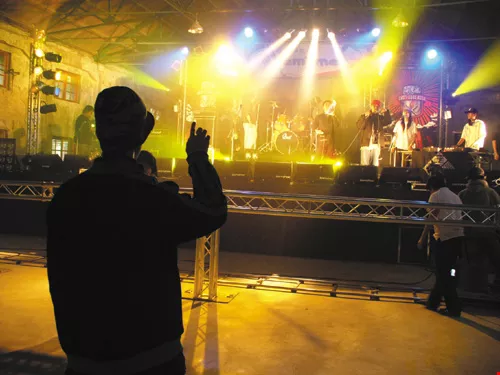
About Kou Chou Ching
Mother-tongue hip hop
In their final year at college, Fan Chiang and fishLIN decided to try their hands at writing tracks. Initially they wrote in Mandarin, but they soon realized that the four tones of Mandarin left their lyrics sounding too "flat" for hip-hop music, with its focus on vocal and tonal variation. The eight tones of Taiwanese and Hakka, however, gave their performances more flavor.
The two both believe that to overcome these tonal limitations, lyrics in Mandarin have to make up for it with unnecessary ornamentation, the lazy tones common in non-native pronunciation, or the over-emphasized patterns of dramatic performance. These give the language more tonal variation, but sound forced.
fishLIN's mother tongue is Taiwanese, and Fan Chiang's is Hakka, but the two both grew up in the Mandarin-language education system. They use these diverse influences to give Kou Chou Ching's music a "multilingual" flavor, as heard in their track "Confluent People," where they switch between all three languages, representing their hope for greater respect and tolerance between Taiwan's different ethnic groups.
In hip hop, where lyrics come as thick and fast as machine-gun fire, fluidity of language is everything. However, to most young Taiwanese today, their family mother tongue is not their language of everyday conversation, and Fan Chiang and fishLIN are no exception. Despite their love for writing lyrics in their respective languages, they tend to think first in Mandarin; while their mother tongues should theoretically be the languages that come most naturally to them, they've had to rely on their writing and talking with their families to build up their verbal dexterity in them.
For example, when writing in Hakka Fan Chiang often imagines himself chatting with his grandfather, because "that way the language flows more naturally," rather than sounding like it's been translated out of Mandarin.
When he comes across older men yelling and arguing in Taiwanese while out and about, fishLIN tries to eavesdrop, because hearing the older generation yelling back and forth in Taiwanese "not only illustrates the power of the language, but has a special kind of rhythm to it; it's very hip hop."
As opposed to the numerous Taiwanese speakers, Hakka speakers like Fan Chiang are relatively few (only 30% of Hakka under 30 understand the language, and only 10% are fully fluent), so when he performs on stage, occasionally the audience misses the jokes.
Taking it back to the old school
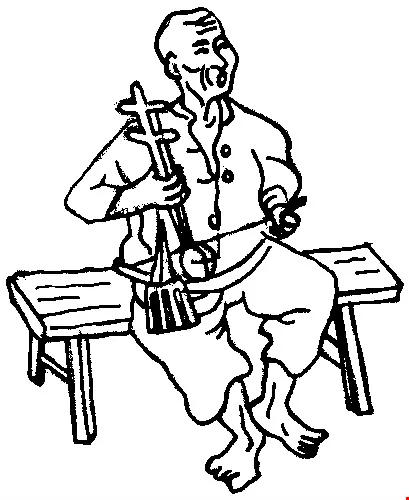
The local aspects of Kou Chou Ching's music go beyond the simple matter of multilingualism; they also present a variety of elements of traditional Taiwanese music in their tracks, including nanguan, beiguan, Taiwanese Opera, traditional Hakka music, mountain songs, and quanshi-ge.
fishLIN says that when he had just started trying to compose tracks, he found a lot of traditional music forms to be very rhythmically "heavy," making them very suitable for adaptation to hip hop. One example is the first song the two wrote together, "Diudiu Sixiang Qi," which started when the two were practicing the Ilan folksong "Diudiu Tong" and starting mixing in the Hengchun folksong "Sixiang Qi"; then they began increasing the tempo and mixing in sound effects from games like Super Mario Brothers and Street Fighter, creating a song brimming with nostalgia.
Another song, "Against Nature," starts with a Puyuma song in praise of nature, and is built on a melody from late folksong master Chen Ta's "Workers' Song." The original yueqin sound is mixed with a strong bassline running through the track and a sorrowful suona solo, creating a mournful song about the destruction of Taiwan's natural environment.
In "Your Name is Taiwanese," a Taiwanese Opera singer's singing of the word "Taiwan" is sampled, cut up, and mixed in a chaotic fashion to create the opening to the track, resulting in something that raises a smile from listeners. "Raise the Red Envelope" contains lots of old court music, including the yangqin, bamboo flute, sanxian, and drum, used in an ironic fashion to mock today's greed-driven "red envelope culture."
Their album name, Fuke, means "revival" in Chinese, and they chose this particular name to represent their attitude toward old music: they didn't want to simply use the original music, but instead hoped to inject these "old goods" into a modern context, giving them a new lease on life.
As well as using the common hip-hop technique of sampling, taking pieces of traditional tracks and remixing them for use in their own pieces, Kou Chou Ching also counts among their number two skilled traditional musicians, who play instruments such as the suona, bamboo flutes, reed pipes, and yueqin, which take pride of place in the band's music.
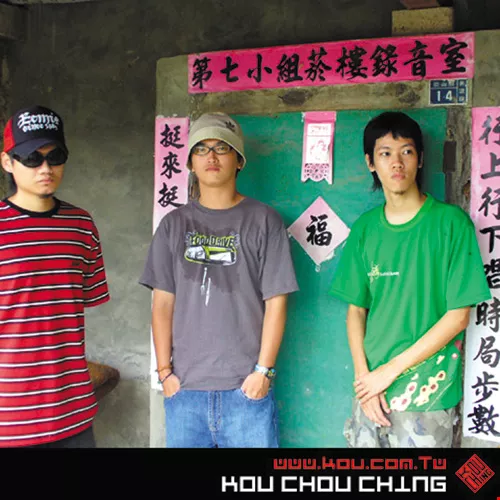
Melding the ancient and the modern, Kou Chou Ching's music has taken them across Taiwan, from the "Earth" music festival in Miaoli, to the "Respect to ChthoniC" concert in Taipei, and eventually to a studio in the renovated Meinung tobacco factory.
Sampling spirit
fishLIN and Fan Chiang's interest in traditional music is largely the result of their family backgrounds. fishLIN's father loves listening to nanguan and beiguan music, and so fishLIN has been a fan since childhood, listening alongside his father. Fan Chiang, on the other hand, loves the traditional mountain songs of the Hakka, "because my grandfather used to listen to them every day." Once the two started to get a grasp of sampling, they began collecting old records to serve as inspiration and the primary creative resource in that respect.
When most Taiwanese hip-hop acts sample music, they go hunting for tracks from abroad to try and make themselves look hip and trendy. But Kou Chou Ching draws their samples from old Taiwanese music, always giving credit for each track. The goal of sampling, the two say, is to "hopefully get the audience interested in the songs we sample." Fan Chiang likens the band to a bridge: "Hopefully we can help everyone better understand the beauty of traditional music, and once you've crossed that bridge, even if it's burned behind you it doesn't matter anymore."
Of all the many kinds of traditional music, Fan Chiang's favorite is quanshi-ge, with its positive messages, emphasis on vocal power, and almost rap-like semi-spoken style. fishLIN, on the other hand, loves beiguan, because "the singers can hit such high notes when they sing falsetto, it's amazing!" He also loves the music that accompanies it, because with there frequently being no fixed rhythm, only experience and knowledge can help you play accompaniment, meaning there's a high degree of technical skill involved.
To Fan Chiang and fishLIN, traditional music has a lot of elements that are still current in modern music, such as the methods used by the late singer Lu Liu-hsien, who could chant over 40 lyrical sections in succession without going red or running short of breath. "Looking at it from the modern perspective, he'd have made one heck of a rapper!" they joke.
A mixed reception
Not everyone likes Kou Chou Ching's mixing of traditional and modern styles: some in Taiwan's hip-hop circle have likened it to "adding chocolate to noodles." But others have praised their style as like "adding spices to beef noodles."
However, in hip hop in other countries, taking traditional elements and even mixing them with electronic music has long been common practice. One example is the world-famous Japanese-born DJ Krush, who has long included a range of traditional Japanese instruments, such as the shakuhachi, samisen, taiko, and koto, and his unique musical style has met rave reviews.
Meanwhile those who could have been most opposed to Kou Chou Ching's style--the older generation--have been largely supportive. "These 'traditional' elements we're using now were the pop music of their childhoods," Fan Chiang and fishLIN explain.
Fan Chiang's grandfather saw Kou Chou Ching perform once on Hakka TV and was full of praise for his grandson's "subversion" of Hakka music. And on one occasion, when the band was playing in a Hakka village in Fenglin, Hualien, the old men in the audience, upon hearing the bridge of one track--which was a traditional section--jumped up and started dancing with huge smiles on their faces. In the end, they rushed to the front of the crowd and grabbed CDs, giving them the thumbs up and telling them how good their performance was.
The band is currently on tour, and have stopped referring to themselves as a hip-hop act, preferring to call themselves a "traditional Taiwanese chanting group." This is part of their embracing of a "local" attitude; the term "hip hop" sounds too foreign and "just brings to mind all the jumping around and dancing, with none of the depth we wanted," whereas "chanting" is something common to Mandarin, Taiwanese, and Hakka cultures, and gives the band a link back to their traditional foundations.
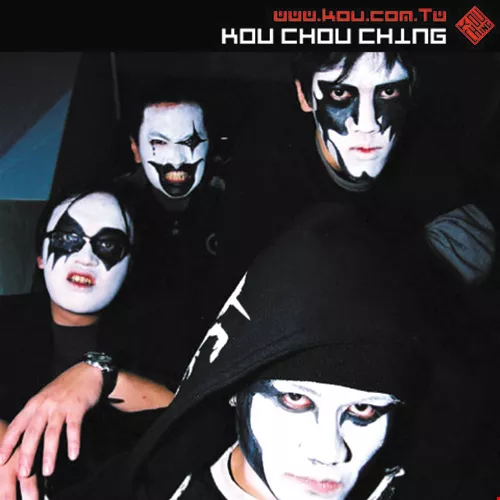
Melding the ancient and the modern, Kou Chou Ching's music has taken them across Taiwan, from the "Earth" music festival in Miaoli, to the "Respect to ChthoniC" concert in Taipei, and eventually to a studio in the renovated Meinung tobacco factory.
The same but different
Traditional Taiwanese music may have some similarities to hip hop in terms of rhythm and delivery, but in terms of spirit, how could the two share anything? After all, they're the children of two different cultures and two different ages.
To the members of Kou Chou Ching, the stop-start nature of quanshi-ge vocals are like rap, the clanging sounds of beiguan like heavy metal, the classical refinement of nanguan like orchestral music, and with its focus on vocals, Hakka mountain music is like the blues. Overseas, hip-hop artists look to traditional music forms to 'borrow' from, recycling and reviving old music and giving it new life, so why shouldn't Taiwanese hip hop do the same and look to artists like Lu Liu-hsien and Huang Ke-lin for inspiration?
Hip-hop culture has taken the world by storm, with even Taiwan being swept by a fever for taking on hip-hop style; however, many people just copy the superficial elements--the look, the moves, the style of speech, the oversized shirts, chains, and beanies--and even try and copy American rappers' obsession with gangs, partying, "bitches," and "bling." As a result, many people dismiss Kou Chou Ching's deliberately Taiwanese sound as being "not black enough" and ignoring the spirit of overseas hip hop. But traditionally, hip hop in the African-American community sampled other forms of music from the same community, such as jazz, blues, and gospel, and the lyrics focused on social problems facing the community; Kou Chou Ching believe that in light of that, there's no difference between their own style and spirit and that of genuine Western hip hop.
To them, the core of hip hop is a combination of creativity and tolerance. Musically nothing is off limits, and elements of both old and new can be mixed together in the tracks; the most important thing is "keeping it real"--being true to yourself, respecting all kinds of music, and rejecting bias and prejudice.

Keeping it real
In 2005, Kou Chou Ching released their own self-produced, unofficial album Fuke, and while it was a limited release of only 1000 copies, fans and critics alike absolutely loved it, and it has led to the band being considered the vanguard in a reduction of Western aping and a growth in the embracing of traditional local music in the hip-hop scene.
Their latest song, "Black Hearted," incorporates vocals from Taiwanese Opera in a condemnation of the shoddy, low-quality products that keep making their way onto the market and endangering the lives of consumers.
Today Fan Chiang runs a recording studio, while fishLIN is dividing his time between study and music. The band is currently preparing their first formal release, and with their respect for the music that has gone before, regardless of what lies ahead for Kou Chou Ching, their brave foray into the creation of hip hop with a local flavor has assured them a place in Taiwanese music history.
Members:
fishLIN: Lyrics, music, Taiwanese-language vocals. Graduate of National Taipei University of Technology's Department of Architecture; currently a student at Taipei National University of Arts' Graduate Institute of Architecture and Historic Preservation.
Fan Chiang: Lyrics, music, Hakka vocals. Graduate of Fu Jen Catholic University's Department of Business Administration.
DJ j.little: Turntablist. Graduate of Fu Hsin Trade and Arts School's Department of Fine Arts and Craft
Achino: Suona (Chinese oboe), other traditional instruments. Graduate of National Taiwan Normal University's Department of Civic Education and Leadership.
Yobo: Suona, other traditional instruments. Graduate of Soochow University's Department of Philosophy.
Albums: Fuke (2005), Ho-Hai-Yan Indie Music Awards 2004 (compilation) (2005)
URL: http://www.kou.com.tw
Hip hop: Hip hop originated in the mid-1970s, in the African-American ghettos in the Bronx borough of New York. The youth of the time would take turntables and remix tracks from old records, combine them with basslines, and create a form of music that didn't need any musical instruments for performance. Rappers would use tempo, rhyme, and improvisation to rap solo or engage in "battles." This musical style gradually became a phenomenon, evolving into a grassroots social movement amongst the African-American community, eventually becoming popular around the world in the 1980s. Artists that best represent this form include Afrika Bambaataa, 2Pac, DJ Krush, and Eminem.
Rap: The word "rap" is an abbreviation of "rhythm and poetry," referring to the way rappers concentrate on the meter of the track, employing a half-singing, half-speaking vocal style with an emphasis on rhymes at the end of each line and lyrics about the ups and downs of life. Today's rappers have begun using elements of other musical styles--including rock, metal, and jazz--instead of just limiting themselves to hip hop. Iconic rap artists include Public Enemy and Run DMC.
Quanshi-ge: Meaning "songs of exhortation," this is a traditional form of Taiwanese folk song. In more agricultural times, information spread slowly, and many songs were passed along by medicine salesmen who doubled as bards and traveled from village to village. The content of these songs was largely made up of historical tales and local stories, and they were delivered in a throaty, emotional style. Most songs were aimed at encouraging the people to do good, to strive to better themselves, and to reject greed. Amongst the best-known singers of this style are Lu Liu-hsien and Wu Tien-luo.
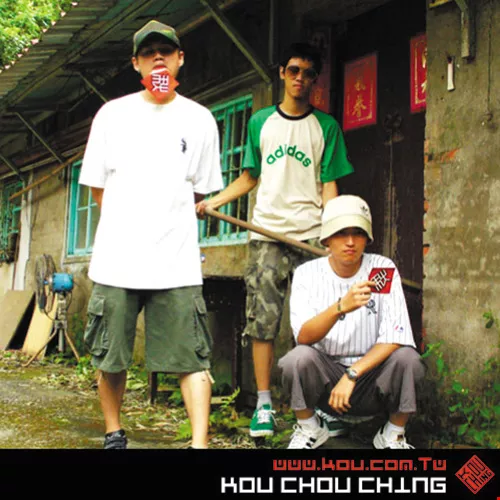
Melding the ancient and the modern, Kou Chou Ching's music has taken them across Taiwan, from the "Earth" music festival in Miaoli, to the "Respect to ChthoniC" concert in Taipei, and eventually to a studio in the renovated Meinung tobacco factory.
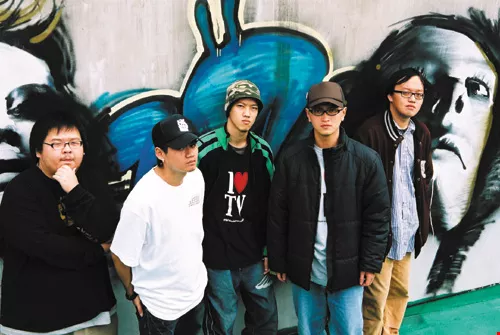
While they may look hip hop, Kou Chou Ching prefer to refer to themselves as a "traditional Taiwanese chanting group," in the hopes of breathing new life into this old art form.



About Kou Chou Ching
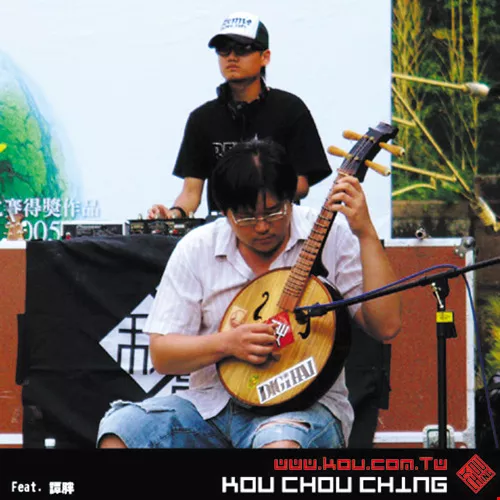
Melding the ancient and the modern, Kou Chou Ching's music has taken them across Taiwan, from the "Earth" music festival in Miaoli, to the "Respect to ChthoniC" concert in Taipei, and eventually to a studio in the renovated Meinung tobacco factory.


@List.jpg?w=522&h=410&mode=crop&format=webp&quality=80)


