Taiwan's Big Apple-Taipei in the Eyes of Everyone Else
Lin I-hsien / photos Diago Chiu / tr. by David Mayer
November 2000


There is more to space than just physical space. That's why "Taipei" is more than just a place name.
Taipei, as the capital of Taiwan, is a symbol of authority. It is a link in the global economic chain. Explosive ideas originate here. That's why all eyes in Taiwan are forever turned in its direction. But what do people in Taiwan's other cities, the invisible ones, see when they look at Taipei? What values does Taipei represent to them?
On a rainy day in Taipei, men and women dressed for the office, briefcases in hand, head toward an entrance to the city's subway system. Not far away, a group of street people hang out near Lungshan Temple waiting for the weather to clear. "Taipei is dirty. It's fun. It's exciting," says Cheng Tao-tsung, director of historical records at Chihkan Tower in Tainan, a fortress built by the Dutch in the 17th century. "They've got all those illegal street vendors there. There's still a spirit of plunder about the place!"
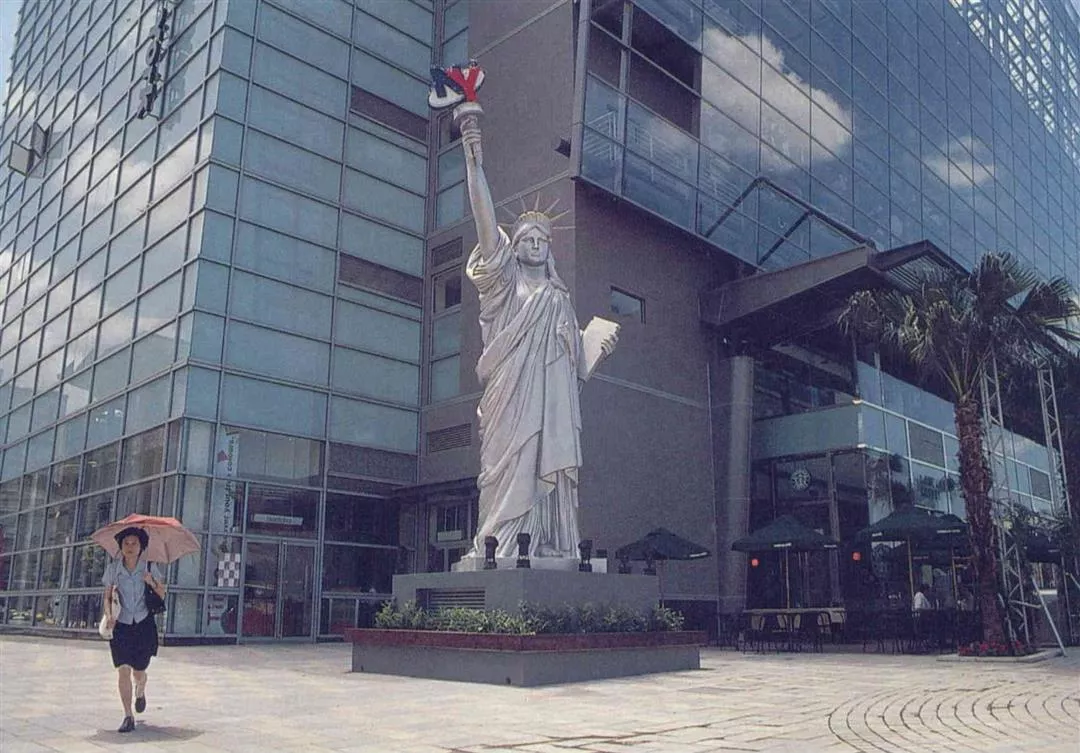
This miniature version of the Statue of Liberty stands in the Hsinyi commercial district on Taipei's east side. Is it a symbol of liberty, equality, and fraternity? Or capitalism, consumption, and the market economy?
Taipei, full of opportunity and dreams, is where many people from other parts of Taiwan come to make their mark. But the city affects everyone differently.
Chang Chin-yu, presently employed at Kun Shan University of Technology in Tainan County, once spent several years working in Taipei. "I felt powerless in Taipei, like a little cog in the wheel, but I don't feel like that here in the south. People down here are more frank and open, and you have more opportunity to use your abilities. I'm a dynamo here!"
Remarking on the quick pace of life in Taipei, Chang Chieh-lung, president of Ilan Community College, quips: "Everything changes so fast in Taipei, I've got to update my image of the place every time I go there. And there are so many sounds, so many flavors, and so many people, it's enough to turn you into a manic-depressive!"
But does Taipei affect everyone so badly? Read on!
"Life in Taipei is easy," says Lin Chao-cheng, a professor of Chinese at National Cheng Kung University in Tainan. A place can give you a sense of security by offering close personal relationships, explains Lin, but it can also do so by providing a free and easy environment where people don't butt into your affairs. In Taipei you don't have to put up with so many traditional restraints, and even the most ordinary sort of person can find the warmth he or she wants. "That's what people like about Taipei," says Lin. And Wang Mei-yu, who works in Taichung, concurs: "I like the energy of Taipei. Every day there's something saying to you, 'Hurry up!'"
But what about people who were in Taipei a few decades earlier?
Chen Chueh-hui, a professor at Tunghai University in Taichung, grew up in Taipei, and remembers when the entire city was served by just a few bus routes: "You used to be able to stroll on the slow-moving streets next to the river and gaze up at the moon. It was nice."
Memories of Taipei don't spark such fond reveries, however, for Hsieh Chen-fang, who works for the Humanistic Education Foundation in Kaohsiung. She left Kaohsiung in her teens to attend senior high school in Taipei. "When I went to Taipei to attend senior high, I was really impressed with the place. I thought Taipei was more cultured, and that my own hometown was a cultural wasteland," recalls Chen with a chuckle. "I told myself, 'Ive got to stay right here in Taipei!' But when I look back on it, I realize how shallow my views were. I didn't understand anything back then. Eventually, though, I woke up and began to understand the fundamentally unfair social structure that underlies the surface phenomena of the place, and I learned to give Kaohsiung a fairer shake."
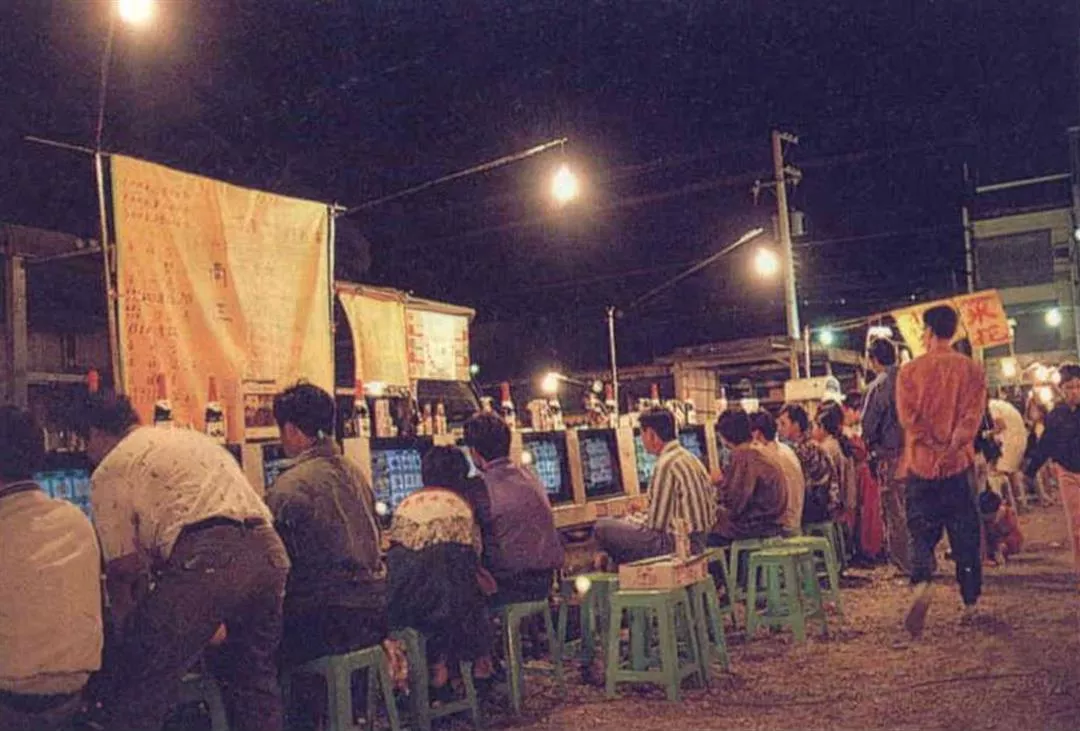
At this temporary night market in Taipei County, young men try their luck with the slot machines. These games are outlawed in Taipei City, but are extremely popular in other cities and counties.
And has the structural inequality changed in the decades since Hsieh left Taipei? It appears not. Taipei's dominant position in the mass media encourages people there to interpret everything in Taiwan from a Taipei-centered perspective, says Dr. Tseng Kui-hai. Tseng is chairman of the Southern Taiwan Society, a Kaohsiung-based organization composed of intellectuals from southern Taiwan. "We people in other parts of Taiwan have got to shout ourselves hoarse to be heard over the roar of Taipei!"
The upper echelons of power are all concentrated in Taipei, and the news media tend to place inordinate focus on events there simply because they take place close at hand. According to Wang Yu-fen, chief editor for the Central Taiwan desk at the China Times, this could feed an arrogant attitude on the part of those in positions of authority, and these people "might get to thinking that what goes in Taipei is the standard for everything."
Unbalanced distribution of authority means that not every place receives the same degree of media exposure. An announcement by the head of just about any government agency at all in Taipei will receive prominent coverage. "When they lowered fares on Taipei city buses, the story was placed on the national news page. Now there's a sign that something is seriously out of whack," says Wang.
As an instrument intended to serve the public, the mass media ought to do all it can to provide the public with balanced information about many different subjects and regions so that people can understand their rights and have an opportunity to speak their mind. Unfortunately, however, it appears that our Taipei-based mass media have not provided such opportunities to people throughout Taiwan. It is well understood that no matter where you live in Taiwan, if you've got a protest to make or a situation to explain, you'll have to budget time and money for a press conference in Taipei. "That's the arrogance of the mass media in Taipei," complains Cheng Cheng-yu, executive director of the Southern Taiwan Society.
Not only do people have to hold their press conferences in Taipei, it is also crystal clear that public opinion in Taipei is assumed to represent public opinion throughout all of Taiwan.
According to Huang Wei-fen, a reporter for the Tainan-based Chinese Daily News, at many newspapers the decision about whether local news stories go onto the national news page is made by editors who have been in Taipei for many years. Moreover, local stories don't make it onto the national page unless they are written by a reporter from headquarters in Taipei. "But a reporter from Taipei may not have the same perspective as a locally based reporter," says Huang.
In addition, most experts in every field live in Taipei, which further multiplies Taipei's clout. Formosa Television (FTV) chose to establish its head office in Kaohsiung in 1997 in order to symbolize north-south parity. Nevertheless, as Chen Shen-ching, director of the FTV Southern Taiwan Center, explains: "We had to set up our main broadcasting studio in Taipei, otherwise we would have had to spend big money getting people down to Kaohsiung to appear on our news programs, variety shows, and whatnot."
The Southern Taiwan Society's Cheng Cheng-yu shakes his head and laments: "Taiwan's lopsided development has been going on for too long. We have very few institutions of higher education in central or southern Taiwan, and those we do have are very weak in the liberal arts. You can hardly find any experts down this way if you want to hold a town meeting or public debate on something."
A progressive cityIndeed, one-third of Taiwan's universities are concentrated in Taipei, and the city's residents boast the highest level of education in Taiwan. The existence of a mature civil society, furthermore, is the international measuring stick by which we assess how progressive a city is.
"Taipei is the only place in Taiwan where a civil society exists," says Taichung resident Chen Chueh-hui. "The city belongs to you. You have a right to speak your mind on public affairs, and to get involved. In Taichung, on the other hand, we have an urban peasant mentality. We've still got our local factions. We still haven't abandoned old ways of thinking or established new relationships."
Certain prerequisite conditions must exist for civil society to come into existence, however. The commons that existed in Western cities some centuries ago gave people a chance to interact, and from there they developed the habit of discussing public affairs. In modern society, however, commons no longer exist. The role once played by commons is now performed by professional organizations and the critical exchange of ideas in the mass media. These have given birth to a sort of "virtual commons," a self-regulating society that exists outside the sphere of government.
"These conditions do not exist everywhere in Taiwan," says Hsu Chuan-sheng, director of the Taichung County Bureau of Social Policy. The reason why the mechanisms of civil society have not yet formed in most of Taiwan, says Hsu, is that active non-government organizations and easy access to information don't exist everywhere. "In many places in Taichung County, not very many people even subscribe to a newspaper."
But has Taipei, which has darted ahead of the pack in Taiwan, actually achieved a satisfactory form of civil society?
Ilan Community College's Chang Chieh-lung thinks not. In fact, he hopes that the Taipei model of civil society will not affect Ilan. "Their civil society is inadequate. It is still stuck at the stage of people protesting against the government in order to safeguard their own personal interests."
Indeed, when you look back at the various community campaigns both large and small that have been organized in Taipei in the past, the citizens of Taipei have generally taken an interest in public affairs only to protest against inadequate public services. It was only during the administration of former mayor Chen Shui-bian that everybody started talking about civil society, and some criticized that the whole thing was nothing but a ploy by local governments to co-opt the non-government sector. It appears that we will have to wait a while longer to see whether Taipei will develop a truly creative and spontaneous civil society characterized by progressive thinking.
Cosmopolitan but shallowThere are more cultural activities in Taipei than anywhere else in Taiwan, and the capital city boasts the highest number of newspapers, magazines, and television stations sets per thousand persons. But what does it all look like to people outside Taipei? What do they think when they see the gleaming bank towers, the sleek cars rolling down the streets, and the department store display windows?
"It doesn't have a distinctive character of its own. It's just a big hodge-podge." So says Lin Ko-chin, who grew up in Taipei and now works at the Ilan County Museum of History. And Huang Han-ti, a Taipei native now living in Hualien County and working as a freelance journalist, gives an even bleaker assessment: "There's nothing culturally unique about Taipei. They've just copied the chintziest of Western culture. It's just a bunch of borrowed bric-a-brac."
Commentators have described Taiwan as "culturally shallow." Although it is very open and accepting of outside influences, it is difficult for anything to take deep root here. In the opinion of Cheng Kung University professor Lin Chao-cheng, "This phenomenon is especially pronounced in Taipei."
What does cosmopolitan Taipei have that it can call its own? As the conduit between Taiwan and the international community, Taipei is influenced by many foreign cultures. Surely something creative has managed to take root here. Or has it? Hsiao Chiung-jui, director of the Tainan City Culture Bureau, came away wondering the same thing after visiting the 2000 Taipei Biennial. It was very international, said Hsiao, "but I didn't see anything of our own there."
Artist Chang Chin-yu feels that Taipei often gets completely immersed in its own atmosphere and starts to believe that it represents the cutting edge of Taiwan's arts community. Having seen how a few international art exhibits were set up, however, she has come to question how Taipei identifies the themes for its exhibits: "They seem to think they're the Tokyo or New York of Taiwan. But what about just being the Taipei of Taiwan?"
Taipei as hegemonTaipei moves in lock step with other international cities, as is evidenced by its conspicuously modern buildings and public facilities, but this also brings into sharper focus just how far out of step the rest of Taiwan is with the global mainstream.
The minute you step out of the train station in any county seat outside Taipei, you'll find the streets bristling with garish shop signs and all sorts of tacky places to spend your money-pachinko parlors, betelnut stands, karaoke booths, 7-11 stores. . . The narrow streets running higgledy-piggledy in every direction assault the senses with hordes of pedestrians and careening scooters. Nevertheless, the people in these not-so-modern towns are not completely envious of Taipei. Theirs is a complex attitude.
"If someone were to claim that the big park they built here at Tungshan River was a Taipei park, I wouldn't argue otherwise," say Chang Chieh-lung. "Just look at the place on holidays. Luxury cars come streaming in, and they're almost all from Taipei."
Ilan County is admired by other counties around Taiwan for its success in the area of cultural development. Could Chang be just a wee bit concerned about the influx of population that can be expected after the Taipei-Ilan Expressway is completed?
Ilan, says Chang, naturally welcomes companies to invest and people to move into the area. But how would that change lifestyles and consumption patterns in Ilan? "That I don't know," Chang confides. "I just hope that we can hold our own against the tide."
But in this age of information explosion, it is virtually impossible to cut oneself off from outside influence. Cheng Tao-tsung opines that culture has always been a matter of continual exchange and accumulation. In his view, it matters little that Taipei influences and judges other places from a position of superiority. "The important thing is: Do we have confidence in our own culture? Do we know enough about it?"
From his perspective as a Taipei native living in Ilan, Lin Ko-chin gives a much more negative assessment: "Taipei calls all the shots. It's a tyrant." In Lin's analysis, Taipei acts as the leader on many fronts, and even though it was largely the people of southern Taiwan who voted Chen Shui-bian into office, they still don't have a voice in the nation's cultural or political affairs.
"Taipei represents the creme de la creme, and everything that is refined," says Lin. "The hopes and dreams of people in other parts of Taiwan have been affected by Taipei. Acting through the mass media, Taipei creates consumer demand, and people outside the capital are used to being spoon-fed this way." And in a capitalist society like ours, control of consumer markets confers the power to pass judgement. Pointing to the arts as an example, Lin states that because there are so many scholars and experts in Taipei, an artist almost has to be anointed by Taipei before he or she can become known. More tragic still, "Art requires a market, and Taipei is a very big market. You have to tailor your work to succeed in Taipei if you're going to command any sort of price."
A second TaipeiDo the invisible cities of Taiwan hope to become a second Taipei?
Says Chang Chin-yu, "Taipei stands as a beacon and a warning to other cities about what lies ahead on the road to modernization. Modernization is both progressive and destructive at the same time. Take Kaohsiung, for example. Its geographic conditions are ideal for the development of a great port city. There is no need for it to get so competitive with Taipei that it ends up becoming just as nerve-jangling and chaotic as Taipei is."
In the view of Kaohsiung resident Fan Fang-ling, tastes in Taiwan are gradually moving away from a preference for the gaudy toward an emphasis on the subtle and refined, "and the people of Taipei deserve to feel proud on this point." But Kaohsiung ought to have its own style. "I was not at all pleased when Chen Shui-bian took Taipei's Lantern Festival activities and moved them to Kaohsiung," says Fan, who feels that Kaohsiung would have been better off using the money spent on the Lantern Festival to develop Kaohsiung's own Flag and Drum Festival, which has local roots. "What has worked out successfully in Taipei won't necessary do so well in Kaohsiung. If the central government starts throwing resources at Kaohsiung packaged in a Taipei mold, Kaohsiung should have the gumption to reject them."
Huang Han-ying, director of the Hualien Culture Bureau, describes herself as breaking virgin ground: "One Taipei is quite enough for Taiwan." Taiwan's other cities ought to work to create a style of their own. "We should all value our own cultural heritage. Hualien's stone sculpture, for example, has become famous throughout the world. This is something we can all be proud of in Taiwan."
According to Chung Pao-chu, who works at the Hualien Branch of the Taiwan Environmental Protection Union, "It's great that Taipei has a subway system, but we don't necessarily need one in Hualien. There are many ways to build a mass rapid transit system. Maybe Hualien could build an electric streetcar system," says Chung with a laugh. "That would certainly be a tourist draw, wouldn't it?"
The central government has long concentrated its efforts on building up Taipei as the island's international showcase city. Now, however, other cities around Taiwan, no less than Taipei, must deal with the impact of today's trend toward globalization and Taiwan's difficulties in the arena of foreign relations. Taiwan's invisible cities agree unanimously on one point: "It is high time our government stopped putting such lopsided emphasis on Taipei!"
Expressing yourselfIlan has managed to organize many outstanding international activities even while strapped for resources, and Tainan, which was once Taiwan's leading city, is working hard to build up its cultural activities. These efforts have been accompanied by more difficulties than anyone would imagine.
"Every time Ilan has organized one of these big activities," reports Lin Ko-chin, "they've had to mobilize not only local government employees, but also members of the general public. When you don't have any money, you've just got to think of other ways to get the job done. But Ilan ought to start asking itself about the lasting effects of these efforts. In concentrating on this or that activity, have they used up resources that might have been more profitably directed toward other types of cultural development?"
According to Wu Hui-ping, deputy director of the Taichung City Culture Bureau, "We would also like to organize big, distinctive annual events, just like they've been doing in Taipei and Ilan, but if we go whole hog on big annual activities, we'll spend ourselves broke and not be able to offer people the less conspicuous activities that go on day in and day out throughout the year."
Intercity buses depart for Taipei once every few minutes from the dilapidated bus station in Hsinchu, but pity the poor soul who just wants to get around Hsinchu. The wait for a city bus can be as long as half an hour. That is actually a common situation throughout Taiwan, and where it isn't the case, it's because there are almost no city buses at all!
"The people of Taiwan have worked their fingers to the bone for the past 40 or 50 years to build up a city like Taipei," says Beatrice Gysen-Hsieh, a native of Taichung who works there as director of research and development at the Taiwan Museum of Art. "Isn't it about time we called it quits?" And Hsu Chuan-sheng, who lived in Taipei for over 20 years and now works in Taichung County, laments: "Taipei ought to take notice of the rest of Taiwan from time to time. When you've got lots of money yourself, you should show a little concern for your brethren who aren't quite so well off, instead of grabbing for all the resources you can get without the slightest sense of shame."
A cultural gap separates Taipei from all of these invisible cities, all of which are working hard to do the best they can amidst straitened circumstances to achieve a brighter tomorrow.
Does that make Taipei feel lonely?
Indeed, how does Taipei feel about it? The capital city empties out over the holidays as people head back to their hometowns, leaving her like an opera diva after a performance, sitting alone backstage in a rare moment of quiet, smiling at herself in the mirror. . . .


@List.jpg?w=522&h=410&mode=crop&format=webp&quality=80)


@List.jpg?w=522&h=410&mode=crop&format=webp&quality=80)
