The Hot New Travel Trend:Guesthouses
Chang Chiung-fang / photos Jimmy Lin / tr. by Jonathan Barnard
January 2006


Have you already seen all of the world's big tourist attractions? Or perhaps you've already taken in Taiwan's scenic spots in all four seasons of the year. If so, maybe you should try another kind of travel experience: a rural guesthouse.
In recent years guesthouses in Taiwan have risen dramatically in popularity. Small groups of three to five good friends might use them to take their vacations together, or families with children stay at them to experience country life.
What are guesthouses like? What's their attraction? Let's take a closer look.
Liao Shu-chen, a teacher at a junior high school, has long been a transcontinental traveler. She and a friend from work arrived in Hualien on a blustery summer night last year. They stayed for their first time at a guesthouse: Desert Castle.
"Where's the desert?" was their first thought upon arrival. Then when they stepped inside and experienced living there with the mountain wind and sea rains outside, the two understood: "The desert feeling is inside: it's what frequent travelers know inside their heart. At first hearing, one might think it refers to the feeling engendered by the rolling dunes of the desert; in reality it's the determined discarding of the city's restraints," wrote Liao in her travel journal. "There is a deserted building on Hualien's coast. After traveling to many nations, that is where my spirit returns."
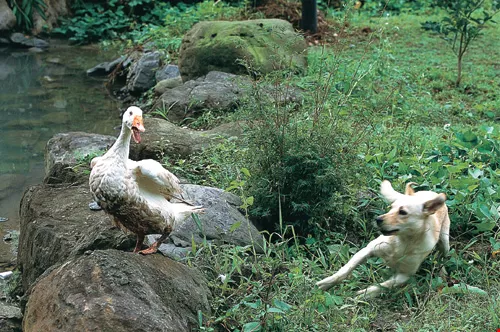
Likewise traveling to Hualien, Ho Yi-shen and family decided to stay at the Rising Sun Mountain Villa. When their two preschool children first arrived at the guesthouse, they expressed their excitement at staying in "someone else's pretty home." Not long after arriving, they were playing with the children of the hosts in the yard and feeding the family pets: a flock of ducks.
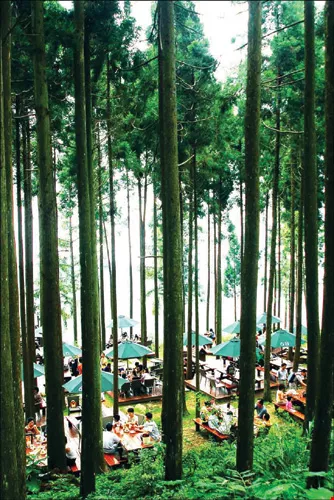
While the ancients would grow tea in the mountains, today people are more into their coffee. From mountaintop to seaside, there's sure to be a coffee shop. This picture shows an outdoor one at the Luku guesthouse in Nantou County.
Bed and breakfasts and other sorts of homestays have been popular abroad for many years. At first they arose because inns and hotels in tourist areas were insufficient to meet demand, so local farmers would rent out rooms.
For instance, during the 1960s in Japan, with the rising popularity of swimming beaches and ski resorts, there was a major shortage of hotel rooms. This sparked a rise in Western-style B&Bs. According to the Japanese Ministry of Agriculture, Forestry and Fisheries, there are now more than 5000 of them throughout Japan. Each has the character of the home it is in, which is one of their most attractive selling points.
Unlike the intensely competitive management of big commercial tourist hotels, guesthouses have experienced a more natural development in most places. Taiwan is no exception.
Taiwan's first country guesthouses appeared near Kenting National Park around 1981. Unlike most scenic spots, which are along the road from somewhere to somewhere else, Kenting is located at the remote tip of Taiwan's southern tail. Almost all tourists who visit Kenting stay the night. Particularly during summer and winter vacation, it is very hard to find a hotel room there. That's how guesthouses got a start. According to estimates, one out of three local households offers rooms to let.
Famous for its sunrise, Alishan National Scenic Area has had a similar experience. In the early years, when information wasn't so easily available, many travelers didn't start looking for a place to stay until they arrived. If hotels were full, they'd ask local residents if they had spare rooms to let. After a while, residents thought they might as well just open guesthouses.
Luku in Nantou County, a tea-growing region, presents a special case. Originally, rooms were offered as a convenience to wholesale tea buyers. These evolved into guesthouses for tourists.
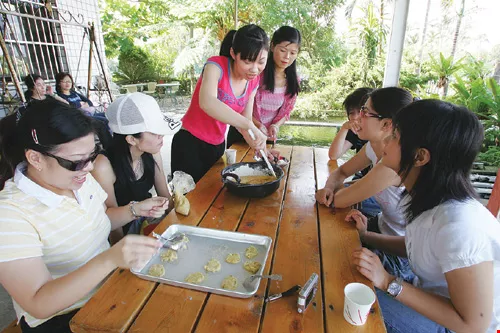
"Experience Farm" wins over visitors through hands-on activities. This is the first time these girls have made their own lavender cookies, a fascinating experience for them.
Lin Kun-yuan, director of the Hotel Inspection and Supervision Center of the ROC Tourism Bureau, notes that the early guesthouses were mostly secondary lines of business for their proprietors. But along with the steady growth of Taiwan's tourism market, and especially since Taiwan officially adopted the two-day weekend in 2001, both demand and supply have risen. In recent years there has been rapid growth in guesthouses, which have demonstrated a greater variety of business models.
The Tourism Bureau's "Domestic Travel Situation Survey Report" shows that in 2004 90% of ROC citizens had traveled within Taiwan. The total number of trips stood at 110 million (an average of 5.7 per person), which represented a rise of 6.8% over the year before. And those choosing to stay at guesthouses on these trips rose from 2.4% to 4.4%.
As far as the supply is concerned, with Taiwan shifting toward a service- and high-tech-based economy, the traditional agriculture, forestry and fishery industries have all been in decline. What's more, the rise in agricultural imports as a result of Taiwan joining the World Trade Organization has forced many farmers to look for second businesses.
In the age of the Internet, many of the larger guesthouses can form strategic alliances or create their own websites. By offering information publicly on the Internet, they allow potential guests to do their own research and book rooms online. By so doing, they can reduce customers' fears of the unknown and can market their guesthouses more effectively.
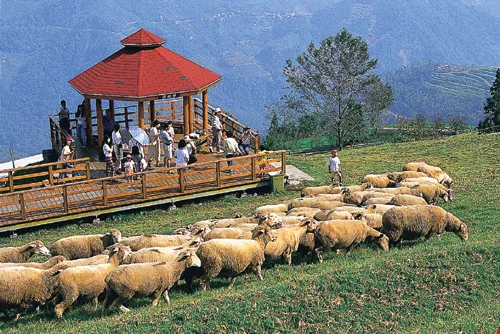
With its gorgeous surroundings and rich agriculture, Nantou's Chingching Farm is a winner with travelers, and is the wellspring from which Taiwan's guesthouse phenomenon has poured forth.
According to Tourism Bureau statistics, there are now 1,165 legally registered guesthouses in Taiwan, which represents a rise of 18 times over the 65 in 2003. The largest concentrations are found in Nantou (265), Ilan (193) and Hualien (245).
The Shangri-La Sky Garden Guesthouse, which is set in the Chingching Farm area of Nantou, began operating in 1996. It has been called the grandfather of "luxury guesthouses" in Taiwan.
The Shangri-La, with its European-style architecture, stirred up a whole fashion for guesthouses in the Chingching area. What's more, Jen-ai Township in Nantou County has a sister-city relationship with Engelberg in Switzerland, so that Chingching has acquired the name Little Switzerland.
Guesthouses in the Ilan area have also burgeoned over the past two years.
Among Taiwan's scenic areas, Ilan's Tungshan River Hot Spring Scenic Area trails only Tanshui for the number of visits it receives a year. In particular, during summer vacation around the time of the International Children's Folklore and Folkgame Festival, it attracts huge inflows of tourists. Consequently, Ilan's guesthouses have grown like mushrooms after rain.
Chen Fang-liang, the founder of Yilan Holiday House (an alliance of legal guesthouses in Ilan) and the proprietor of the North Europe Holiday House, points out that in 2002 there were only nine legal guesthouses in Ilan. Today there are 200. If you included those guesthouses that are not legally registered, the current total would surpass 1000.
With the natural beauty of the Taroko Gorge, Oceanpark and other theme parks, Hualien has also experienced a dramatic rise in guesthouses over the past two years. One operator, a Mr. Chen, points out that the 50-60 guesthouses in Hualien two years ago have increased to 200 now. If you include illegal operations, the Hualien total also surpasses 1000.
"Experience Farm" wins over visitors through hands-on activities. This is the first time these girls have made their own lavender cookies, a fascinating experience for them.
Fairly described as a "warring states period" of guesthouses in Taiwan, this is a somewhat chaotic era, but it also reveals a great variety of styles and approaches. Some put stress on the style of architecture; some go the route of emphasizing the country experience; some use natural ecology as their calling card; others seek victory through their scenic vistas. With these varying approaches, the public can pick and choose from among them to meet their specific needs.
The Ilan township of Tungshan, which is near the Tungshan River Park, has the river as its backyard. It's the area of Ilan where guesthouses are most numerous.
The Spring Villa is a Japanese-style guesthouse next to the Tungshan River Park. The villa's garden has a lotus pool, an open-air cafe, and several small chickens leisurely strolling about.
"The boss has become a servant," says Chiu Fu-mei, who owns the Spring Villa with her husband. Her husband previously made ovens in Taipei, but the sun set on that industry, so they came to Ilan to set up a guesthouse. They handle all the basic services themselves.
The guesthouses along the ocean in Ilan's Wai-ao Beach area are in an area with beautiful coastal scenery. Ocean views are their selling point. Among the guesthouses near the shore are Sincere Home, Sights at Beach, and the guesthouse at the Hsiho Fishing Village Experience Fish Farm. A row of homestays face the azure sea. In the morning you get a view of the sun rising from behind Turtle Island.
If you're near the ocean, you stress the ocean views. If you're in the mountains, you stress the mountain vistas. Rising Sun Mountain Villa, which is up in Yuli, Hualien County, has the Coastal Range on one side and the Central Range on the other. It's on a hill surrounded by mountains. At night you sleep under a sky filled with stars, and in the morning you are awoken by the sun rising over a distant mountain; it's like a fairyland.
Li Chien-chin and Cheng Lan-yi, the young proprietors of Rising Sun, are a couple who decided two years ago to move to Hualien from Taipei. Here they built a homestay on a piece of land that their father had left them, physically laboring to slowly build by hand the entire villa.
Although the scenery is beautiful, most tourists only go as far as Juisui to go rafting on the river. Because very few make it to Yuli, Li is still struggling to think of ways to attract tourists.
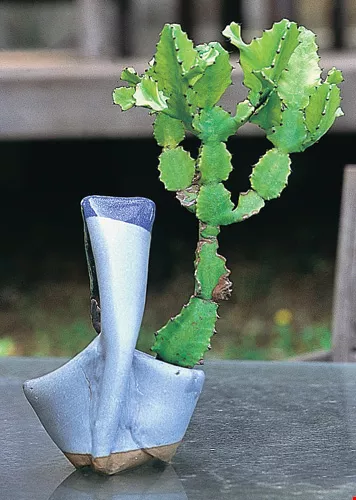
Some guesthouses are less in the business of operating a homestay than aspiring to enjoy with their guests their exquisite masterpiece.
Xinyuan was the earliest guesthouse in the Chenchu area of Ilan. In 2000, Tsao Yuan-en, an avid gardener, was named a champion "Ilan greenifier." With her friends' encouragement, she decided to let others enjoy her beautiful garden. And so she became the first person in her area to open a guesthouse.
Flowers are a principal feature of Xinyuan. Surrounded by flowers in all the seasons of the year, the place has a different spirit from season to season. In order to support these flowers and plants, the hosts spare no efforts. For instance, in 2005 there were five typhoons, so to prevent the plants from being damaged they had to move them--in or out--ten times all told.
"I'm a homebody. After work, I stay in and grow flowers or decorate." Tsao looks around her at the crystal lights, tables and chairs she has collected, and the garden full of plants and flowers, and says with feeling: "All this comes from what my guests have invested; I ought to share it with them!"
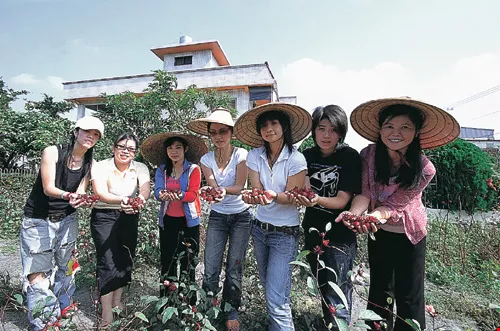
The boss of Fairy Tales Village (right) leads guests around the farm to pick roselles in season. They then have great fun candying them themselves.
"Experiences" are another thing that guesthouses strive to provide. Some of these are different cultural experiences; others are different lifestyle experiences.
Kavalan House, a guesthouse run by Taiwanese Aborigines, is located in Ilan's Wuchieh Township. Its "tree house" is its most distinctive feature. "We allow city kids to live out their Tarzan fantasy," laughs Chen Hsiu-e, the woman owner.
The tree house is plastered with notes left by guests: One of them reads: "This is the only place my kids have made a big fuss about wanting to bring back a bunch of friends to, to fish, slide down bamboo poles, ride their bikes, ride swings, and pick passion fruit. Everywhere you turn there are surprises!"
Chen says that the Kavalan people, who lived next to the water, have a tradition of building houses on stilts. Originally, she had only wanted to build an observation platform up in a tree. After she turned the platform into a room, it unexpectedly met with high acceptance, and in fact became their most popular room.
Apart from the tree house, the century-old well and large trees are ancient treasures. Chen Hsiu-e says that Taiwan guayule (Palaquium formosanum), a fruit tree that is very common in areas where the Kavalan people live, is a "tribal tree." Chen shares her unique tea--a mix of the leaves of cassia, breadfruit, and guayule trees--with her guests.
For the Fairy Tales Village Farm, which is located in the Plum Blossom Lake Recreation Area of Ilan's Tungshan Township, the route they take is experiencing farming village life, and do-it-yourself.
Fairy Tales Village, which has a candied fruit and smoked meat workshop, has agricultural products all four seasons of the year. From September to December, it's the roselle season; from March to September, the mulberry season; from November to March, the kumquat season; from December to June, the strawberry season; and from July to September, the sunflower season. There are also guava and organic vegetables throughout the year.
Fairy Tales Village provides various kinds of set itineraries with a great variety of content, from making handmade cookies, to picking fruit, to do-it-yourself candied fruits, to wild freshwater clams, to making sky lanterns and so forth.
Operating a leisure farm, as soon as you usher one group out, you usher the next group in. A bystander might think it seems exhausting, but the proprietor Wu Li-chu is happily busy: "The profits are about the same for operating a farm as for a regular guesthouse," she says, "but there's twice as much work." Wu knew all along she wouldn't make a lot of money with an experiential guesthouse, but she's in it purely because she's interested.
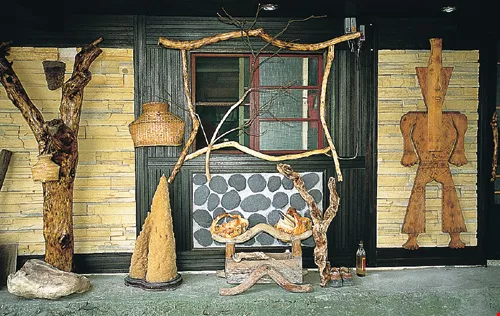
Kavalan House, in Ilan County, has a uniquely Aboriginal style which shows through in its architecture and decoration.
Along with the increasingly fierce competition among guesthouses, some people are bucking the trend and moving toward luxury.
Three years ago Wu Shih-tsung and Luo Yu-hui, who had both worked in finance for 20 years, moved from Taipei to the Wai-ao Beach area of Ilan. From buying the land to building their house, they invested more than NT$17 million to build an Aegean-style blue-and-white Greek villa. Here they commenced a new stage of life and a new way of making a living.
Their Sincere Home has taken a luxury approach with four bedrooms, each with its own style. With rooms that go for NT$5000-6000 per night, it has not only introduced high rates but also led to a spate of guesthouses opening in the neighborhood.
"What we sell is a meaningful living environment, which is more than just offering rooms for let," says Wu Shih-tsung. For instance, he says that Sincere Home's dining room doesn't just provide a romantic dining environment, but also serves an abundant breakfast. From the soup, through the toast, fruit, pastries and coffee, a meal can take a good hour.
Who goes to guesthouses?Different styles of guesthouse attract different kinds of customer. Nevertheless, which group of customers is the main source of business for guesthouses?
According to a "Guesthouse Consumer Survey" by Yen Ju-yu, a student in the Applied Life Science Department of Fu Jen Catholic University, the largest group of guesthouse consumers are those aged 21-30 (48%), followed by the 31-40 age group (33%). Most are college- or university-educated (71.7%) and unmarried (56.7%).
Guesthouses that emphasize the scenery are most popular (45.5%), and individual wooden cabins are the most popular form of room (45.8%).
"Guesthouse Visitors' Accommodation Experience," a 2003 research paper by Liao Jung-tsung, a graduate student in Chaoyang University of Technology's Department of Leisure Recreation and Tourism, lists four main reasons why travelers pick a guesthouse: "Beautiful natural scenery," "A relaxing environment," "Intimate and unpretentious service," and "A pristine and unpolluted environment."
Kuan Hsiao-yu, who is in her early twenties, has stayed at guesthouses with her classmates on three trips to Hualien and one to Kenting. They first surfed the Internet to find guesthouses that had an authentic local style, elegant environment and reasonable price.
Have you stayed at a guesthouse? What do you expect of guesthouses? Why not get online and find a guesthouse to suit your own demands. It may just give you a distinctly different travel experience from what you would get at a hotel!


@List.jpg?w=522&h=410&mode=crop&format=webp&quality=80)


