Tending the Flame of a Heritage Industry —Fengcheng’s Traditional Charcoal Makers
Chang Chiung-fang / photos Chuang Kung-ju / tr. by Jonathan Barnard
June 2016


Historically, Chinese believed there were seven necessities in life: firewood or charcoal, rice, oil, salt, soy sauce, vinegar and tea. Note that the first of these was the fuel needed for daily living.
People are thought to have begun using charcoal more than 40,000 years ago. The two decades after the end of World War II represented the charcoal industry’s golden era on the island. In the 1960s propane as a cooking fuel hit the market and the use of charcoal went into decline. Now the scene of smoke curling skyward at dusk is rare indeed.
And yet charcoal hasn’t completely disappeared. Taiwan still has a small number of makers preserving the old ways and passing down their legacy.
It used to be that most of Taiwan’s charcoal manufacturers were located near Zaoqiao in Miaoli, Xuejia in Tainan, Dashu in Kaohsiung and Hengchun in Pingtung. Among those, only a few holdouts in Kaohsiung’s Dashu remain.
Located in Hsinchu’s Baoshan, the Fengcheng Charcoal Kiln—“The Home of Charcoal”—is one of the few producers still operating in northern Taiwan. The proprietors, Li Yongxing, who is in his fifties, and his octogenarian father Li Shenghua, regularly perform the age-old process of filling their kiln with wood and creating charcoal.
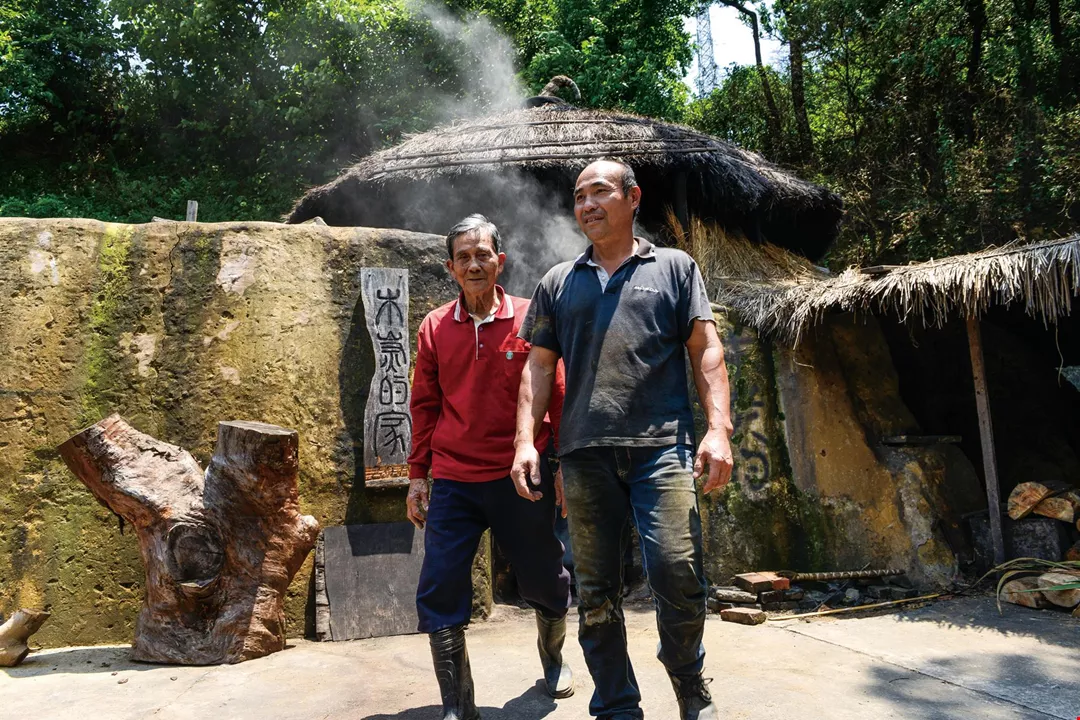
Father and son Li Shenghua and Li Yongxing are guardians of the traditional ways at the “Home of Charcoal” in Hsinchu’s Baoshan Township.
Home of charcoal
Fengcheng follows the traditional methods of making charcoal. The kiln is on a small hill with an elevation of 200-some meters. Li Yongxing points to the top of the kiln, explaining that back in the day people would rent a water buffalo to turn in circles in order to compact the soil at the hilltop, which would become the walls of the kiln. People would then step in to do the finishing work, making a kiln door opening and digging out material to create the chamber inside. The kiln walls are thick at the bottom (40–50 centimeters) and thin up top (about 15 cm).
Taiwan’s charcoal is made with wood from acacia and longan trees, typically sourced locally. Take the charcoal produced by Fengcheng, for instance. The Baoshan area has many stands of acacia, so Fengcheng naturally uses acacia wood. “Charcoal made from acacia wood burns with little smoke,” says Li Yongxing, explaining the advantages of his choice. “It doesn’t crack easily, it produces a steady heat, and it leaves little ash.”
The elder Li, who has witnessed the rise and fall of the charcoal industry, feels deeply about the industry and has a lot of wisdom to offer about it. He recounts that when he was young he grew rice and tea and would go to help out at the kilns in his spare time. Charcoal was always just a way of making some extra money when farm work was light. Later, when he switched to growing oranges, he also started making charcoal himself.
At its peak, Fengcheng had five charcoal kilns, but the lifespans of kilns are limited, and they are prone to collapse when not in use. Once that happens, you’ve got to build a new one from scratch. Li recalls that in the 1980s new kilns were 150% percent larger than today, producing about 9000 kilograms of charcoal per firing. But after the family’s kilns collapsed in the 1999 earthquake, there was a gap of several years when Fengcheng produced nothing.
“The township mayor said that it would be a shame to lose a traditional industry like charcoal production, so in 2004 the local government provided us with funding to build a new kiln.”
Fengcheng now typically fires its kiln once every two months, producing some 4000 kg of charcoal each time.
“Generally speaking, the largest quantities are produced from the Mid-Autumn Festival up to around Chinese New Year’s.” Li Shenghua explains that the charcoal Fengcheng produced in March sold out in one day.
Their stock went so quickly mainly because production of charcoal in Taiwan has been in steady decline and is now just a niche industry. With the widespread use of propane and the opening of the domestic market to imported charcoal, which has flooded in from Indonesia, Vietnam and Malaysia, there’s very little of the traditional stuff made from Taiwan wood for sale any more.
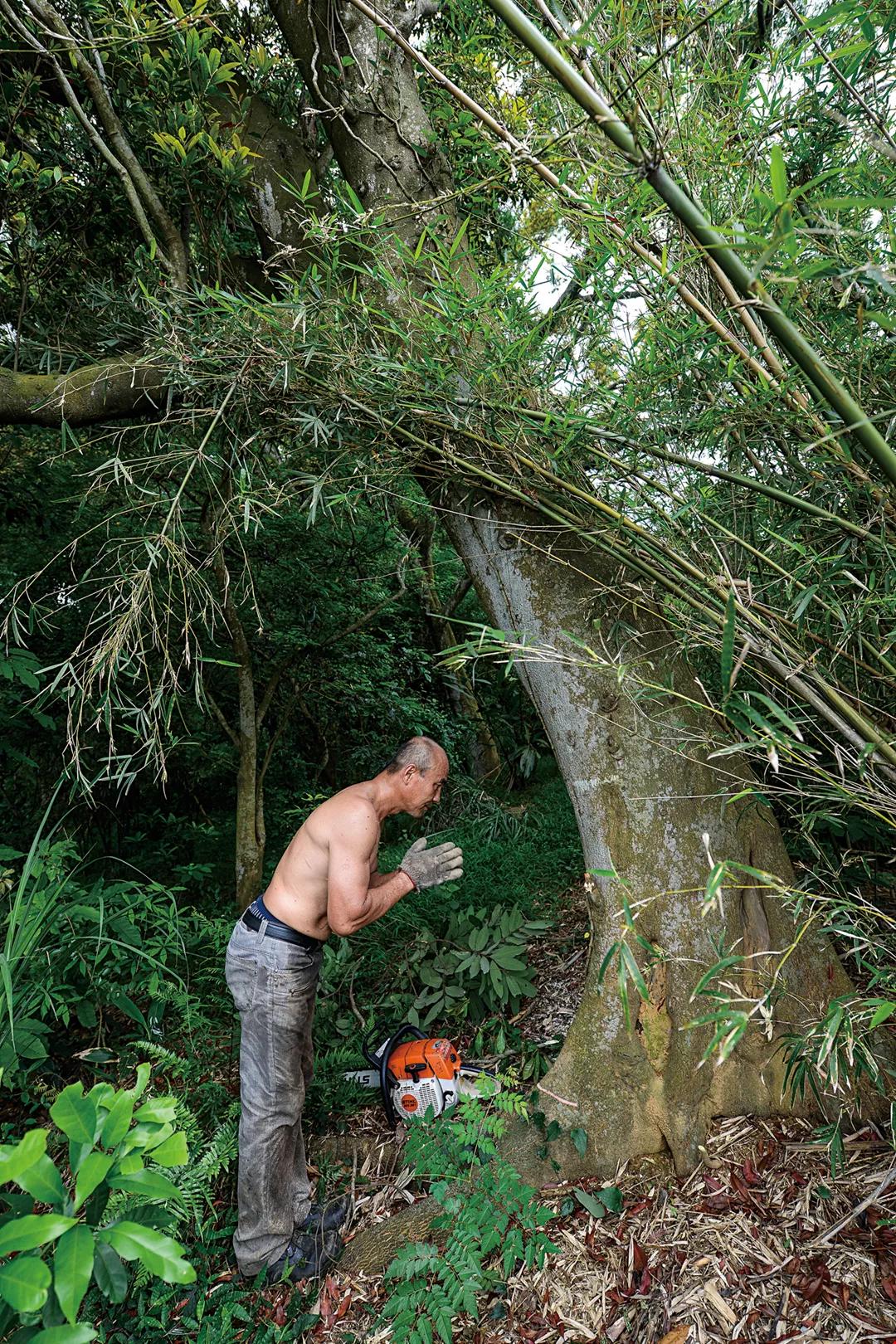
When you eat fruit, goes the Chinese expression, pray to the tree: Li Yongxing never forgets to show the proper respect to the source of his livelihood.
A disappearing industry
If it’s a dying industry, why put up with all the hassles and hard work?
“I felt I just had to do it!” Li Yongxing often laments that young people aren’t going into the industry. With no one else of his generation seemingly inclined to learn the old techniques, Li decided it was incumbent upon him to carry on the tradition. When his father first taught him how to make charcoal, Li had thought he would just have a little fun with it in his spare time. He never intended to make it his main career.
To produce charcoal, you need first and foremost the raw material: firewood. But with growing prohibitions on cutting, there is less and less available. Li purchases some of the wood he uses, and some is given to him by friends, but at any rate he’s got to go up to the mountains to cut all of it himself.
“Before felling a tree, he first pays tribute to its spirit,” says Chen Shengzong, a friend who has long tagged along to make a record of what Li is doing and has taken special note of this gesture of appreciation.
Only when he’s accumulated enough wood will Li fire the kiln to produce charcoal. The wood can’t just be thrown in the kiln willy-nilly. There’s an art to stacking it. And with greater experience, more and more wood can be placed in the same limited amount of space.
As a general rule, you create a meter-wide base of large pieces of wood and then stack smaller and thinner pieces on top of it, thus filling the kiln in layers.
After the wood has been stacked, the doorway to the kiln has to be sealed, with just a small hole from the fire chamber and an opening at the top to release the smoke. Li is expert at sealing the kiln. He fills the doorway with bricks and seals the gaps with mud. “You can’t let air in, or the fire will turn the wood to ash instead of charcoal,” he says.
Between the door to the fire chamber and the larger kiln filled with wood, there’s a wall with the aforementioned opening. “You light the fire so that the smoke enters the kiln to char the wood. You don’t want the wood in the kiln exposed directly to flames.”
The kiln will smolder for 25–26 days at the fastest. To keep the fire in the chamber going, most nights Li has got to get up and check on it every three hours or so.
How do you know when the wood has become charcoal? The elder Li says mysteriously, “There is a sign.”
The “sign” is a stick that he has inserted into a hole in the brick-filled kiln doorway about 80 cm off the ground. “When the stick has turned into charcoal, it means that all the wood in the kiln has turned as well, and you can start to extinguish the fire.”
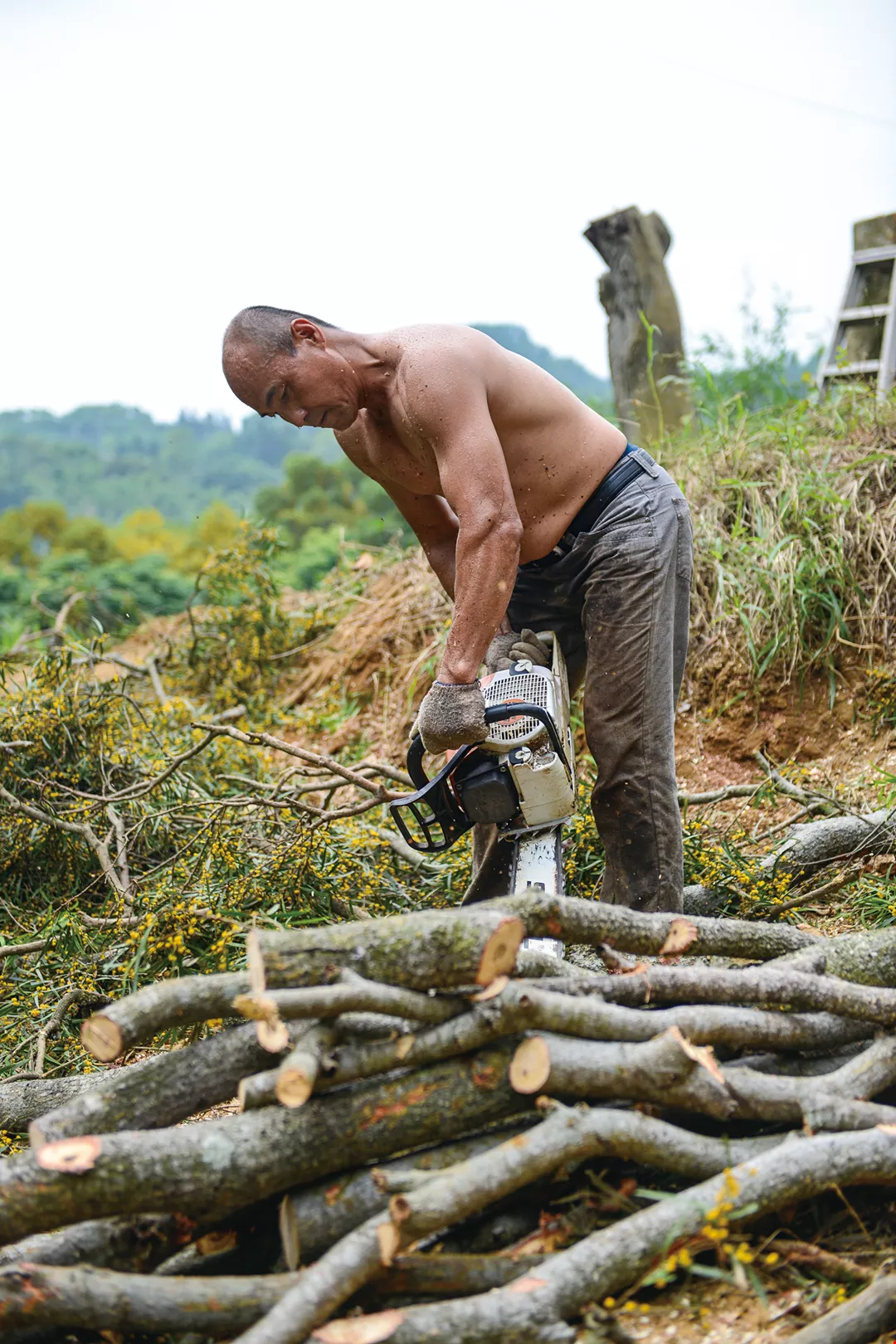
After felling a tree, you’ve got to cut it into convenient lengths for moving off the mountain.
Extracting charcoal in the snow
The length of the kiln’s cooling period depends upon the weather. It typically takes about two weeks in winter and three weeks in summer. “The temperature inside the kiln can be 400–500°C, and at the door from the fire chamber it can be 700–800°C, or even as high as 1000°C,” says Li Yongxing.
Charcoal is removed from the kiln typically in the middle of the night, so you’d never see the process if you weren’t given advance notice. This year, on January 24, Taiwan was in the grip of a cold front, and the ground in the mountains of Hsinchu was covered with ice and snow. That happened to be the day that Fengcheng’s charcoal was ready to be pulled from the kiln, so the rare scene of “extracting charcoal in the snow” would unfold.
A “scene” it may have been, but it wasn’t particularly scenic. When a kiln is opened, the heat gushes out, and all one can see are workers wearing headlamps moving into a pitch-back kiln and pulling out charcoal that is equally pitch black. “It’s only the real deal if you get covered in soot” laughs Li Yongxing. The kiln is full of soot and very hot, with temperatures in the 40s Celcius. Faces likewise turn black as workers wipe the sweat from their brows.
“It’s no joyous harvest.” Li says that on the day they empty the kiln they superstitiously don’t even answer the phone—fearing that the process might have been unsuccessful, so that they won’t have anything to sell to those wishing to make an order. But who would come in the dark to buy charcoal? Li says that a barbeque place in Jianshi Township comes to get it for grilling their meat, and tea makers buy it for curing their tea. But most of it is bought by consumers for their own use.
From midnight, when the process begins, until seven or eight the next morning, by which time the kiln has been emptied, Li never stops moving. The empty kiln represents the conclusion of the entire traditional process of making charcoal.
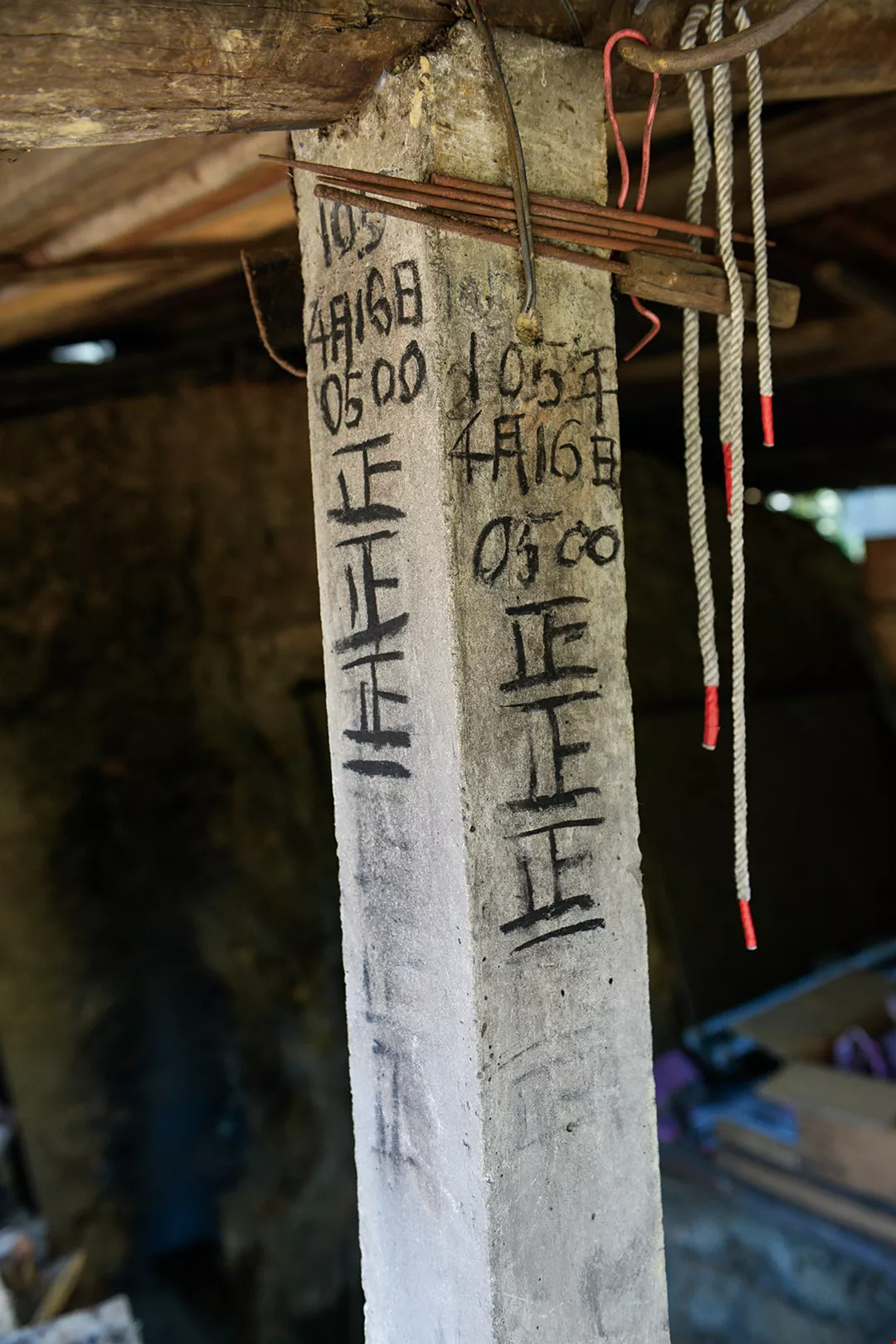
The date the kiln was loaded with wood is marked clearly on a pillar. During the entire charcoal-making process of 20-some days, the kiln has to be checked once every three hours to ensure that the proper heat is maintained.
New uses for an old necessity
Back in the era before gas, charcoal was a necessity. The image of an old grandmother huddled over a portable charcoal stove is already a thing of the distant past—but it was something akin to seeing young people clutching disposable heating pads to keep warm today.
Fortunately, charcoal is not without other uses. Apart from grilling meat, it has come to be used in various other products found in everyday life. For instance, it is used in filters to purify water and air, as well as in shampoos, shower gels, soaps, odor absorber pads, clothes, and socks.
The old problem of air pollution from the production of charcoal has also been solved, with the smoke collected as pyroligneous acid, or “wood vinegar,” whose main component—acetic acid—can be used as an insecticide. It has become one of the hottest-selling secondary products from the manufacture of charcoal.
Another by-product is the sweet potatoes roasted by the door of the kiln’s fire chamber. Li Yongxing says he’s used the heat there to roast hundreds of pounds of sweet potatoes to give to friends and relatives. As far as he is concerned, the life of a charcoal maker is as delicious as these tubers. Though kiln proprietors are sooty and black on the outside, on the inside they are golden and sweet.
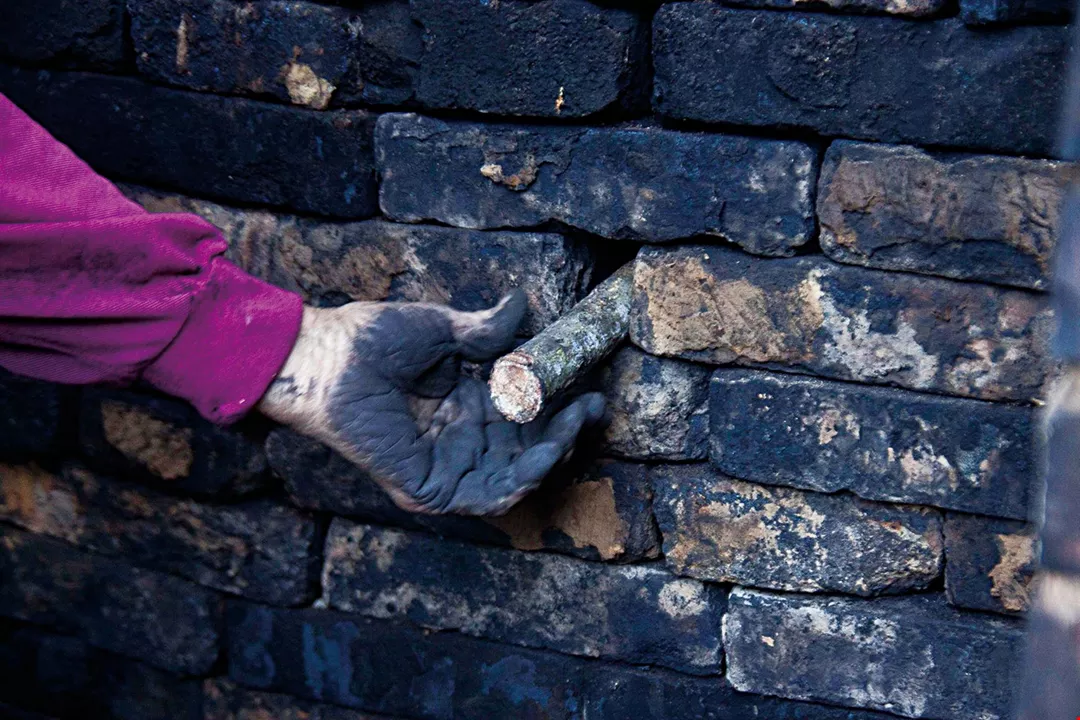
This stick in the doorway to the kiln can indicate whether the wood within has been turned to charcoal yet. (courtesy of Chen Shengzong)
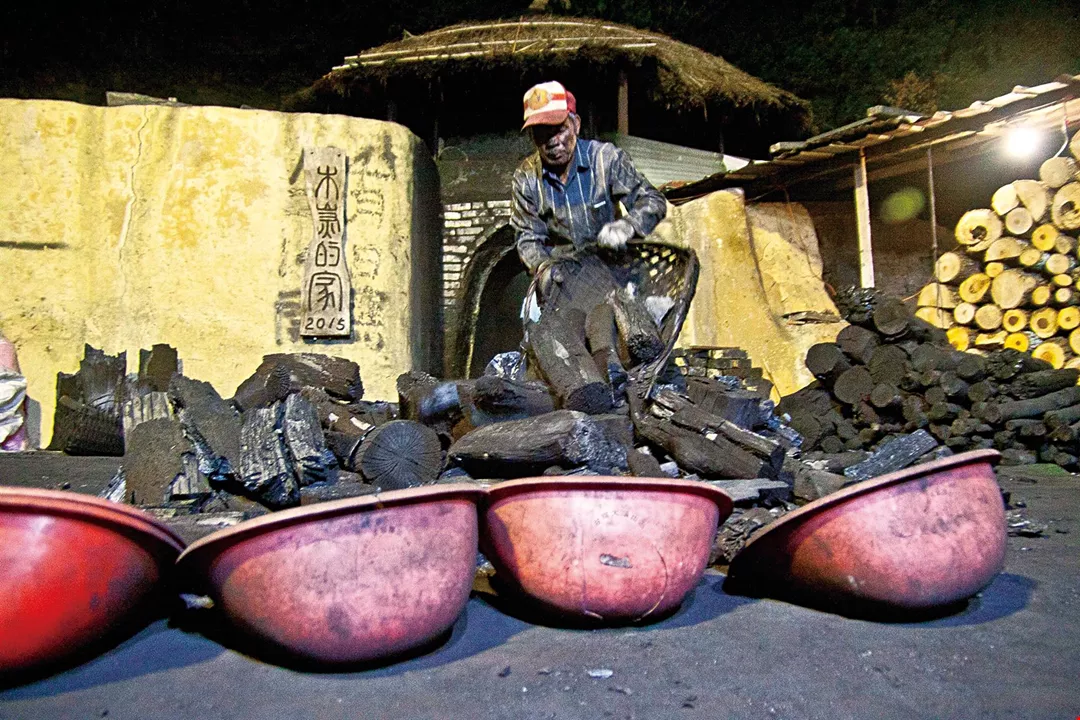
Taking advantage of the cool of night to unload the kiln, they work from midnight until seven or eight the next morning. (courtesy of Chen Shengzong)
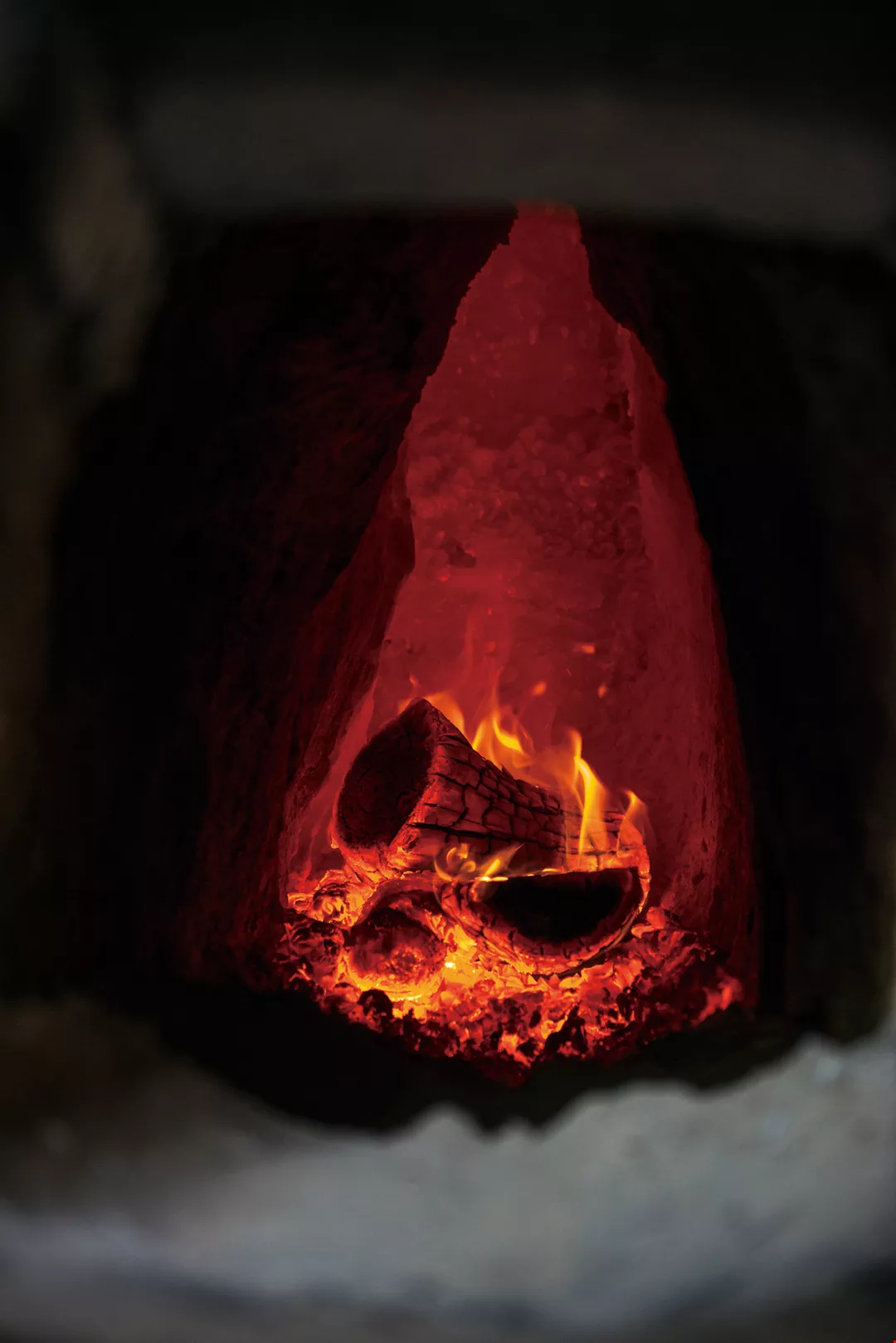
Firewood is turned into charcoal by being smoldered at 400–500°C and then left to cool.


@List.jpg?w=522&h=410&mode=crop&format=webp&quality=80)
