Kil’n It!
Yingge’s 200 Years of Ceramics History
Lynn Su / photos by Lin Min-hsuan / tr. by Phil Newell
October 2025

.jpg?w=1080&mode=crop&format=webp&quality=80)
Ceramics making is an ancient set of skills that have long been the basis of an industry. In Taiwan, the most important bastion of world-class ceramics manufacture is New Taipei City’s Yingge District, known as “Taiwan’s Jingdezhen.” (Jingdezhen, China’s “porcelain capital,” has been a center of ceramics production for more than a millennium.) Though Yingge’s ceramics industry has no astonishing background story or dramatic past, it has its own tale to tell.
Walking on stone-paved Jianshanpu Road, we are flanked by shops selling tableware, tea utensils, vases, porcelain figurines, ocarinas, toilets, and funerary urns. This street, famed for supplying ceramic products needed “from birth to death,” is especially noteworthy for its strong identity and “shop in front, factory behind” character. Adjacent to an industrial zone, it stands apart from other old streets.
A brief history of Yingge ceramics
Yingge is famous throughout Taiwan for its ceramics, and is the rare small town that combines industry, culture, and tourism. Its proximity to Taipei City means that whether it be a working day or a weekend or holiday, there are always groups of domestic and foreign tourists who have made a special trip to come here.
The Yingge Ceramics Museum, located on Wenhua Road and opened in 2000, is a good first stop for learning about the town. The permanent exhibitions explain in depth Taiwan’s ceramics culture, as well as the history of the industry in Yingge, in easily accessible terms.
Through the museum’s clear glass windows, we can see in the distance Jianshan Hill, from where much of the clay used by the local ceramics industry was sourced in days gone by. This, in combination with various other factors—including the wood and coal produced in neighboring Sanxia and Shulin, and freight shipping on the Dahan River (the main form of transportation prior to the building of the railroads)—facilitated Yingge’s historic rise as a ceramics center.
Historical documents indicate that the birth of Yingge’s ceramics industry can be traced back to 1804, when a man named Wu An brought ceramics-making techniques to the area from Cizao near Quanzhou in China.
During the era of Japanese rule in Taiwan (1895–1945), the Japanese systematically invested in the ceramics industry in clay-producing areas including Beitou, Nantou, Miaoli, and Yingge. The authorities enacted an industrial associations law to provide a legal foundation for the management of industrial operations, while also forming the Jianshan Ceramics Association. In 1931 the Japanese regime launched an industrialization drive, bringing mechanization and modern technology to various industries, including ceramics.
Towards the end of World War II, with Taiwan cut off from trade with China and Japan, the domestic market for household pottery became the main driver of the ceramics industry. In 1968 Yingge received a boost when coal burning was banned in Beitou and many ceramics firms relocated from there to Yingge. As early as 1962, ceramics businesses from the town had gone to Seattle to exhibit at the World’s Fair, pioneering the export market. The 1990s were the glory days in Yingge, with as many as 1,300 manufacturers active, and products being packaged for export still warm from the kiln. Yingge became known around the world as “Taiwan’s Jingdezhen.”
.jpg?w=1080&mode=crop&format=webp&quality=80)
Yingge’s “old street” is in fact only about 20 years old. But here you can see the splendor of 200 years of ceramics culture.
The power of Taiwanese manufacturing
Before the 1980s, as technology progressed, there was a major change in the ceramics industry in Yingge about once every decade. Products evolved from the coarse earthenware pottery of the early days to household ceramic ware, to industrial ceramics, to art ceramics, to precision ceramics; firing changed from coal-burning kilns to automated gas and electric kilns; and product decoration shifted from hand painting to computer printing. Firms were constantly evolving.
As an example, in her book From Street-Food Bowls to Outer Space, writer Bao Ziyi relates how the Qinghui Kiln, which originally specialized in producing thick porcelain bowls for use in small family-run eateries, transitioned step by step to producing heat-resistant ceramic filters and ceramic cores for industrial use.
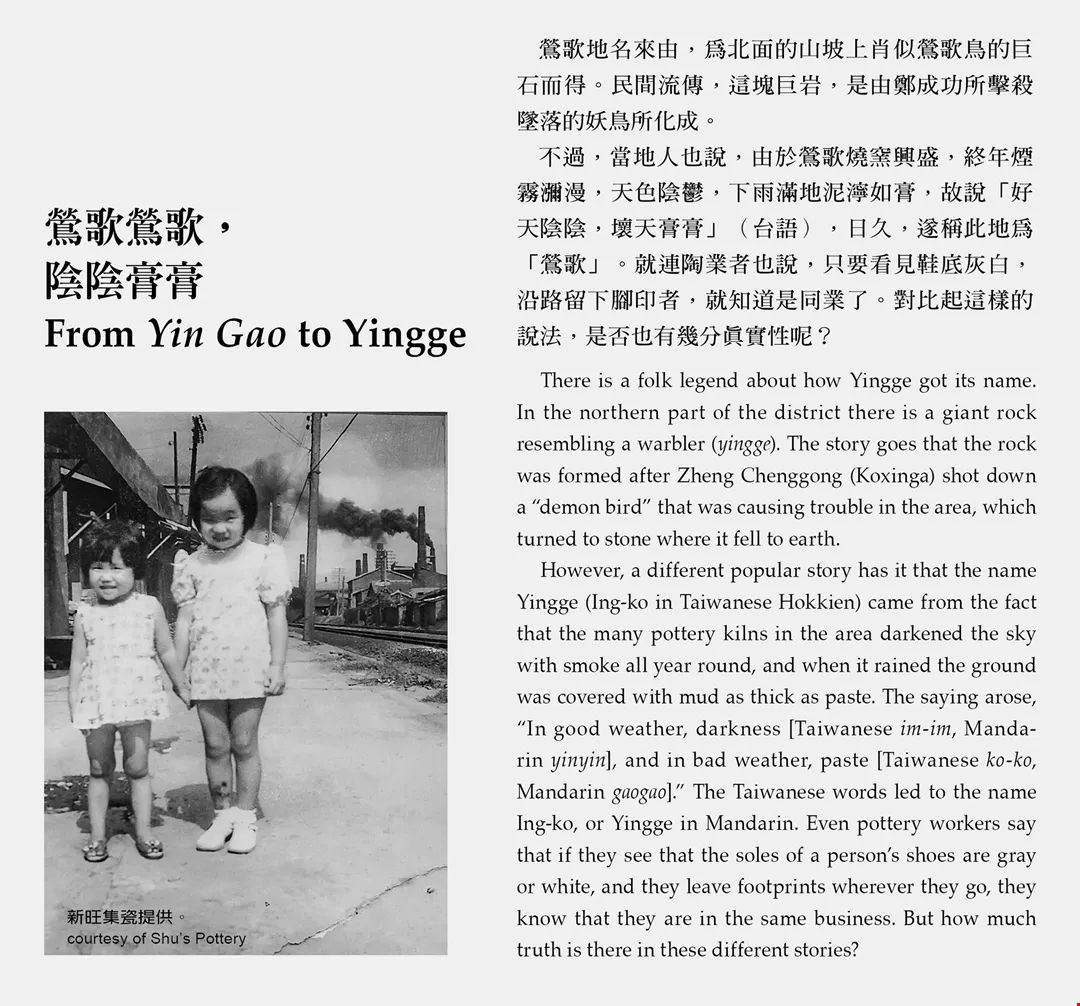
A venerable firm now known as Shu’s Pottery is another case in point. Founded in 1926, it started out as the Xiexing Kiln, selling ceramic tiles, but in recent years has founded the “Shu’s Pottery” handmade ceramic art brand and has also launched products under the name “Koga Tableware.”
Pioneering ceramic artists like Shu’s, besides realizing their creative vision and expressing their aesthetic sense, also pay attention to how to enable their industry to continue to stay at the cutting edge and sustainably operate in changing times. Through them we can see that the ceramics industry in Taiwan is not only culturally emotive, but also has the resilience and confidence that is typical of manufacturing in Taiwan.
.jpg?w=1080&mode=crop&format=webp&quality=80)
Yingge’s ceramics industry produces five major categories of goods: household items, construction materials, bathroom fixtures, artworks, and industrial ceramics. You can see many objects here, including everyday tableware, roof tiles, electrical insulators, and toilets.
.jpg?w=1080&mode=crop&format=webp&quality=80)
.jpg?w=1080&mode=crop&format=webp&quality=80)
.jpg?w=1080&mode=crop&format=webp&quality=80)
.jpg?w=1080&mode=crop&format=webp&quality=80)
.jpg?w=1080&mode=crop&format=webp&quality=80)
.jpg?w=1080&mode=crop&format=webp&quality=80)
.jpg?w=1080&mode=crop&format=webp&quality=80)
The permanent exhibitions at the Yingge Ceramics Museum introduce local ceramics history and culture in an easy-to-understand way.
What makes Yingge ceramics?
As a result of doing a lot of contract manufacturing work, Yingge makes five main types of products: objects for daily life, construction materials, bathroom fixtures, artworks, and industrial ceramics. Compared to most well-known ceramics towns around the world, whose reputations rest on making products for daily life, Yingge is certainly an outlier. But precisely for this reason, consumers who visit the town find not only a dazzling array of ceramic products, but also a somewhat eclectic mix of looks and styles.
In particular, when Yingge’s own clay deposits ran out, the raw material that had defined local ceramics disappeared. Local manufacturers had to import clay from other places, including Japan, the US, and Europe.
Another puzzling thing is that unlike Japan, Taiwan seems not to have had any famous ceramics makers with long histories of producing the same products and designs for five or ten generations. Even those in the business find this odd.
Perhaps migrant people, as the Han Chinese were in Taiwan, innately are free from the burden of history. But one could also see this as an expression of Taiwanese resilience. Most Taiwanese ceramics makers personally handle every step of the production process, from selecting, wedging, and shaping the clay to firing, glazing, and painting the product to packaging and retail sales. “The only thing missing is digging up the clay oneself,” quips Calvin Lu, director of sales and a member of the third generation of the family that owns Tai-Hwa Pottery. This explains the advantage of Taiwan’s ceramics makers in contract manufacturing: By mastering every step, they are nimble at making changes, and can meet the requirements of any client.
However, it is just for this reason that “Yingge ceramics” is “like a synthesis of the world’s ceramics,” says Lu. Perhaps one cannot say that they have any distinguishing features that are recognizable at first glance, or are technically or culturally more refined, or that they carry on traditions from China or Japan. But if you talk about their characteristics or style, in the course of development each maker has blended and improved their relevant skills and craftsmanship, giving each brand a distinctive character.
.jpg?w=1080&mode=crop&format=webp&quality=80)
Steve Shu, fourth-generation manager of Shu’s Pottery.
.jpg?w=1080&mode=crop&format=webp&quality=80)
.jpg?w=1080&mode=crop&format=webp&quality=80)
Shu’s Pottery is nearly 100 years old, and is now in the hands of the fourth generation of the founding family. Their in-house museum displays equipment that their forebears used to make ceramics, as well as replica classic green bowls.
.jpg?w=1080&mode=crop&format=webp&quality=80)
New generation, new chapter
In the late 1990s, the relocation of manufacturing industries offshore led to a decline in Yingge’s fortunes, and the Asian Financial Crisis added fuel to the flames. This caused ceramics firms to rethink their strategy and turn their attention from exports to the domestic market. They joined hands to hold the Yingge Ceramics Festival in front of the Yingge train station, and the event caused a sensation, pushing Yingge in the direction of tourism.
In 1997, the Ministry of Economic Affairs lent a hand by selecting Jianshanpu Road and other streets in the old part of town to be turned into a pedestrian district. In 1999, the area became a shopping district.
However, it is hard to save industries in decline. Today there are fewer than 100 factories and workshops in Yingge, and the younger generation inheriting family businesses are facing the challenge of figuring out how to keep them afloat or revitalize them.
In 2019 the Ministry of Economic Affairs and the Taiwan Design Research Institute jointly launched the nationwide “T22 Local Industry Revitalization via Design Project,” creating an opportunity to turn things around in Yingge. The project calls for cross-sector cooperation to combine the strengths of different companies. For example, six companies formed teams to design tableware for three Michelin-starred restaurants, while Shu’s Pottery worked with Japan’s Nakagawa-Masashichi stores to launch the Koga brand.
“If we do nothing, but just sit like the proverbial frog in hot water, sooner or later this industry will disappear.” The heirs to these family enterprises have long been worried about their future. In 2023, successors to Shu’s, Tai-Hwa, Anta, Tao Ju, Excellence Collection, and Shin Tay Yuan announced the formation of the “Tao-Ci-Wa Generational Cooperation Association” to plot a way forward.
They have followed the example of Japan’s Kouba Fes (the Tsubame–Sanjo Factory Festival) by combining traditional crafts with tourism to promote “Yingge Open House” activities. Besides organizing a market, they welcome the general public into their factories for on-site visits and learning and even lay on an annual banquet for guests.
This despite the fact that ceramics is a relatively conservative traditional industry. Looking back 200 years, ceramics making techniques were family secrets. Today, the older generation of business leaders in the industry still resist letting peers inside their plants. But now owners from the second, third, or fourth generations of their families chat together as they jest self-deprecatingly: “Opening up a factory to outsiders today can be considered a ‘big breakthrough.’” “We’re grown up now and we don’t listen to anyone!”
Nonetheless, what these heirs to Yingge’s ceramics tradition hope for is to formulate a collective vision and achieve breakthroughs to find a path for the continued development of their hometown. Through mutual aid and cooperation, they aim to carry Yingge’s 200-year-old ceramics industry forward into future generations.
.jpg?w=1080&mode=crop&format=webp&quality=80)
Shin Tay Yuan uses transfer printing to print images on ceramics. Visitors to the factory on Yingge Open House day not only find rare machinery, but can also see how the company uses exclusive technology to print sections of paintings onto tiles which can be assembled into larger images.
.jpg?w=1080&mode=crop&format=webp&quality=80)
Tai-Hwa Pottery, known as the Palace Museum of Yingge, is adept at combining colored images with gilding to produce vessels with a retro style. Visitors to the factory on Open House day can see the mastery of the artists at work. (photo by Jimmy Lin)
.jpg?w=1080&mode=crop&format=webp&quality=80)
Ceramics is a rath er conservative traditional industry, but some firms are keeping up with the times and have taken on a new look. The photo was taken at Yu Yao Tang Pottery, founded by husband-and-wife ceramic artists Lu Ching-hui and Tsai Mei-ju, which specializes in tools and materials for ceramic art. It shows a wall of ceramic tiles that are used to demonstrate glazes made to open-source formulae.
.jpg?w=1080&mode=crop&format=webp&quality=80)
Visiting Yingge on Open House day, one can experience 200 years of Taiwan’s ceramics history. (courtesy of Tao-Ci-Wa Generational Cooperation Association)
.jpg?w=1080&mode=crop&format=webp&quality=80)
Through the Tao-Ci-Wa Generational Cooperation Association, heirs to well-known Yingge ceramics firms hope to use mutual cooperation to keep their industry going into the future. From left: Yu Yao Tang Pottery founders Tsai Mei-ju and Lu Ching-hui; Shin Tay Yuan’s second-generation heir Greg Wang; Tai-Hwa Pottery sales director Calvin Lu; and Victor Hsu, special assistant to the chairman at Excellence Collection.
.jpg?w=1080&mode=crop&format=webp&quality=80)
courtesy of Tao-Ci-Wa Generational Cooperation Association
.jpg?w=1080&mode=crop&format=webp&quality=80)
At Yingge Open House and Yingge Table Feast there is a catered outdoor banquet using Yingge tableware, including green ceramics made by Anta Pottery, yinyang bowls with contrasting colors made by Shu’s Pottery, calligraphy-decorated ceramics from Mao’s Studio, and printed objects from Shin Tay Yuan. Such works really convey the elegance of Taiwanese culture. (photos courtesy of Tao-Ci-Wa Generational Cooperation Association)
.jpg?w=1080&mode=crop&format=webp&quality=80)
.jpg?w=1080&mode=crop&format=webp&quality=80)
.jpg?w=1080&mode=crop&format=webp&quality=80)
 (1).jpg?w=1080&mode=crop&format=webp&quality=80)
.jpg?w=1080&mode=crop&format=webp&quality=80)
.jpg?w=1080&mode=crop&format=webp&quality=80)
.jpg?w=1080&mode=crop&format=webp&quality=80)
@List.jpg?w=522&h=410&mode=crop&format=webp&quality=80)


@List.jpg?w=522&h=410&mode=crop&format=webp&quality=80)
@List.jpg?w=522&h=410&mode=crop&format=webp&quality=80)
