A Virtuous Cycle: The Tour de Taiwan Goes from Strength to Strength
Kobe Chen / photos courtesy of the CTCA / tr. by Phil Newell
April 2015


Taiwan has long been known as a “bicycle kingdom” for its cycle manufacturing prowess. But in recent years Taiwan has also been taking the bicycle from the realm of industry into popular daily life. Wherever you look—from Taipei City’s “YouBike” public bike rental system to the amazing bicycle trail at Sun Moon Lake that has been lauded in the international media—Taiwan has step by step been transforming itself into a “bicycle island.”
In March 2015, following closely on the heels of the Taipei International Cycle Show, the Tour de Taiwan cycle race was held. The organizers invited 188 top riders from 32 countries to participate, giving the people of Taiwan a chance to appreciate, right up close, top-class competitors facing off against one another.
The 2015 Tour de Taiwan cycle race was held from March 21 to March 26. The five-stage, five-day event tested the physical stamina and psychological willpower of the contestants. The fourth day in particular—the mountain climbing stage—was especially arduous, not only because the route itself was demanding, but also because of the day’s low temperatures and dense fog. It turned out to be the most critical stage of this year’s event.
Taiwan’s top competitor in the race was Feng Chun-kai, the first ever cyclist from Taiwan to be signed to a top professional international cycling team. In the three Tour de Taiwan events from 2012 through 2014, Feng took home the polka-dot jersey as “King of the Mountains” (best climber). The top climber on this year’s Chinese Taipei team, he was expected to challenge the leading riders from other countries.
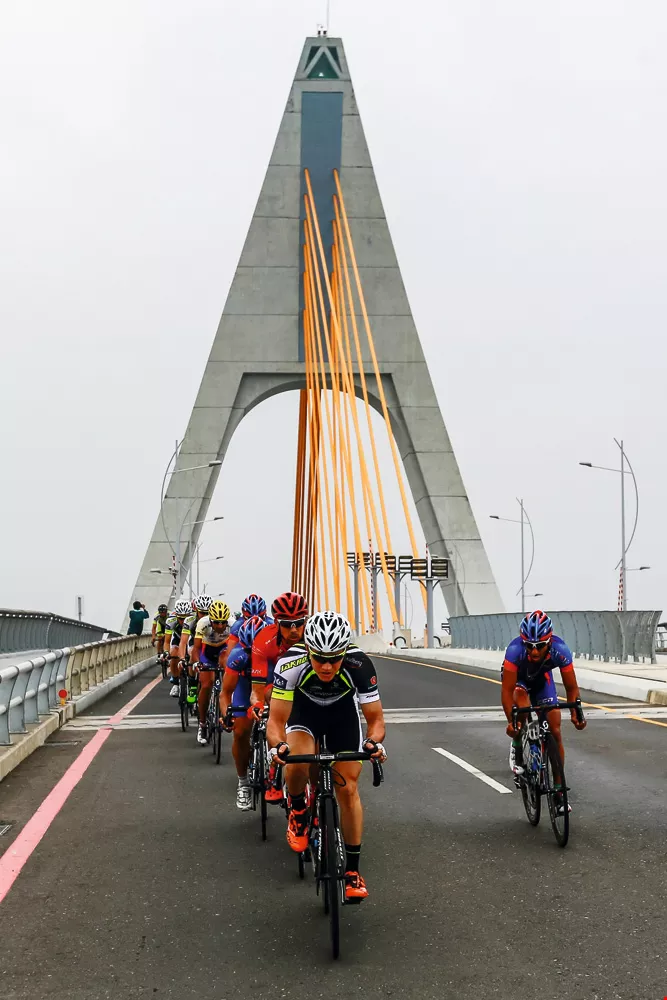
The race route passed by many famous scenic spots, including the Giant Buddha at Baguashan in Changhua County and the sea bridge at Dapengwan in Pingtung, creating a great opportunity for the international media to get up-close exposure to many of the island’s most aesthetic views.
The 2015 Tour de Taiwan consisted of five stages, starting in Taipei City, and then moving through Taoyuan City, Changhua County, the mountain stage, and the ultimate stage, known as the “Terrific Taiwan” stage. For each stage riders could accumulate points in different classifications, such as as sprints or climbs, so that each stage (and especially each “classified” segment within a stage) was important in its own way. The riders who got the most points on these sections could win the coveted green jersey for best sprinter or the polka-dot jersey for best mountain rider.
This was the first year that the Tour de Taiwan added a mountain stage. The route started off at the Xiangshan Visitor Center at Sun Moon Lake, passed by the Tatajia area of Mt. Jade (Yushan), and terminated at Mt. Ali (Alishan). The extreme challenge posed by this mountain route, with a total length of 109 kilometers, attracted a number of top climbers to test their mettle.
Feng Chun-kai, who had won the King of the Mountains title for three consecutive years, fell during the second stage of this year’s event, missing out on quite a few points. By the time Stage IV rolled around, it was clear he had no chance to win this year’s best climber jersey. But he nonetheless displayed the true spirit of sportsmanship, bolting out ahead right from the beginning of the stage to leave other riders in the dust. He maintained the lead for 89 kilometers, accumulating quite a few points. Unfortunately just before the long climb that culminated the stage, he was passed by the Iranian team, and then began to fall back in the pack, finally finishing the stage in 81st place.
The big winner this year was Iran’s Samad Pourseyedi (Mirsamad Pourseyedi Golakhour). He not only took the yellow jersey as the top overall individual rider, he also won the blue jersey as the top rider from an Asian country and the polka-dot jersey for King of the Mountains, a triple crown.
Having won last year’s Tour of Japan title, Pourseyedi was seen as the favorite for the 2015 Tour de Taiwan. After the event, he called the Tour de Taiwan one of his major competitions for this year. “Especially once I learned that they had added the extremely difficult mountain climbing stage, I was even more confident, because climbing is where I have my edge.”
Feng Chun-kai, who has a great deal of experience in international competitions, points out that as the Tour de Taiwan has upgraded its competition classifications and increased the difficulty of the route, the quality of the participating teams has also gotten stronger. It is now considered one of the most competitive cycling events in all of Asia.
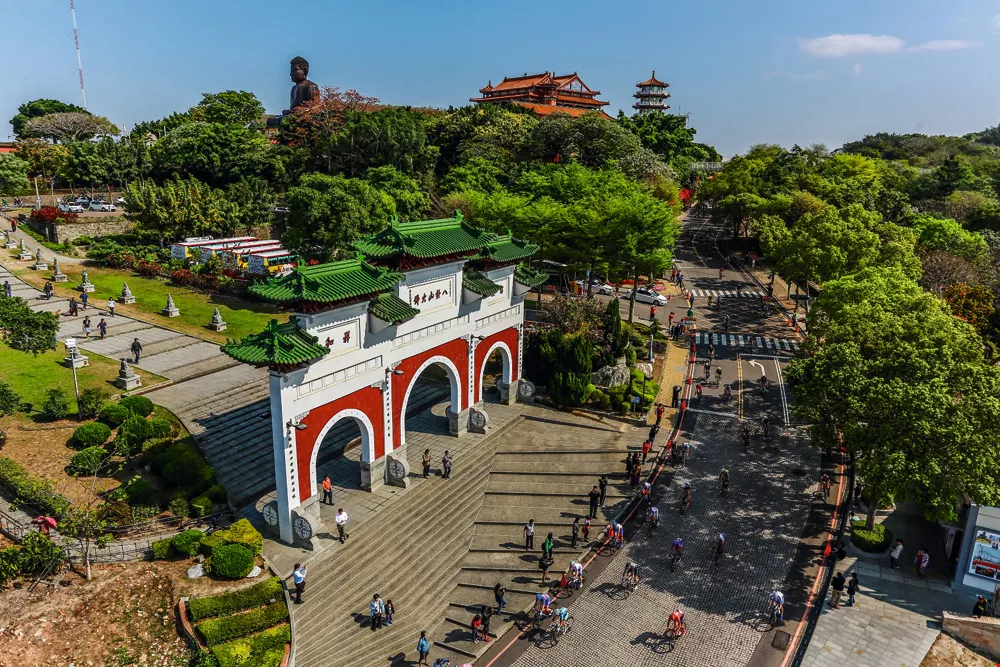
The race route passed by many famous scenic spots, including the Giant Buddha at Baguashan in Changhua County and the sea bridge at Dapengwan in Pingtung, creating a great opportunity for the international media to get up-close exposure to many of the island’s most aesthetic views.
The earliest cycling contest of note in Taiwan was a round-the-island race held in 1978, which came about as the result of efforts by King Liu, the founder of Giant Bicycles. The event began in Taipei, followed provincial highways south along the West Coast, and then came back up north along the East Coast. It took one week to complete the circuit of the island.
In recent years, thanks to major promotional efforts by the Chinese Taipei Cycling Association (CTCA), the Tour de Taiwan has been upgraded from a Class 2.6 event (a race in multiple stages for elite men sanctioned by the Union Cycliste Internationale, but offering no UCI points) to a Class 2.1 event (the lower the second number, the more UCI points there are, and the higher the quality of the participants). Taiwan is now a major stop on the Asian cycling tour. Next year it is hoped that the race will be upgraded yet again, to class 2.HC (a multi-stage “hors categorie” race, one level below a grand tour).
“The whole meaning of the growth of the Tour de Taiwan, from its origins as something run by some people in the cycle industry to today’s internationally recognized multi-stage event, is in spreading the word about Taiwan as a ‘bicycle kingdom,’” says CTCA secretary-general Lee Kai-chih. This year, not only did professional photography and film teams come from a number of countries to attend the tour, the organizers also deployed four drone-mounted airborne cameras to record the best footage of the race. Also, throughout the five days of the race, sports stations in Taiwan broadcast highlights of each day’s action, so that citizens could better understand this type of event.
UCI America Tour Advisor Pierre Hutsebaut opines that, given Taiwan’s organizing capabilities, there should be no problem in getting the Tour de Taiwan upgraded to Class 2.HC. The key will be in whether the event can attract more corporate sponsorship. “This is not just a sporting event. There’s a lot of marketing involved, and a lot of commercial considerations.”
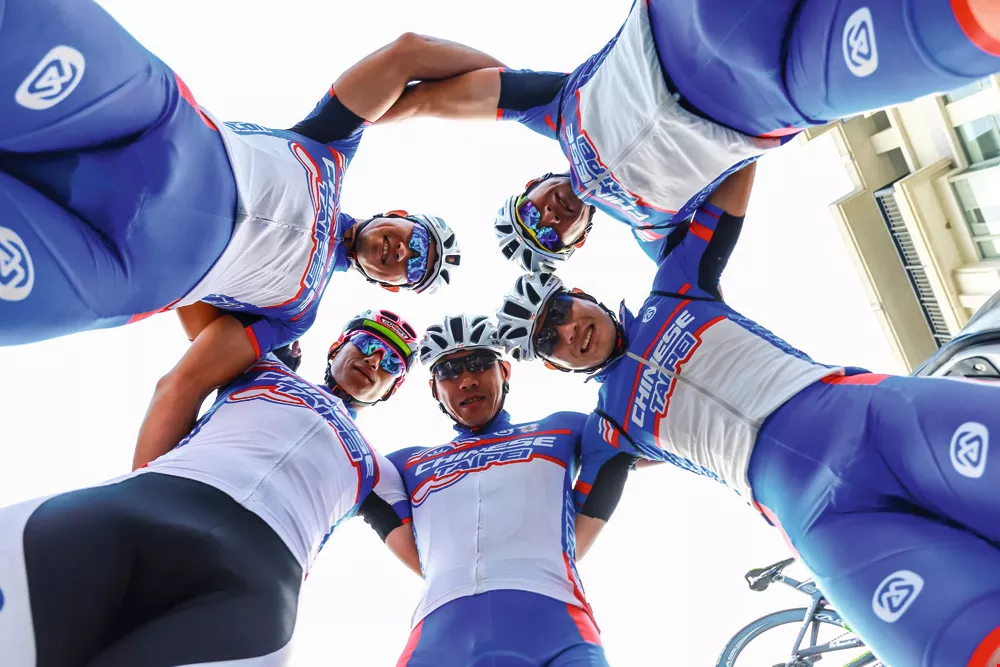
Five riders from Taiwan competed in this year’s Tour de Taiwan. Though most of the time they ride for separate teams, the fact that they often train together allowed them to work well together as teammates.
In order to increase the ripple effect of the Tour de Taiwan and attract more sponsors, in 2005 the event was moved from its traditional date in September each year to March, to synchronize it with the Taipei International Cycle Show (TICS). As a result, March has virtually become “national cycling month” in Taiwan.
The TICS is not only the largest show of its kind in Asia, it is the second largest in the world, attracting more than 10,000 buyers. The 2015 edition opened on March 18, and spanned both the Taipei World Trade Center and the TWTC Nankang Exhibition Hall.
It was not only the latest technologies and “warhorses” of the world’s leading cycle manufacturers that were on display. Top riders participating in the Tour de Taiwan are also annually invited to the TICS, where, with their star power, they naturally become the center of popular adulation.
While many small companies, heeding the notion of carpe diem, do their best to sell their in-house products to the cyclists, the bigger firms have larger ambitions, hoping to find additional opportunities to work with these professionals.
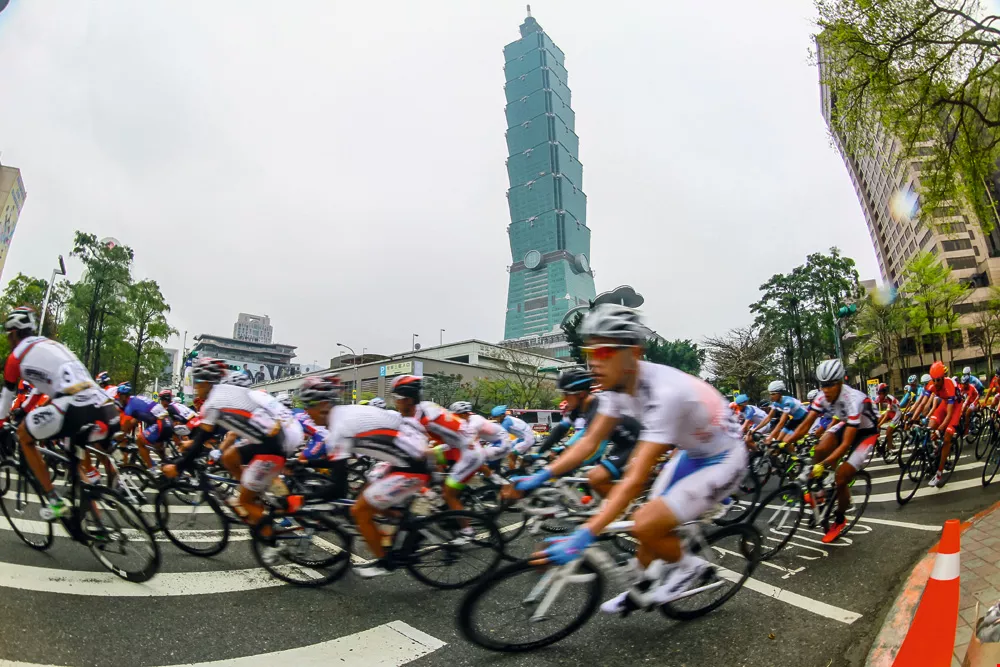
188 professional cyclists coursing through the streets of Taipei…. What a sight! No wonder the Tour de Taiwan was the talk of the town in March.
The locations where the Tour de Taiwan goes naturally become the focal points of attention for international media that are “along for the ride.”
Day 4 of the 2015 Tour de Taiwan, the mountain stage, started out at beautiful Sun Moon Lake, one of Taiwan’s top scenic attractions, and only got better from there. Riders then proceeded to Yushan National Park’s Tatajia area, which, though already at an altitude of 2610 meters, is in the shadow of the majestic peaks of the Central Mountain Range. Finally, the route had its finish line in Alishan National Park. No wonder people were saying that this day at the races was “not to be missed.”
Jasper Ockeloen, the ace rider for the Netherlands’ Parkhotel Valkenburg Cycling Team, was especially attracted to the 2015 Tour de Taiwan by the challenge of the mountain roads, because climbing is his specialty. “In comparison to Europe, the mountain roads in Taiwan are longer and less steep, so they really put your stamina to the test.” Ockeleon did a number of sessions of specialized mountain training to prep for the Tour de Taiwan, and he was pretty satisfied with his seventh place overall finish.
Unfortunately, he pointed out, though the scenery is undoubtedly beautiful, while racing you have to keep focused on the road, and you can’t waste any time rubbernecking in admiration. “In the future, during the off season, I will definitely come back to Taiwan and really take my time to enjoy the landscapes and food here,” Ockeleon promises.
2015 has been a big year for cycling in Taiwan. In February at the Asian Cycling Championships in Thailand, Taiwan set a new record by taking nine gold medals, and has gained a reputation as an Asian powerhouse. The 2015 TICS was the biggest ever, and bicycle exports are up 9% over last year. With the successful completion of the Tour de Taiwan, there is great hope that it will win an upgrade for next year. Meanwhile, in cities there has been great success with public bike rental systems, and across Taiwan local governments have been steadily opening new recreational cycling paths and trails.
Taiwan is evolving from a kingdom of bike manufacturing to an island where cycling is an important part of the culture of daily life.
@List.JPG?w=522&h=410&mode=crop&format=webp&quality=80)

@List.jpg?w=522&h=410&mode=crop&format=webp&quality=80)


