A Great Place to Meet
Kate Yang / photos Tsai Chih-yang / tr. by Christopher J. Findler
November 2004


In 1983, Page One was still just a department in Singapore's Kinokuniya Bookstore-an agency selling books on art design and lifestyles. It began doing its own publishing and after 20-odd years of steadily accumulating its own list of titles, Page One stepped out to set up book outlets in Malaysia, Australia, Thailand, and Hong Kong where, with four branches, it has become the top brand.
With the goal of making its shopping center world-class in mind, the Taipei Financial Center (Taipei 101) asked Page One in February of this year to set up shop on the premises. Page One was provided 2,400 square meters of floor space to do with as it saw fit. Page One leapt past the competition to become Taiwan's largest integrated bookstore in terms of both floor space and the number of publications offered.
Once the Taipei Financial Center receives safety certification at the end of October, large numbers of companies will start moving in. The estimated 85,000 employees they bring will become Page One's most important clientele, lending credence to the idea that they alone will be enough to sustain Page One.
Drawing a correlation between New York's Manhattan and Taipei's Hsinyi District, Page One's Corporate Affairs Department assistant manager Dennis Liu believes that Taipei 101 is situated at the epicenter of a very wealthy and sophisticated Asia. Taiwan is also the most vibrant market for Chinese-language publications in the world. It's no wonder that following its arrival in Taiwan, Page One would become the flagship of integrated bookstores.
To give Taipei's Page One a rapid transfusion of international experience, branch managers from Japan, Thailand, Malaysia, Singapore, and India take turns heading it up. When browsing through the store, it is not unusual to hear one of them spouting out instructions in mangled Mandarin, which makes one wonder whether these foreigners can truly understand the tastes and habits of the local market.
"Folks from Hong Kong and Singapore can speak both English and Chinese. We've also recruited a number of local publishing industry people with experience working in bookstores to work with them. I'm sure they've got their fingers on the market's pulse. When first taking the helm, for example, one manager from Japan took the initiative to go with the publications manager to visit all of our publishers and distributors in order to get a feel for the market as quickly as possible," explains Corporate Affairs Executive Jose Cheng.
Recently discharged from the military, Jules Lee, the newest addition to the corporate affairs department, chose Page One as the springboard to a career in books because of his fondness for the written word. He explains that Taipei's Page One is the group's largest storefront. Bigger even than the headquarters in Singapore, it brings together the best from all the stores. Its Chinese-language books, for example, cover such categories as military education, social science, law, and economics-far more than other branches. Throwing together managers from different countries and with diverse areas of expertise has really sent the sparks of ingenuity flying.
He points out that the convenience of Taipei 101 has made it a favorite meeting place for businesspeople. As a result, in addition to maintaining its eight major categories of art books, including publications on lifestyle and art design, Page One has expanded its range to include a comprehensive collection of books on finance, economics, and business management to meet the needs of its new clientele.
Based on the Taipei experience, 1,650 square meters of floor space will be the standard for future Page Ones in other countries.
When asked about rumors that Page One recruited a number of highly experienced individuals from Eslite Books when it first arrived in Taiwan, Jose Cheng promptly sets the record straight, "Only a few of our employees and none of our business planners came from Eslite. The ones we did take on are almost all floor managers." Corporate cultures, after all, vary from company to company and you really have to be careful about hiring employees from other bookstores. Singapore also sends individuals over from time to time to train employees on such topics as developing an eye for which foreign titles to buy and how to contact the international procurement department. To maintain Page One's distinctive flavor, all information and training is brought in directly from Singapore.
Jules Lee goes on to explain that Eslite, the epitome of chic bookstores in Taiwan, plans with the island of Taiwan in mind. Page One, on the other hand, has its eye on the world. The members of its international staff have disparate views on various subjects and appoint tasks to branches in different countries. Hong Kong, for example, is responsible for Taipei's image design. This management style is very different from those of most bookstores in Taiwan where the owner or a designated team is in charge.
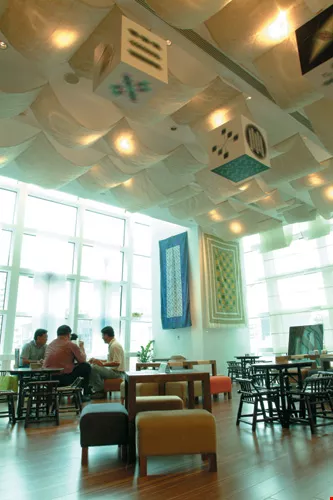
The coffee area has a distinctly Asian ambience-Vietnamese porcelain and coffee beans, lacquerware from Myanmar, Oolong tea from Thailand, Turkish apple tea, and choice gyokuro tea from Japan.
Towards the WTO era
In the past, most bookstores in Taiwan shied away from investing in foreign titles. Page One, however, has made "the most comprehensive collection of English-language titles in Taiwan under one roof" its motto.
Following its accession to the WTO, Taiwan has made getting in step with the rest of the world a primary goal. Learning English will become increasingly important and the age at which Taiwanese begin studying English will continue to drop. These considerations convinced Page One to jump headfirstinto developing Taiwan's English-language book market.
In Singapore, where Page One originates, English is an official language and English titles are the rule. The competitive market of Taiwan, on the other hand, is the world center for Chinese-language publications. With this in mind, Page One opted to set up an outlet providing large collections of both Chinese publications and English publications from Europe and North America to bring together East and West and offer readers the largest variety of choices possible.
Jules Lee reveals that there is a secret to stirring up interest in foreign-language books in Taiwan. The reason they have been unpopular is that most bookstores carry mainly literary classics and readers shrink from the idea of spending all of their time looking up words in the dictionary just to understand a single page. Page One is challenging this tradition with entertaining light reading. Now, individuals with average English skills and the desire to sample the world of English-language books can come here to find books just right for them.
Page One currently stocks 350,000 volumes comprising 240,000 titles. The one-to-one ratio of Chinese to English books makes it possible to set up rows of bookracks with English books on one side and Chinese books on the other. In the literature section, for example, Chinese literature is displayed on the one side, while the latest in European and American literature is arrayed on the other. Service counters are located in each section to assist customers who might otherwise find themselves lost in the store's vastness.
Jules Lee recalls that when the store first opened, the numbers on the account books were a bit of a shocker-English-language books made up an unexpected 55% of sales. An evaluation six months after the grand opening showed fluctuations in sales ratios between Chinese and English titles. Each now comprises about one-half of sales.
Jose Cheng notes that when they first entered the market with English-language-oriented inventory, opinions diverged widely and were generally pessimistic. Page One, however, insisted that the people of Taiwan had the right to English books and were probably prepared to accept them in large numbers.
In sharp contrast to Eslite, Page One is known for introducing a wide variety of books into Taiwan, offering almost all of the titles that publishers have to offer. It tends to avoid concentrating its publications around market trends. Cheng explains, "If you are going to satisfy the demands of a disparate readership, you have to offer all kinds of titles. Other important considerations include whether the time required to import books can keep pace with market trends, whether the books are what the general public wants, and whether they can meet the needs of some schools, in particular the special needs of schools teaching English and American literature."
Quite a few teachers at the Taipei American School have shared with Page One that because it used to be impossible to buy the books they needed in Taiwan, they had to lug boxes of books back with them when returning to Taiwan from trips abroad. Now, they can choose suitable textbooks and extracurricular reading materials at Page One. Life just got easier.
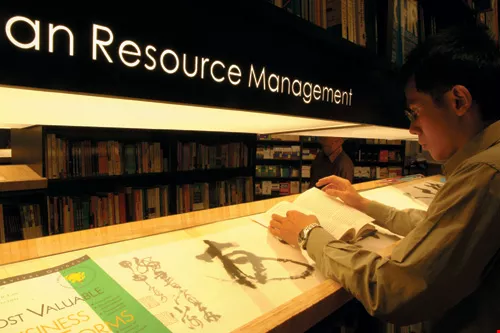
Artwork is often exhibited on the reading platforms located on top of the bookshelves. More frequently, however, readers lay their selections on these platforms to facilitate reading like they would in a library.
Selecting books
Page One's sheer size allows it to carry a larger collection of books than other bookstores in Taiwan, but Doubting Thomases in the industry question how Page One, which boasts a zero-inventory policy, can bear the burden of so many books and still entice readers not to simply browse, but to buy.
Jose Cheng says there is an art to it. To stay abreast of international trends, English-language book selections are based largely on New York Times book reviews. As to Chinese titles, Page One carries all the books of some famous authors such as Chang Man-chuan, while older books by other writers might not be stocked unless they have particular literary value. Books not in stock, however, can be ordered.
Page One may be huge, but there is simply not enough room to carry some books such as test preparation books, textbooks, and government publications. Selections tend to be lifestyle-oriented and are decided on jointly by Singaporean and Taiwanese managers. Cheng is of the opinion that Taiwan's readers tend to place a lot of stock in recommendations by celebrities and in attractive covers.
Jules Lee believes that consumers in Hong Kong and Singapore buy books based on personal taste. Due to the higher cost of living, books in Hong Kong, in particular, generally are not wrapped in book bands, something readers in Taiwan are quite fond of. Recommendations by celebrities that appear on book bands increase a book's authority and sales appeal.
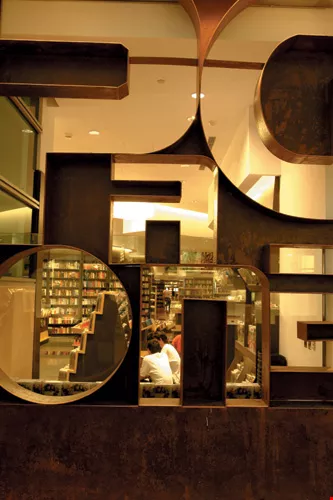
Based in Singapore, Page One set up a branch in Taipei 101 early this year. Boasting 350,000 Chinese and English books and 240,000 titles, it is currently Taiwan's largest bookstore.
Painting-inspired
In addition to a large selection of books, Page One boasts a highly original layout. The moment you walk in the door, you find yourself surrounded by a uniqueness of style that stands in sharp contrast to other bookstores in Taiwan.
Tan Kay-ngee, the Singaporean designer responsible for the interior designs of 11 Page Ones around the world, senses a desire to "return to nature" in Taipei's greenery. With this in mind, he designed the bookstore in Taipei 101 around the twin themes of "Chinese landscape paintings" and "Chinese wordplay." Whereas bookshelves in most bookstores are set up like so many upended boxes, those in Taipei's Page One vary in height and resemble chains of mountain peaks stretching into the distance, while the white gauzy fabric draped beneath the ceiling lights represent clouds. The arrangement was inspired by Chinese landscape paintings-luckily, the venue was large enough to carry it out convincingly. In the section where Chinese wordplay is the theme, bookracks are arranged vertically, horizontally, and at various angles to represent the unique lines of Chinese characters.
In addition to books, Page One has works of art and craftwork, including lacquerware from Myanmar, Vietnamese porcelain, and handicrafts from such Asian countries as Turkey and Thailand. It also has a special display area in which themes are changed monthly to introduce the arts of different places and infuse art into everyday life.
Nine rest areas of various sizes are set up throughout the store. Designed around Chinese landscape paintings, they are set off to the side like so many small mountain caves, giving visitors the opportunity to relax or read free of outside interference.
Tan says bookstores should not merely for reading and buying books; rather, they should be places to make friends with others that share an interest in books. Hence on top of some of the bookracks, in addition to new books and bestsellers, Page One exhibits works of art and posters based on the themes of spring, summer, autumn or winter, as appropriate. Visitors browsing on either side of the racks can see each other. The chest-high reading platforms are popular with readers, because not only are they well lit and well positioned for reading, it is nice to read around others who also enjoy reading.
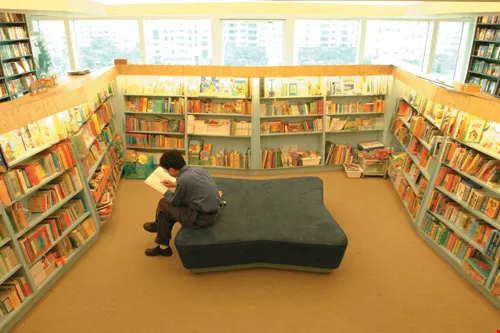
For readers, Page One's biggest draws include natural lighting and the nine "cubbyholes" where booklovers can take a break.
Big is beautiful
Page One is an international chain. According to Neil Peng, marketing and creative director for Kingstone Books, this has raised the bar for other bookstores in Taiwan. Peng does not conceal his admiration for this new kid on the block. Page One's two fortes-size and quality titles-are serving as a wake-up call for its competitors.
Peng points out that being a multinational concern gives Page One more sources of information for obtaining its wares. A person interested in aesthetics, for example, will find himself inundated with books on the subject, many of them totally unheard of among Taiwan's art intellectuals. Eye-opening experiences like this are shaking up local bookstores. Peng feels that once Taipei 101 is fully open for business, Page One will charge out of the gate. The ensuing battle for Taiwan's book market will be something to see.


@List.jpg?w=522&h=410&mode=crop&format=webp&quality=80)


