

The battle flags are flying and smoke fills the air. In this millennial presidential election, Taiwan is facing a generational transfer of power and pressing domestic and external issues. A choice for president shouldn't be finding "the least rotten apple in the bunch." Rather, voters should set their expectations high, and judge the candidates by their words and deeds, in order to choose a knowledgeable, far-sighted leader.
With the election at hand, this month we are reporting on issues of interest to voters, and have also sought out the views of the five candidates, especially on the issue of cross-strait relations. Readers can get an idea of where each of these hopefuls might take Taiwan. In the meantime, the real control over the future of Taiwan lies in the hands of citizens who will cast their ballots on March 18.
James Soong: We Need to Transcend the Existing Political Parties
(tr. by John Murphy)
Q: If you are elected, what positions will you adopt on issues of national defense, arms procurement, and maintaining the peace?
A: Our country's military strategy has already changed from the past policies of "military counterattack" and "integrated attack and defense" to the current "solid defense and effective deterrence." But because of the strategic disadvantage of Taiwan's small size, we should be more actively developing a "forward defense strategy." That is, we should carry the defense lines toward mainland China. We should do all we can to prevent the war from being carried to the Taiwan Strait or to Taiwan proper.
The idea of "forward defense" requires the coordination of three major structures: The first is an early warning system, the second is a crisis decision-making mechanism, and the third is a pre-emptive capability. Only in this way can we ensure the security of Taiwan.
As for arms procurement, first we must improve the "arms acquisition" process. This includes restoring the arms purchasing units in the various military services; strictly implementing systems analysis for weapons we want to purchase, to ensure that these weapons are suited to our national defense needs; and establishing a testing and evaluation unit, to affirm that purchased weapons conform to the original design needs.
Secondly, we must establish a strict purchasing process. This includes understanding the cost structure of weapons we wish to purchase in order to improve the military's ability to negotiate prices; devoting more attention to contract management to ensure the military can protect itself legally; better understanding of the arms export control procedures of relevant countries, so that we may adapt our purchasing methods; and understanding of the relevant corporations and of new products on the market.
In terms of maintaining the peace, the only way to truly prevent war is for us to play a certain role in regional security and to construct confidence-building mechanisms with Communist China.
Q: Do you believe it is possible to have a breakthrough in cross-strait relations, and if so, how?
A: Cross-strait relations should be approached with a serious, responsible attitude. We must think of the people, and actively negotiate to resolve dangers and difficulties for citizens. I advocate that the two sides should immediately open negotiations under the principles of "negotiating as equals" and "unconditional entry into negotiations, but agreement only under certain conditions." Cross-strait negotiations could be separated into political negotiations and economic negotiations, to make it easier to progress and achieve a win-win situation.
In political negotiations, we should attempt to organize a "creative forum" with multiple channels and multiple topics, exchanging views on subjects of importance in a long-term planned way, in order to create a sustainable, long-term peace mechanism for the two sides. Economic negotiations, on the other hand, would be for establishing norms for economic and trade relations between the two sides. These are essential to promote trade and economic development on both sides. If the two sides can, based on mutual trust, establish a normal negotiating mechanism, only then can we speak of a breakthrough in relations.
Q: If you are elected, will you approve the "three direct links"? Should the "no haste, be patient" policy be altered?
A: I advocate using an "active and positive" attitude to replace the principle of "be patient." The three direct links are by no means similar in terms of their implications for security, law, and technical issues. Therefore, we should abandon the tradition of seeing them as a single unit. I would separate them and decide them individually.
Under the precondition of national security and the national interest, cross-strait links should conform to two major requirements: First, they should contribute to raising national competitiveness. Second, they should be compatible with entry into the World Trade Organization.
Currently phone calls and mail across the strait must go through a third location. I recommend that in this area direct links immediately be opened. As for direct trade, after entry into the WTO, we will have to face liberalization anyway, so the government should face up to the problem directly.
In terms of the security considerations of direct shipping and air travel, the political, legal, economic, social, and psychological barriers are more important than the purely military issue. National security should be based on law. There should be clear standards and convincing reasons, instead of sweeping slogans and ideology to substitute for the fact that the government is unwilling to face up to reality. The two sides should undertake negotiations on direct shipping, and this issue should not be decided unilaterally.
Q: It seems that foreign policy is at cross-purposes with cross-strait policy. Which of the two is more important? Can we achieve our goals in both at the same time?
A: The biggest obstacle to our diplomacy is mainland China's opposition. We are both battling to steal away countries with whom the other has formal diplomatic ties, and fighting a white-hot war to participate in international organizations. Inevitably, competition in foreign relations impinges upon cross-strait relations and disturbs cross-strait harmony.
We cannot give up trying to expand our international space just because of mainland opposition, yet we also cannot afford to allow the development of foreign relations to damage cross-strait trust. The two sides should work together to find a balance that will take into account both international and cross-strait relations.
We should let the mainland understand that Taiwan's desire for international recognition comes out of the yearning of Taiwan people for a dignified existence. If the mainland responded positively, this could, on the one hand, persuade people in Taiwan to have more faith in the mainland, and could dissipate support for Taiwan independence.
We should also reassess what we are doing, and not deliberately provoke the mainland. As we promote substantive diplomacy, we should be equally active in promoting a substantive mainland policy. We must create a situation in which cross-strait relations are benign and become a supporting element in substantive diplomacy, not an obstacle. Foreign policy and mainland policy should be like the two wheels of a cart or two wings of an airplane, moving forward together.
Q: One of the special features of the 2000 election is the high degree of factionalization among parties. Do you accept the idea of a "coalition government"? What do you think the impact of a coalition government would be on future democratic development in Taiwan?
A: The main problem with Taiwan's democratic development thus far has been parochialism and excessive ideological emphasis in the parties, so that the parties no longer represent public opinion.
In this election, we have been pushing the idea of "transcending parties and factions." If this idea were applied to a future government, naturally that would be a form of "coalition government." That is, the new government would not be controlled by one party or a small number of people, but would allow the participation of people from various parties and groups.
But there would be a difference with what people generally mean when they say "coalition government." In general, coalition government involves cooperation among political parties, such as the left alliance and right alliance of French politics. But a government that transcends parties should be based on individual merit, without reference to party affiliation. Only this type of coalition government would truly transcend parties and factions and be "a government of the whole people."
Q: Every election, disputes over politics and money surface. If elected, how would you deal with the problem of money in politics?
A: The two main paths to resolving problems involving politics and money are legal controls and self-discipline. Legal restraint involves legislation and enforcement. We must first undertake the appropriate legislative tasks, and amend laws governing political contributions, lobbying, political parties, compulsory trusts, and election rules. Once completed, the laws can only be effective if they are strictly enforced. Thus law-enforcement agencies must be able to thoroughly enforce laws in order to prevent financial interests and political interests from working together behind the scenes for illicit ends.
As for self-discipline, this is a problem of individual politicians. Many old expressions tell us how great the influence of politicians is. For example: "A noble statesman is like the wind, the common people like the grass; when the wind blows, the grass naturally bends in the same direction." We must be examples for others, and not engage in inappropriate dealings with money. We must also strictly regulate our subordinates and be sure that they respect the law and behave correctly.
Q: There was a long delay between the breaking of the Chung Hsing Bills scandal and the time you made explanations to the public. Was this because there are too many skeletons in the closet in Taiwan politics? If you are elected, how will you deal with the problem of the assets of the Kuomintang?
A: The main reason it took so much time to explain to the public was not because we were protecting people or being secret, but because the amounts of money involved were enormous and the period of time that we had to go back and check was extensive.
The KMT says it wants to put party assets in blind trust, but putting them in trust is not enough. First we must investigate clearly where these assets came from. Anything that does not belong to the KMT should be returned to the country. Only what is left should be put into trust.
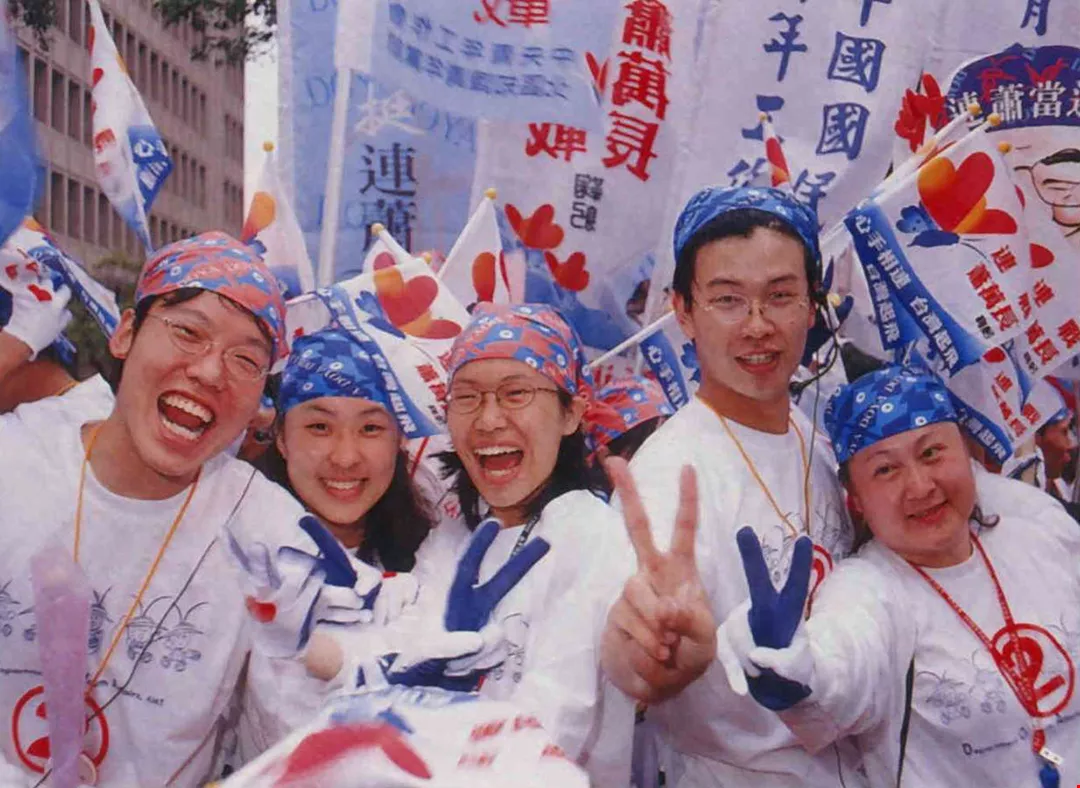
The candidates paraded to the Central Election Commission to choose their candidate numbers. Lien Chan drew No. 2-two fingers being "V for victory"-and young supporters celebrated this auspicious sign.

@List.jpg?w=522&h=410&mode=crop&format=webp&quality=80)


