Throwing Open the Sugar Mill's Gates:Chiang Yao-hsien's Community Building Journey
Vito Lee / photos Jimmy Lin / tr. by Scott Williams
May 2007


More than a decade ago, the national community-building effort planted a seed amidst the old dormitories on Hsingtang Road, a small street in the residential section of Kaohsiung County's old Chiaotou sugar mill compound.
Chen Chi-nan, then vice minister of the Council for Cultural Affairs, first advocated community building in 1994. The idea was to marry the cultural awareness of locals of a given area with government policy, thereby fostering the formation of a grassroots civil society in which locals would decide local issues.
Over the years, community building has become official policy, but the promise of those early days has waned. These days, in all of Taiwan only a very few communities like Chiaotou continue with such efforts.
The crucial common element keeping the community building effort alive in those communities that have persisted has been the drive and determination of key local players. Chiaotou's Chiang Yao-hsien is a case in point. Now in his 40s, Chiang has been involved with community building in the township since his university days.
Township residents didn't appreciate how much they had lost until the sweet smell of the cane being processed at the mill had gone. The realization sparked their efforts to salvage the mill, an endeavor in which Chiaotou's citizens have now been involved for over a decade.
Built in 1901 under Japanese rule, the Chiaotou mill was Taiwan's first modern sugar refinery. Tosaburo Suzuki, founder of Japan's Tokyo Sugar Refining Company, came to Taiwan himself to build the offices in the heart of the mill. The classically elegant building is surrounded by tropical trees, and features raised pedestals, an arched main entrance and a sun-screening narthex.
Though township residents regard the sugar mill as a treasure, it has never been easy to get inside.
"Entrance to the mill was strictly forbidden when it was in operation," says Chiang. "Only the dormitory areas were accessible." Chiang recalls visiting the mill's dormitories as a child on his first-ever elementary school outing. "In those days, no one but workers was allowed into the mill. We looked at the rain trees in the dormitory area, ate shaved ice in the Chungshan Hall, then watched the trains on the north-south line pass by. We went home thoroughly satisfied with our day."
The mill's gates remained shut when its production slowed in 1980, though local residents continued to enjoy visiting the dorm area. None of those spending their leisure hours there--the couples eating ice cream, the children playing, or the elderly citizens enjoying the cool shade--ever expected the government to issue an order in the 1990s that would nearly erase this repository of local history and memory.
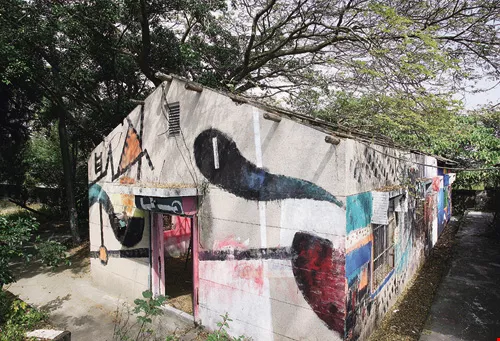
The mill's grounds are filled with a diverse collection of objets d'art created by the many artists-in-residence to which it has played host.
The first grass root
In 1979, Chiaotou, located in the northernmost part of urban Kaohsiung, became the site of the first public protest against the Nationalist government in Taiwan, and the township was long a stronghold of dangwai (anti-KMT) sentiment. Chaiotou's populace has never trusted the KMT or central government policy. The profound humanism of many of the dangwai activists involved in the democracy movement also seems to have rubbed off on the township, giving residents a "progressive" air. Lin Ching-yao, who once worked as a secretary to noted dangwai activist Yu Teng-fa, is a case in point.
When Lin returned home to Chiaotou after leaving his job with the county government, he staged Taiwan's first ceremony to honor a tree spirit, dedicated to an old dead tree. By commemorating the tree in this way, Lin was attempting to focus attention on the preservation of local culture. It was this concern for the town's roots that galvanized Chiang. On completing his undergraduate work in Tunghai University's Chinese department, Chiang returned home for the summer to await the start of graduate school. "I headed over to the township administration offices to ask Lin how I could help," recalls Chiang.
"The mill is one of our township's treasures," Lin told Chiang. "But ongoing cutbacks at Taiwan Sugar make it unlikely that it will be kept up." Anticipating the mill's decline, Lin gathered his friends, who began putting together an oral history. They also formed a sugar-industry reading group, which Chiang naturally joined.
Chiang began studying Japanese in order to be able to read the masses of documents dating from the Japanese era. The rich data he obtained from Japanese organizations and Taiwan University gave him a new perspective on the mill.
While Chiang had his head buried in books in the sweltering heat of southern Taiwan, a plan that would determine the mill's future was gradually taking shape in air-conditioned offices at the island's other extremity.
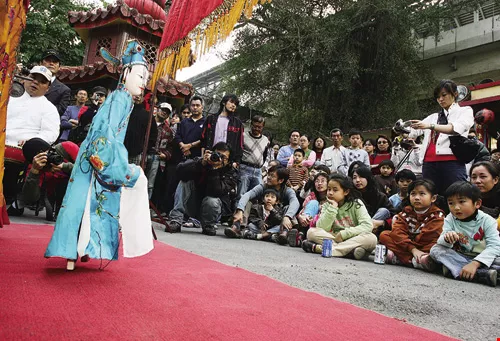
The success of Chiaotou's community building effort, which turned a decommissioned sugar mill into a living, functional space, is apparent from the crowds that come to attend performances and exhibitions on its grounds today.
Stopping the bulldozers
In an effort to address the longstanding development bottlenecks in Taipei and Kaohsiung , the Ministry of the Interior in 1992 began work on the Tanhai and Kaohsiung New Town Development Plans. Announced in 1994, the Kaohsiung plan called for the immediate leveling of the Chiaotou mill site, the repository of so much local memory and color, to make room for a new town.
"The people of the township were never consulted," says Chiang. "They were furious when they heard the news. That was the moment at which the concept of community building began to take hold in Chiaotou. And for that reason, community building in Chiaotou has, from the outset, been tied to preserving the mill."
"Township residents naturally welcomed plans to develop a new town and spur the local economy," says Hsu Chung-ming, the 56-year-old township head. "But the second stage of the land use plan required the leveling of the mill, which sparked opposition."
Lin established the Kio-A-Thau Culture Society at that time ("Kio-a-thau" is the Taiwanese pronunciation of Chiatou). His goals were twofold: First, he hoped that the organization would be able to draw the government into discussion of the plan. He also wanted to establish contacts with the county government in hopes of getting the mill preserved as a heritage site.
But though the groundbreaking for the first stage of plan went forward at breakneck speed, the land was too far from downtown Kaohsiung to interest private developers. And because the New Towns legislation superseded local construction codes, no other development was allowed within the 2,000 hectares designated for stage one of the plan. On learning that their land had been locked up, the townspeople were fit to be tied.
The first stage's failure to get off the ground brought the second stage to a halt and coincided with increasing political participation in the late 1990s by local social actors concerned about the preservation of cultural heritage. The Kaohsiung County Government exploited this activism to oppose the central government, and announced that it had designated the sugar mill a heritage site. In so doing, the county at least temporarily laid to rest local worries that the sugar mill would "disappear."
Chiang Yao-hsien, affectionately known as "General Chiang," speaks in a scratchy voice with a heavy Taiwanese accent. When he sits under a tree thinking, the look in his bloodshot eyes is that of an angry young man.
A treehouse nut
But, though locals had managed to dodge this bullet, another issue was in the breech.
When work on the Kaohsiung rapid transit system began in 2001, plans called for locating the terminus of the north-south Red Line in Chiaotou. Planners had routed the Red Line through the western side of Hsingtang Road, requiring the removal of a number of ancient trees and historic buildings, and leading to a new round of protests.
"The Kaohsiung rapid transit system's passage through Chiaotou calls for three stops in two short kilometers. And none of the stops are in a densely populated area!" says Chiang, angry at the absurdity of the plan. He stands next to the ground leveled for the New Town with a book bag on his shoulder and a cigarette clenched in his mouth. Vast fields of sugarcane still grow nearby. "On one side, you have vacant land where no one lives. On the other, you've got sugarcane fields. We're building a rapid transit station in the middle. Is it supposed to carry cane?" he asks.
The system was intended to be an extension of the New Towns plan. Though the plan has failed, the city's Mass Rapid Transit Bureau continues to insist on building the original route through the non-existent new town. It won't revise the route to meet Chiaotou's actual needs, to preserve the old trees, or protect the integrity of the sugar mill heritage site.
During the two years in which the rapid transit project was advancing into the mill, there were frequent news reports about the protests led by "General Chiang," who seemed to always have another trick up his sleeve in his sparring with the rapid transit bureau. He lobbied policymakers, organized hearings, and recruited friendly organizations to perform protest plays. He also moved into a treehouse he had built in a camphor tree and a rain tree that were about to be removed.
But the rapid transit line proved to be a far knottier problem than the new town. Neither the MRT protests nor the debates about the issue that took place online and in the media were able stop the system's advance. Police protected the excavators on the day they moved onto the mill's grounds, and the trees were removed.
To Chiang, the saddest thing is that in spite of all the differences between the KMT-led and DPP-led political factions, both are equally complacent when it comes to reconsidering and amending unjust policies and addressing issues of environmental protection. "The community-building policy called for building partnerships between the central government and local communities," he says. "Was there any sincerity in that? I don't see it."
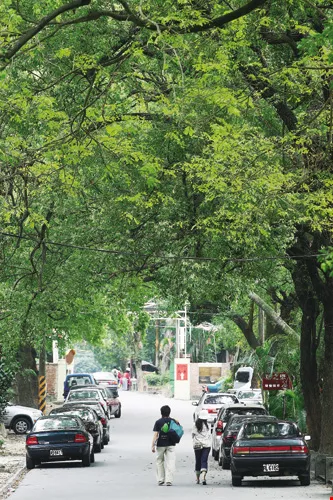
Walking in the shade under the trees on the way to the sugar mill's dormitory area. Chiaotou's residents have spent their leisure time here for generations. The area has later become a center of community building.
From preservation to reuse
Having succeeded in preserving the mill itself, the question became what to do with it. "If we viewed it as a heritage site, it would forever be something to look at rather than use; the space would become lifeless," says Chiang. "The ideal approach was to incorporate the heritage of this representative of industrial civilization into the workaday structure of local residents' lives, to make it a part of community life."
Since 2001, the arts village established on the mill grounds in 2001 by the Kio-A-Thau Culture Society and the Kaohsiung County Cultural Affairs Bureau (CAB) has been sponsoring artistic and cultural activities and inviting local and foreign artists to live and work here as artists in residence.
"At the outset, everybody was wondering who'd be interested in coming to Chiaotou," recalls CAB director Wu Hsu-feng. But as word gradually got out, the Kio-a-thau Arts Village not only began building good relations with the townspeople, but also began to acquire a measure of international renown. In recent years, its artist-in-residence program has attracted the likes of the American artist Lexa Walsh and the French photographer Philippe Callandre, adding an international dimension to the distinctly localist character of the village.
"Arts villages typically attract 'shiftless people' like myself, who come by to chat over some drinks," says TV director Ko Shu-chin. In 2006, Ko, the ex-wife of director Lin Cheng-sheng and a longtime Taipei resident, decided to return home to Kangshan Township--just over ten minutes by car from Chiaotou--to work on a script. "At first, I found the lifestyle here really unfamiliar," she says. "I couldn't find any coffeeshops or bookstores, and there wasn't any art."
A friend brought her to Chiaotou, where she discovered that art and coffee weren't unique to urban centers. She soon became a regular visitor.
Like the young and old who regularly visited the mill, Ko soon became fast friends with the seemingly rustic but very sharp Chiang.
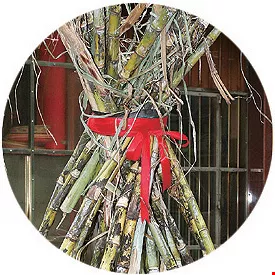
In February of this year, Ko and Chiang organized the Golden Sugarcane Film Festival, which drew the participation of 23 amateur filmmaking teams from Taiwan and abroad. Once registered, the teams finished up their scripts before spending a week in residence at the mill making their films. The result was a series of short films set in the mill, shot in digital video, and edited on computers.
"The old 32-millimeter standard made it hard to break into film," says Chiang. "Digital video has liberated filmmaking, making it both simpler and more democratic." The short films created for the next few years' festivals will ultimately constitute a video archive that will offer a portrait of the mill.
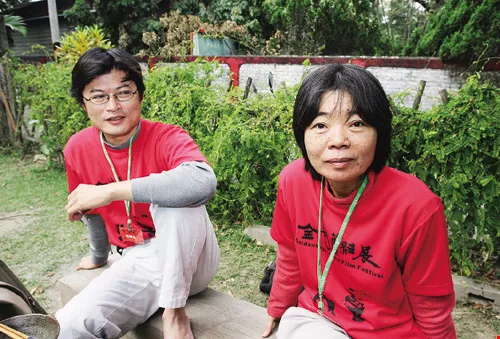
When Chiang met Ko Shu-chin (at right in the photo on the left), their caffeine-, alcohol- and cigarette-fueled discussions of literature gave rise to the February 2007 Golden Sugarcane Film Festival, which attracted 23 filmmaking teams from around the world.
A distorted ideal
But Chiaotou's community builders are facing the problem eventually faced by their counterparts around Taiwan--securing the sources of funding crucial to keeping their community building efforts going. Many--Chiang included--take on government projects to keep their work moving forward. "I do all the arts events and cultural surveys I can," says Chiang, who leads a team of ten. "It doesn't earn much, but it lets me limp along using one project to fund another," he says, sounding worn out. But what really gets him down is that even though the government, including the Ministry of the Interior and the Council for Cultural Affairs, creates community building plans every year and allocates resources to them, these resources never actually make it into the communities for which they are intended.
Chiang explains that community building initiative has been underway for years, and there are a number of teams all across Taiwan known for their community building work. The government can't provide guidance and support to each and every one, so many "agencies" have appeared. On the one hand, these organizations bring together public-service-minded academics, providing them with the chance to contribute their knowledge and expertise to the community. But, viewed from another perspective, they're something like lead contractors or intermediaries: They provide staff, rapidly draw up plans to compete for funds, and guide communities through event set up and public relations. When the end of the year rolls around, they produce one slick, heavy report after another chronicling their projects.
"The community builders who receive annual government subsidies of NT$1-2 million often have no idea what was in the proposal submitted in their name!" says Chiang. This tendency to focus only on putting out pretty reports is the most egregious distortion of the original spirit of community building.
These organizations are quite large and need funding to keep themselves afloat as well. "They ultimately end up devouring the bulk of government resources annually earmarked for community building projects, leaving only scraps for the communities themselves," says Liao Chia-chan, head of the New Homeland Foundation of Puli, Nantou County.
"Overall, about half of all monies budgeted annually for community reconstruction in Taiwan end up in the hands of these 'administrative platforms,'" estimates one Southern Taiwan community builder.
"Slogans are easy," says Chiang. "'A bottom-up policymaking process.' 'A partnership between the government and local communities.' 'Rolling out democracy.' But real community building requires a long-term effort on site. You begin by talking with the people who live there and understanding their needs, then look for a way to make it work. You don't just jump in and start giving orders based on 'community-building expertise' or like some sort of high-and-mighty academic."
Chiang has seen one after another of the passionate young people who took up community work with him desert their posts, some even making big money by taking up government projects in the name of pursuing community development, and admits that he sometimes feels very alone and wants to give up.
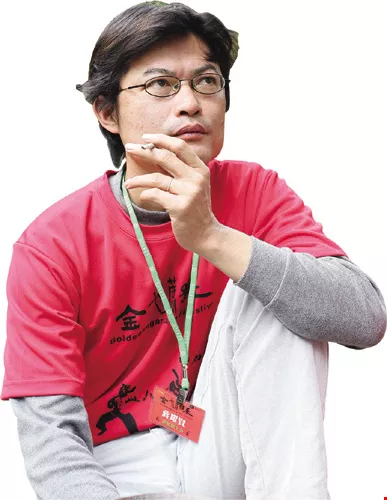
Chiang Yao-hsien, affectionately known as "General Chiang," speaks in a scratchy voice with a heavy Taiwanese accent. When he sits under a tree thinking, the look in his bloodshot eyes is that of an angry young man.
A faded dream
In addition to taking on government projects, Chiang also earns money writing, producing both essays and fiction. "Its all for prize money," he says. "I make about NT$20-30,000 per month doing community building, so literary prizes look pretty appealing."
But there's a heavy sense of despair in the worldly-wise Chiang's writing. His parents were blue-collar and growing up money was always tight. "Add to that an early marriage and an early divorce. When you turn that kind of life into literature, people aren't going to find it upbeat," explains a female friend.
But Chiang feels invigorated as he waves to the people of Chiaotou and the shadows of the mill trees gently sway. He recalls the preservation of the mill and the long road to getting it opened to the public. He remembers how the mill owners resisted signing a new lease, and objected to his "interference." He remembers how the mill management contested the county government's decision to declare the mill a heritage site. He remembers....
No policy lasts forever, and the term "community building" will certainly fade from memory. But when the next generation takes a stroll here amidst the singing of cicadas, they should spend a moment thinking about the ideal that underlay it and the thin man known as "General Chiang."

@List.jpg?w=522&h=410&mode=crop&format=webp&quality=80)


@List.jpg?w=522&h=410&mode=crop&format=webp&quality=80)
@List.jpg?w=522&h=410&mode=crop&format=webp&quality=80)
