Ancient Giants of the Forest--Taiwan's False Cypresses
Chang Chin-ju / photos Lai Chun-piao / tr. by Robert Taylor
March 2001


The Bible says: "If you have faith as a grain of mustard seed, you will say to this mountain, 'Move hence to yonder place,' and it will move; and nothing will be impossible to you." For small as the mustard seed is, it grows into a mighty, spreading tree. Applying these words to Taiwan, they most aptly describe the Taiwan red cypress, whose tiny seeds are the origin of Taiwan's greatest trees. From conelets three millimeters in diameter come seeds no larger than sesame seeds, yet they grow into huge trees up to 60 meters tall. The Taiwan red cypress witnessed Taiwan's birth, squeezed up by the collision of two tectonic plates, and its progress from a fragile mass of broken rock to a more stable geology. It has also witnessed the rise and fall of Taiwan's forestry industry.
Hsiuluan Village, an Atayal community in eastern Hsinchu County, was one of the last places in Taiwan to be reached by modern civilization, and was once famous as the "village without lights." In the mountain forest above Hsiuluan's outlying hamlet of Chenhsipao, bushes and creepers form a dense undergrowth, and a blanket of damp fallen leaves makes the going slippery underfoot. Every ten to 20 meters, a magnificent Taiwan red cypress, thousands of years old and with a trunk three to four meters thick, towers 40 meters into the sky. Awe-stricken hikers standing below these great trees have the impression of having fallen into a sea of jungle, from which they can barely see the sky.
This remnant of virgin cypress forest runs northward to Taoyuan County's Mt. Lala and to Chilan in Ilan County. This great wall of trees acts as a vital "safety valve," regulating the flow of water into the Shihmen Reservoir, the Tanshui River and the Lanyang River, on which millions of people in northern Taiwan depend for the water they drink. The coat of green which clothes the mountains intimately affects water quality and soil stability in Taoyuan, Hsinchu, Miaoli and Ilan Counties.

The seeds hidden in the tiny conelets of the Taiwan red cypress seem blessed with a mysterious power. In the harshest of natural environments, they grow into mighty, towering trees. (photo by Jimmy Lin)
A land of clouds and mists
Taiwan's "false cypresses"-trees of the genus Chamaecyparis, a subdivision of the cypress family, Cupressaceae-are relics of the ice ages which brought them to our geologically young island. Thirty million years ago, Chamaecyparis species were distributed all over the world. But after the ice ages, the high mountains of Taiwan, which were squeezed up from the edges of two tectonic plates a million years ago, became their refuge. Today, only six false cypress species remain anywhere in the world, scattered far apart in North America, Japan and Taiwan. Two of them are native to Taiwan: the Taiwan red cypress (Chamaecyparis formosensis, a.k.a. the Formosan cypress) and the Taiwan yellow cypress (Chamaecyparis obtusa var. formosana, a variety of hinoki cypress).
The home of Taiwan's false cypresses is at medium elevations from 1,300 to 2,600 meters, which is Taiwan's area of greatest precipitation and a major source of water for over 100 rivers. At these elevations there is much rainfall but relatively little wind, and the mountains are shrouded in clouds and mists all year round; hence the forests there are also known as cloud forests. In this environment of constant humidity, the Taiwan red cypress grew into East Asia's biggest conifer, with average heights from 30 to 40 meters.
The cypress forests also mark the transition between Taiwan's broadleaved and coniferous forests. False cypresses make up more than 70% of the trees in this zone, but they are accompanied by a rich variety of other plants, including other big trees like Formosan taiwania (Taiwania cryptomerioides), Formosan cunninghamia (Cunninghamia konishii) and Chinese yew (Taxus mairei). Hidden in the dark, damp understorey are a third of Taiwan's fern species, and the millennia-old false cypresses are also a paradise for epiphytic plants-as many as 80 species have been found growing on a single tree.
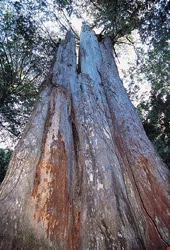
The seeds hidden in the tiny conelets of the Taiwan red cypress seem blessed with a mysterious power. In the harshest of natural environments, they grow into mighty, towering trees. (photo by Jimmy Lin)
Taiwan's Earth God
The devastating 21 September earthquake of 1999 left Taiwan's landscape covered in scars, but researchers discovered that the places least damaged by the quake were areas of natural forest. In mountain regions where the rainfall is most abundant, the geology most fragile and erosive forces most powerful, the false cypresses, with their massive trunks and mighty root systems, cling tightly to the frail earth.
Professor Chen Yu-feng of Providence University, who has been studying Taiwan's flora for many years, explains that false cypress forests often grew where river erosion created large areas of debris from rockslides. As tectonic forces pushed Taiwan continuously upwards and the rivers carved their way downward, such areas of collapse occurred in many places. Doughty false cypress seeds seized the opportunity to colonize this hostile territory shunned by other plants. There they gradually grew into gigantic trees, rehabilitating the land and attracting other species. At the same time they protected downstream areas, making them suitable for settlement and farming. "The growth of the cypress forests stabilized the rubble brought down by the rushing mountain rivers. The false cypresses are living 'spirits' which naturally restore the land," says Chen Yu-feng.
For the past million years, clouds rolling in on northeasterly monsoon fronts in winter and southwesterly airflows in summer have carried their moisture into the mountain valleys, to slowly condense onto the slopes where the false cypresses grow. Steeped in this dampness, the flora and fauna of the forest continued an unending cycle of growth and renewal through the changing seasons. The only humans who entered there were the aboriginal people who came to hunt and to collect wild fruit and berries. Every few decades the shaking of the earth would ravage this ecosystem, but protected by the vitality of the cypresses the land would gradually recover.
The nemesis of the cypress trees
However, the advent of mechanization, coupled with human greed, heralded a period of rapacious exploitation. In the 19th century human beings swarmed into Taiwan's dark mountains like busy worker ants. The false cypresses, which had conversed with the clouds for a million years, were identified as top-grade timber, and were thus condemned to an inexorable fate.
After Taiwan was ceded to Japan following the Sino-Japanese war of 1894, while the Japanese were still quelling resistance to their rule they also went into the island's mountains to collect botanical specimens. In 1896, a Japanese biologist collected the first specimen of Taiwan red cypress on Yushan, and before long the Taiwan yellow cypress was found there too.
In 1899, the great cypress forests of Mt. Ali were discovered, and in 1912, the Japanese colonial government began large-scale logging there. Everywhere the Alishan Mountain Railway passes at higher elevations was once cypress forest. Soon afterwards the forests of Mt. Taiping in modern Ilan County and Mt. Pahsien in Nantou were also opened up for logging. Endless streams of cypress logs flowed out of the mountains, and were carried across the sea to Japan to become pillars for Shinto shrines.
Quite apart from the incomparable quality of their timber, in terms of numbers alone the Taiwan red and yellow cypress took second and third place among Taiwan's trees, so they became long-term cash cows for the island's forestry industry. After Taiwan's return to Chinese rule, from the 1950s to the 1980s the ROC used forestry income to support its industrial development. The logging grounds advanced deep into Taiwan's heart, consuming even greater areas than under the Japanese. False cypresses accounted for two-thirds of the 300,000 hectares of commercial forest, and contributed 70-80% of forestry income.
All of Taiwan's forest recreation areas today are to be found in the former cypress logging grounds. The Alishan Mountain Railway, and the long forestry roads which wind through Taiwan's four major mountain ranges, were all built for the sole purpose of shifting the huge cypress logs down the slopes. "You could say that everything connected with Taiwan's forestry industry developed around the false cypresses," says forest ecologist Yang Kuo-chen, an associate professor at Providence University. The history of forestry in Taiwan is a history of false cypress felling, says Yang.
Hinoki and merihi
If you speak of "hinoki," the Japanese name of the Taiwan yellow cypress, older Taiwanese will lift their noses as if catching a whiff of its unmistakable fragrance-it has a firm place in their memories as the best of timbers. The Taiwan yellow and red cypress each have their own different qualities. The Taiwan yellow cypress grows pencil-straight towards the heavens, and has a higher content of oil, from which a fragrant essence can be refined. In 1971, after the Shinto gate at the Meiji Shrine in Tokyo was struck by lightning, the Japanese authorities especially came to Taiwan to buy 11 huge, straight Taiwan yellow cypress logs 16 to 24 meters long, cut from trees over 1,500 years old, to create the world's biggest Shinto gate.
As for the Taiwan red cypress-merihi in Japanese-it is even more magnificent in appearance than the Taiwan yellow cypress. But the Taiwan red cypress's trunk is often divided, and because it mostly grows in wet river valleys the heartwood is prone to be eaten away by bacteria, producing strangely tangled hollow trees. The crown is also broad and difficult to cut. This is why the gigantic ancient trees that have escaped the loggers' chainsaws, such as those at Mt. Ali and Mt. Lala, are all Taiwan red cypress.
Human life is fleeting, but cypress is forever. As the forestry industry gradually declined, the forestry huts built in the Central Range in the Japanese period fell into disrepair, but their cypress-wood washbasins are still as good as new. The close grain of their growth rings reveals their age, and their resilience.
In the early days, the sleepers used for the Alishan Mountain Railway were cut from broadleaved trees such as beech and Michelia compressa. But tough as these woods are, the sleepers only stood up to three to five years of logging trains rumbling over them, so there was no choice but to change them all for sleepers made of false cypress wood, which lasted for decades. And when the railways were finally taken out of service, the Taiwan Forestry Bureau (TFB) sold off the old sleepers, and from the proceeds not only was able to recoup the cost of dismantling the railways, but was also left with a tidy sum for its own coffers.
For the older generation, the excellence of false cypress wood is hard to put into words. Old folk to this day still rattle on about how the cypress-wood sleeping platforms of Japanese-style houses were long-lasting and hard-wearing, and how the best bathtubs were of course those of made of false cypress wood. In the eyes of furniture makers, "False cypress wood is light and easy to work; it is flexible, rotproof and termite resistant. It rarely warps, and hardly shrinks; it planes to a smooth, fine surface. It's so versatile: boats, bridges, carriages, cabinets or coffins-there's not one it's not suitable for." In short, of all Taiwan's commercial timbers, there's not another to match it.
Pining away
However, behind these sweet memories of cypress wood are the regrets of the foresters. Surveys made before logging began at Mt. Ali, Taiwan's earliest cypress logging area, showed that there were more than 300,000 false cypresses over 1,000 years old, but today all that remains of them is a few lonely-looking old trees scattered among introduced Japanese red cedar (Cryptomeria japonica) and flowering cherries. Despite its great fame, deprived of the company of its own species the most celebrated of the giant Taiwan red cypresses of Mt. Ali finally succumbed to lightning and fire.
The TFB once hoped that if a few false cypresses were left standing in each of the old logging areas, they would seed naturally. But they discovered that although the trees were completely uninjured, they died one by one. Late Taiwanese forestry expert Liu Chin described these few remaining trees as "dying of loneliness." It seems that when abandoned by the companions they had relied on for millennia, and left to face the rigors of their environment alone, these ancient survivors went into terminal decline.
But an even greater cause for regret is that "50 years of intensive false cypress logging tore the heart out of Taiwan's life-support system. This devastation, coupled with agriculture moving up into the mountains, can only result in landslides, floods and all kinds of 'natural' disasters. . . ." With ecologists' warnings ringing in their ears, now that floods and mudslides have become a common occurrence, people can only nod in tacit agreement.
Large-scale logging of false cypresses continued right up to 1989. With forestry earning no profits, and in response to energetic lobbying by civic groups, the Executive Yuan finally banned the cutting of natural forests, at last giving a respite to the giant trees which protect Taiwan's land.
But the great wall of 20 million gigantic false cypress trees which once stretched the length of Taiwan had already been breached. Apart from some scattered local stands, the Taiwan red cypress forest of Mt. Hsiukulan in central Taiwan, and the 10,000-plus hectares of Taiwan yellow cypress at Mt. Chilan in Ilan County in northern Taiwan, are the island's only remaining forests of giant trees.
Whose national park?
Humans cut down the million year-old cypress forests in less than a century, but the story of their destruction is not over.
Amazingly, the ban on logging natural forests has not protected Chilan, the only single-species forest of hinoki cypress surviving in the world today. Before the ban, the Vocational Assistance Commission for Retired Servicemen (VACRS), which manages Chilan, had already cut down almost 6,000 hectares. To generate income, VACRS has continued logging there under the pretext of "clearing away dead and fallen trees to make space for young trees to grow." Ecologists and biologists can only repeat again: "The trees have been growing by themselves for tens of thousands of years, so why would they need human help for their saplings to grow?"
In response to this situation a popular movement sprang up to push for the establishment of a "cypress forest national park," in the hope that with national park status, the last remaining virgin Taiwan yellow cypress forest could be saved. Perhaps the millennium year was a decisive one for the trees, for the Executive Yuan allocated new funds to the VACRS so that it no longer needs to cut down trees to bolster its finances, and also approved a plan to set up a national park. But so-called ecotourism is now emerging as another threat to the trees' survival. To assure the livelihood of the local Atayal aborigines of Chilan, when the cypress national park is set up consideration will have to be given to how to balance the need to protect the forests with the demand for sustainable tourism. How can Taiwan's false cypresses become more than just a tool of human economic activity? Can the sad history of cypress logging teach the people of Taiwan a lesson in how to truly care for their land? Perhaps these questions are still more important than the issue of establishing a national park.
A future for the cypresses?
At the Atayal village of Chenhsipao in Hsinchu County, by three in the afternoon the clouds rolling in from afar have quietly slipped over the ridges and covered the whole mountainside where the cypress trees grow. Here, in Taiwan's remote but vitally important heartland, gigantic trees which have survived the long river of time and escaped the ravages of logging stand undaunted, like guardian spirits quietly protecting the Atayal people and Taiwan's land.
Only if we can allow the cypress trees a future, will the people of Taiwan also have a lasting future.

@List.jpg?w=522&h=410&mode=crop&format=webp&quality=80)


