For the Sake of an Unfulfilled Dream
Wang Jia / photos Vincent Chang / tr. by Robert Taylor
June 1995

.jpg?w=1080&mode=crop&format=webp&quality=80)
One of them is a young photographer who could not endure the noise and vexation of the city, yet was weary of the tedium of the countryside, and who for a time looked after his child full-time at home; the other, an old photographer who has carried on his family business in this small town, who has never married, and who, now that the other members of his family are gone, is left all alone.
The two had never met until a neighborhood movement to protect a temple and save some trees brought out a mass of old photographs of their hometown, Yangmei, and changed both their attitudes to life. Between these two, the image of another crucial character--Wu Chin-miao--is also gradually becoming clearer.
For Liang Kuo-lung, who grew up on Yangmei's New Street, the "Chin-miao Photographic Studio" on Old Street was something whose existence was as natural as that of Hsifukung, the town's oldest temple, and Pokung Hill behind the temple with its big round shade trees. He had never stopped to think about it, and had no particular feeling for it either.
Sometimes, like the Qing dynasty railway bridge piers near the hill, it seemed to symbolize the little town's former prosperity, but at the same time reminded one of its present decline.
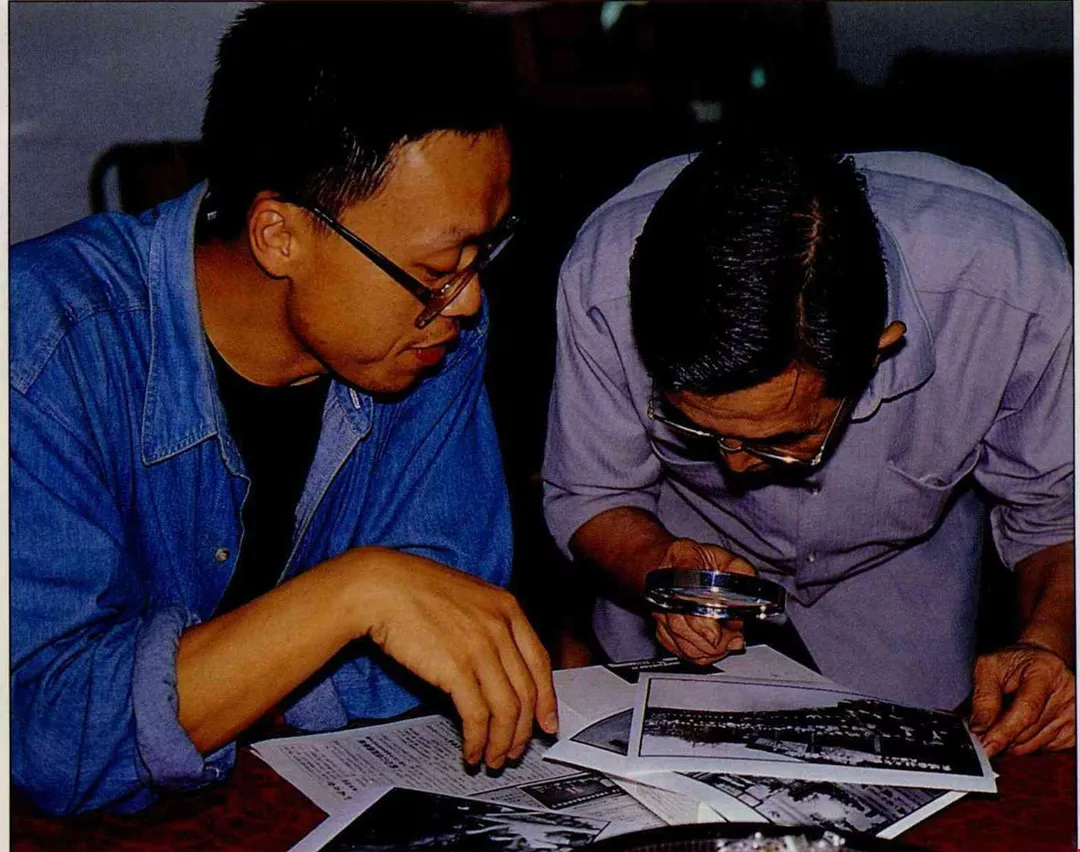
(left) How could I forget a picture I took myself? Ah-lung's grand dad and my father are both in it.
Urban angst, bucolic boredom
"Growing up in a small town in the 1960s and 70s, local consciousness wasn't as strong as nowadays." Liang Kuo-lung, born in 1959, says that in the past he always thought that what the older generation had left them was a declining, hopeless place.
But the problem was that Liang, who was used to tickling fish and netting shrimps in the stream by New Street, found city life quite unbearable. After he finished technical college, he followed his own interest and chose a career in photography. He photographed the Yangmei of the 1980s, but was not satisfied with his pictures, and destroyed them all. Later, he spent two years travelling throughout Taiwan taking a series of portraits of centenarians. "Faces of the Century," which he completed in 1989, not only attracted attention and praise from within the ROC, but later was also exhibited in Belgium.
When he had just finished shooting "Faces of the Century," his son was born. But as he and his wife were both busy working, the child was placed with a child minder 24 hours a day. "In fact I felt very guilty--the child had been born, why shouldn't it spend more time with its parents?" So the young father volunteered to become a full-time househusband. Two years went by in a flash. Busy with nappies and feeding bottles, Liang Kuo-lung had to live with the frustration of not being able to continue his creative work.
When he received an invitation from the Museede la photographie in Charleroi, Belgium, for an individual exhibition, Liang Kuo-lung was in fact very hesitant to accept. One reason was his aversion to big cities, which prevented him spending more than two or three days at a time even in Taipei, and another was that he did not wish to rest on his laurels. Also, at the time he had already been looking after his child for two years, so his first reaction was that he would be too worried about leaving his son.
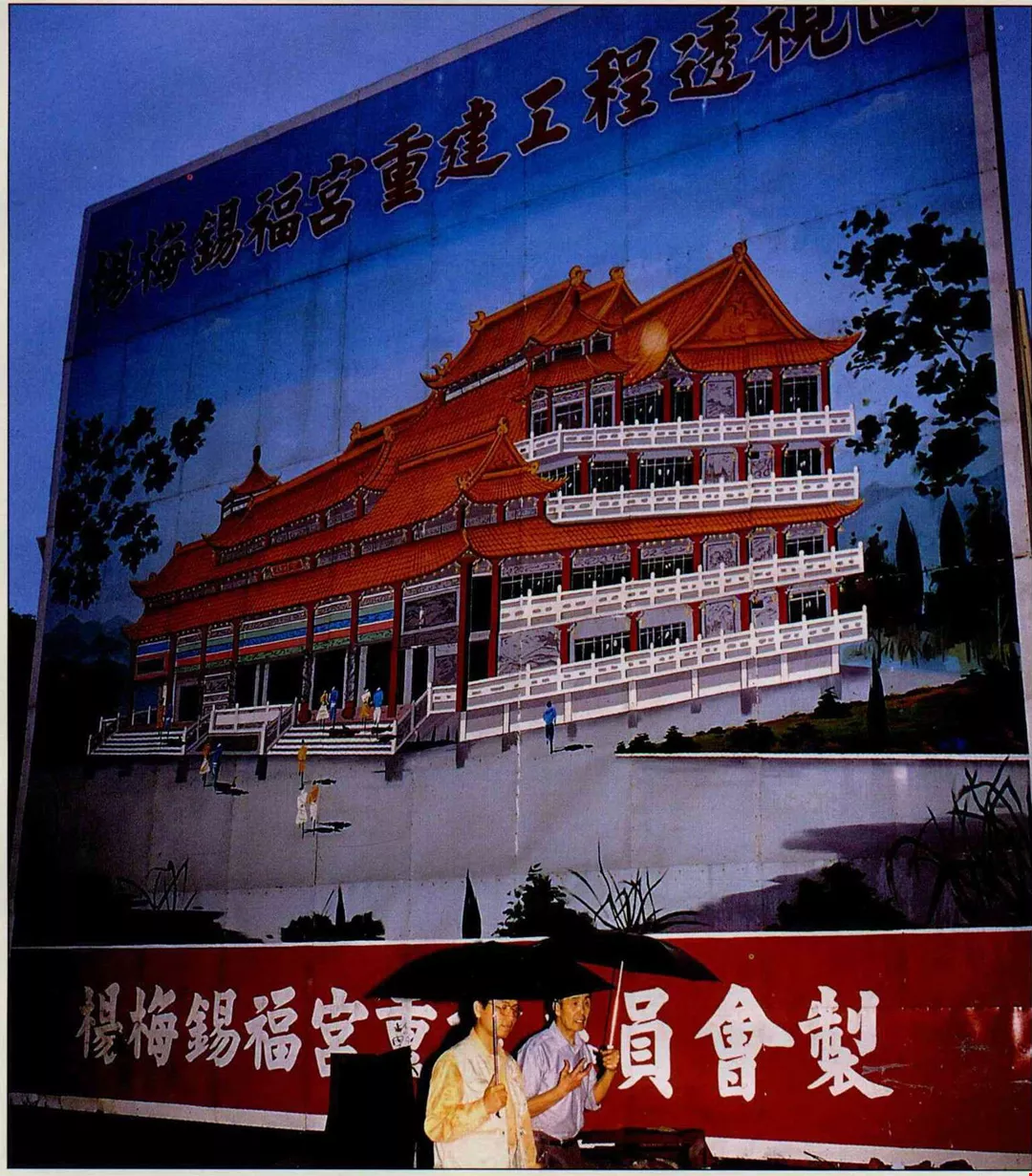
One evening, hearing that an old tree on Pokung Hill has fallen down, Wu Chin- jung and the "out-of-towner"-- Tseng Nien-you, instigator of the campaign to protect the temple and save the hill--hurry off to investigate.
Old photos? Nothing doing!
With no great enthusiasm, Liang Kuo-lung accepted the Belgian invitation. But for the first time, the Belgian capital Brussels changed his view of cities: a big city could after all allow the old to survive alongside the new and retain a sense of beauty and a leisurely pace of life.
At the exhibition, an old lady who lived in a retirement home, and was brought by her son, said to Liang through the interpreter:"I really wish I could be like the old people in your photographs." What she meant was to be surrounded by children and grandchildren.
Can comprehensive medical care, old people's homes and a welfare system give people contentment in their old age? Is it inevitable that "five generations together under one roof" and having one's children and grandchildren at one's knee should become a thing of the past? Liang Kuo-lung has come to feel deeply that in human life there is after all no inevitable logic which says that the old must be replaced by the new. Whether in terms of one's environment or lifestyle, one has to rely on feelings and love to create the culture in which one can live contentedly.
Returning from Belgium to his little town, Liang Kuo-lung found that his creative urge had returned. He carried on looking after his son for another year. Then, as the child was a little older, he again slung his camera across his back and travelled around photographing Hakka villages. At that time there was a fashion in artistic circles for old photographs, and as Liang Kuo-lung went around taking photographs, he took the opportunity to collect any he could come by. It was only then that he thought of the "Chin-miao Photographic Studio" on Old Street, where they still used an antique-looking bellows-type camera.
In April last year, Liang Kuo-lung stepped into the old studio and explained what he wanted, but to his surprise Wu Chin-jung dismissed him with the words:"Old photos? I threw them all out long ago!" At this rebuff, Liang left in a despondent mood.
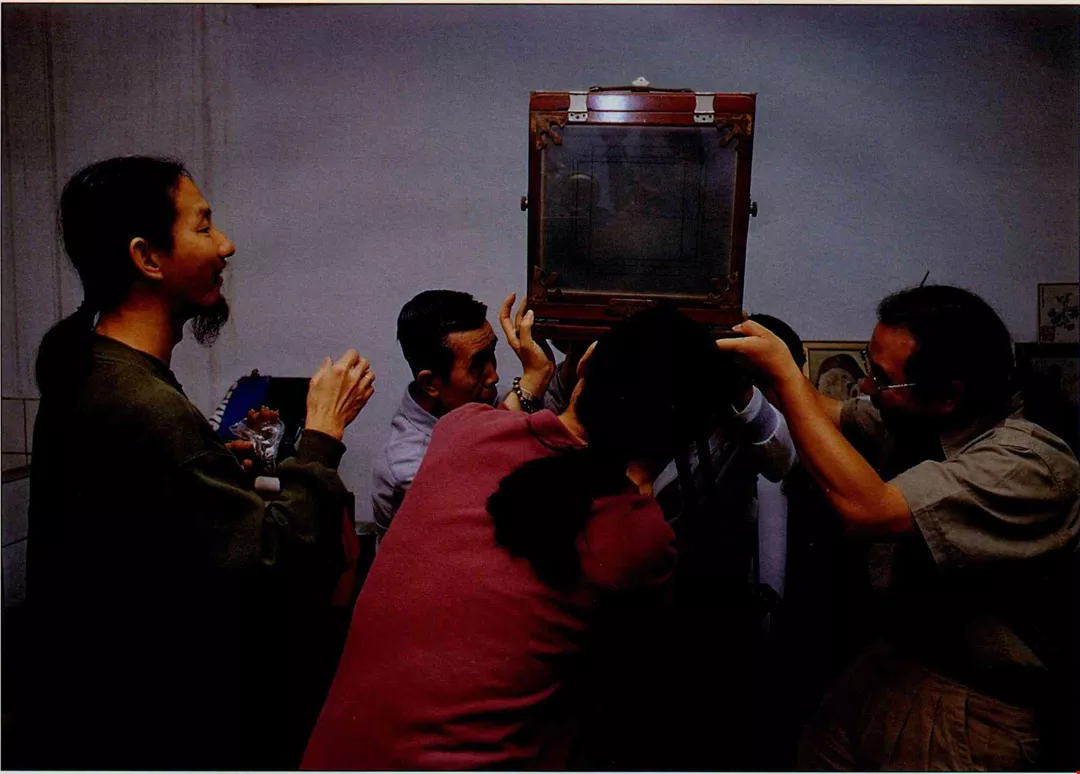
With this 6-inch "portable" camera which they used for outdoor shots during the Japanese era, Wu Chin-jung and his brother photographed countless Yangmei characters.
Too clever by half
(Wu Chin-jung:) "Last year Ah-lung came looking for old photos, but I told him the old photos weren't so important. They were going to tear down the old stage outside Hsifukung temple, so if he was interested he should hurry and photograph that, otherwise he'd miss the chance.
"A few months later he turned up again with three people from out of town--what do you think they wanted? They'd heard that Hsifukung temple was going to be torn down and rebuilt, and that the trees on Pokung Hill were to be cut down and the hill flattened, so they'd come to ask me what we could do. Would the head of the neighborhood help? Would he heck! Yangmei people are clever--too clever by half! Those young folk really are sincere, they resisted on Pokung Hill for 18 days. Ah-lung went handing out leaflets with his son even in the rain. The temple management had secretly sold off things from the temple for NT$150,000, but he spent NT$300,000 out of his own pocket to buy them back again. Even people from out of town came to save our temple, so how could Yangmei people pull in their heads like frightened turtles? The last time Hsifukung temple was rebuilt was only about 40 years ago; my brother went with the 6-inch camera to photograph the beam placing ceremony. The old folk over 90 on the street would have seen the temple rebuilt three times in their lifetime--it wouldn't be right. And how could they go flattening Pokung Hill? It's the turtle's head of Turtle Mountain, and people go there every day to sit in the shade.
"At the beginning when they went to protest on the hill, I didn't know if the young people could manage it. I didn't put much trust in them. I wasn't at all sure they could pull it off. Then later they agreed not to knock the temple down for the time being, so we were half-way to saving it. The young folk thought up a new trick: they didn't disband the society to save the temple--they turned it into the 'Yangmei Culture Promotion Society.' They asked me to be president. Why ask me? We Hakkas have a saying:'If you want things done right, ask the old folk.' But I'm not that old, and my name doesn't count for much around here at all. So can anyone tell me why they asked me?"
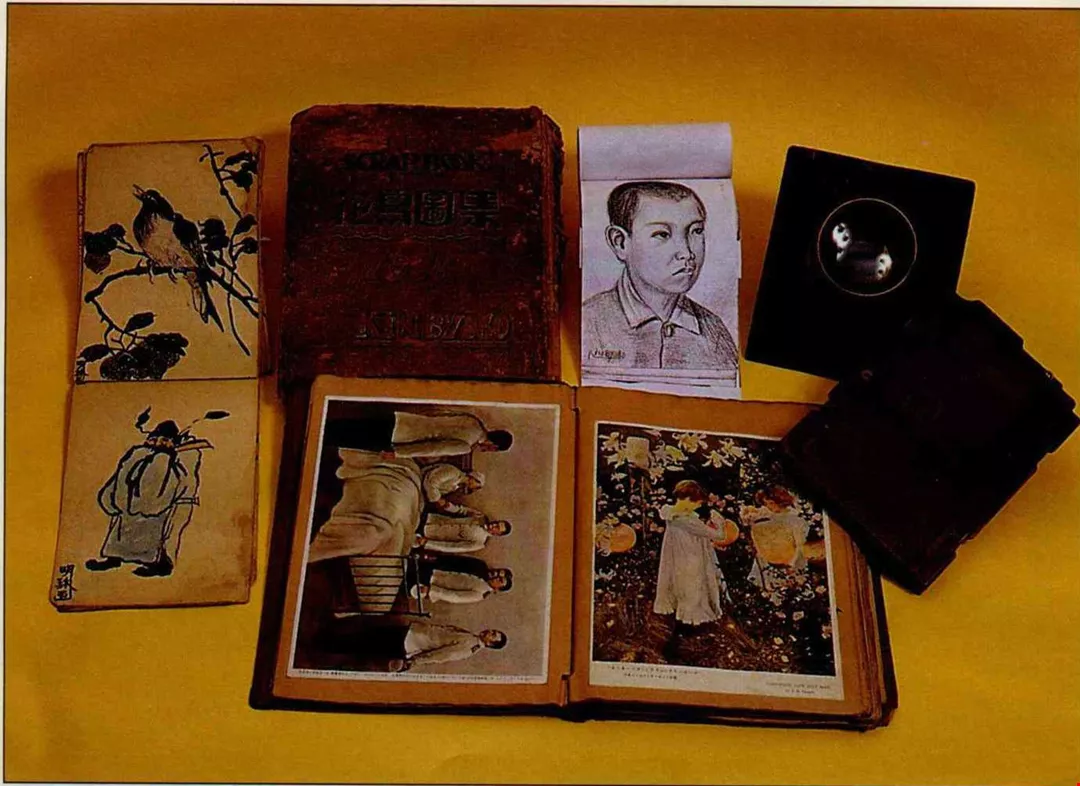
Chin-jung's treasures: his sister Ming-chu's sketchbook; his brother Chi n-miao's old lens, photographic plate holder and scrapbooks; and a sketch of Chin-jung drawn by Chin-miao when he was in his teens. All are very well preserved.
Unearthing old photos
The campaign in Yangmei in July of last year to "protect the temple and save the trees" attracted an enthusiastic response from local people and the media. Wu Chin-jung of the old photo studio not only went up the hill to lend his support, in the mornings and evenings he would even buy lunch packs, bring tea and light incense. This came as a great surprise to Liang Kuo-lung, who only a month before had been sent a way with a flea in his ear when he went looking for old photographs.
In the eyes of locals and neighbors, the Wu family of the photo studio were undoubtedly a strange lot. Their comments are mostly on the lines of "eccentric" or "being thrifty was in their blood." Furthermore, the two Wu brothers and their sister never married, and of course this added to their air of mystery.
What surprised Liang Kuo-lung even more was that after the protest campaign ended, Wu Chin-jung suddenly--quite unbidden--brought out an old photograph taken years ago by his elder brother Chin-miao. The picture showed the star of their rescue campaign: Hsifukung temple itself. After that, every once in a while Wu would bring out another photo, each time stressing:"That's all there is, there aren't any more."
"I could feel he wasn't just fobbing me off with the pictures--it was purely for the sake of the temple," says Liang Kuo-lung.
From last summer to the beginning of this year, every three to five days Wu Chin-jung would bring out a photograph, or a handful of them. He gradually brought out all kinds of old pictures, mostly taken by his brother, but also some of his own. Then in March this year he suddenly produced almost 200. From the mottled, yellowed images, the young people saw a whole history of Yangmei emerging, from the Japanese occupation to the return to Chinese rule, from family portraits to company ceremonies.
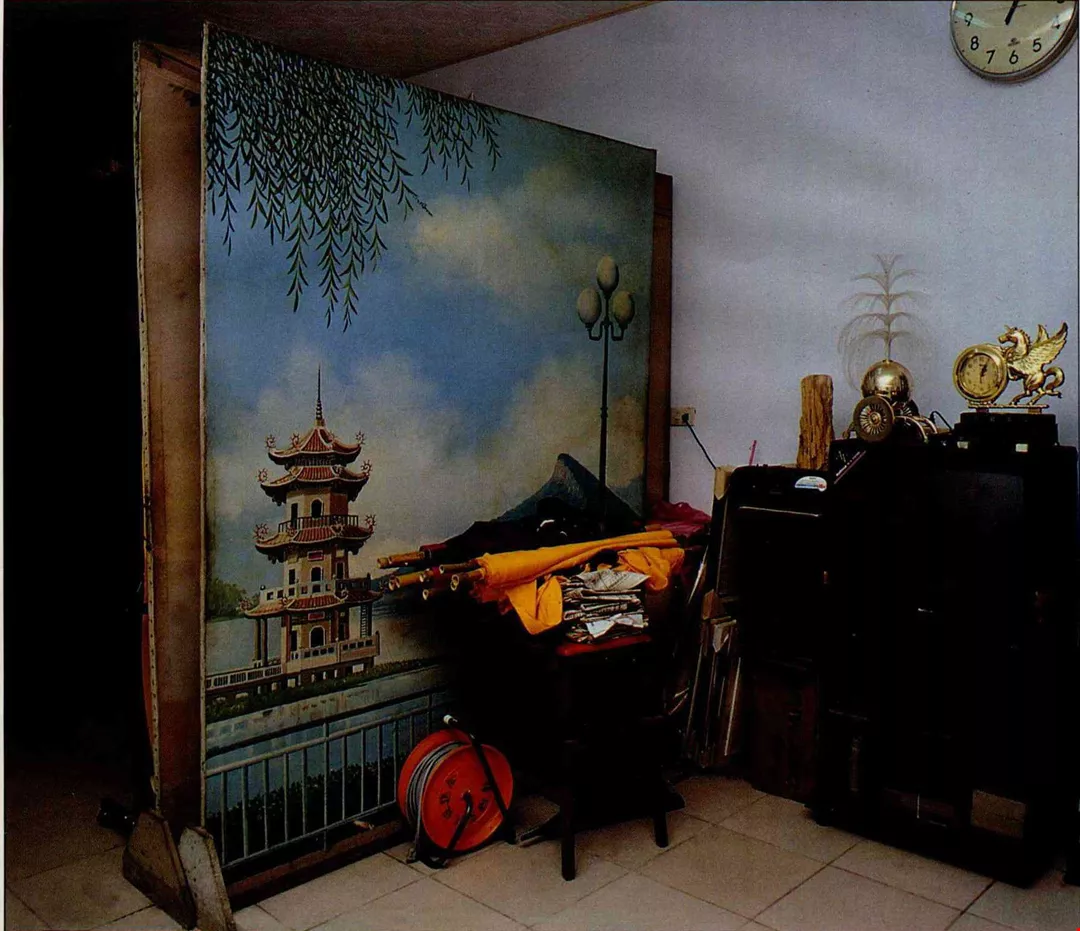
Chin-miao himself painted these three backdrops for customers to choose between: Japanese style, Western style and Taiwanese scenery. "I only made a new print from this just recently." Above is the glass plate taken by Chin-miao. To this day, Wu Chin-jung still refers to photographs as "plates.".
Mother embroidered, brother and sister painted
(Wu Chin-jung:) "Under the Japanese my father ran a grocery at the market. He was very capable, and he sold everything from alcohol and tobacco to sugar and salt, hardware and even buttons. He also understood Chinese herbal medicine and sold ready-made medicines. At that time the railway line had already been moved to New Street. People from the coast came to Yangmei to trade. The market was very lively. People from out of town weren't so well fed and in the summer people who came to trade would often faint. Then people from the market would come and call my father:'Someone's got heatstroke!' No matter how busy he was he would drop everything in the shop and take some medicine with him and go to scrape their backs. He'd scrape for half an hour or an hour, as long as it took until the person groaned and came round.
"Mother often said that Father had saved at least a hundred people's lives there, but not one of them ever came to our house to thank him. Well, there was one, I remember an old woman in the town sometimes mentioned it, and she'd bring straw shoes which she wove herself. That's how my parents were. I've been taken advantage of in this life, someone else has got my land, so being good is no use--why didn't I learn to be harder in those days?
"Before my mother was married she used to embroider trousseaus. My brother and sister both learned to draw embroidery patterns. People would line up to wait for them. My brother was born in 1915, he was nine years older than me. He was best at drawing and painting. When we were little, after it rained there would be a layer of sand over the muddy patches in the street, and my brother would draw dragons in it with his big toe. He would draw all the way from the market to the doctor's house. He often took me to Pokung Hill to draw.
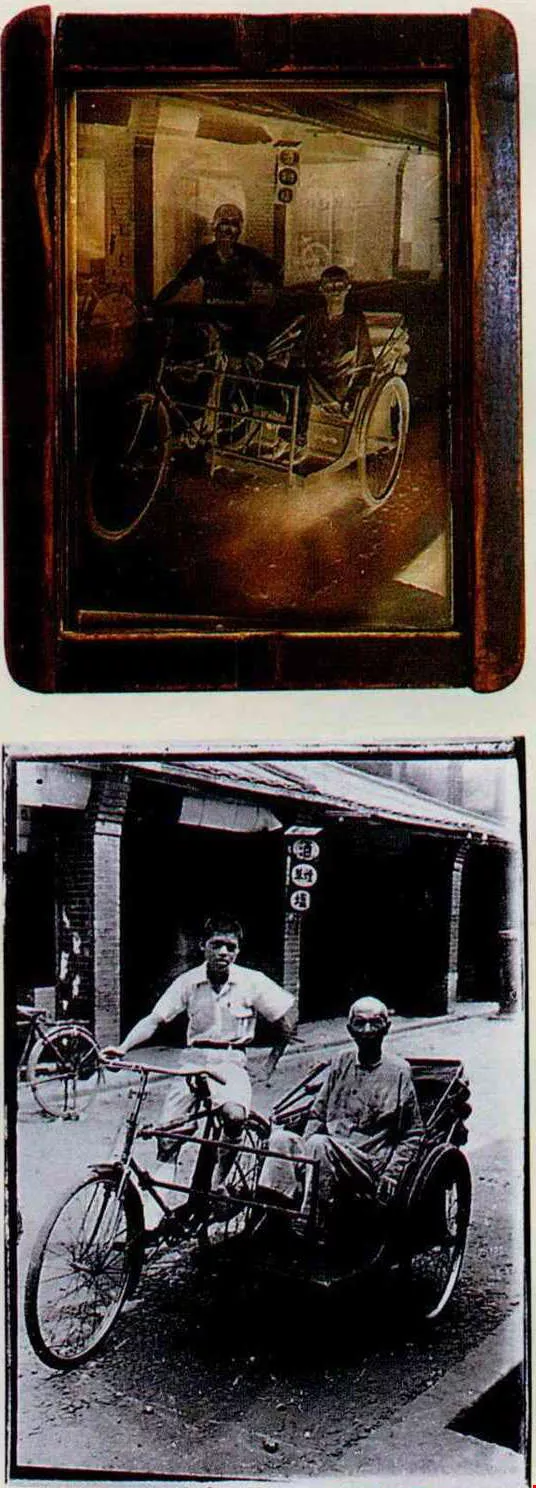
"I only made a new print from this just recently." Above is the glass plate taken by Chin-miao. To this day, Wu Chin-jung still refers to photographs as "plates.".
My brother was an expert
"The year Hirohito became emperor my brother was 11, and he took part in a drawing and painting competition put on by the town council to celebrate the new emperor's accession. His 'Pine, Crane and Rising Sun' won first prize. The second-prize winner was a well-known painter from the town who painted the Taiwanese holding bowls and chopsticks in one hand and a rising-sun Japanese flag in the other, cheering. At the prize-giving, the first prize was two camel-hair singlets, but when the judges saw that my brother was a child, they didn't give him them. Later Father asked him:'Why does your painting only have a pine and a crane, and why's the rising sun so low in the sky?' My brother replied: 'The emperor has only just ascended the throne, so we don't know his achievements yet!' My brother thought more deeply than most people.
"When my brother was 16, he began painting people's portraits. When Hakka parents reached 50 or 60 years of age, their married daughters had to get them 'added happiness portraits' made, to use when they passed on. Later my brother bought a 4-inch camera and photographed the faces of the people who wanted portraits done, then he copied the photographs in charcoal. Everything apart from the faces--the clothes, chairs, floor tiles, vases--were all drawn from pure imagination. My brother was very skillful, he never drew any two alike.
"Later the lease on the shop at the market ran out, and Father didn't want to carry on with it anyway. So he rented a house on Old Street as a studio for my brother. He bought a big camera and hung up a sign saying 'Photo Studio.' My sister could tint and retouch photographs, and when I was nine I started helping too. When it was busy, even father lent a hand. My brother was an expert, he learned how to do sepia and restore faded photos by himself, but the colors haven't changed, just look! Aren't they up to scratch?"
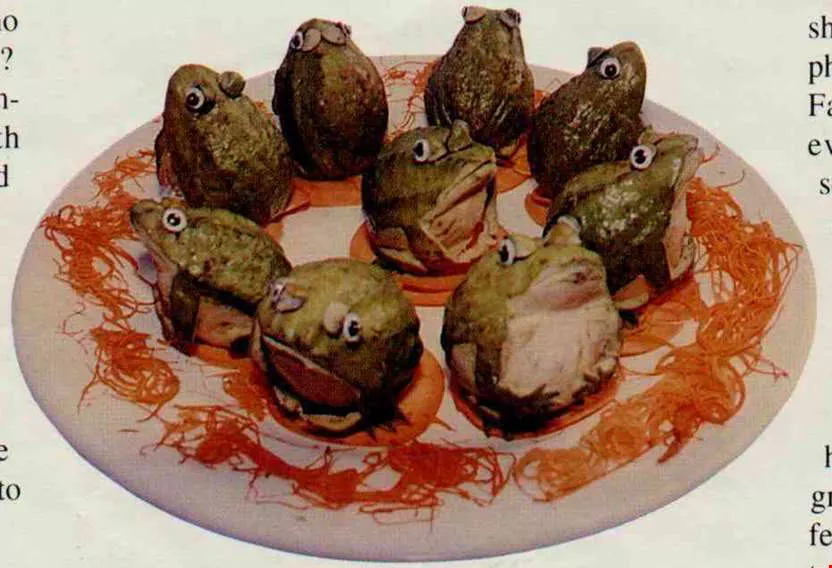
Fruit carved by Chin-miao's skillful hands. (courtesy of Wu Chin-jung)
His legacy: a complete record of the little town
After seeing first just a few and then large numbers of Chin-miao's and his brother's old photographs, Liang Kuo-lung was amazed that a single studio and one photographer could leave such a complete photographic record of a locality, and that they should be so well preserved.
Judging from the photographs which have emerged so far, the period when Wu Chin-miao was most active as a photographer seems to have been in the 20 years from 1935, when he formally set up shop, to 1955. In that period, this young photographer monopolized almost all of Yangmei's market. Family portraits, wedding celebrations, political events, business occasions, and ceremonies at schools and public offices were all grist to his lens. At one time Yangmei had 12 Japanese-language schools, and one year he photographed the graduation ceremonies at almost all of them.
Wu Chin-miao had only six years of public schooling, and coming from a family of modest means, he differed from other photographers of his generation who were either from wealthy backgrounds or had studied in Japan. Liang Kuo-lung feels that despite these disadvantages, as a small town photographer Wu Chin-miao was able to go beyond the level of a mere artisan. He showed imagination in composition and a keen feel for capturing the moment, and he left behind many photographs with an individuality of style, which although they were taken as commercial photographs, are moving and worth more than a passing glance.
At the beginning of the 1960s, the images left behind by Chin-miao gradually grow fewer and fewer. Perhaps because of his failing health, most of what remains is studio work, and the magnificent outdoor shots become very rare indeed.
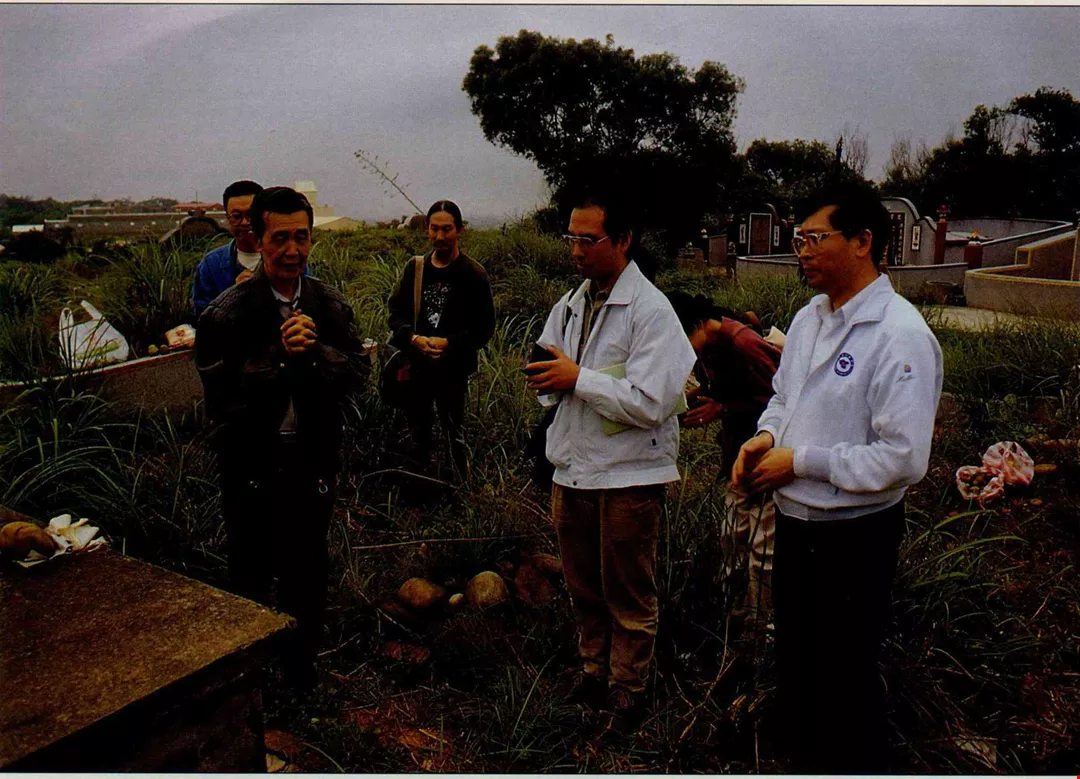
My mother, father, brother and sister are now all in this little square tomb. Sanjieye [a protecting spirit of the Hakkas] has sent these young people to recognize our achievements. It's surely the will of heaven.
An all-round talent
(Wu Chin-jung:) "When I was nine, we moved from the market to Old Street, and when I was 28, Father bought this shop. My brother and sister and I all took photographs. Customers would choose between us, and some would choose me. Later my brother looked after the shop and sent me to do the outside work. Whenever a family's son or daughter was getting married, they'd tell me the time well in advance, and when the day came I'd ride over on my bicycle with the 6-inch camera and tripod. On a good day I'd go to three different places. It was very hard work. In June after the rice was harvested, Mother would plant sweet potatoes, and in winter, in the farming slack season, she'd grow vegetables.
I wasn't so clever, but my brother and sister could both play the violin, the dulcimer, the samisen, the erhu, even the guitar. My brother was second to none when it came to worshipping the Yimin [Hakka ancestors] too. At Yimin festival every neighborhood would put up tables of offerings. Everyone else put on a big show and offered huge carp, big lobsters, and enormous red dough turtles. But what did my brother make? He put eyes on guavas and carved them into the shape of frogs sitting on a lotus leaf; and he used goose and duck eggs and white radish to make red-crowned cranes and ducks on the water. He even made a pair of colorful parrots with red mangoes for their bodies, and pumpkins, cucumbers, tangerines and eggplants for wings and tails. Or he'd stick lotus leaves onto a winter melon, and carve lotus flowers out of white radish, with raw ginger for tree roots and stones, and in the lotus pond he'd even have little fish and live shrimps swimming about.
"It was the same every year at Lantern Festival too. My brother would make Sou Wu [of the Western Han dynasty] herding sheep [by Lake Baikal as a prisoner of the Huns], or the angel scattering flowers [a story from a Buddhist sutra]. On the backdrop of the platform she stood on, there was a 12-pointed sun, on the second level, which turned, there were a pair of dragons, and the top level also turned. The platform in the middle which the angel stood on revolved too, and she was dressed and made up by my brother and sister.
"My brother loved going to Taipei to buy books and see Japanese art exhibitions. He'd set off bright and early by train and come back late at night. He'd bring back Western color magazines and cut out all the foreign paintings in them. He filled up a lot of scrapbooks.
"My brother had a lot of worries, because the whole family depended on him. Later he got very fat and smoked a lot, and sometimes when he was developing pictures the was so wrapped up in it he wouldn't even notice if the cigarette burned a hole in his clothes. In 1984 at the Yimin festival, he was ill, but he still insisted on carving fruit. I still have a picture which my brother and I took with the automatic timer, with the camera pointing out through the studio door. That's the last picture of him. When I saw the picture I could see his face was full of worry. He died that December."
Unfulfilled dreams of being a painter
The more Liang Kuo-lung learns about Chin-miao's life, the more compassion he feels for him. "I always have the feeling that Chin-miao died of worry." Liang Kuo-lung has a strong sense of regret that he was too late to meet this older photographer, and has deep sorrow and sympathy towards him.
There's no doubt that for the little town of Yangmei, Wu Chin-miao was a rare talent, but he was born before his time and had no-one who could really understand him. In fact, photography was not the pinnacle of artistic creation as far as he was concerned: he left behind many oil paintings and sketches. He long dreamed of going to Japan to study fine art, but because his mother doted on her eldest son, he was never able to go. Furthermore the good friend with whom he had planned to go died suddenly. Chin-miao left behind a picture of himself in front of his friend's grave; the half-round burial mound seems symbolic of his unfulfilled dreams.
Basically, Wu Chin-miao relied completely on his own innate artistic talent and enthusiasm to find his own way. He knew of all the older painters, but had no contacts with them. He had no teachers and was never involved in any artistic group. Having grown up in a conservative, thrifty Hakka household where his studio stood in front of his mother's pigsty, buying paints by mail order from Japan or going to Taipei to buy books and visit exhibitions was in fact quite extravagant. He once thought of marrying, but later nothing came of it.
Looking at Yangmei with love
Liang Kuo-lung says that Wu Chin-miao never particularly intended to stay at home, but circumstances beyond his control made him unable to leave the small town. But his artistic talent and desire to study painting helped him to transcend the limitations of a small-town photographer, and leave behind precious images of life in Yangmei.
"We have the opportunity to go up mountains and down to the sea, and travel abroad, but we weren't able to look carefully at Yangmei, so we couldn't photograph it with Chin-miao's empathy." Liang Kuo-lung regrets that he destroyed his pictures of Yangmei in the 1980s, for today Old Street has been torn down and rebuilt, and nothing remains of its former aspect.
Looking at Chin-miao's photographs, Liang is constantly learning new things. "In fact we needn't try to be too ambitious; just photograph what you want to and do your best, even if you're just making a record. If a Chin-miao emerges once in 50 years, then Yangmei can live on in images."
What Liang Kuo-lung regrets most is having missed the opportunity to get to know Chin-miao. Even as a child, he knew that "the Lantern Festival lanterns on Old Street were the best," but he didn't know that this was due to Chin-miao's ingenuity. It was only a decade after Chin-miao's death that Liang finally had such an intimate dialogue with him in images, in the darkroom.
In the photographs we occasionally see the youthful Chin-miao, a spirited, handsome young man. Especially in a few pictures of him larking around with friends at the seaside, it is obvious that he was a lively, enthusiastic person--how could it be that he never married, and died beset with worries?
Marriage depends on fate
"Father had a brain hemorrhage, and he died three days later. So my brother became head of the family. My brother and sister and I never made any distinction between what money was whose, and we never had our own separate savings. Mother did the accounts of the shop every day. She lived to be 98, but she never used a walking stick a single day of her life.
"My brother never went in for riotous living, he was always very thrifty and earnest. Ask anyone on the Street. The three of us did as Mother told us; we never thought of opposing her. Sometimes matchmakers came, but marriage depends on fate and so does finding a partner. If you want to choose someone, you have to find someone to choose you, and if you're picky, they can be picky too. Somehow time goes by, and once you're on the way down the hill you can't stop however hard you put the brakes on.
"The year after Mother died my brother went too. Next it was my sister. I'm the last one, that's worst of all. Two years ago I cleaned up their bones on my own. The auspicious time was in the evening. I cooked a chicken in sesame oil to take. When I was nearly there my bicycle tire burst, and I couldn't stop myself from crying.
I still have dreams
"I'm no match for my brother in anything, I'm not as clever, not as gifted. I'm pretty stupid. We'll see if maybe I can live a bit longer, but now on my own I'm like a twisted old bit of bamboo--it might snap any minute. If I hadn't met these young people I don't know if I'd have lasted this long. They think these old photographs are something really special, so every day I go sorting out old pictures. Last night I weighed myself. I've lost three kilos, but I also feel a good few years younger.
"I'm old, what's going to become of these old pictures and scrapbooks and old equipment? It's all just junk. The young people look up to us, they say they want to open a memorial hall, but I don't think we deserve it.
"I've still got business to look after at the shop, I still have to earn a living! I'd still like to get married and have children too. How can they talk about a 'memorial' already? I wonder if heaven will be good to me? Will I get my wish? I'd like it that way, but will I get to see it?"
[Picture Caption]
Old Street is no longer old, and among the sparking new doors and floor-tiles of Chin-miao photo studio, only Wu Chin-jung's antique camera and his collection of old photographs bear witness to its history.
(left) How could I forget a picture I took myself? Ah-lung's grand dad and my father are both in it.
One evening, hearing that an old tree on Pokung Hill has fallen down, Wu Chin- jung and the "out-of-towner"-- Tseng Nien-you, instigator of the campaign to protect the temple and save the hill--hurry off to investigate.
With this 6-inch "portable" camera which they used for outdoor shots during the Japanese era, Wu Chin-jung and his brother photographed countless Yangmei characters.
Chin-jung's treasures: his sister Ming-chu's sketchbook; his brother Chi n-miao's old lens, photographic plate holder and scrapbooks; and a sketch of Chin-jung drawn by Chin-miao when he was in his teens. All are very well preserved.
Chin-miao himself painted these three backdrops for customers to choose between: Japanese style, Western style and Taiwanese scenery.
"I only made a new print from this just recently." Above is the glass plate taken by Chin-miao. To this day, Wu Chin-jung still refers to photographs as "plates."
Fruit carved by Chin-miao's skillful hands. (courtesy of Wu Chin-jung)
My mother, father, brother and sister are now all in this little square tomb. Sanjieye [a protecting spirit of the Hakkas] has sent these young people to recognize our achievements. It's surely the will of heaven.

@List.jpg?w=522&h=410&mode=crop&format=webp&quality=80)


@List.jpg?w=522&h=410&mode=crop&format=webp&quality=80)
@List.jpg?w=522&h=410&mode=crop&format=webp&quality=80)
