


Outside the market, a student covered in white powder raises anti-war consciousness through a performance art piece.
Alternative action #1: Squats
Graffiti art is a guerrilla-style reclamation of public space. But when an artist gets tired from those guerrilla strikes, he needs a place to rest. That's why Bbrother and a group of creative-minded friends started searching for an abandoned building to squat in. After they moved in, this building that was forgotten by the city and fell into disuse found new life. But just like graffiti art, this squat too may soon disappear after the authorities move on it, and become just a fleeting, beautiful memory.
The squat came about after Bbrother got drunk one night last January at the Paris Commune coffeeshop in Taipei's Kungkuan area and decided to paint some graffiti outside. The owner got angry and dragged him off to a nearby abandoned building, saying, "If you want to paint, paint here!" Bbrother was inspired right then and there to move into the building and start working there as part of an artist squat movement.
The places they choose for squats are abandoned city buildings whose dilapidated state fleetingly provides a space with unlimited potential. They actively seek out this kind of place and then define it as a platform for action that, after being occupied, can be used for all kinds of creative activities--whatever you think of, you can do there. Some spray wild graffiti on the walls, some treat an entire room as a canvas, some start second-hand book exchanges, some hold film appreciation nights. Some get really ambitious and dream of opening coffee shops and band practice spaces or even holding an arts festival.
The squatters are mostly students with backgrounds in the arts. After moving into this kind of space, they first do a basic clean-up. Then they bring in some necessities, like generators, lights, locks, and stereos, slowly turning it into their own private workshop.
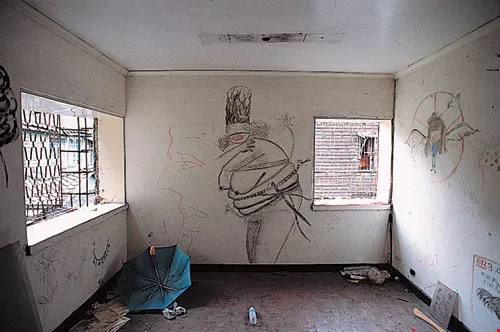
The run-down space of an abandoned building presents a refuge from the social order.
These squatters hope to create a commune-like environment of mutual assistance, but they all have their own homes and can't stay at the squat around the clock. The people who actually live there are vagrants who, for the most part, keep to themselves and don't interact with the students. But, Bbrother says, "Sometimes we'll give some money to one or two of the friendlier ones so they can get something to eat."
Squatters enjoy a respite from the normal order of things in the squat, but they can't live there permanently. Sometimes their things are stolen by homeless people, and sometimes patrolling policemen will throw them out. The place ends up slowly returning to the way it was before. Currently, only two of the student squats remain. The once artistic appearances of the others have now disappeared.
Bbrother knew from the beginning that, just as graffiti is ephemeral, this kind of action was built on utopian ideals that could never be fully realized. But as an art movement, the squat would show their attempt to escape social norms and test the limits. "Even if it fails, it will be an invaluable experience," he says.

A band plays on the bridge as traffic snarls below.
If the squat is a reflection on space in the city, then Bbrother's "No Currency Market" is a challenge to the capitalist monetary system. It's been popular in recent years for young people in Taiwan to create and sell crafts at streetside stalls, and Bbrother is taking this phenomenon in a new direction. He believes that monetary value cannot be the only arbiter of the value of a work of art, so he's holding a No Currency Market in which the use of money is banned.
The idea behind the market is to get participants to forget temporarily that money exists at all, and replace it with the notion that everything they need can be attained through the exchange of goods or services. They can perform sit-ups in order to hear a poem, trade an old CD for a used book, or give a back massage to see a light show with sparklers. You can bring anything to trade, even your dog--they don't get to bring it home, though, they "borrow" it for half an hour.

People can exchange services for goods--a sketch for a dog walk, a reading of a poem for a massage, or a photograph for a song. Anything is allowed, except money.
The participants in the market are for the most part students who share the same ideals--it has limited success when outsiders come along. When unable to use money to carry out transactions, many people suddenly feel at a loss. They argue about the comparative worth of the items involved, and completed trades are not as many as one would hope. Most people merely act as curious bystanders. Bbrother says that he isn't against the idea of money: "I just want to play around and see if there are other possibilities for person-to-person exchange outside of using money."
The No Currency Market has been held three times so far, each time in Kungkuan. As a way of redifining the ways of using public space, one time Bbrother purposely chose to hold it on a pedestrian bridge outside Kungkuan's Shuiyuan Market that had been made obsolete by the opening of an underground MRT station with a passageway and the creation of a crosswalk on the street's surface. Bbrother hopes that temporarily occupying the forgotten bridge reminded people of its existence: "The bridge shouldn't be just a space you pass through. It should be a public space that invites you to stop for a while and get involved."

The run-down space of an abandoned building presents a refuge from the social order.

On a bridge over Roosevelt Road in Taipei's Kungkuan area, a different sort of market opens.


@List.jpg?w=522&h=410&mode=crop&format=webp&quality=80)


