Kinmen:Seeing the World's Cultural Heritage in Taiwan
Yang Ling-yuan / tr. by Julius Tsai
March 2005


Visiting a world-renowned scenic spot and gazing upon the wonders of a mountain panorama invariably brings refreshment for the soul. However, standing in front of the fragmented remains of ancient buildings and artifacts, to experience an encounter in the vast flow of time, can truly move one to the core. Though such an encounter may be with a time and place far distant, lingering in a wondrous and as yet undimmed moment from antiquity can evoke collective human memories and can deeply touch one's innermost being.
In the latter half of last year, the Council for Cultural Affairs put on a series of media tours on "Classics of Historical Architecture," hoping to rekindle a search for roots and an appreciation of historical architecture among the public. Among the sites visited was Kinmen-alone among ROC national parks to receive that designation on the basis of its cultural value. Kinmen, a place of great cultural resources, once a sealed-off battle zone, and now a place characterized by dynamic growth as well as uncertainty following its opening up, is certainly worth exploring.
Just prior to landing in Kinmen, I reviewed my own mental images of the place: "wind-lions," underground fortifications, peanut candy, cleavers made from shell casings, and Kaoliang Liquor.... I was eagerly anticipating the visit, for Kinmen was said to be a place with unique mountain scenery and seascapes, remarkably clean streets, air rendered pure and sweet by the lack of auto and industrial pollution, and authentic popular traditions that have thus far escaped overdevelopment. It seemed to be a place of refreshing sights and sounds.
Emerging from the airport and boarding a tour bus, I was first taken to some of Kinmen's essential sites, such as the National Park, Chungshan Memorial Forest, Chukuang Pavilion, and Kuningtou. I initially thought that this visit to Kinmen would be a retracing of the typical tour book itinerary. Not long afterwards, however, the bus pulled into a remote village. Before my eyes stood tidy rows of courtyard dwellings interspersed with old ancestral shrines and temples. In another village I saw "Western-style" houses scarred by artillery shells and the passage of time, a testament to the blood, tears, and heartache of Kinmen's emigres, who were forced by poverty to seek their fortune overseas. On Kinmen, one could still find in underground recesses the secret passageways and air raid shelters that had been constructed to withstand attacks from Communist China. I was amazed to discover that Kinmen, a place long sealed away by the circumstances of war, was in fact a place whose history and culture had been preserved quite intact.
Perhaps most do not realize that the island of Kinmen, cut off by half a century of war, has been a place where three cultures have co-existed: those of the Southern Min, of the emigres, and of the military. Aside from a short period of occupation during World War II, Kinmen never became a Japanese colony. Thus, its popular disposition as well as scenery differ from those of the main island of Taiwan. I had initially thought that Kinmen's buildings would have been ruined by the August 23rd artillery battle of 1958 and the lengthy military stalemate with China. It had not occurred to me that just the reverse was true, that the long-term military defense of the island had in fact protected its architecture, thus suspending Kinmen in a historical state dating back to the latter period of martial law.
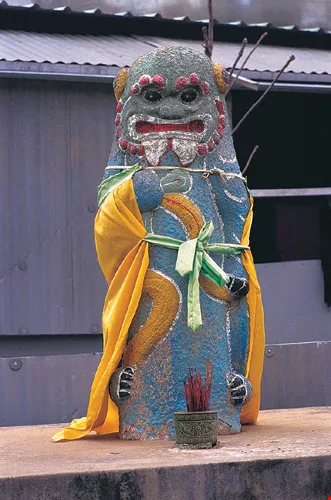
The wind-lions of Kinmen stand sentry all over the island to protect it from strong wind (left, photo by Cheng Yuan-ching). The roofline ornaments that adorn Kinmen's traditional buildings-including scrolls, kylins, ornamental spheres, flora, and bats-all hold symbolic meaning (facing page, photo by Lin Wen-cheng).
Intersecting cultures
In the many desolate dwellings and ancestral shrines of the island one can still find well-preserved carvings and wall adornments, executed in a refined, lively manner. While the Kinmen National Park Headquarters has taken over the management of certain historically significant sites with the intent of rebuilding or restoring them, the vast majority of sites remain in a state of disrepair as they await funds for restoration.
On a small hill stands a grave mound from the Ming dynasty. Despite the passage of more than 400 years, the site-from the mortuary stele, stone offering table, and pavilion in front of the gravestone, to the carved stone animals that flank the pathway and serve as a mark of official rank-is reasonably well preserved. No tourist signs could be found there, just clumps of weeds and cowpats, joyful testament to the fact that this place has not been disturbed by overdevelopment from tourism. According to Chiang Po-wei, assistant professor at the Kinmen campus of the National Kaohsiung University of Applied Sciences and a longtime Kinmen researcher, the island has been able to preserve its traditional settlements and architecture to a high degree. Indeed, its village settlements may be considered the last "gene pool" for Southern Min architecture, manifested in the red-tile-roofed dwellings that may be found everywhere here.
According to Chiang, the technical difficulties that attend the production of red tile, originally invented by the Romans, should not be underestimated. For tiles to emerge from the kilns red, they must be rapidly cooled down from a temperature of 800-1000°C. If the cooling takes too long, the tiles turn black, which is the typical color of roof tiles in Japan and Korea. In Kinmen, whose native granite makes a common and convenient building material, red tile is an expensive material out of reach of most ordinary folk.
In the 1930s it would have cost 5000 silver yuan to build a red-tile-roofed dwelling in Kinmen. By way of comparison, a wedding at that time would have cost 130 yuan to put on. In the early years, Quanzhou in Fujian Province was a conveniently accessible international trading port, and there large amounts of the needed raw materials were imported from the Arab world, which at the time possessed the most advanced technology for the production of red tiles. Red tiles subsequently became a symbol of the unique Southern Min architectural technology of Fujian and Taiwan.
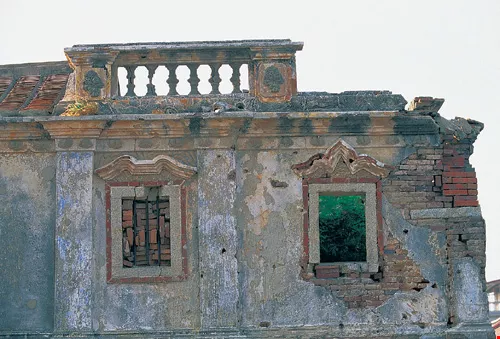
Opening up to the outside world has resulted in the accelerated destruction of Kinmen's older architecture. Many colored tiles, dating back more than 80 years, have been surreptitiously removed by locals and sold as art objects. (photo by Lin Wen-cheng)
Communal villages
Traditional Kinmen clan villages exemplify the preservation of ethnic bloodlines on the island. They were settled on the model of the communal village, with a large ancestral shrine in the center of the village that would serve as a focus of activity. On wooden tablets kept in the shrine would be recorded all of the glorious achievements of the clan, such as success in civil service exams, attainment of high office, and resplendent careers. Every year the families in the villages, who collectively maintained the ancestral shrine, would work together to fund vital activities such as the annual ancestral sacrifices and winter solstice festivities. In the early days, villagers would even erect storefronts by the shrine that would be rented out, thus providing funds for the shrine's upkeep. At the shrine of the Huang Clan in Houputou the two annual rites are still carried out, and have become important local festivals.
Having inherited the complex ritual protocol of the Han Chinese, the inhabitants of Kinmen also developed their own communal guidelines based on clan-based ethical principles. For example, there is a custom of "building against the mountain and facing the water," referring to the way a house is build against a slope as a shelter against the wind, and with the water situated at a lower elevation to provide a convenient supply for irrigation and household needs.
Buildings had to strictly abide by ancient taboos against building in front of the temple or behind the ancestral shrine, or against having the height of one's house exceed that of the ancestral shrine. The reasons for such restrictions was that the temples needed open spaces in front for activities, while the ancestral shrines, symbolizing the origin and coming together of the clan itself, occupied a high place from which to watch over clan descendants. As a mark of respect to the ancestors, the lower-ranking living family members dwelt in front of it, with buildings increasing in height to correspond to familial rank. Moreover, the height, form, layout, and number of buildings of subsequent clan members could not exceed those of the ancestral shrine. Such were the unique spatial ethics of the place.
The Kinmen National Park Headquarters oversees 12 key villages among the 168 clan villages on the island. The most famous of them all is the settlement at Chiunglin, over 800 years old and renowned for the cultural and martial achievements of its native sons.
In the grand ancestral hall at Chiunglin are enshrined six "presented scholars," who passed the imperial exams, six "recommended men," who passed the provincial exams, 15 "tribute scholars," who advanced to the imperial university, six military generals, and hundreds of national academy students and local scholars. The shrine is adorned with inscriptions such as "Scholarly Brethren" and "Soaring Achievement." This is a true Kinmen landmark.
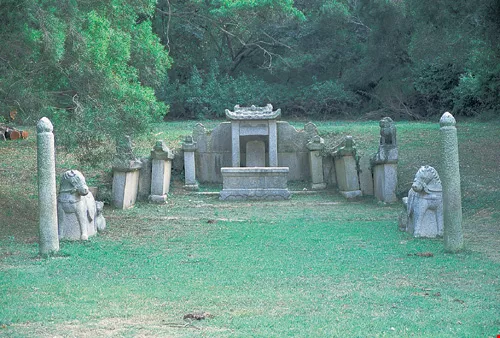
Kinmen's two intact ancient tombs are Class 2 historical landmarks. Pictured here is the 400-year-old gravesite of the Ming dynasty official Chen Chen. (photo by Lin Wen-cheng)
Living monument
The resplendent clan village at Shanhou was built during the Qing dynasty in the Guangxu era (1875-1908). Its founder was a Chinese emigre surnamed Wang who had gone to live in Japan's Kobe and had sent back funds to his home village. The 16 matching two-building family complexes, along with an ancestral shrine and a school-the "18 core buildings of Shanhou"-were all completed at the same time. Quite different from other villages, which developed organically to suit the needs of their inhabitants, Shanhou was master-planned so that all of the houses, facilities, and spaces conformed to a single design scheme.
In 1979, the Kinmen County Government decided to renovate Shanhou into a "folk culture village," adding a stable, surrounding wall, inscriptional tablets, and six themed exhibition halls. Shanhou is the only village in Kinmen that charges a fee to visit it and in recent years has been turned over to the national park for its upkeep. Many of its residents have returned from afar, setting up eateries and souvenir shops there. Many first-time visitors are under the mistaken impression that this orderly, well-appointed village is in fact a theme park that was built recently. However, when one walks by local doorways and finds the signs displaying "Residence" that forbid entry, one realizes with a start that the whole place is in fact a living historic monument.
The clan village at Shuitou is another worthy destination. A local proverb goes, "It's not hard to get as rich as Shuitou folk, but it's hard to get a house that nice." Driving along the small roadways, one enters a small bay and suddenly sees a scene of open fields. Sprinkled among houses of red tile roofs one catches sight of two-storied Western-style mansions. While such houses stand out, their overall effect is not a jarring one.
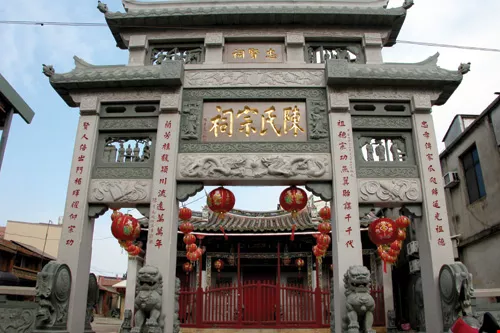
Chen is the most dominant surname on Kinmen. The Chen ancestral shrine, a gift of the renowned industrialist Chen Chung-kuang, took six years to complete. In front of it stands a ceromonial arch built of granite. (courtesy of Chiang Po-wei).
The emigre spirit
On one side of the village stands a tidy row of grand old houses that are not inferior to modern mansions. It turns out that these structures-nine Min-style buildings supported on 18 massive beams-were built in the reign of the Qianlong emperor (1736-1796) of the Qing dynasty by Kinmen resident Huang Shao-kuang. After attaining success in the civil service exams, he took the money that his mother had borrowed, intending to "purchase" an official position, and built these grand dwellings. All nine of the buildings were erected together and they still stand today, more than 250 years later. They predate the master-planned settlement of Shanhou by 120 years.
While the traditional settlements of Kinmen have a long history, the Western-style mansions among them tell a different story.
After the Opium Wars of the 19th century, the Qing government was forced to open five treaty ports along the Chinese coast. Among these, Xiamen, with its proximity to Kinmen, attracted many Kinmen residents who sought their fortunes in Southeast Asia, many beginning as coolies but slowly earning money and building businesses. Those who made it rich in foreign lands not only sent back money to build houses on Kinmen but also introduced architectural trends from the places they had dwelt in. Based on their memories of architectural forms there, local builders used local materials to build these Western-style mansions.
These dwellings, which combine Chinese and Western architectural elements, exhibit much stylistic intermingling. In a hall set aside for devotion to Mazu and the ancestral tablets, for example, one can find chubby angels adorning the walls and the roofs. One also finds turbaned Indians, which indicates not that the owners had friends from India, but that they imitated the British custom of portraying their servants on the walls of their homes as a show of status. Some of these Western-style mansions have clock faces carved in the walls that invariably display the time as being 12:30. This represents the ancestors' hopes that their descendants be industrious, working hard even when others were taking their breaks.
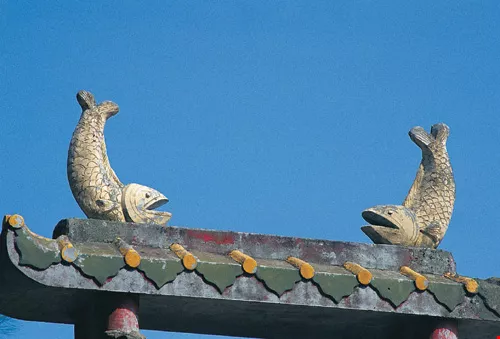
Even a simple memorial displays past artisans' meticulous craftsmanship in showing reverence for the ancestors. (photo by Cheng Yuan-ching)
Rise and fall
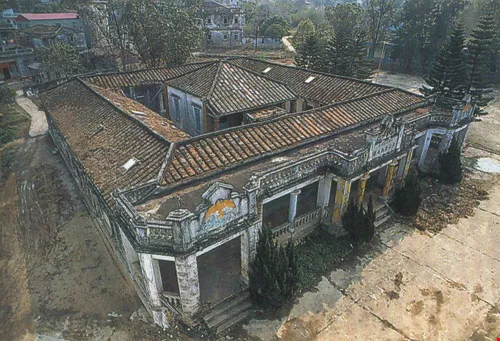
The Chen Ching-lan House is the grandest of the 130-some Western-style mansions on Kinmen. Chen Ching-lan (1881-1943) was from Chenkang on Kinmen. When he was 21, he traveled to Singapore to find work, and later founded a company called the Nanjin Ninety-Eight Trading Company in Indonesia (many trading companies of the time used "Ninety-Eight" in their names after the practice of taking a 2% commission on transactions). Chen profited greatly from his trading company and opened up a branch of it in Singapore called the Chengyuan Company. He also invested in a number of businesses and became an influential businessman and leader among the overseas Chinese in Southeast Asia.
With his business success, Chen sought to give something back to his homeland. Not only did he found a number of schools and public projects in Southeast Asia, Fujian, and Kinmen, when he was 36 he bought an expansive piece of oceanfront property in Chenkang on which to build a Western-style mansion. The inspiration for this structure probably came from Singapore, and the design called for deluxe materials such as cypress as well as stone from Fujian. It took four years to complete the mansion, which was finished in 1921, at the cost of over 100,000 silver yuan. The "Mansion of Chenkang" is a two-storied affair, and from it one can see the southern bay of Kinmen in the distance. Seven rooms open up to the front and feature a massive arch and two smaller arched doorways. The house has quite a refined beauty to it.
After Chen's mansion was completed, one part of it was designated the family dwelling and another as an elementary school for Chenkang. When more classroom space was needed, even parts of the Chen family ancestral shrine were put to use. Chen worked hard to promote education in his hometown, even funding the hiring of teachers from Gulang Islet and Tongan in Xiamen.
During World War II the Japanese army occupied Kinmen, and many of its residents were scattered abroad in Southeast Asia. Chen himself died of illness in Singapore, never again to set foot in his beloved home. His mansion was converted into an operations center for the Japanese army.
Following the end of WWII, the civil war between the Nationalists and the Communists erupted. The Nationalist army based artillery units here and later used the mansion as the 53rd Infantry Hospital, with clinics, hospital rooms, and living quarters for the medical staff. In 1954, during the September 3 bombardment, Kinmen junior high students were temporarily moved to Chenkang to take refuge from the fierce artillery fire. Many middle-aged residents of Kinmen still remember spending part of their youthful days in this place.
After the August 23, 1958 bombardment, the Mansion of Chenkang was designated as a recreation center for the military, with such facilities as a dining hall, barbershop, general store, medical clinic, pool hall, teahouse, and even a small library and cinema. During those days, entertainment options in Kinmen were few, and for the soldiers and officers engaged in the heavy responsibilities of defending the island, the place must have seemed a paradise. Later, with the calming of relations between Taiwan and China, traffic between Taiwan and Kinmen increased steadily. Prior to the end of the military administration of Kinmen at the end of 1992, the recreation center at the mansion had long ceased operation.
What is lamentable is that without the military outposts, the Chen Ching-lan Mansion has been neglected and fallen into disrepair, with some of its side buildings even suffering typhoon damage. Recent years have seen an increase in public sentiment for preserving historic sites, but Chiang Po-wei still feels that the government has done too little too late to prevent natural disasters, termites, and human destruction. If this beautiful historical building were to collapse, it would be a great public loss.
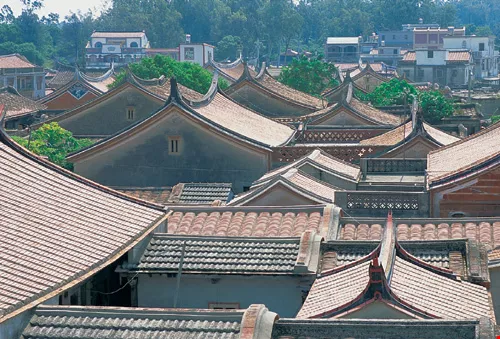
Seen from above, the variegated array of rooftops in this village express a conception of Southern Min space. (photo by Lin Wen-cheng)
Underground networks
Aside from the Southern Min villages and the Western-style mansions built by emigres, Kinmen was long prized as a strategic military site by the naval powers of China, Japan, and Europe from the early Ming dynasty. Set among the early traditional buildings can be found trenches, observation platforms and battery towers built to defend against thieves and incoming bandits.
Kinmen's battle scars reached a high point in the aftermath of the civil war between the Nationalists and Communists and the Nationalist retreat to Taiwan. At the entrance to the village at Peishan is still preserved a bullet-scarred mansion, a corner of it reduced by artillery to ruins. This site is a testament to the intensity of the Kuningtou Battle of 1949, by which Taiwan took a step forward to finally gain a measure of stability.
With long-term tensions across the Taiwan Strait, underground passageways and command centers were built under Mt. Taiwu and small passageways were carved out along the seashore. To guard against artillery bombardment from the other side, the army created an "underground Kinmen," creating such battle-ready spaces as tunneled passageways, fortifications, and operations centers. Moreover, underneath the main settlements were dug extensive passageways. Notably, underneath the village at Chiunglin was formed a unique network of passageways. All residents, whether male or female, young or old, had to undergo mobilization, organization and training by civil defense authorities. The community center was later turned into an operations center, and throughout the village were set up 12 emergency entrances to form an effective defensive network.
These historic, formerly secret defense systems have now been turned into a popular "tunnel experience" for tourists. What is surprising, however, is that Kinmen, long under military administration, never had housing settlements for military families. Rather, a handful of former soldiers ended up marrying local women and were absorbed into Kinmen village life.
Chinshui Elementary School, once commandeered as a Japanese military hospital, was built with the funds-raised over a period of more than ten years-of emigres to Southeast Asia. It is Kinmen's largest school building, and is now undergoing restoration to eventually become a local museum. (courtesy of Chiang Po-wei)
World Heritage dreams
Throughout my three days of touring through Kinmen, I would begin each day's activities at around 5 a.m. However, I never saw sanitation workers cleaning the streets, which nonetheless remained tidy and clean. Entering into the villages and mountain areas I also never encountered disorderly gravesites, as there would be in Taiwan; all of the residents were buried together in the military cemetery. Although the long period spent under strict military administration restricted the daily lives of the residents here, it also meant that after Kinmen was opened up, it resulted in a good legacy and public image for the development of tourism here.
Kinmen has passed through periods of splendor as well as times of war, but has retained a cultural heritage characterized by its richness and completeness. Many scholars thus hope that Kinmen can be made a UN World Heritage Site. Through the mediation of scholars and experts, moreover, efforts have been made to transfer worthy historic sites to the purview of the county government to fund their restoration. In 2003, such funds amounted to NT$20 million, of which Southern Min sites received up to NT$1.5 million each. Significant public buildings or unused dwellings may receive full funding for restoration as long as they are leased to the state for the next 30 years. One such building is Chinshui Elementary School in Shuitou. However, many historic sites in dire need of restoration still languish, either for lack of funds or because their owners cannot be found to do the application.
On top of all of this, because Taiwan is not a signatory to the international agreement on World Heritage sites, it is not able to apply directly for inclusion on that list, making any efforts towards inclusion extremely difficult. Scholars feel, however, that if sentiment for such designation can be mobilized, public awareness and involvement in historic preservation might be elevated, which would be an achievement in itself. If in the future World Heritage designation were to be successfully obtained, international resources could be brought to bear on the effort to preserve these fragile historic sites as well as greatly increase tourism into the area, all of which would help Kinmen flourish.
The dream of Kinmen becoming a World Heritage site may be a distant one. However, the greatest present danger may come from Kinmen residents themselves. Many feel that after the arduous processes of demilitarization, democratization, and the opening up of the island, it would be desirable to sweep away the old historic sites, and strive to quickly build up a modern Kinmen and increase ties to the international community to make up for the last half-century of inactivity. The balance between the historic and the modern, culture and economics, personal gain and public good is fraught with complexity. These are issues of concern to the people of Kinmen and Taiwan alike.
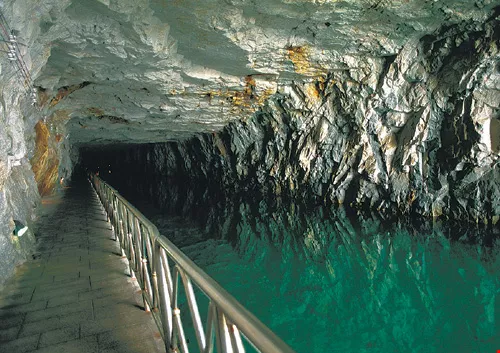
In Little Kinmen one can find the Mt.Chai Tunnel. Though a man-made tunnel, it gives the impression of being formed out of nature itself.
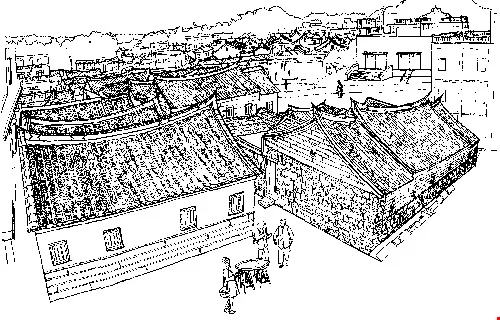
Aside from topographical and strategic considerations, the form of the villages reflects the healthy state of the clan and the continuation of its values. (courtesy of Chiang Po-wei)
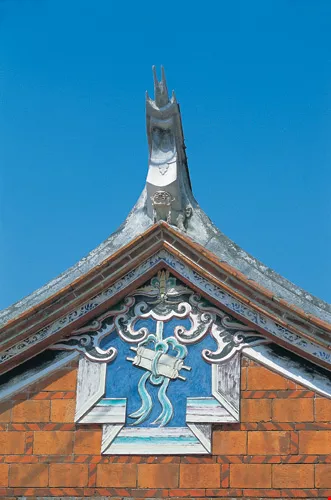
The wind-lions of Kinmen stand sentry all over the island to protect it from strong wind (left, photo by Cheng Yuan-ching). The roofline ornaments that adorn Kinmen's traditional buildings-including scrolls, kylins, ornamental spheres, flora, and bats-all hold symbolic meaning (facing page, photo by Lin Wen-cheng).
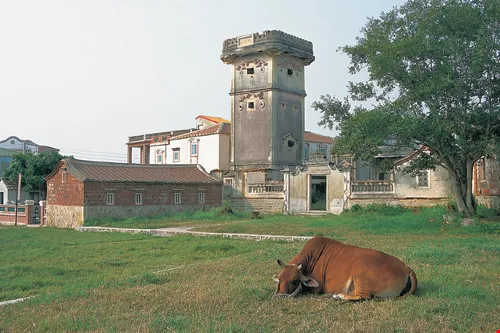
The Western-style mansions of Shuitou stand proudly, exuding the atmosphere of foreign lands. Teyueh Tower rises in the midst of the village, a watchpost in olden days. (photo by Lin Wen-cheng).
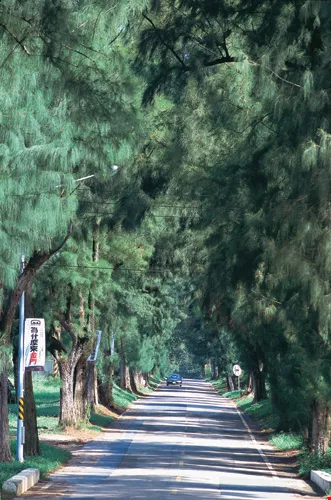
Clean, spacious tree-lined boulevards lend historic Kinmen a pastoral feel.
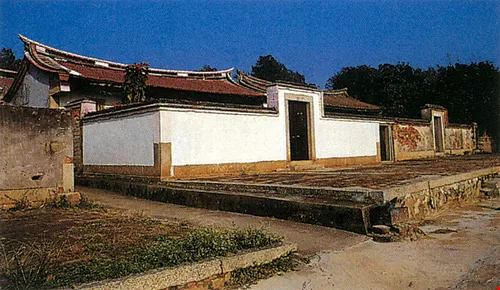
"The 18 beams of Shuitou" uphold the beauty of Shuitou architecture, drawing admiration from visitors (courtesy of Chiang Po-wei).
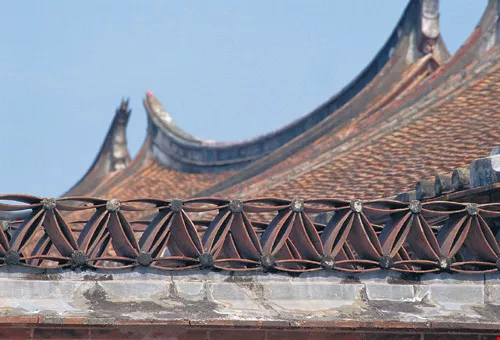
Strolling through the heart of the Shanhou complex, one sees traces of the wisdom of past generations. Here, cut tiles arranged in floral patterns along the tops of the low walls serve as an ideal security system. (photo by Cheng Yuan-ching)

@List.jpg?w=522&h=410&mode=crop&format=webp&quality=80)


