Picture Books for Multiculturalism: An Immigrant Mother’s Tale
Lee Hsiang-ting / photos Chang Su-ching / tr. by Jonathan Barnard
May 2015
As a volunteer reader in schools, Vietnamese “new immigrant” Cheng Mei and her sons created picture books about Vietnamese culture and traditional stories. With her Vietnamese-accented Chinese and expressive body language she was a hit with the kids at school.
Telling stories has enriched Cheng Mei’s life and helped her children to be better accepted at school. She now gives back to Taiwan by volunteering at many places. Hers is a story of admirable determination and hard work.
Cheng Mei, 51, currently serves as an interpreter for the Taiwan New Residents Development Association, and regularly goes to the New Taipei City Government, the New Taipei City New Immigrants’ Hall, hospitals and elsewhere to work as a volunteer. Under a program to develop mother-language teachers, cosponsored by the Ministry of Education and the Ministry of the Interior, she also taught Vietnamese in public schools. Having lived in Taiwan for 18 years after marrying a Taiwanese man, she says she has often been helped by Taiwanese people. So given an opportunity, “I too want to help other people.”
When she first arrived in Taiwan, she couldn’t speak Mandarin. When her sons were two or three, they would often go out together for walks in the park. A lot of people would talk to the children, and Cheng would pull paper and pen from her pocket to take notes. “Then I would practice at home with my kids,” she recalls, “because they were the only ones who wouldn’t laugh at me.”

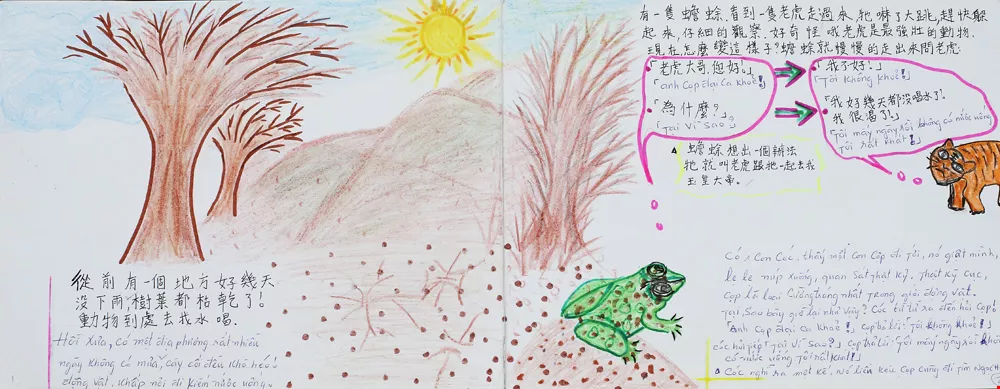
The picture books that Cheng Mei created by drawing from traditional Vietnamese folk tales give children an opportunity to make multicultural connections.
When she had just come to Taiwan, Cheng didn’t even know how to use a washing machine. She wasn’t used to the cold winters. Her son frequently had colds, and she couldn’t figure out why, so she talked to his nursery school teacher about it: “It turned out I was giving my child too many clothes to wear. He’d work up a sweat by the time he got to school, which was why was coming down with colds.”
“Language poses the biggest obstacle for new immigrants like me,” says Cheng. So as to assimilate as best as possible, she pushed herself to overcome the language barrier. Even if she was exhausted from looking after her children all day, she forced herself to attend night classes in Chinese. Her determination not only led to progress in the language, but also opened up other learning opportunities.
Cheng has never concealed that she is an immigrant. She always took the initiative to tell her teachers she is a Vietnamese mother, and her teachers always helped her with various matters. She says, “I frequently tell my immigrant friends: It’s important to be able to ask for help. So long as you can open your mouth, you’ll find that Taiwanese society is welcoming. Everyone is willing to help us. Immigrant mothers in particular are under a lot of pressure. I still feel that psychological pressure today. I’m always worrying that my kids are falling behind.” Even now that her children are in high school and junior high, Cheng says she still worries. In this, she probably speaks for a lot of immigrant mothers.

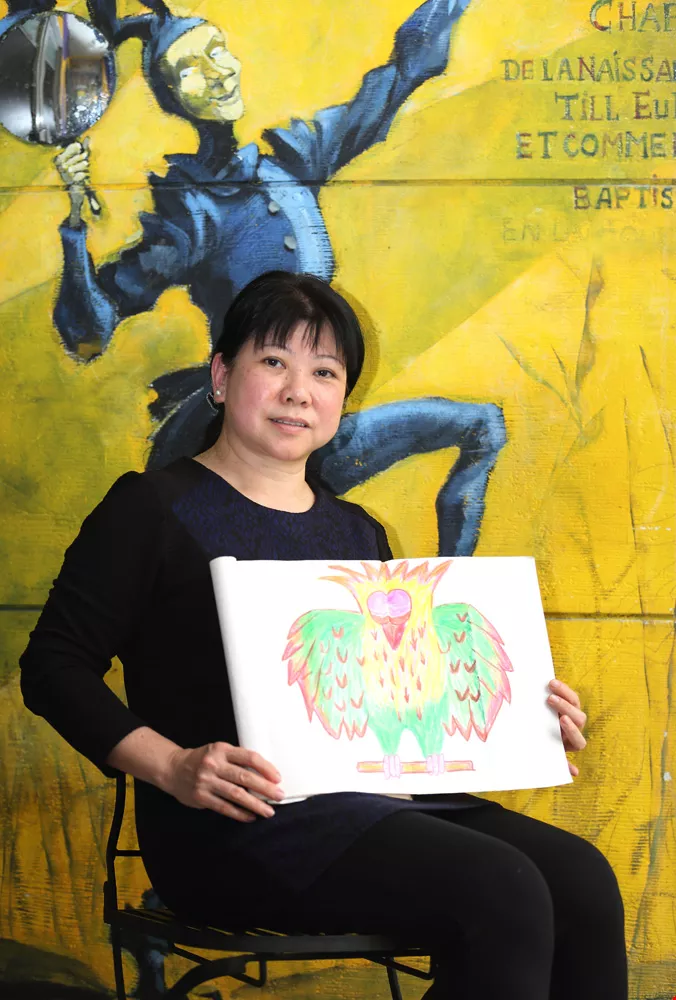
Immigrant mother Cheng Mei created picture books by hand and diligently learned storytelling techniques in order to bring joy to countless children.
Once, when Cheng’s son was in kindergarten, he was asked to get up on stage and tell a story about his hometown. To help him prepare, Cheng rushed to the library to borrow books and gather relevant materials. That night she even recorded him making his speech, again and again.
It was just a storytelling competition, so why practice so hard? Cheng responds: “It’s because my son once asked me, ‘Why are you Vietnamese and so ignorant?’ When children are in school, they compare themselves to their classmates. When he said that, I really felt sad. So I told myself: I’m going to work harder still.”
Though her son didn’t win a prize for his talk, the experience ignited her fighting spirit, and she decided to enroll him in another competition. Consequently, she herself took a training class at the library for mothers wanting to learn to lead story times. When you fall, she says, you pick yourself right up. That’s how Cheng got involved in storytelling. She even took the initiative to go to schools to volunteer to lead story time. The display of courage surprised even herself.
“After I saw other mothers using picture books as they told stories, I went to a bookstore, but the picture books were expensive. I couldn’t afford them, so I decided to make them myself.” Fortunately, the teachers of her two sons quickly discovered that they had artistic talent, placing them in selective arts classes both in elementary and junior high school. They in turn helped Cheng create illustrations for her books on Vietnamese folk tales. Working together drew them closer.
Cheng enthusiastically helped at school, taking active involvement to overcome her psychological pressures. Her children’s acceptance there helped her to regain her confidence and ultimately serve as a model for other immigrant moms.
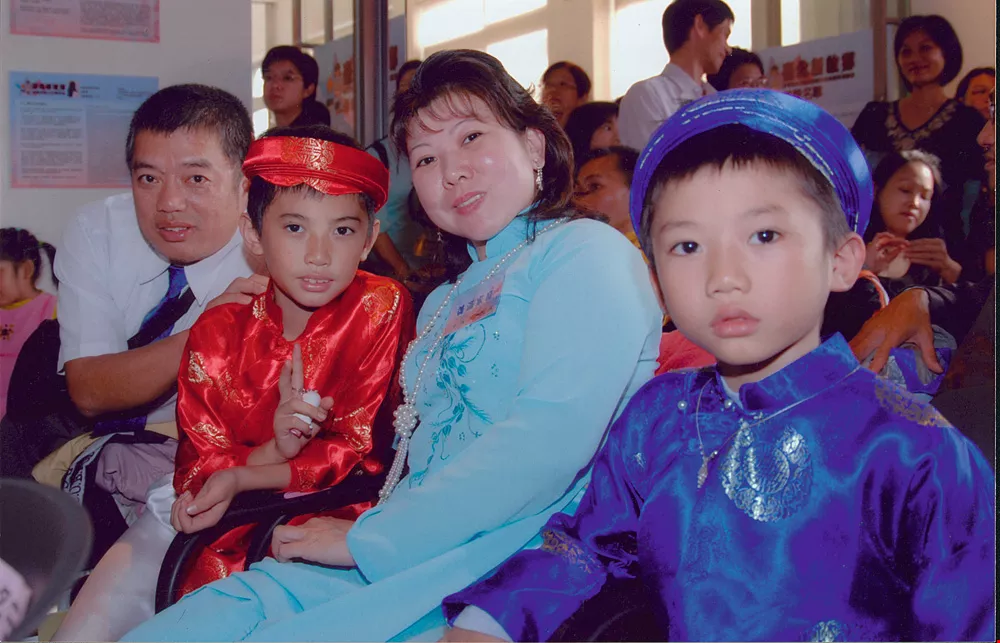
Volunteering as a “story-time mom” helped to improve Cheng Mei’s Chinese, and it also provided her children with a good model about the importance of taking the initiative in education.

Cheng says that when school lets out for the day, sometimes other children come up and say, “Auntie, my mother is also from Vietnam; she’s an immigrant too.” It fills her with a sense of affirmation.
The positive attitude she takes to embrace cultural differences has won the approval of her own children and their schoolmates, but Cheng says that she herself is the biggest beneficiary. Her success as a volunteer has enriched her life in a new land. And by telling stories countless times, her Chinese has also quickly improved.
When new immigrants face the double challenges of marriage and immigration, the process of adjusting to cultural differences and adapting to a new role may indeed create pressures, but Cheng Mei’s positive approach toward facing those challenges head on has both given her a sense of belonging in Taiwan and added vitality to Taiwan’s multiculturalism.