Taking Taiwan to the World--FTV English Edition
Vito Lee / photos Jimmy Lin / tr. by Scott Gregory
June 2005


Taiwan's media, both print and broadcast, is turning international. Monday editions of the United Daily News and Commercial Times newspapers feature supplements with bilingual versions of articles from the New York Times and the Wall Street Journal, to give readers first-hand access to English-language news and a wider worldview.
Taiwanese and the world are coming together in the broadcast world as well, with a variety of English- and Japanese-language programs cropping up with the goal of "marketing Taiwan" to the world, as well as serving the more than 500,000 foreigners living here and helping them to better understand their surroundings.
For years, Asian media outlets have been meeting the needs which have arisen through globalization by providing English-language news. Though Taiwan may have started a little late, there have been English news programs on free-to-air and cable TV since the 1990s. Unfortunately, low ratings and a lack of advertising sales kept them from staying on the air long. Because of this, the government decided last year to lend official support to the production of an English news program in the hopes of fostering global perspectives in Taiwan as well as a better understanding of Taiwan by foreign residents.
For Formosa TV, which was commissioned to produce the show, the last nine months have seen constant change as it struggled to find its audience for FTV English Edition. Not long after the Lunar New Year holiday, Chinese headlines were added down the left side of the screen in addition to the English subtitles across the bottom, and this little change brought a ratings jump of 25%.
"The Chinese headlines attract Taiwanese who want to study English through the English news," says Hsu Kuo-neng, director of the Government Information Office's Department of Domestic Information. The number of long-term foreign residents of Taiwan (including blue-collar workers) is estimated at around 500,000, though no one is sure how many of them comprise the show's core audience.
"The foreign demographic is increasingly broad. We're still trying to find out what sort of jobs they do and what countries they're from," says FTV English Edition's producer, Tang Shen-shen. It's clear that the target audience is foreign residents of Taiwan, and the producers don't want to let the program turn into an ESL show. But the rise in the number of Taiwanese viewers cannot be ignored.
The Chinese headlines may please the locals, but the content is still chosen to suit foreign audiences. Taiwanese festivals, foods, and scenic spots have been introduced, and even the high prevalence of kidney dialysis in Taiwan was the topic of a special report. These help foreign residents better understand Taiwan.
"FTV English Edition is especially strong on cultural reporting. A report on a reworking of Macbeth called Kingdom of Desire, an introduction to the calligraphy of Tung Yang-tzu, and coverage of an exhibition of aerial photos of Taiwan especially stand out in my mind," says one British teacher of English at a university in northern Taiwan. In March, viewership again jumped 20%, leading the producers to decide that a joint emphasis on news and lifestyle reporting was the future of the show.

FTV English Edition's ratings are on the rise-giving more exposure to its anchors Jeffrey Mindich and Jinny Chang.
Inviting the world in
FTV's English Edition is a newcomer compared to Taiwan's longest-running English-language news program, which has run on the Chinese Television System (CTS) since May, 2002. That half-hour program, aimed at the local market, combines news reportage with English teaching based on some of the news material. Though the independent CTS show and the GIO-assisted FTV show are both losing money, other stations, including Beautiful Life TV, are preparing to enter the English news market.
How the competition will bear out is yet to be seen, but the biggest challenge is sure to be the foreign media.
With the growth of the Internet and satellite broadcasting, international networks such as CNN are becoming increasingly popular sources of international news. Surveys show that foreigners in Taiwan rely on TV and newspapers for over 80% of information. With most of Taiwan's cable companies carrying CNN, that is doubtless their primary source of TV news.
Will Taiwan's local networks have to bow to the mighty CNN? Not necessarily.
"I'd been in Taiwan half a year before I learned through an FTV English Edition report that you can win prizes from your shopping receipts," says Susie, a South African English teacher. From receipts to residency, employment, studying Chinese, medicine, and Taiwanese taxes, "lifestyle news" is what foreign residents want most.
"Of course you can get mainstream international news from CNN, but thoughtfully edited local news could provide foreign residents with useful information about life in Taiwan. That would surely win a loyal audience," suggests one Taiwan-based American white-collar worker.
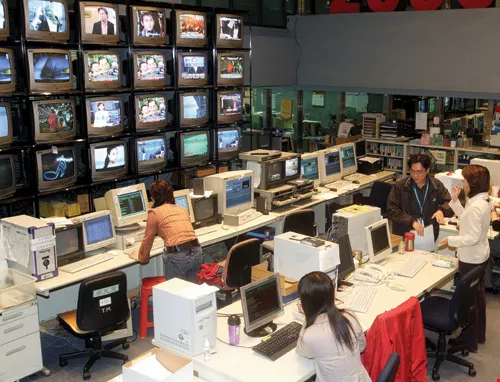
Cable and terrestrial channels, and a large news team, are assets to FTV in producing an English news show, but only time will bring experience.
Absorbing the local lifestyle
FTV English Edition had to start from scratch, and with a mere 0.1% share of Taiwan's TV audience, it's tough. Though with other stations looking to follow, it seems that it's made an achievement. But English news programs need high standards of accuracy, and finding editors and reporters with a high level of ability in Chinese and English as well as familiarity with Taiwan's newsmakers and current events is key to success for any such program. This presented some problems in FTV English Edition's early days.
"For example, take the mid-May elections for the 'mission-oriented National Assembly.' Even many Taiwanese are unclear about what the 'mission' refers to, and our translators and editors, most of whom are foreigners, not only have to know all about it, but to be able to explain it in English," says English Edition's Mandarin-fluent British acting editor-in-chief, Sam Ellis.
The show currently employs 20 editors, translators, reporters, and anchors. Most hold master's degrees or higher, a rarity among Taiwan's electronic media. But in the long run, if English news fails to find its share of the market in Taiwan, it will be difficult to keep them on board.
Taiwan is also behind other Asian countries in the competition to attract international talent. China, Hong Kong, Singapore, Japan, South Korea, the Philippines, and Malaysia all have high-quality English news programs. Some have been on the air for a few years, some for decades, some are publicly supported and some privately run. Each has aired for longer than Taiwan's two put together.
"Many foreigners find Taiwan a friendly country, so we are taking that to the next level by supplying more information," says Hsu Kuo-neng. Last year, the government decided to improve service for foreign residents of Taiwan, and a yearly NT$67 million was budgeted for English TV news as part of the package. The government hopes to close the gap with those other Asian nations, and provide the "basic infrastructure" needed for internationalization.
World-class news source
In addition to serving foreign residents of Taiwan, FTV has a larger plan for the future. They hope to create a source of news that is "world-class" in its depth and seriousness, forging its own style in Taiwan's chaotic media environment.
For most of the first half of May, news of comedian Ni Min-jan's suicide filled national TV news coverage. Reports of his ill-fated affair, his love life, and even rumors of supernatural events seemed to be aired around the clock. In contrast, FTV English Edition only aired three stories-one on the day his body was found, one on the day of his funeral, and one on the local media's fixation on the story.
"Many foreigners really can't believe what gets shown on the news in Taiwan," says Tang Shen-shen, who previously produced Chinese-language news for many years. She says that in order to give foreigners a better impression of Taiwan, they steer away from the extreme, titillating content used on other cable news programs.
There are currently four Taiwanese reporters producing original English reports for the show in order to give it its own perspective. There are around 17 stories every day, and around one third are made in-house. "We try to choose wire stories from European sources to provide a viewpoint other than America's," explains Sam Ellis.
April's march in protest of China's "anti-separation" legislation attracted the attention of the international media. Some, including CNN, used source material from FTV, and it could be said their reports included FTV's perspective.
Having strengthened its production of original English reporting, FTV now submits weekly reports to CNN. These reports, which have covered the march, Lien Chan's visit to China, and even Taiwan's unique Mazu festival, present a unique opportunity to give Taiwan international exposure and present a Taiwanese perspective.
Take it from John, an American resident of Taiwan who went from never watching Taiwanese TV to becoming a loyal viewer: "From providing a service to foreigners to presenting Taiwan's perspective, producing English-language news is a step Taiwan has to take in becoming more international. In the long term, it's definitely worth it!"
English News Shows in Taiwan
|


@List.jpg?w=522&h=410&mode=crop&format=webp&quality=80)


