If Taipei Had Been Designed in the Tang Dynasty ……
Chang Chin-ju / photos Vincent Chang / tr. by Phil Newell
April 1995


Taipei is the city in Taiwan that is most competitive as an international center. For Taiwan to become a "regional operations center," Taipei's performance will be decisive. Taiwan's other major cities--such as Kaohsiung and Taichung--see Taipei as the trend--setter and follow its example. They too want rapid transit systems, huge skyscrapers, and enormous tax revenues.
Taipei has far more international resources than other cities. Transnational organizations send delegations, and foreign arts troupes perform there. It is the most diversified of Taiwan's metropolises. People from all over Taiwan go there to "make it big."
However, recently the German magazine Der Spiegel ran an article comparing the cities of Asia's newly industrialized nations and, citing environmentalists, called Taipei "a pigsty." Earlier, an English court deciding a custody battle ridiculed Taipei as not fit for human habitation.
In 1990 two American magazines, Fortune and Newsweek, did surveys of Asian cities, and concluded that Taipei is East Asia's "ugly duckling." It was criticized for inadequate infrastructure, polluted air, and abysmal traffic, with the final blow being: "Worst of all, it is truly ugly."
Whatever foreigners may think, Taipei residents are even more dissatisfied. Air pollution, ubiquitous sidewalk vendors, illegal construction, and illegally parked motorcycles make even walking about an annoyance. It is crowded, dirty, and over-burdened. Lin Ku-fang, a scholar of music, says that Taipei residents always react instinctively. If there is a traffic accident, the drivers jump out of their cars and fight it out. People run into each other and exchange angry glances. "There is neither the space nor the time for people to sit around and ponder things."
Taipei is also a place where construction is crude and lacks any aesthetic sense, where the first ones to tear down historic buildings come out ahead, and where residential and commercial space is mixed together chaotically. Hsia Chu-joe, a professor in the Graduate Institute of Building and Planning at National Taiwan University, describes Taipei as "sticky cake": Neither officials nor urban planners can do anything with it.
In fact, as early as the Tang dynasty China had a city (Chang'an) with a million people. Foreign urban planners have praised Chang'an and Beijing as being the best laid out cities in history.
Doesn't Taipei have urban planning, too? Why can't Taipei's problems be controlled by planning? What can Taipei, with its forest of skyscrapers and sea of automobiles, learn from traditional Chinese cities? How can Taipei's Chinese make their home suitable for a tranquil life and a prosperous future?
Taipei just had its 110th birthday.
How did this special municipality of the ROC, which is envied by some and condemned by others, get its start and develop into the place it is today?
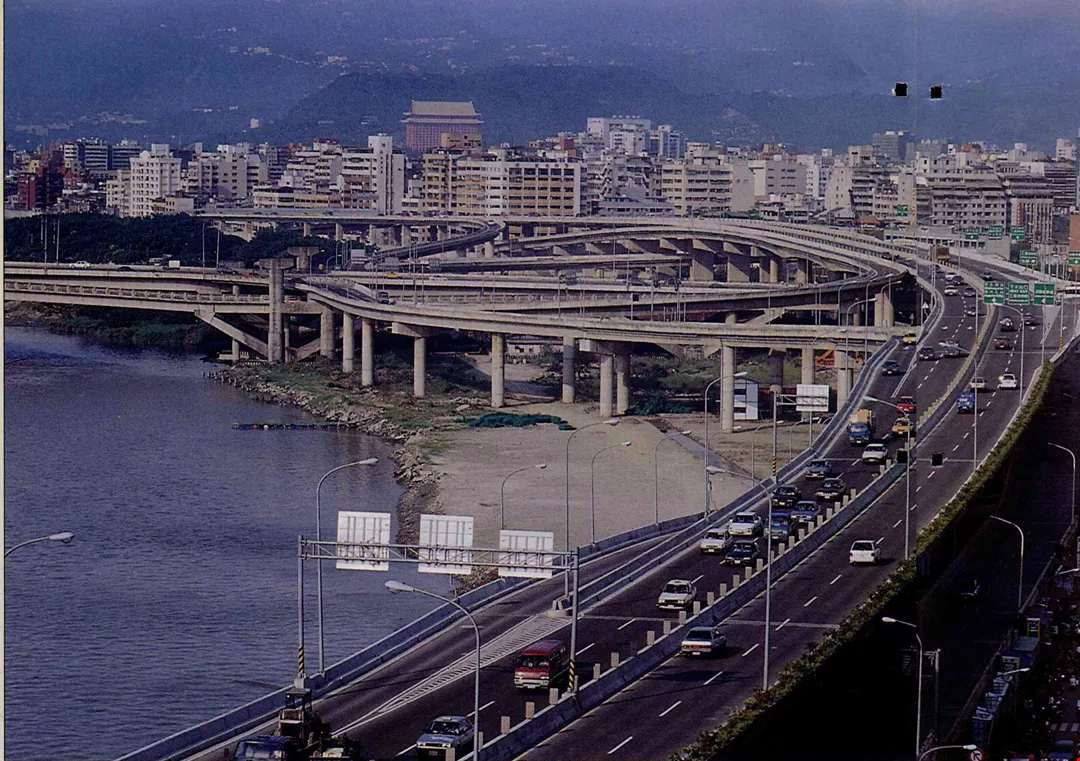
Is a so-called modern city simply one designed for automobiles? The elevated road on the riverside dike has blocked access to the water and ruined the view.
The birth of Taipei
The Qing dynasty founded Taipei in 1879 on the basis of traditional Chinese methods for constructing an urban area. At that time there were already population concentrations in Tataocheng and Wanhua, and Qing officials chose to site an administrative center between these two commercial areas. Unfortunately, the dynasty only put up a few government buildings, and there was no further development.
In 1895, Taiwan was ceded to Japan. The Japanese had come to Taiwan to stay. They demolished the Empress of Heaven Temple (built by the Qing court) and other symbols of Chinese culture. They employed what they considered to be the most modern urban planning methods, imported from the West. Not even in Japan proper did they have an opportunity to implement such a comprehensive urban design.
Western urban planning was at that time driven by the need to resolve problems that existed in urban concentrations following the industrial revolution. Problem areas included housing, health, hygiene, and recreation.
The Japanese paid particular attention to public health. They began by installing underground pipes and sewers, bringing the water from its source in Kung Kuan into the city center. Roads are another important prerequisite for a modern city, so in 1901 the colonial government implemented an "urban restructuring plan." It tore down the city walls, and built many six-lane roads (including what is now Aikuo East Road). Masonry from the city walls was used to lay sewers.
But the project that has had the greatest impact down to the present was the "Greater Taipei Metropolitan Area Plan." Announced in 1932, it provided the layout for a city of 600,000. Except for the addition to Taipei of six outlying districts (including Shihlin, Mucha, and Neihu) when Taipei was made a special municipality in 1967, modern Taipei is based essentially on that 1932 layout.
The Japanese rulers renovated the houses in Chinese residential areas (for reasons of public health). They also mapped out several residential areas for Japanese immigrants. Because the flow of Japanese into Taipei was slow and steady, the city's growth could be kept within the constraints of the plan.
Today, 100 years after the Japanese first arrived, Taipei's population of 2.7 million is more than five times the peak population of the occupation era (500,000). Yet Taipei's urban plan is pretty much the same.
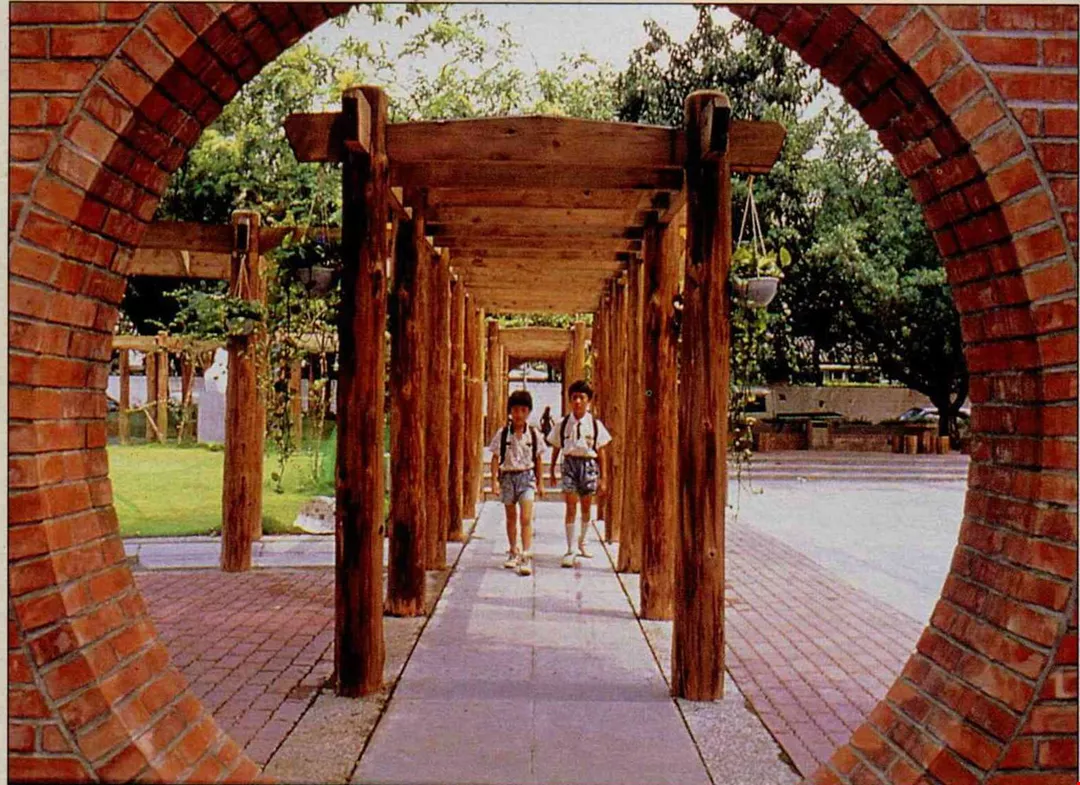
"Sungchang Poetry Garden" is one of the few parks which merges together with surrounding neighborhoods to create open space with pleasing views. (photo courtesy of commonwealth magazine)
One hundred years without change?
In 1949 the national government moved from mainland China to Taiwan. Those were chaotic times. The refugees thought they would only be in Taiwan temporarily, and in any case the government had neither its own plan for the city nor skilled city planners to draw one up. Indeed, it was not until 1954 that the Japanese handbook explaining Taipei's urban plan was even translated into Chinese.
Except for a couple of main streets along the route from the airport (Jenai Road and Chungshan North Road) beautified to impress foreign visitors and diplomats, other areas steadily got out of control. When the Japanese pulled out of Taipei, the remaining population was only 290,000. When the new wave of residents arrived in 1949, the population nearly doubled, and took over a great deal of land set aside for public works, especially parks. Since the government has long lacked any corresponding social programs to deal with these people, illegal structures from this period still remain on the sites of the future Number 14 and Number 15 parks.
When Kao Yu-shu became mayor of Taipei in the 1960s, his primary task was the removal of illegal structures. All cities have had problems with illegal structures. In many metropolises the problem is addressed by building housing for those with low and middle incomes. But in today's Taipei, governed by the recently elected Chen Shui-bian, policy is still focused on tearing the structures down.
The occupation of public land by illegal structures has prevented urban planning from playing an effective role. But, argues Chang Jing-sen, the executive director of Taipei's Department of Urban Development, the main reason for the loss of control over urban development has been the failure to implement land reform in Taipei. In his PhD dissertation he noted that when rural land reform was implemented in the 1950s, many landlords used their compensation money to buy urban land. During the four years it took to implement rural land reform, rents in major cities rose four- or five-fold, until control of the land was concentrated in relatively few hands.
So Taipei's urban planning has a weak foundation.
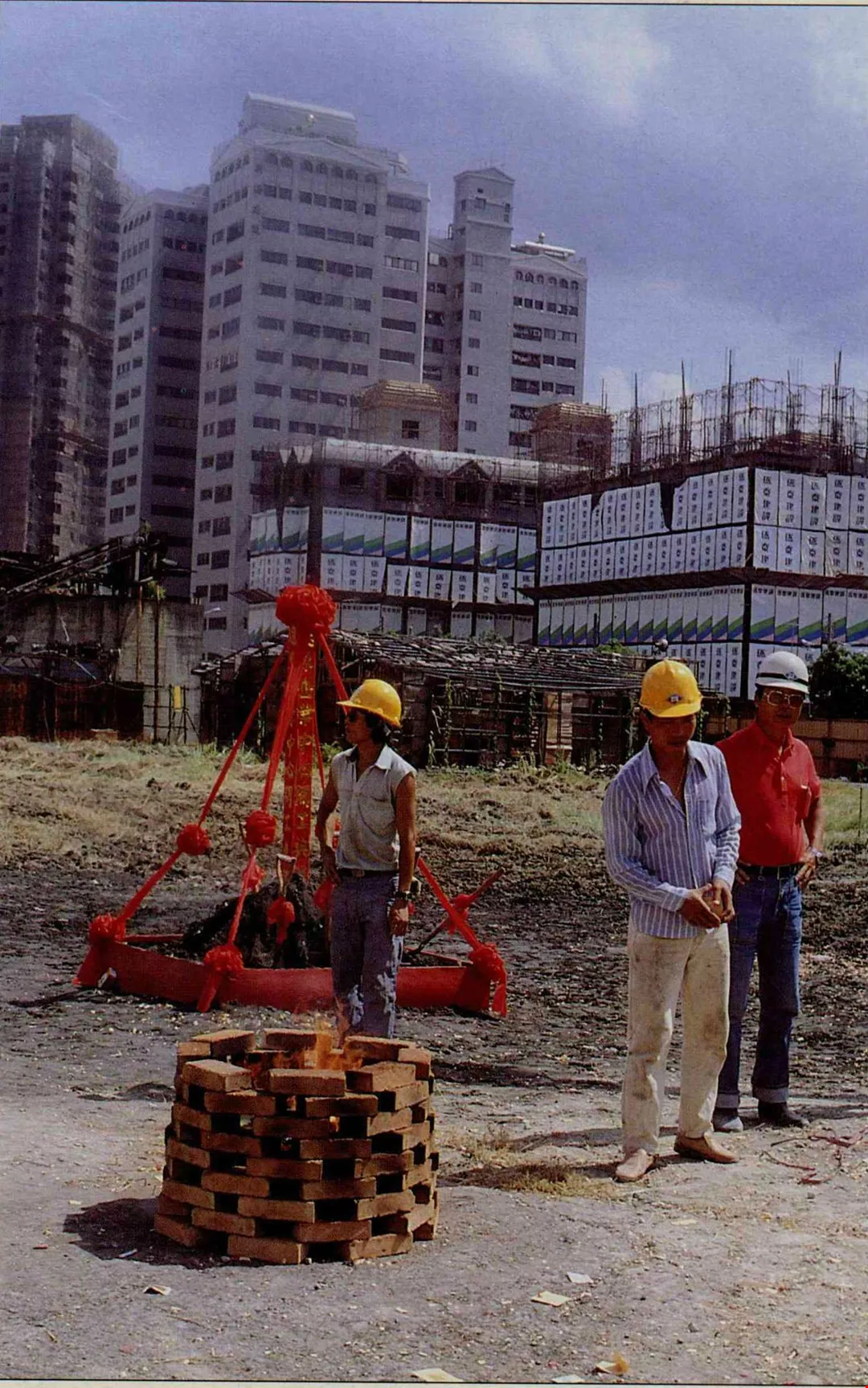
The lack of parks and greenery in Taipei has caused many scholars to declare that what the city needs more than anything else is open space. But even in jam-packed Taipei, people are still building on new sites.
A lack of urban land reform
In 1964 UN experts invited to Taipei warned that by the year 2000 Taiwan's urban population would increase by 67%. They pointed to cities like New York and Detroit, where an absence of long-range planning meant that water and road systems had to be repeatedly dug up and rebuilt, leading to tremendous waste, while blind private investment in housing led to urban sprawl, so that even enormous investments in infrastructure could not keep supply in balance with demand.
Although the govenment frequently amended the city plan (for example, in 1964 it passed revisions to the urban plan to renovate the city and create incentives for private investment in public works), drawing up plans is not the same as implementing them. Urban renewal and infrastructure require money, which must be appropriated early and in large amounts. Unfortunately the budget for these items was eliminated, and the government never made funding for urban planning a major concern. Chang Jing-sen says that the government had little hope that urban plans could be effective, and was passive about both funding and planning.
With most land in the hands of a few landowners, no funding for infrastructure, and no control over population flow, the government had little choice but to let the city grow willy-nilly.
In 1967, Taipei was made into a special municipality (equivalent in rank to a province), and it incorporated several outlying districts, raising the population to 1.6 million. In 1978 the North-South Freeway was opened to traffic, making north-south travel much easier. Taipei's population shot up to 2.4 million by 1984.
Urban planners recognize that unrestrained growth can kill a city. Therefore urban plans in the West control growth through laws governing floor area ratio and zoning.
Controls on floor area ratio limit the floor space of residences to a certain ratio to site space, insuring that the number of residents remains low, and thus naturally reducing the number of vehicles and the size of local commercial sites. This policy was only put into place on a district basis in Taipei in 1983.
In the early 1980s, there was a great deal of idle capital in Taiwan and much foreign capital also flowed in. When the government raised the idea of limiting population density, the whole city (especially the "Eastern District") went into a frenzy of building, with everyone trying to build to the maximum floor space. Speculation began to govern urban land use. Landlords and construction companies worked together to develop districts in their own financial interests, and many older neighborhoods were broken up.
Waves of new arrivals into Taipei, starting in the later 1940s and continuing in the 1970s and 1980s, combined with the dramatic increase in land prices in the 1980s and 1990s, led to illegal expansion and construction of houses everywhere, so that now illegal structures are a normal part of Taipei life.
Though floor area ratio limitations were finally implemented in 1993, "the current limits would permit 10 million people to live in Taipei," says Lin Chin-jung of Taipei's Division of Urban Design.
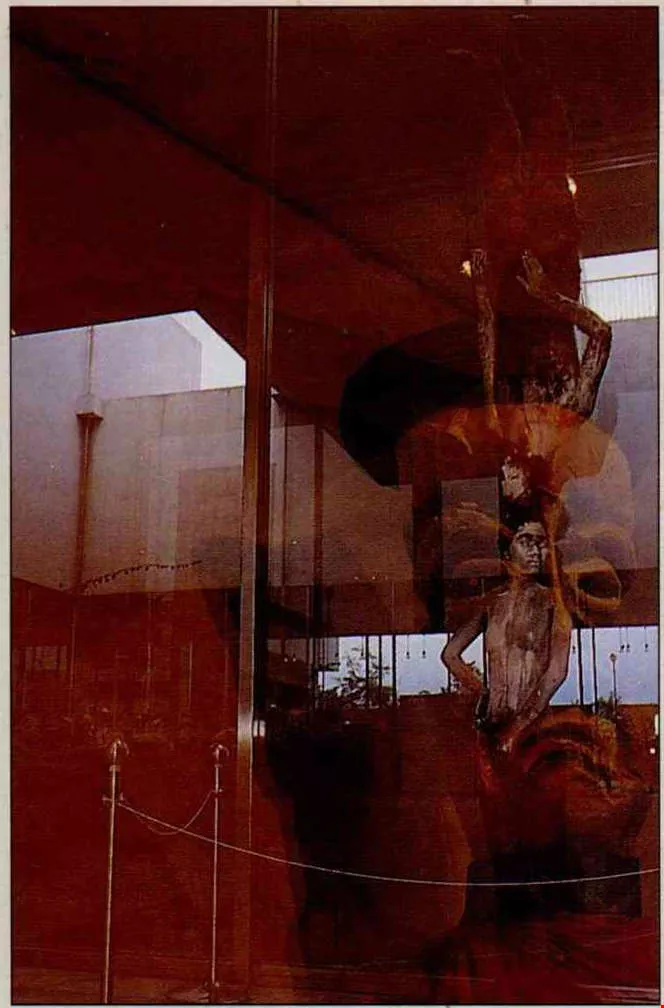
The Taipei Municipal Museum of Fine Arts is one of the city's most important cultural venues. (photo by Hsueh Chi-kuang)
Public works lose out to growth
Every step has come much too late. Foreign experience suggests that subway systems should be built when the population approaches one million; Taipei only began its mass rapid transit system when population exceeded two million.
Since the economy grew rapidly as the population increased, there was a multiplier effect, and not just a linear increase, in the demand for cultural, transportation, and recreational infrastructure. These all require public space.
But with profits from rising land prices going into private hands and inadequate funding on the government side, speculation was the order of the day. Any space that showed green turned to gold, and there were pressures to open all places to development. Not only did public facilities not increase in the plan, there was a dramatic drop in public space per capita.
Huang Shih-meng is a professor in the Graduate Institute of Building and Planning at National Taiwan University (NTU). He likens public access areas to the circulatory system: They both must be kept open to insure the healthy functioning of the organism.
But funding for public works is limited, and development has been too slow. Past plans stipulated that the amount of space for parks, athletic fields, plazas, and playgrounds should be no less than one-tenth the total. But in Taipei the main commercial areas have been continually expanding so that now the Provincial Museum is the one and only display hall for natural science educational purposes in all of the capital.
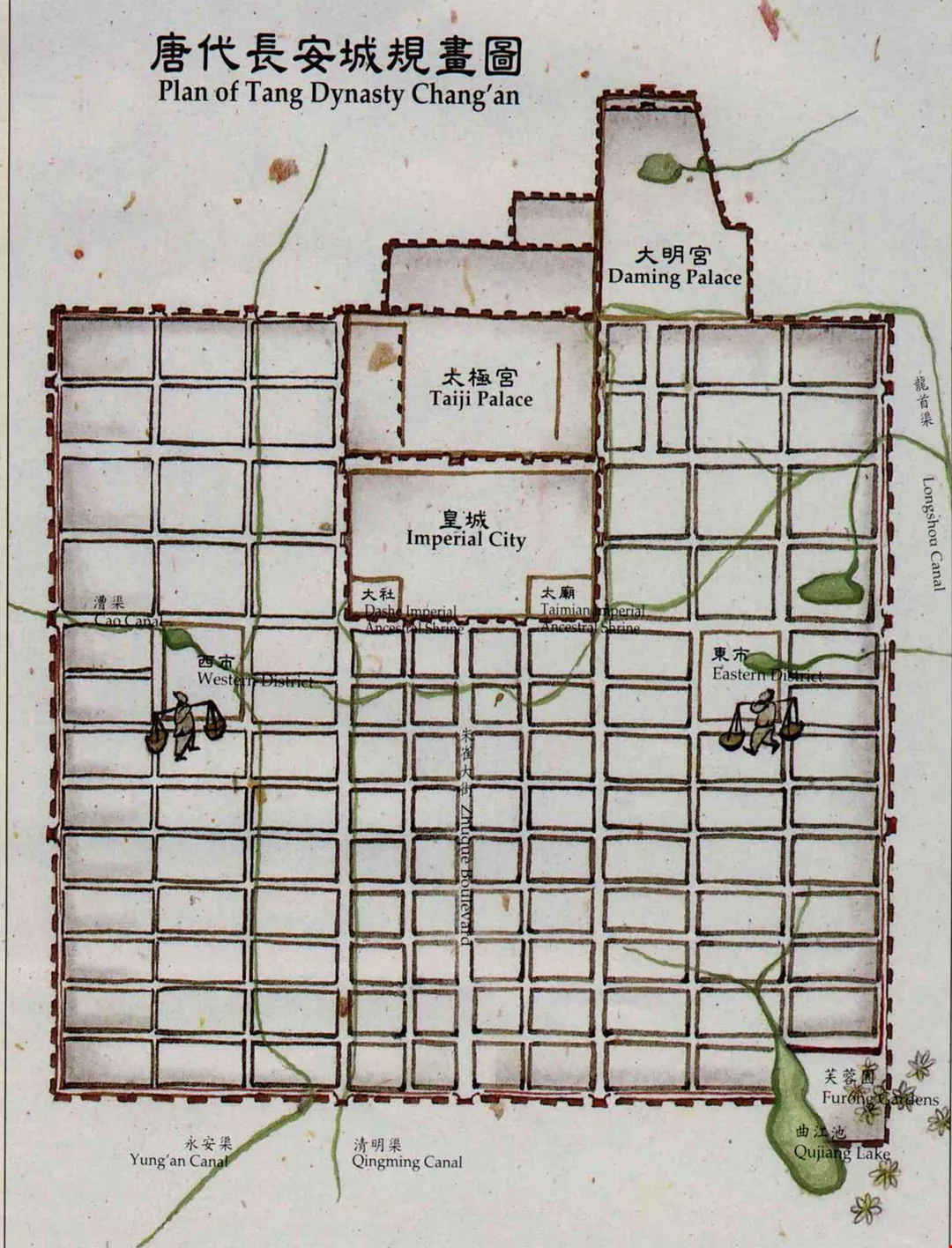
Plan of Tang Dynasty Chang'an source: Chinese Architecture and Town Planning/map drawn by Lee Su-ling Unless you start with undeveloped land, it will be hard to bring about large-scale and orderly city planning. The chessboard layout of Tang dynasty Chang'an is very suitable for today's cities, where automobiles play a leading role. Its central Zhuque Boulevard was more than 100 meters wide.
A heaven for speculators
Hsia Chu-joe says that the biggest difference between Taiwan's industrialization and urbanization experience and that of advanced countries is that the space allotted for recreation (parks, etc.) in Taipei is too small.
Meanwhile, the underground economy and street vendors have proliferated. One in four Taiwanese is a "boss," and all of them want to have ground-level shops. This smashes efforts at zoning, and leads to things like brothels in apartment buildings and residences turned into restaurants, making Taipei less livable.
After 1980, idle capital, looking for higher returns, began to flow into the service industry. Big investors opened shopping centers, small ones started up restaurants and karaoke bars. Taiwan's cities are thus lively but chaotic places, and are heaven to the risk-taker and speculator, further undermining attempts at planning.
Under these conditions, "Taipei's urban policies bent to the prevailing winds, allowing commercial activities to spread into residential areas, turning a blind eye to illegal structures, and implementing the law 'flexibly,'" says Deng Tsung-de, also at NTU's Building and Planning school.
But in recent years, as Taipei has come into greater financial resources than other cities, public pressure has pushed the government to begin recovering some illegally occupied public land. But because the whole city thrives on commerce, and because of pressure from speculators, it seems that policy is unevenly implemented.
The most recent example of the commercialization of space originally planned for public use is the Takashimaya Department Store in Tienmu. Kuo Chung-juei, who lived in Japan for 20 years, says that in Japan they would never put a department store next to a school. But Takashimaya is next to a school and a residential district, creating traffic problems.
"What Taipei most needs right now is open space," says Huang Shih-meng. Everyone wants to expel the Air Force headquarters, China Steel, and military factories from land they occupy illegally, but all they can think of is turning it into commercial space. Developers are even greedily eyeing the Kuantu Plain, Taipei's last water release area.
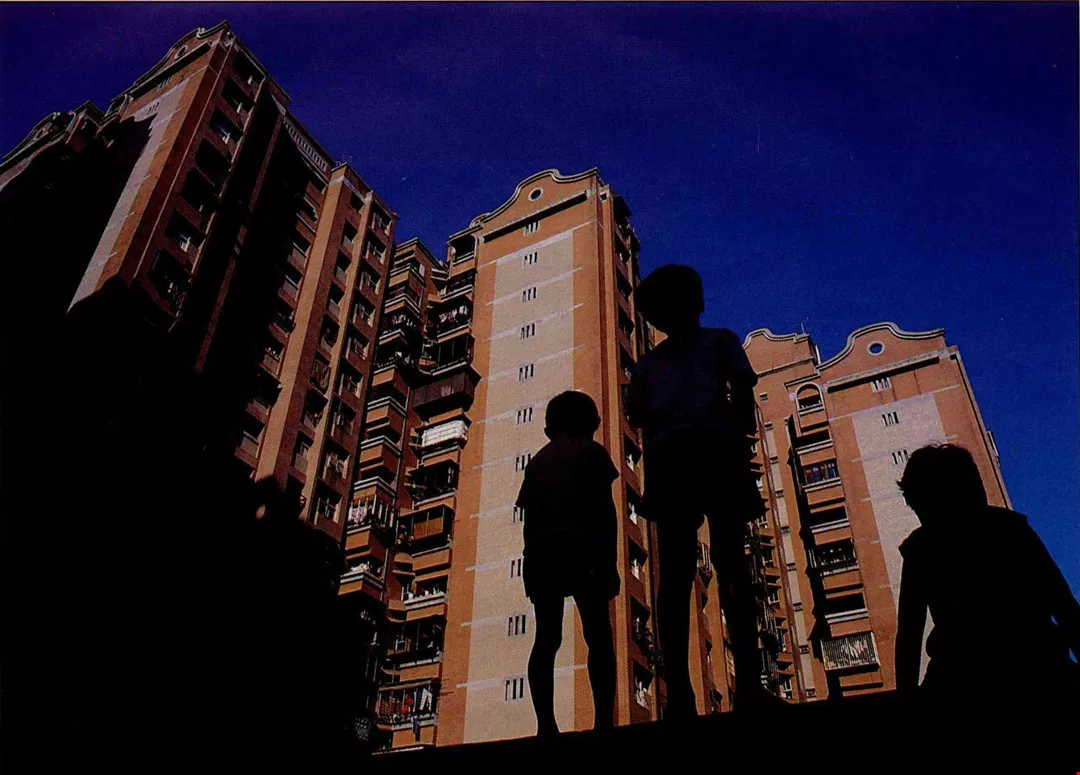
A forest of skyscrapers and a sea of cars: Where do the children play? (photo by Chiu Sheng-wang)
Occupying residential land
During the Japanese era, the whole western part of Taipei was mapped out as a commercial area. But the Japanese did not understand the way local people lived. The western district is not fully utilized for commerce because Chinese prefer to shop nearer to their homes. Thus, for example, the Far East Department Store on Jenai Road has been illegally operating in that residential district for years, paying fines each and every month.
Moreover, "the urban plan we are using today is too simplified," says Hsia Chu-joe. It is just a road map with districts marked off in red, yellow, or green. But people can build with reckless abandon in all districts. If someone wants to destroy the overall view, there are no regulations to stop them. In the Japanese era they at least set norms for arcades, but on Taipei streets there are arcades at all different levels, with signs for businesses of all types.
Plans remain on paper. And with public infrastructure rushing to catch up, the quality of construction suffers, sacrificing both safety and aesthetics. "Taipei's urban policy is that there is no urban policy," concludes Wu Kwang-tyng, an associate professor of Architecture and Urban Design at Chinese Culture University.
Is there no other way?
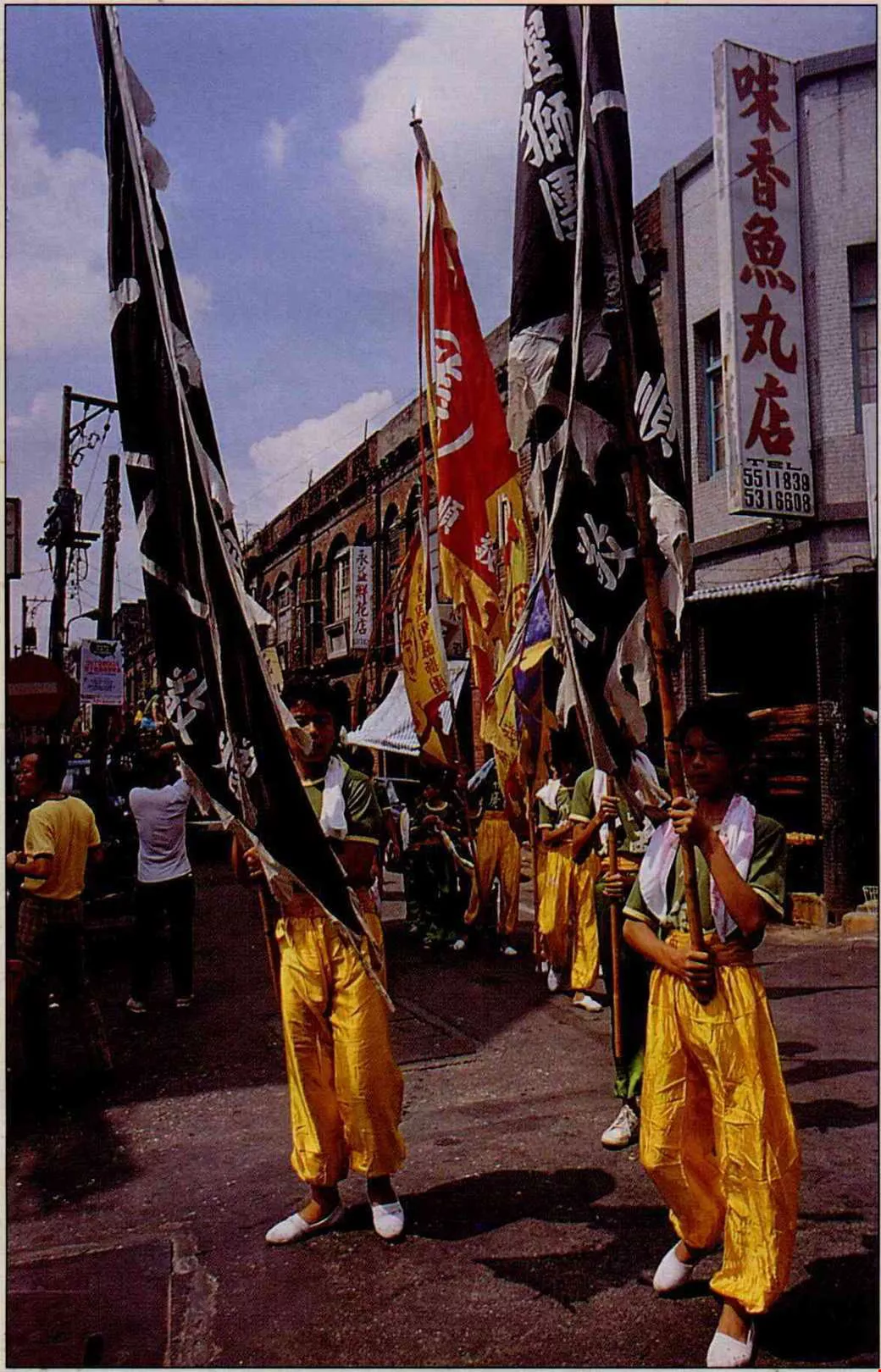
(left and right) Today's Taipei has many newcomers from rural areas side-by-side with well-dressed Western-educated office workers; Taipei hopes to become an efficient international city while still retaining its cultural identity.
From Chang'an to Taipei
But what if the traditional Chinese city plan envisioned in the Qing dynasty for Taipei--a plan that was half completed but left unfinished--could have been brought to fruition?
The earliest Chinese urban plan, from the Zhou dynasty (1122 BC to 255 BC), states that cities should be square, have three gates on each side and nine main roads running parallel both horizontally and vertically, and provide key sites for various temples and a commercial district.
While no city ever followed this plan rigorously, old towns were consistently walled and surrounded by moats, both for defense and to make them easier to manage. And unlike modern cities, where tall commercial skyscrapers blot out the horizon, the most important buildings in traditional cities were temples or centers of culture and education. Thus in imperial times not only the capital, but even provincial and prefectural cities, were all based more or less on a standard model, and differed only in scale.
"The Qing were very careful in building Taipei," says Lin Chien-lang. They wisely chose a site between commercial districts, and then built all the key structures--temples, schools, and cultural centers--first. "At least they weren't completely mindless like people today."
Traditional cities were built around an axis formed by the main roads and public buildings, which was like a plaza. Ceremonies took place there, and traffic revolved around this axis. Comparing these street patterns to the Western-influenced rotary-centered street patterns of Japanese cities, old Chang'an would probably still be more convenient. Chang'an long prefigured the concept of governing overall traffic flow, so that some say that Chang'an looks "progressive" even today.
Today, Taipei residential areas suffer from the invasion of the sex industry and fire hazards like restaurants. But in traditional cities commercial areas were set apart. In the Tang dynasty capital of Chang'an there were designated business districts, one in the east quarter and one in the west, where virtually all enterprises were concentrated. Businesses opened at dawn and had to close at dusk. The great poet Li Bai wrote "Sleeping in a Chang'an Wine House," describing how, when intoxicated, he and his friends would miss the curfew and have to spend the night in the tavern.
Meanwhile, residential areas in Chang'an were divided into "neighborhoods," each with its own wall. Disreputable businesses were forbidden to open in these neighborhoods. Taking into account daily needs, there was a rice shop and a market in each neighborhood to buy sundry items, but these were all businesses that did not conflict with the life of the neighborhood.
Controlling growth
Chinese urban planners have long known that it is difficult to control all the political, social, and economic factors in urban growth, so in all cities, large and small, the central or local authorities would include more space within the city walls than was immediately necessary. This was the case for both brand new cities built from scratch and also when walled cities were built around preexisting population concentrations.
In Chang'an, several neighborhoods were sparsely populated, indicating that the authorities had left room for unanticipated growth. It was discovered in 1945 when aerial mapping was done of Quanzhou in Fujian that one-fourth of that city was still open space. Liu Shih-chi, a researcher in the Sun Yat-sen Institute for Social Sciences and Philosophy at the Academia Sinica, notes: "Leaving empty space on which crops could be cultivated had two functions: preparation for long-term defense and allowing for additional growth." This suggests an understanding of the concept of "managed growth."
Of course, as in the present, traditional city plans also suffered gaps between theory and practice. By the Sung dynasty, Chinese cities grew less orderly, and began to more closely resemble today's helter-skelter Taipei. Hsia Chu-joe suggests that a city's layout is the product of its times, and there is no eternal good or bad. The differences between orderly Chang'an and the tumultuous Sung era cities reflect different cultures and times.
Thus, for example, traditional cities in north China were supposed to face southward toward the imperial court. This was not only because the emperor was there, but also suited the angle of sunlight and the winds in northern areas, thus making the city a more comfortable place to live. Today people have little regard for placement, because they don't need natural sunlight: everything is electric.
A modern British city planner once said that "perhaps the greatest single work of mankind is Beijing." Beijing and Chang'an are the basis of the Chinese claim to fame in urban planning, because even in the imperial era they understood that it is necessary to consider the practical requirements of the lives of the residents.
Cities are for living
Today's city reflects a commercialized culture of economic development and hedonism. No one argues that material life is unimportant. But in excess, it leads people to overlook how to live in true ease. People no longer consider whether or not they live in comfort, but only whether or not there are economic benefits to be gained. Today's city is for speculation, not for habitation.
Obviously, we are no longer in the Tang dynasty, and it is not possible to enforce a perfect city plan. Problems such as compulsory purchases of land by the state and so on make urban planning a very convoluted process. Still, looking back, many problems could have been prevented in the development process. No wonder one scholar bemoans, "It's too bad the Qing city plan for Taipei was never fully implemented."
No one can say for sure that if Taipei were built on traditional lines it would be a more livable place. If Taipei citizens all moved into Chang'an tomorrow, naturally it would have its problems, too. It's just that the disorder in Taipei makes one long for an alternative.
Hung Wen-hsiung, an associate professor of architecture at Tunghai University, says that in fact there has never been an urban plan suitable for all cities in all times. "Every country is groping toward what modern urban planning and development should be, and there are flaws in all urban plans. Nothing is 100% perfect."
Taipei is still developing its own character, and although it is more chaotic than ever before, it is also dynamic. Hung says he often tells his students that they can see the chaos of Taipei as a reflection of a society in flux, giving hope that there is the opportunity to construct a better future.
Maybe now is the time for Taipei to settle on an urban plan all its own.
[Picture Caption]
p.6
The Taipei of the Japanese occupation era-surrounded on all four sides by mountains and bisected by the Tanshui River-is now a forest of construction. The illustration below is a Japanese era map of Taipei, with those buildings dear to the Japanese specially marked. (photo below courtesy of Lin Han-chang)
p.8
Is a so-called modern city simply one designed for automobiles? The elevated road on the riverside dike has blocked access to the water and ruined the view.
p.10
"Sungchang Poetry Garden" is one of the few parks which merges together with surrounding neighborhoods to create open space with pleasing views. (photo courtesy of commonwealth magazine)
p.11
The lack of parks and greenery in Taipei has caused many scholars to declare that what the city needs more than anything else is open space. But even in jam-packed Taipei, people are still building on new sites.
p.12
The Taipei Municipal Museum of Fine Arts is one of the city's most important cultural venues. (photo by Hsueh Chi-kuang)
P.13
Plan of Tang Dynasty Chang'an
source: Chinese Architecture and Town Planning/map drawn by Lee Su-ling
Unless you start with undeveloped land, it will be hard to bring about large-scale and orderly city planning. The chessboard layout of Tang dynasty Chang'an is very suitable for today's cities, where automobiles play a leading role. Its central Zhuque Boulevard was more than 100 meters wide.
p.14
A forest of skyscrapers and a sea of cars: Where do the children play? (photo by Chiu Sheng-wang)
p.16
(left and right) Today's Taipei has many newcomers from rural areas side-by-side with well-dressed Western-educated office workers; Taipei hopes to become an efficient international city while still retaining its cultural identity.
@List.JPG?w=522&h=410&mode=crop&format=webp&quality=80)

@List.jpg?w=522&h=410&mode=crop&format=webp&quality=80)


