

The inauguration of Chen Shui-bian on 20 May officially drew a line under the 12 years and four months of the "Lee Teng-hui era." But the effects of President Lee's presidency, with all its momentous twists and turns, continue to be felt; and when we consider that President Chen has been seen as "the man most able to continue the 'Lee Teng-hui line,'" the prospect looms large that although "retired," Lee will not be inactive, but will continue in the role of elder statesman and trusted adviser to the new government. Today, we look back on Lee Teng-hui's 12 years in power, not to pass judgement on his successes and failures, but in the hope that an understanding of the past can serve as a guide to the future, by which we can more clearly understand Taiwan's present situation and future challenges.
With Lee Teng-hui's 12-year presidency coming to an end, the press has been busy appraising Lee's performance. A poll in early May by the Shanshui opinion research company found that the public gave Lee Teng-hui a reasonably good overall mark of 67 out of 100 for his achievements in office. The highest individual mark, 73, was for "promoting democratic reform in Taiwan," while the lowest, 48, was for "combating criminality and corruption in politics." Another survey, conducted in May by the United Daily News, found that 74% of those polled were satisfied overall with Lee's achievements during his 12-year tenure as a whole, but somewhat less-61%-were happy with his more recent performance.
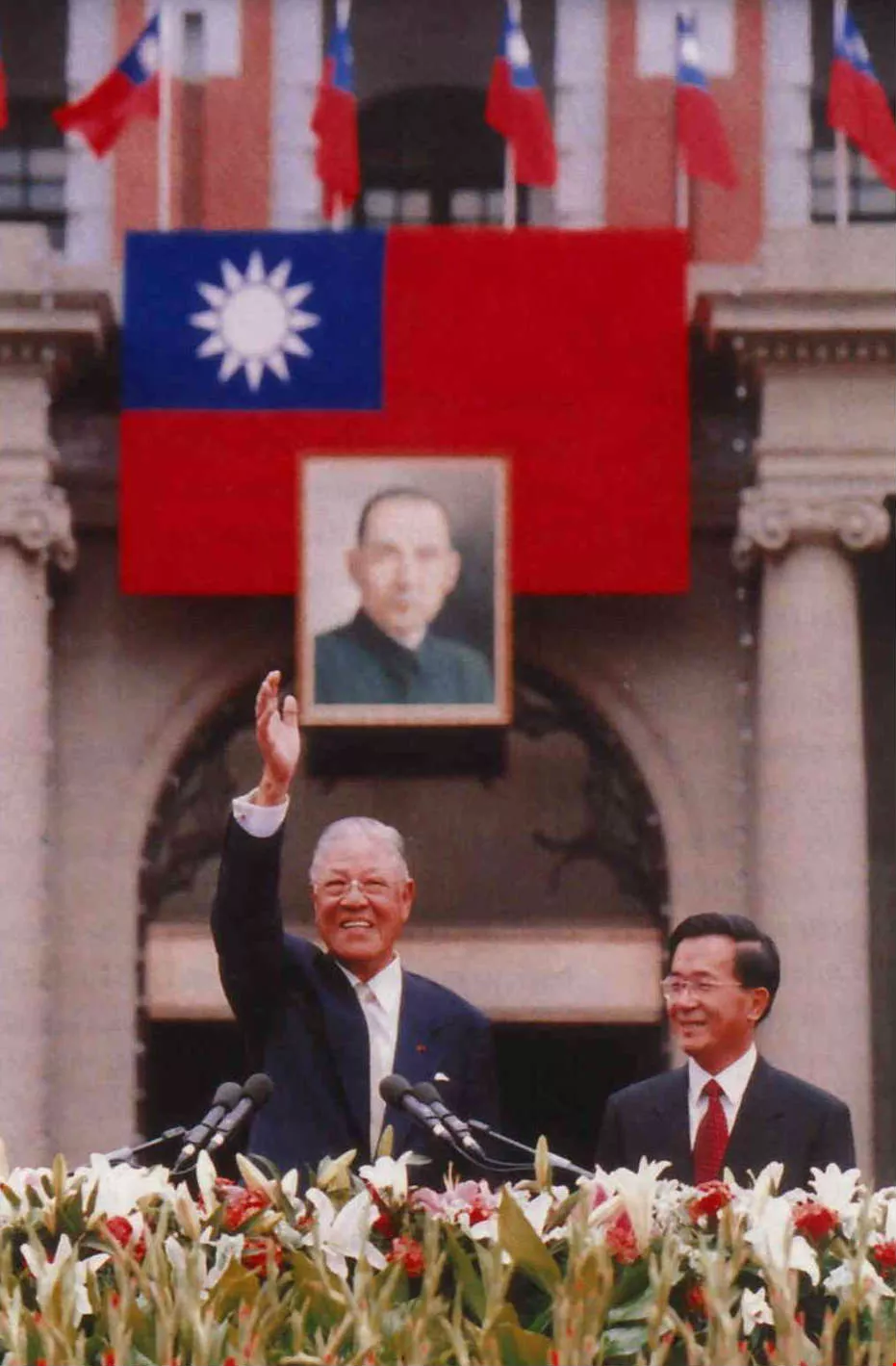
At the inauguration on May 20, Lee waved goodbye while incoming president Chen Shui-bian stood by with a smile. Lee was the first "Taiwanese" president of Taiwan, the first popularly elected leader in Chinese history, and the first to peacefully transfer power to an opposition leader. How will history judge him? (courtesy of the Taipei Photojournalists Association)
On 13 January 1988, the strongman Chiang Ching-kuo died and Lee Teng-hui stepped in to take his place. Taiwan at that time was in the midst of an "economic miracle" fueled by the export success of its small and medium enterprises. The strong economy, a hardworking and well educated workforce, and encouraging initial progress at the Hsinchu Science-Based Industrial Park, provided a solid foundation for the Lee Teng-hui era to build on. In his last years Chiang Ching-kuo, by allowing family visits to mainland China, lifting martial law, ending the ban on new media organizations, and permitting the formation of opposition parties, had also opened the door to the democratization of Taiwanese politics.
After many years of authoritarian rule, however, there were still many restrictions on free speech, publishing, the formation of political parties and civic organizations, and freedom of the individual. In terms of ideology, the stress on the ideal of a unified Greater China and institutionalized anti-communism threw a pall over local culture, and a Taiwan-oriented consciousness had not yet openly emerged. The political environment and the distribution of cultural resources were less than fair, and due to the influence of a world-view centered on the Chinese mainland, progress on urban rapid transit systems and many other important basic infrastructure projects was slow.
Many scholars agree that in his 12 years at the helm, Lee's greatest contribution has been the democratization of Taiwan. His achievements include pushing through full elections to the legislature, introducing the direct popular election of the president, building a framework for multi-party politics, bringing the armed forces under the control of the state rather than the KMT and requiring them to maintain strict political neutrality, and guaranteeing basic freedoms such as freedom of speech and of association. These changes have freed the people from "white terror" and blatant authoritarianism.
In 1991, the Temporary Provisions Effective During the Period of National Mobilization for Suppression of the Communist Rebellion were abolished, thus restoring constitutional government, and this paved the way for scrapping of the blacklist (which prevented political exiles returning to Taiwan) and release of the ROC's last political prisoner. The Human Rights Monument was erected on Green Island last December, and this year's presidential elections brought about a peaceful transfer of political power between political parties, something never before seen in Chinese history. The completion of the "quiet revolution" is Lee Teng-hui's proudest achievement.
The merit of the quiet revolution's achievement in breaking the previous one-party monopoly on power is beyond doubt. Looking more closely, however, although Taiwan has achieved the outward form of democracy, it still does not present a good model of the rule of law and a strong civil society. Corruption in official places is frequently in the news, and the public at large appear insufficiently versed in the ways of democratic politics. The entrenchment of organized crime and big money in the political fabric, the inadequate prestige of the judiciary, and a lack of ability to impose public authority, all go to show that we are still a long way from being a "high-quality democracy."

Competition is always cruel, and the new economy cannot be separated from "the new unemployment." Only through the cooperative efforts of government and business, and constant learning by the individual, can the shock be minimized. (photo by Chen Ko)
Apart from democratization, another area in which Lee Teng-hui rates his own achievements very highly, but on which other commentators' judgements are mixed, is that of constitutional reform. In the decade following the 1990 National Affairs Conference, the National Assembly revised the constitution six times, gradually bringing the ROC constitution more into line with Taiwan's local needs, but by introducing direct presidential elections he also changed what had been more or less a cabinet system to one of dual leadership by both the president and premier. The powers of the president have been expanded without a commensurate increase in the powers of supervision by other branches of government, and just how such a dual-leadership system is supposed to operate remains a delicate issue for Chen Shui-bian's new government. The sidelining of the National Assembly in April of this year removed that body's ability to act as an uncontrolled "constitution-amending monster." But will the loss of the assembly as a counterweight to the power of the Legislative Yuan also give rise to new anomalies? Citizens have continued cause for concern.
Lee Teng-hui's "indigenization" policy is another controversial issue. In the past 12 years, Taiwan has gradually turned from being "a province of the Republic of China," to being "the Republic of China on Taiwan," and then to the present situation where one hardly ever hears the name "Republic of China." The national anthem, which refers to Sun Yat-sen's Three Principles of the People, and the national flag, with its white sun set in a blue sky-the symbol of the KMT-have almost disappeared. Instead, concepts such as "new Taiwanese" and "Taiwan first" have become mainstream values.
The idea of a "new Taiwanese" identity was put forward as a rallying call for all Taiwan's different ethnic groups, as common stakeholders in Taiwan's future. "Taiwan first" is a counter both to the remnants of the "Greater China" mentality within Taiwan, and to the pressure from the communist regime across the Straits. Both concepts should in fact be seen as entirely natural, for over 70% of Taiwan's population is of long-established Taiwanese ancestry, and the island has not been ruled from the mainland for more than a century. In an interview with Japanese writer Shiba Ryotaro in 1994, Lee Teng-hui clearly expressed his feeling that "the Kuomintang is an alien political force," and of "the tragedy of being born Taiwanese."
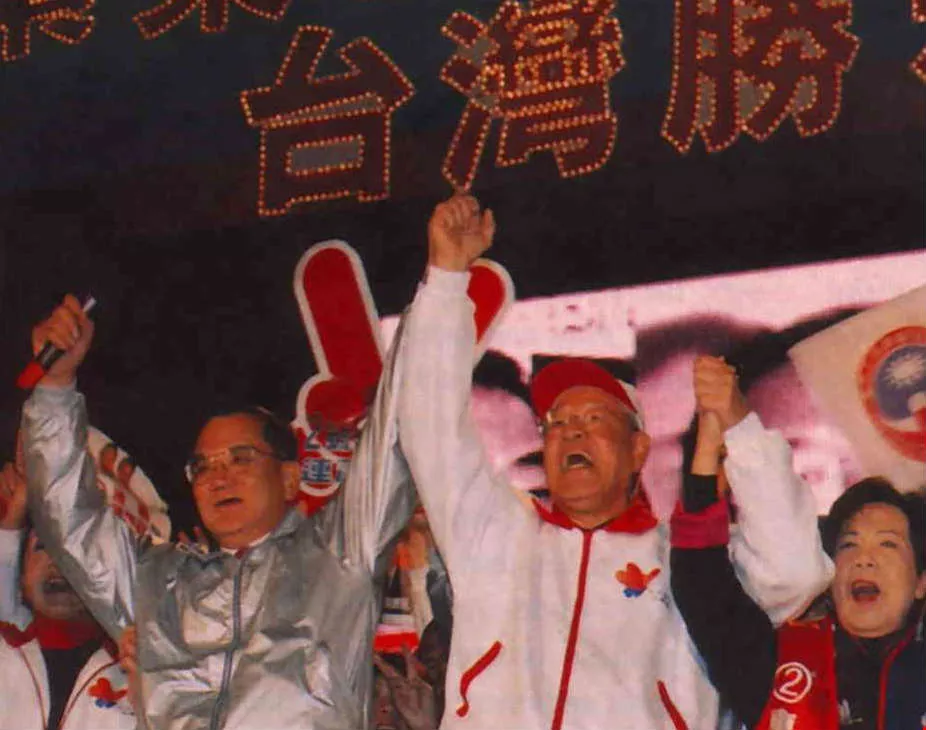
During this year's intense presidential election, Lee Teng-hui travelled widely in support of his chosen successor, KMT candidate Lien Chan. Still, one of Lee's close friends was publicly quoted as saying "Chen Shui-bian is the real successor to the Lee Teng-hui line," and, after Lien's defeat, Lee was accused of being too lukewarm in his backing. (photo by Pu Hua-chih)
Regrettably, however, while Lee Teng-hui was implementing "indigenization," putting "Taiwan first," and energetically promoting Taiwan as a sovereign state on the international stage, relations across the Taiwan Strait became increasingly estranged and suspicion-ridden. In recent years, the policy of "no haste, be patient" regarding Taiwan's economic involvement in the mainland, and the description of political contacts as "state-to-state" relations, have embroiled Taiwan in constant wars of words with Beijing, and cast a shadow over regional peace. In other words, the results of Lee Teng-hui's "excision of China"-presented as "indigeniza-tion"-has on the one hand resulted in the people of Taiwan acquiring self-confidence and dignity, but on the other has also led to the contentious issue of reunification versus independence being constantly raised, the sense of national identity of the general public in Taiwan becoming very confused, and cross-strait tensions reaching an all-time high. So much so that the Taipei stock market plummeted by over 400 points in less than an hour just because near the beginning of his inaugural address President Chen said: "Taiwan stands up, representing the. . . dignity of the country." Newspapers also made much of the fact that in his address, Chen mentioned "the Republic of China" only five times, but "Taiwan" 43 times.
With the process of indigenization having already progressed so far, why would mentioning Taiwan a few times provoke such panic? This is precisely the point where the "Taiwan first" concept breaks down. Relations with the mainland at the highest political level have reached impasse after impasse, and dark war clouds gather over the Taiwan Strait; yet at the grassroots level, what with trade links, fishing links and intermarriage, the people are inseparably intermingled, and the same is true on the academic, cultural and religious fronts and even in the entertainment and travel industries. Ideologically, Taiwan rejects and resists mainland China, but in real life there is constant contact. This contradictory dislocation also leaves ordinary people at a loss.
Taiwanese, or Chinese?Regrettably, however, while Lee Teng-hui was implementing "indigenization," putting "Taiwan first," and energetically promoting Taiwan as a sovereign state on the international stage, relations across the Taiwan Strait became increasingly estranged and suspicion-ridden. In recent years, the policy of "no haste, be patient" regarding Taiwan's economic involvement in the mainland, and the description of political contacts as "state-to-state" relations, have embroiled Taiwan in constant wars of words with Beijing, and cast a shadow over regional peace. In other words, the results of Lee Teng-hui's "excision of China"-presented as "indigeniza-tion"-has on the one hand resulted in the people of Taiwan acquiring self-confidence and dignity, but on the other has also led to the contentious issue of reunification versus independence being constantly raised, the sense of national identity of the general public in Taiwan becoming very confused, and cross-strait tensions reaching an all-time high. So much so that the Taipei stock market plummeted by over 400 points in less than an hour just because near the beginning of his inaugural address President Chen said: "Taiwan stands up, representing the. . . dignity of the country." Newspapers also made much of the fact that in his address, Chen mentioned "the Republic of China" only five times, but "Taiwan" 43 times.
With the process of indigenization having already progressed so far, why would mentioning Taiwan a few times provoke such panic? This is precisely the point where the "Taiwan first" concept breaks down. Relations with the mainland at the highest political level have reached impasse after impasse, and dark war clouds gather over the Taiwan Strait; yet at the grassroots level, what with trade links, fishing links and intermarriage, the people are inseparably intermingled, and the same is true on the academic, cultural and religious fronts and even in the entertainment and travel industries. Ideologically, Taiwan rejects and resists mainland China, but in real life there is constant contact. This contradictory dislocation also leaves ordinary people at a loss.
Into the "post-Lee era"To return to domestic politics, in the open atmosphere of democratization and indigenization under Lee, Taiwan has become increasingly pluralistic and international in outlook. In particular, there have been salient achievements in the pluralization of education. The joint college entrance exam system, which has dominated educational thinking for nearly half a century, is about to be abolished, and other topics such as women's rights, children's issues, workers' rights and environmental protection have all come to the fore as campaign issues at one time or another. The liberation of the diverse forces within Taiwanese society since the lifting of martial law has been a revelation, and many people have hoped this would lay the foundations of a flourishing civil society and allow autonomous civic campaign groups to become a third force in addition to government and business. Sadly, however, the vitality of these various campaigns was short-lived, so that despite its pluralism and openness, Taiwan lacks voices of introspection and balance.
Lee Teng-hui's domineering leadership style, in which he made no bones about his likes and dislikes, was also a topic much discussed while he was in office. After many years of factional disputes and party purges within the Kuomintang, the party is riven by long-standing internal divisions, and the fratricidal struggle between Lien Chan and James Soong was the direct cause of its defeat in the latest presidential election. In its efforts to revive itself after this crushing reversal, the hundred-year old party has only now discovered that there is no shortage of hypocritical sycophants within its ranks, but precious few worthy and able people of good repute. The flight of specialist talent, and a failure to take a clear moral stance, have been seen as some of the most serious failings of Lee Teng-hui's governance.
Looking back overall, what is paradoxical is that Lee's greatest contributions to Taiwan are also the areas which have attracted the harshest criticism. Inspired by his great love of Taiwan, he stood alone against the power of the conservative factions which opposed him, swept away various entrenched practices, and brought Taiwan into a new world which one would not have dared to imagine 12 years ago. Nevertheless, although the shackles of the old era are gone, Taiwan in the new era is still beset with difficulties, and on coming to office the new government will immediately have to grapple with many difficult issues, including the constitutional system, cross-strait relations, rampant criminality and corruption in politics and government, a burgeoning budget deficit, the state of the economy, and social welfare programs. Which parts of the "Lee Teng-hui line" will be continued in the future? Which need to be adjusted or even reversed? We look to the new government to make wise choices.
Into the "post-Lee era"To return to domestic politics, in the open atmosphere of democratization and indigenization under Lee, Taiwan has become increasingly pluralistic and international in outlook. In particular, there have been salient achievements in the pluralization of education. The joint college entrance exam system, which has dominated educational thinking for nearly half a century, is about to be abolished, and other topics such as women's rights, children's issues, workers' rights and environmental protection have all come to the fore as campaign issues at one time or another. The liberation of the diverse forces within Taiwanese society since the lifting of martial law has been a revelation, and many people have hoped this would lay the foundations of a flourishing civil society and allow autonomous civic campaign groups to become a third force in addition to government and business. Sadly, however, the vitality of these various campaigns was short-lived, so that despite its pluralism and openness, Taiwan lacks voices of introspection and balance.
Lee Teng-hui's domineering leadership style, in which he made no bones about his likes and dislikes, was also a topic much discussed while he was in office. After many years of factional disputes and party purges within the Kuomintang, the party is riven by long-standing internal divisions, and the fratricidal struggle between Lien Chan and James Soong was the direct cause of its defeat in the latest presidential election. In its efforts to revive itself after this crushing reversal, the hundred-year old party has only now discovered that there is no shortage of hypocritical sycophants within its ranks, but precious few worthy and able people of good repute. The flight of specialist talent, and a failure to take a clear moral stance, have been seen as some of the most serious failings of Lee Teng-hui's governance.
Looking back overall, what is paradoxical is that Lee's greatest contributions to Taiwan are also the areas which have attracted the harshest criticism. Inspired by his great love of Taiwan, he stood alone against the power of the conservative factions which opposed him, swept away various entrenched practices, and brought Taiwan into a new world which one would not have dared to imagine 12 years ago. Nevertheless, although the shackles of the old era are gone, Taiwan in the new era is still beset with difficulties, and on coming to office the new government will immediately have to grapple with many difficult issues, including the constitutional system, cross-strait relations, rampant criminality and corruption in politics and government, a burgeoning budget deficit, the state of the economy, and social welfare programs. Which parts of the "Lee Teng-hui line" will be continued in the future? Which need to be adjusted or even reversed? We look to the new government to make wise choices.


_DSC2938@List.jpg?w=522&h=410&mode=crop&format=webp&quality=80)


