Chinese New Year's EveDoing it the Modern Way
Daisy Hsieh / photos Hsueh Chi-kuang / tr. by Christopher MacDonald
February 2000


With celebrations for the long-antici-pated start of the year 2000 barely over, Chinese people began busily preparing to mark another new year. "Spring Festival," as it is known, brings a longer break from work-compared with Western New Year-and is an altogether more meaningful occasion for the Chinese.
Amid today's sweeping tide of modernization, Spring Festival is probably the only annual occasion left with a truly "Chinese" flavor. So how do people celebrate Chinese New Year nowadays? How much of the ancient form of the festival survives, and what new elements have been added in our time?
Under the crisp and pleasant skies of late December, Mrs. Pu, a woman in her late fifties who lives in a military dependents' village in Taoyuan, hastens to place her order for 40 catties (24 kg) of streaky pork. When the meat arrives she chops it into one-catty strips, then steeps these in a marinade of dry-fried star anise and other spices, mixed with rock sugar, salt and Gaoliang liquor. After several days of preparation, the result is larou, or end-of-year cured meat.
There's still over one month to go before Spring Festival, but as Mrs. Pu explains: "It takes a fairly long time to make larou, and you have to make allowance for the weather. It's best to get going early so that you have the meat ready to give out to friends and relatives in time for New Year." Her ever-popular larou is made in accordance with a time-tested recipe. She adds the spices in their special proportions, and then seals the meat in a vat to marinate for six days so as to ensure a full flavor. After being removed from the vat the strips are slowly smoked over a mixture of sugarcane bark, charcoal, orange peel and rice husks, until they have acquired a lovely luster and exude a delicious aroma. Finally the cured strips are hung out for two or three days in the sun to draw off excess fat.
For Mrs. Pu and her husband, the traditional lunar new year has more significance than the Western version. It provides the opportunity for making food in the traditional style of their home region, much of which they give to others, and also brings the whole family together for an eagerly awaited celebration. New Year's Eve dinner is the highlight, with three generations-more than ten hungry mouths-gathered for the feast. "We need at least ten New Year dishes," says Mrs. Pu. In addition to servings of chicken, duck, fish and pork, they always have some of the specialties of her husband's home region, Anhui Province in mainland China, including yuanzi meatballs (minced pork blended with chopped spring onion, ginger, garlic and rice noodles, rolled in cornstarch flour and deep-fried). Other favorites such as pearl balls (meatballs wrapped in sticky rice), pork knuckle in brown sauce, and mixed vegetables, dishes that Mr. and Mrs. Pu like to make for themselves and others all year round, also appear at the table, all cooked with extra special attention for New Year. In fact, preparations for the feast begin three or four days before the event itself.

The Chinese tradition of pasting spring couplets on the door at New Year goes back over a thousand years. Originally a form of talisman, the couplets evolved into cleverly paired lines of lucky phrases. Spring couplets are an essential part of the New Year experience.
The timing of Chinese New Year is determined by the traditional lunar calendar and marks an important transition, the point when Winter gives way to Spring. In China, a country founded on farming, there has always been a tangible link between seasonal changes and the pattern of agricultural production. As this link was absorbed into people's lives it gave rise to the rituals of rural existence, the most prominent of which marked the conclusion of the natural cycle at the end of every year. Thus New Year became the most important of all traditional festivals, symbolizing endless rebirth and the continuation of the natural cycle.
While underpinning the annual cycle of festivals and the daily routine of the people, New Year also, through its religious-type observances, came to express Chinese people's ideas about life, nature, and clan society. The attitudes and lifestyles of the Chinese are also given full expression through the various activities that take place during the holiday. Traditions such as sweeping the house to "drive out the old and bring in the new," venerating the gods, making offerings to ancestors, having the whole family eat together and stay up late on New Year's Eve, calling on friends and relatives on New Year's day, and-for married women-visiting their parents on the following day.
In spite of the changes wrought by modernization, which make it impossible for the New Year to be celebrated in exactly the way that it used to be, and regardless of the simplifications that have taken place, Spring Festival remains the longest and most important holiday in the calendar. It is, as ever, a time of plenty and of family reunion-a great occasion for everyone.

The relatively long break at New Year gives family and close friends a rare chance to get together for food and entertainment. No wonder everyone looks forward to the occasion.
Food is an obsession with the Chinese, and never more so than at New Year when virtually every family-like Mrs. Pu's in Taoyuan-enjoys one or two dishes prepared to their own "private" recipe, plus other edible treats with special symbolism. For most people, dishes such as these are forever bound up with the spirit of New Year.
Writer Lin Wen-yueh has penned numerous articles on the culture of food and drink in recent years, including a vignette (from her collection of essays Epicurean Notes) about New Year with the family, entitled "Luobo Pudding."
"When the Chinese do New Year, one type of specialty is indispensable: New Year pudding. . . . However, as China covers such a vast territory, this pudding comes in different versions according to region. For example, people in the belt south of the Yangtze River generally eat "Ningpo pudding," made from sticky rice shaped into broad bars, while those hailing from Guangdong and the Southern Fujian region go for luobo pudding, made from a mixture of shredded white turnip (luobo) and long-grain rice. As Lin writes: "Although my family moved around a lot when I was little, Mother was quite stubborn about personally taking charge in the kitchen every New Year to make luobo pudding for the whole family. So when we spent New Year in Shanghai, we didn't have Ningpo pudding like the rest of the people there, and when we were in Tokyo we didn't have the "mirror cake" that they like in Japan. No matter where we were, it was always luobo pudding for us."
Lin recalls that there were so many mouths to feed at New Year that they had to use two or three large bamboo steamers to make the puddings. Come New Year, the children were always attracted by the unusually busy atmosphere in the kitchen, and loved running in and out to check on what was going on, meanwhile getting under everyone's feet. Lin's mother wasn't too happy about this, and the kitchen helpers would impatiently wave the kids away, calling: "Shoo! Shoo! Go outside and play!" However, as Lin grew up, her mother would call her and the other girls to her side to watch and help out. She said: "Follow closely, now. One day I'll be gone, and you'll have to do this all by yourselves."
Making luobo pudding is a demanding process and requires plenty of ingredients. Nowadays there's no need to wait for New Year-the pudding can be sampled throughout the year at Hong Kong-style dimsum restaurants or bought readymade in the market. But come the last month in the lunar calendar, Lin Wen-yueh still prepares several luobo puddings the old-fashioned way, so that her family and friends can enjoy New Year pudding "the way mama used to make it."

Amid today's hectic, business-dominated society, more and more people are opting to have New Year's Eve dinner at a restaurant or hotel.
Nowadays it isn't so easy to recreate the elaborate New Years of the past. The speeded-up, stripped-down pace of modern life has reduced the event in scale, and people now regard New Year in different ways according to how it fits in with their lives.
Surveys show that among the Chinese, New Year is ranked as one of the most stressful facets of life. A tale from the past shows how New Year has always been a source of financial pressure for families. During the Ming dynasty (1368-1644), a Fuzhou prefectural magistrate named Cai Junmo issued an order for every family in the district to light seven lanterns for Lantern Festival (the 15th day of the first lunar month). One of the residents of the prefecture, a man named Chen Lie, satirized the magistrate's order with a verse that he painted on a large lantern: "In the homes of the rich, lanterns are as plentiful as rice in the granary/In the homes of the poor, a single lantern reduces fathers and sons to misery/The carefree magistrate may not be aware of this/And simply complains that the music isn't good enough."
In the Haifeng area of Guangdong Province, there is a saying to describe the hardship that the holiday brings for the poor-whom the festival often relieved of a whole year's worth of painstakingly accumulated surplus: "Those with money celebrate New Year; those without money get stripped bare." This was especially so given that the "close of the year" was also the time when creditors turned up to claim their dues and "close" their accounts.
Chen Chih-fan, the scientist and well-known essayist, once described how he, as the eldest son in a poor family, used to spend the days before New Year writing and selling spring couplets in the market, so as to help his father pay off debts and buy goodies for his siblings. On account of his skill at calligraphy, Chen spent many a New Year in this fashion. As a successful scholar he was later able to recall this episode with pride, yet the bitterness and hurt still showed through in his words.

Taking advantage of the break from work to refresh oneself with a hike in the hills-another way of "seeing out the old and bringing in the new.".
On top of economic pressures, New Year, for many housewives, brings the added burden of endless household chores. In the past, this meant a nonstop round of house cleaning, making pudding, doing the New Year shopping and making new clothes, starting from the 8th day of the 12th lunar month. There was also the matter of performing the prescribed observances to heaven and earth, the ancestors, the kitchen god and various other deities. Things are simpler nowadays, but putting together a New Year dinner to fill the bellies of everyone in the family still presents an enormous culinary and physical challenge.
For those who live far from the parental home, there's the added trial of transport conditions-congested roads, fully-booked trains and airplanes-to foil the plans of all who would hurry home in time to spend New Year's Eve with the clan. And if you live in a large family with plenty of old folk and youngsters-all expecting red envelopes of cash-your hard-earned year-end bonus may well be gone by the time New Year is over.
In recent years, New Year has increasingly shown up on the agenda of the women's movement. Many women now object to the tradition of spending New Year's Eve with the family of their spouse, rather than at the homes of their own parents, and point out that this is one of the nasty little legacies of a patriarchal society, something which goes against the modern principle of sex equality. "I'm an only daughter, and my father has passed away, so I really hate leaving mom to spend New Year's Eve all alone." "When we go over to my husband's family, it's nothing but nonstop cleaning and cooking!" These are some of the many complaints expressed by women writing to the letters pages in the press.
For many people, the solution is to book a holiday abroad at this time of year so as to avoid the whole occasion. Others opt to splash out on dinner at a hotel or restaurant so that no-one has to worry about getting everything ready. For modern, urban families, these are two of the fashionable and convenient new ways of surviving New Year.
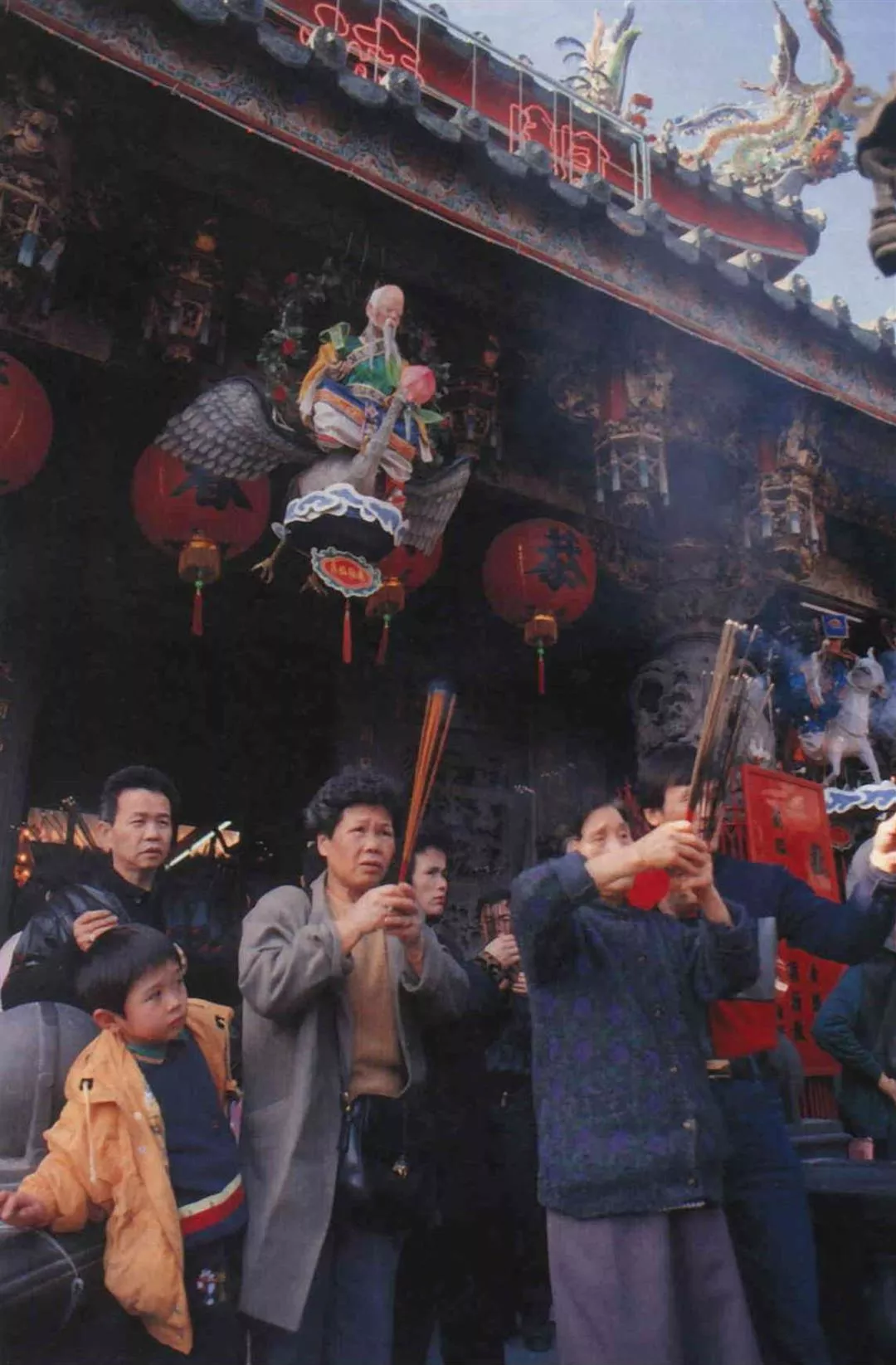
First thing on New Year's Day, many people go to temple to burn incense, venerate the gods, and pray for peace and well-being in the year ahead. (photo by Diago Chiu)
"The most scary thing is the deep-seated clan mentality of the Chinese," says Li Yuan, an author known for his writings on the topic of family. "It can tangle the relationship between parents and children into a never-unraveled web of pain and intimacy-which doesn't always make for happy family reunions." No wonder New Year's Eve is frequently a time of generational conflict.
Li describes the case of his own family. His mother and father came from Hakka backgrounds on the mainland, and as clan identity is strongly emphasized in Hakka culture, his father used to require all his children and grandchildren to be at the family home for dinner on New Year's Eve. Concerned about the burden on the old couple, Li persuaded them to hold the annual get-together at his house, with dinner prepared by his wife and sisters. Striving valiantly to create a party atmosphere, Li took a leaf out of "Old Laizi's" book, (Old Laizi was a legendary paragon of filial piety who acted like a child well into his seventies just to keep his parents amused), dreaming up little pranks with the help of his children. For example, they gave mischievous names to each of the dishes served for New Year's Eve dinner, like "Dongfang the Invincible's Chopped-off Willy," "The Flower of Guanyin's Slender Waist," and "Sea Cucumber, Squid and Meatballs-a Three-in-one World."
"The mood of good cheer and togetherness at New Year can indeed leave some heart-warming memories," acknowledges Li Yuan. "But the occasion can also dredge up less pleasant associations from the past." During New Year's Eve six years ago, Li's father couldn't stop himself getting worked up, in spite of the family's best efforts to keep the mood light. Dinner was nearly over when the old fellow demanded that his children come to his side, and announced: "I want to square up accounts with every one of you, each in turn. . . ." He began to lecture them about how hard he had struggled in his youth to bring them all up, recalling every little incident as though it were yesterday. He broke down in tears once he got onto the things that had hurt him, and after that there was no calming him down.
"He had absolutely no idea that his children all had to swallow their own share of hurt and disappointment while growing up, but never complained to him. Now each of them felt afresh the grievances of childhood, and began to strike back, one after another." Li described the ensuing scenario: "Some wheeled out their heavy artillery and some used the machine-gun approach. Cannon and gunfire rang out on that cold rainy night, while tears flowed and fireworks exploded. The old bruiser, nearly 80 years old, was struck speechless. His authority lay in tatters, long since torn down by his adult offspring. He'd taken so many hits by then that he was riddled with bullet-holes. He slumped miserably back into his chair, lips quivering as if to speak, but no words coming from his mouth."
The evening ended in tears and awkwardness.
"Our family was quite poor when we were growing up," says Li, "and Father suffered plenty of frustrations on our behalf. He thought that we hadn't properly repaid him once we had grown up, and felt quite bitter about it. But he didn't realize that we too, growing up in such circumstances, faced hardship and frustration. Like my elder sister who had to work her way through school. Everyone had something to get off their chest. It all got quite heated." Li felt depressed and guilty about the way the evening turned out. When he went over to his parents house the next day to pay his New Year respects, he asked his children to help smooth things over, and he scrubbed clean the toilet bowl as penance.
Li Yuan's father passed away the year before last. His mother, more relaxed about things than her husband, wasn't concerned about doing a New Year's Eve dinner, so last year the family cancelled the tradition. "Mom decided to take a trip abroad. My family and I like the unusual quiet that descends on Taipei's streets for the period of the festival, and since we didn't want to make any special arrangements, we just stayed home and had a good rest."

The meaning of New Year includes the spirit of giving, extending goodwill throughout society. The picture shows this year's New Year dinner for single old people, organized by the Buddha's Light International Foundation.
"What we are missing," says author Yang Hsiao-yun, "is a way of bringing new meaning into the old tradition, a way of spending New Year that suits ordinary people."
Yang's strongest association with New Year is of going to do the New Year's shopping with the grown-ups when she was little. "We were always very thrifty in those days, without extra cash for new things. New Year was the only time when we got to bring bulging bags and packages back to the house. Just the sight of all those treats-chicken, duck, fish and pork; candies and cookies; fruits and soda drinks-was a thrill for us. Then there were all the New Year presents, like new clothes, shoes and hats. At New Year our parents liked to dress the girls in red from head to toe, for good luck and for fun. We looked as if we'd been dipped in a tub of haw juice."
In spite of the excitement that she remembered feeling, as a child, about getting to wear new clothes and new hats, Yang later began to question this way of spending New Year. She felt especially turned off by the orgy of consumption connected with the festival. "It was only after I had kids of my own that I began to rethink the importance of New Year-partly out of nostalgia, and partly to pass the tradition on to my children," admits Yang. Nowadays she emphasizes just three aspects of the occasion: getting the family together, enjoying the festive spirit, and having a rest. "At one point we tried the fashionable thing, taking the family away for a vacation, but being abroad we really missed that festive flavor."
Eventually she returned to the traditional form, making the New Year's Eve dinner herself, and always including a Manchurian-style pickled cabbage hotpot prepared just the way her parents used to do it. (Her father hailed from Liaoning Province in mainland China.) "With life as busy and stressful as it is the rest of the year, we decided to drop the formal New Year gathering. Instead, we now spend the time relaxing at home, doing whatever we fancy, be it sitting quietly and reading, listening to music, going on an outing, or talking about the ups and downs of the past year. Or we might invite a couple of close friends round to reminisce about old times. It's quiet, and it's really satisfying.
"On the other hand," continues Yang, "the end of the year can also serve as a reminder for people to review their past actions." She always sets aside a little time for herself on New Year's Eve to do just this. As midnight approaches, and with all the household chores taken care of, Yang settles down to quietly reflect on how she has grown during the past twelve months, and to draw up her personal "profit and loss sheet" for the year. "It's nothing to do with money," she stresses. "It's a way of measuring whether I've achieved my objectives, in my work and in my personal maturity. I ask myself what my bad habits are. It's a kind of New Year's Eve dish for the spirit!"
Yang feels that if we redefine New Year in terms of its contemplative and spiritual meaning, rather than just regarding it as an occasion for feasting and partying, then we can better sense how time passes, and see that another phase in our working lives has been completed. In this way we can make our wishes for the year ahead, setting goals for work and for personal growth, without getting maudlin about time's passage and the meaninglessness of it all.
For the Chinese, the family is the basic unit for celebrating New Year, but the family, like society, has been changing in recent years. Couples whose children have grown up and moved out, face the "empty nest syndrome," while many individuals, particularly among the elderly, live on their own. However, for people like these, and for the homeless, there are still ways of enjoying "a good get-together" at New Year.

The way New Year is celebrated changes with time. Just put your heart into it, and you too can have a happy New Year. (photo by Diago Chiu)
One month before last year's Chinese New Year, artist Wang Cheng-liang placed some articles in the press seeking others like himself-single people with nothing special to do on New Year's Eve-to register for a New Year's Eve dinner and party at his studio. You didn't have to know anyone else going. Plenty of people took up the offer, and the party was packed. For Wang, it was the most fun he'd ever had at New Year.
Lin Wen-yueh moved to California once her children had grown up and started families of their own, so she can no longer spend New Year with her immediate family. But her enthusiasm for the festival hasn't waned. "Now I spend New Year with friends who are in similar circumstances to me. Each of us brings a dish for the meal, and makes their own contribution. It's all very relaxed." For Lin, friendship is as heart-warming as family ties. "New Year is part of our shared cultural and ethnic memory. It's a homeland of the soul for every one of us. The external form may have changed, but the memory of some inner yearning, that sense of needing to belong, these are things that can never change."
For those often-overlooked old folk and street people, there are special New Year dinners organized by private welfare groups, enabling them to share in the human warmth of the occasion. Last year the Buddha's Light International Association organized New Year's Eve dinners in the north, center and south of Taiwan, which were attended by more than 5,000 old folk who live alone. This year they are repeating the exercise, and are including a special event in Nantou County to bring some warmth and love to elderly survivors of the 9/21 earthquake there.
Another group, the Creation Social Welfare Foundation-which is well known for its work with street people and for taking care of vegetative-state patients-runs an annual New Year's Eve party for homeless people.
"Giving and serving, these too form part of the meaning and purpose of New Year." The Venerable Yung Fu of the Buddha's Light International Association hopes that today's well-fed, well-clothed people of Taiwan can extend the warmth and love of their own families out to society at large, and especially to those most in need of attention, so as to widen and elevate the meaning of New Year.
It is no surprise that amid the hectic pace of modern life, some of the relaxed good fun has gone out of Chinese New Year. But as a custom that has been part of the culture for so long, it continues to occupy a unique position in our hearts and lives. What remains to be seen is how well we can adapt and update this ancient tradition to fit the changing needs of modern society.


@List.jpg?w=522&h=410&mode=crop&format=webp&quality=80)
