Disaster Survivors Refuse to Lose:Jialan's "Mountain Redoubt"
Chen Hsin-yi / photos Jimmy Lin / tr. by Phil Newell
October 2009


It is September 3, Day 26 following the disasters brought by Typhoon Morakot, and the victims are saying that the high tide of sympathy and help they received has started receding. In the plaza in front of the activity center in Daniao Aboriginal Community in Dawu Township, Taitung County, there is a small, quiet group of people-some sitting, some lying down, some squatting.
It's been quite a while now since anyone from outside the community has come up to inquire into the situation, and in fact this area has long been ignored. Suddenly, a car stops, and out gets-not some government officials or members of a charitable group-but some representatives of an autonomous disaster victims' organization from Jialan Village in Jinfeng Township. They received a "distress" call from a volunteer in Daniao this very morning, and rushed up like a house afire. As soon as they arrive they pull out chairs and invite the locals to "sit down with us and we'll discuss things together."
The seven men and six women in the plaza approach warily. They look weary in body, but their eyes are wide open, as if rolling the dice, numb to everything else around them. In a very friendly way, and speaking with strong Paiwan accents, the visitors from Jialan trot out their first question: "Where would you like to go yourselves? Do you want to relocate the community?" After about a five-second pause, a man breaks the heavy silence: "We don't want to go anywhere... we just want to stay here."
"In that case, we will rebuild the original community. But this will take organization, and people have to stick together, or you will all end up like rice stalks in the wind, scattering everywhere...." At this point someone remembers their manners, and pulls out a bag of betelnuts. So begins a conference of disaster victims with other disaster victims....
The people of Jialan are playing out scenes reminiscent of The Water Margin-of Robin-Hood-type cast-offs from society toughing it out in their mountain retreat. They are writing a new page in the long-running effort to put into practice a spirit of autonomy and mutual support among Taitung's Aboriginal communities.
Jialan Village (pronounced Ka'aluwan in Paiwan) , part of Taitung County, is located on the northern bank of the downstream part of the Taimali River. It has 407 households and a population of 1350 persons. Constituted out of seven Paiwan Aboriginal communities and one Rukai community, it is the largest of the "village"-level jurisdictions in Jinfeng Township, and plays host to the township government offices.
Kimbo Hu has written a song in praise of the beauty of his hometown of Jialan, called "Boy on the Back of a Water Buffalo": "The warm and gentle morning sun / Tiptoes into the plateau to the east / The mountains are still dreaming their dreams / The meadows are silent / Waiting for the early-morning arrival of the water-buffalo drivers."
After night falls, the lamps of people along the riverbank form a silvery ribbon, a promise that residents will remain here and carry on the old lifestyle and traditions. Closer to the riverbed, looking like meadows, are fields of roselle, the main cash crop, which grows well in the free-draining gravel soil.
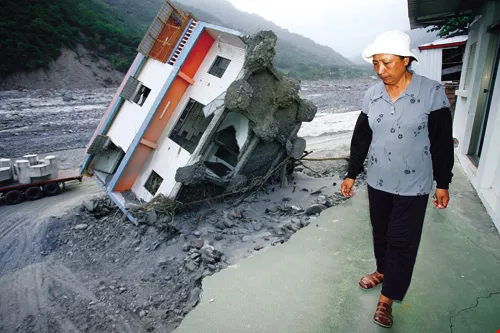
"The pillars for my house were set relatively deep, and it was pretty big as well, so even after it toppled over it wasn't washed away, and it was able to divert the flow of the water and save the houses behind it." The voice of Wu Rongjin's wife Dai Xiuying, though sad, also carries a note of pride. This house, the last to collapse, has become a symbol of the tragedy that befell Jialan Village.
Lessons in recent memory
Nonetheless, the beauty of this mountain village has been built on an alluvial terrace, a place that the ancestors of the Paiwan would never have felt comfortable living in. Geologically speaking, because most of the rivers in the Taitung-Hualien area originate at over 2000 meters above sea level, sudden heavy rains, having nowhere to drain in the narrow mountain valleys, will rush downstream, carrying huge amounts of rock and soil with them, threatening villages on the fluvial erosion surface.
Despite this, both the Japanese colonial authorities and the ROC government, aiming to exploit mountain resources and ensure control over the indigenous peoples, forcibly relocated Aboriginal communities; the eight communities now in Jialan were moved here from the upstream parts of the Zhiben and Manuer rivers, and from the mid- and upstream parts of the Taimali River. By putting them into this place that their ancestors called "Buliblosan," meaning "forest of impenetrable mists," the governmental authorities left them all in a high-risk situation.
When Typhoon Haitang hit in July of 2007, 16 households living close to the river lost their homes; fortunately all the residents got to safety in time. However, lacking any idea of the importance of getting organized, the victims of that typhoon just took the money offered by the government (two years' rent for relocating elsewhere) and scattered to the four winds, and all are still without permanent homes of their own. As for promises by the county government of reconstruction of homes and repair of the dikes, these disappeared into the bureaucracy, never to be seen again.
After the hard lessons of four years ago, the people of Jialan have learned the importance of prompt evacuation. Even more, they have realized that they cannot rely on outside help and that they have to be organized, united, and autonomous.
Returning now to the events of August 8, throughout the night the Jinfeng County authorities monitored the river, and at 4:00 a.m., through broadcasts and door-to-door visits, notified Jialan Village residents to move to the activities center, which is located on higher ground. Within half a day, the weather turned for the worse, the dike was breached, and a lot of people who had not had the time to pack up their family valuables could only watch tearfully as the homes into which they had invested a lifetime collapsed, broke apart, and were finally carried away by the flood waters. Sixty-six homes in Jialan were washed away or destroyed, and nine more have been deemed "dangerous" because they are near the "new cliff."
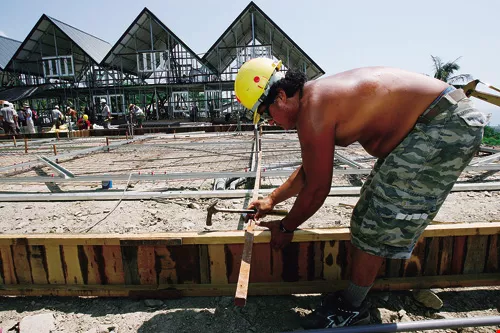
The 65 temporary environmentally-friendly houses can eventually be disassembled and the building materials reused. Most of the indigenous people participating in the house-building have construction experience, so with just a few directions they already have things in hand.
Power of positive thinking
After emergency work was done to open roads linking Jialan to the outside world, tribespeople who had moved away from home (including the well-known singers Kimbo Hu and Panai) came rushing back to their homeland. In addition, friends from many local organizations and neighboring communities came forward to help.
Ulung Lupiliyan, a young person from the Lalaolan tribal community in Xianglan Village, returned home on Day 9. He heard a lot of stories from members of the Jialan young men's tribal organization, such as how a self-help organization and a common kitchen were formed the first day, and how some people went into the mountains to pick wild vegetables to supplement the food supply, others visited homes to catalogue various people's needs, and still others paid morale-lifting visits to the injured or elderly people living alone.
In an article published online, Ulung Lupiliyan wrote: "The young men there also told me that every day the whole community would have dinner together by candlelight. Also, it was very quiet because not a single car passed on the provincial highway between the South Taimali Bridge and Jinlun Village. The starry skies were beautiful, and they even watched a meteor shower all together. Yet, despite this romantic description, I know that when the village was cut off from the outside, it was an unnerving time for everybody."
Romance and laughter in the face of disaster? Oddly enough, this is without doubt one of the ways that indigenous peoples use to recover from traumas.
Jennifer Chen, the associate administrator of St. Mary's Hospital in Taitung, who organized a group on Day 2 to provide medical treatment and psychological nurturing, says that it is very difficult, albeit essential, to create a mood of "positive thinking" in a disaster area, yet the indigenous people she encountered were already acting on their own to give solace to one another and even to find things to be relieved about: "Everyone is still alive, that's great!" "It's a good thing this happened in the mountains, where so few people live; if this had happened in Taipei, what a catastrophe!" And even jests: "I guess it's better that the flooding happened in Aboriginal areas, we're better runners than the Han Chinese!" At meetings and masses organized by the St. Mary's team, the volunteers cited these positive thoughts as models "to encourage the victims and also to express our admiration for them."
However, beneath the facade of optimism, this was no doubt a tragic event that traumatized the villagers to an extent hard for them to fully express. Chen Shih-shien, chief executive officer of St. Mary's Hospital, has an especially strong memory of a scene he witnessed at the shelter on Day 3: An old hunter, who had come down from the mountains alone, and who was soaked to the skin, only muttered the words "so hungry" after rushing desperately into the shelter. He seemed not to even hear the words of concern and questions of those around him, and after getting his bowl of instant noodles just huddled in a corner and ate. After he had eaten about half, someone offered him a betelnut, and then later the same person silently gave him a glass of millet wine; then someone else sent over a bowl of noodles with all the fixings, and talked to him a bit. Perhaps it was the sincere concern for his well-being that helped him relax, or the stimulus of hot food, but as soon as the old man lit up a cigarette and drew a few puffs, he began to weep without stopping.
"There are a lot of people like this who can't really find emotional release, especially among people who were hit by Typhoon Haitang and for whom Morakot is a second disaster. Also, medical personnel, who make helping others their priority, often are the ones who most need emotional support." Chen Shih-shien, who also participated in reconstruction work after the earthquake of September 21, 1999, says that this is why when outside groups come into disaster areas with psychological rehabilitation programs, they first to simply hang out with the victims and win their trust, and moreover have to proceed step by step and work continuously for a long period of time.
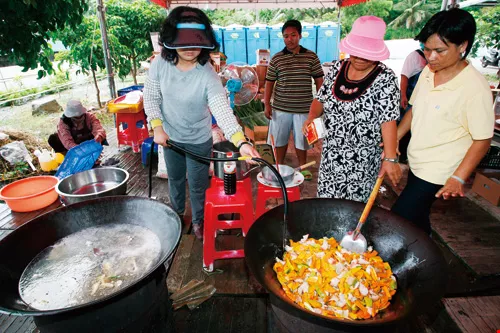
The women of the "Mountain Redoubt" all take a hand in preparing meals; the fresh food is donated and shipped by charitable groups.
Overturning the "shelter"
Two weeks after the flooding, Jialan Village had already established a reconstruction committee whose members declared their determination to rebuild their hometown. Even more unique is that 91 persons from 27 households chose to remain in the temporary shelter established in the Jieda Elementary School. They christened their bastion the "August 8 Jialan Mountain Redoubt." They thus cleverly turned the traditional image of a "shelter" as a place of passively waiting victims on its head, and they are happy to share their experiences with other disaster areas in Taitung.
With the self-help organization in place, it was possible to deal more effectively with the county and township governments and to express needs more clearly and precisely. On August 26, Jialan readily gained the agreement of neighboring Zhengxing Township to use 1.5 hectares of land (part of it publicly owned construction land, and part rented private farmland) to build 65 transitional homes, with life spans of two years, designed by the architect Hsieh Ying-chun (who also is in charge of work on the project) and funded by World Vision Taiwan. The plan gives preference in hiring to disaster victims, and should be enough to provide 36 persons with employment for half a year, at a rate of NT$1500 per day.
When this reporter arrived at the "Mountain Redoubt," relocated to the sports field from the classrooms, she saw a row of neatly arranged tents, with sheet-metal roofing to keep out the rain. Early in the morning, 30 men went to their housing construction jobs bright and early, and those who stayed behind were far from idle: Some handled communal cooking and food supplies, others did patrols and ensured the maintenance and safety of water and electricity, others took care of materiel management, others taught children, and others were responsible for administration. There was even a "nanny" team, charged not only with feeding babies and rocking them to sleep, but also with making tea, putting on music, telling jokes, taking naps, drinking, and arguing (said to have therapeutic value in releasing emotions)-a group whose scope of responsibilities, said one wit, "seems to be getting bigger all the time."
Song Xianzhang, retired former director of the guidance office at Jialan Elementary School, who was chosen as the "Redoubt Outlaw Chieftain," tells an anecdote that speaks volumes to the thinking of the local residents. He says that during this period a lot of officials, including President Ma Ying-jeou, came to show their "concern" for the disaster victims. Worried that living in tents was too much of a hardship, these visitors repeatedly tried to persuade the residents to move to housing in Taitung City. But the answer was always "Thanks, but no thanks," with the reasons being: "We have work to do here, land [planted with millet, sugar apple, and other crops] to take care of, and the problem of the children's schooling has already been taken care of. And even more important is that staying in our hometown is the only way to keep from being cut off from our cultural roots!"

Finding the strength to rebuild through collective mutual support and cooperation is the essence of the "tribal ethic." The photo shows children of the Jieda Elementary School, who generously are sharing their school grounds with the "Mountain Redoubt."
Happiness through labor?!
The road to reconstruction will be long, but the grassroots organizers are very clear about the direction: "We don't want to depend on others. Money that just falls from the sky is easy come, easy go. Only rewards that you earn with hard work really bring happiness."
At present, the Mountain Redoubt organization is drawing on the model of the community weaving workshop set up by Xinxing Elementary School. In Xinxing, the workshop takes orders from outside the community for local women who weave traditional handicrafts to supplement their incomes. Meanwhile, the 30 Aboriginal men of Jialan who are engaged in building homes can, in future, work for other areas of Taitung County that may need transitional housing in the future. Those in charge are already drawing up a long-term blueprint; they not only hope to find land close to hand, they will also apply to the Forestry Bureau to recover wood washed downstream for use as construction material, to build houses that are environmentally friendly and also have a traditional feel about them.
"Although staying in the Mountain Redoubt is going to be tougher, there's a lot to be gained spiritually and psychologically," says Song Xianzhang, a self-professed fan of recycling and DIY, who laughs as he adds: "Outsiders who come here all say how unexpected it is to meet a group of 'happy disaster victims'! Of course living in tents will become tiresome, but when the time comes we'll roast a big pig to get people reinspired!"
Let's go back to the meeting taking place on September 3 in the Daniao Aboriginal community. After a leader had been put forward, someone raised the problem of hot water. "When winter comes, we plan to collect firewood ourselves," says an elderly woman from Daniao. "But we can help you get hot water heaters," says a representative of the Jialan Mountain Redoubt. To which the woman declares: "Don't bother! We just need a big barrel. Wood that's been heated over a wood fire is more fragrant for washing up!" The woman strikes a pose as if throwing her arm around someone: "And at night we can sing and dance and console each other!"
Amidst the laughter, you can see how people's eyes light up, as if they see... hope.
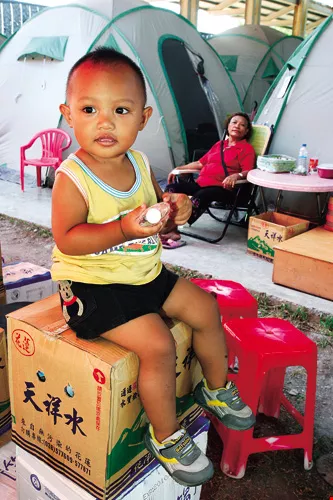
Seeing one's grandchild safe and sound is more satisfying than anything else could be. The tents in the background are the "Mountain Redoubt."
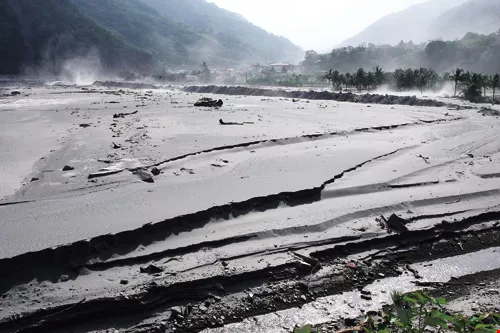
The Taimali River, which originally wound in front of Jialan Village, was turned into an 800-meter wide "mud flats" by raging rivers. After the riverbed is straightened, it will be necessary to delimit a flood plain which will be off-limits for housing or economic uses.

@List.jpg?w=522&h=410&mode=crop&format=webp&quality=80)


@List.jpg?w=522&h=410&mode=crop&format=webp&quality=80)
@List.jpg?w=522&h=410&mode=crop&format=webp&quality=80)
