Public Rental Housing for Young People Becomes a Concrete Reality
Chen Hsin-yi / photos Chuang Kung-ju / tr. by Phil Newell
January 2013


In recent years, real estate prices in Taiwan have skyrocketed, and the trend toward an M-shaped society has gotten more severe. The situation is worst in Taipei City and New Taipei City, where many people cannot afford to even rent a suitable house, much less buy one. Young people lucky enough to have family in the city have to stay with their parents or relatives, while those that don’t have been forced out of the city core into the suburbs.
In 2012 a new Housing Act came into effect, bringing “social housing”—which is ideally meant to ensure “residential human rights” and protect the disadvantaged—off of the drawing board and onto the field of play. What does “social housing” really mean in concrete terms in Taiwan today? Whose interests will be protected? What are the chances of success in Taipei, where the reality is that there is just very little land relative to the large population, and real estate prices are through the roof?
It’s another cold, rainy night in December. But inside the assembly hall of the Wanda Primary School in the Wanhua District of Taipei City, the lights are blazing. There must be more than 50 people here, listening intently to a presentation on a planned Youth Park public housing estate. The proposed project, under the auspices of the municipal Department of Urban Development, would be situated on 4081 square meters of state-owned land next to Youth Park, at the intersection of Qingnian Road and Shuiyuan Road, with beautiful views of both the park and the Xindian River.
The plan is for work to begin on this public housing project in 2014, and to be completed in 2016. It calls for construction of two 17-story apartment buildings with 277 apartment units. These will be available only for rent, not purchase, and the one and only landlord will be the Taipei City Government. Only people between 20 and 46 years of age will be allowed to move in, for a maximum stay of five years.
The man in charge of this project is architect Kuo Ying-chao of the firm Bioarchitecture Formosana, who is famed for the Beitou branch of the Taipei Public Library, which won a “diamond” rating under the government’s grading system for green buildings. He intends to make the Youth Park project green, with excellent access for disabled people. At the ground level, there will be an open plaza with a community activities center, a library, and other public facilities. He is seeking a feeling of dynamism, liveliness, and openness in his design, so that the buildings do not appear like two out-of-place heavy blocks that overshadow and weigh down the surrounding environment.
With more and more people remaining single or having only one child, public housing will have to diversify to meet their needs as well. The photos show a three-bedroom apartment at the Dalongdong public housing project.
Offstage, 33-year-old Miss Lin is excited about the presentation: “The more public housing there is for younger people, the better. If the rent could be just a little cheaper [currently it is projected to be about 70–80% of market rates], maybe I could put away enough money to make a down payment on a house of my own someday.” Miss Lin has come to the meeting with her boyfriend. Though the two have been going steady for some time, they are still not sure about getting married, something that for most Taiwanese includes buying a house. Their salaries are not very high, and once they pay their rent, living expenses, and still-uncleared student loans, they have little left over—certainly not enough to ever imagine that they could afford to buy a home in the Greater Taipei area no matter how long they save up.
However, some local residents attending the presentation are more skeptical. “People who rent are transient, and you get all kinds of people coming and going. This could make our neighborhood less safe and secure.” Others raise objections based on the widespread belief that public housing is always shoddily constructed and poorly managed, and they fear that local property values—which is to say, the value of their own homes—will be adversely affected.
Underlying this one meeting are fundamental issues: How should public housing resources be distributed? Which groups should get priority?
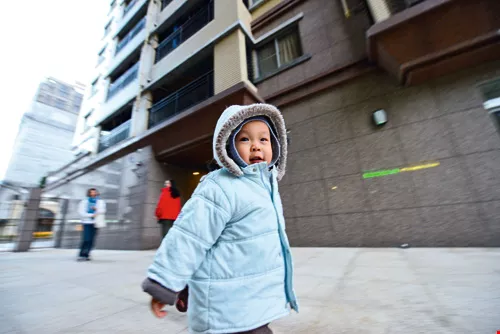
The new rent-only housing being built by the Taipei City Government will help make the dreams of many young families come true. The photo shows a work called My Home is My Castle, by Li Liang-jen, which sits at the entrance to Dalongdong Public Housing.
The magazine My Housing regularly publishes a “pain index for homebuyers.” The most recent one shows that in the third quarter of 2012 the pain index in Taipei City was 28.8. In practical terms, this means that to buy a newly constructed three-bedroom condominium of about 100 square meters, a two-income household would have to spend their entire disposable income on a mortgage for 28.8 years!
Over the last two years the Ministry of the Interior has rushed through new housing legislation and has come up with trial programs to be run in cooperation with the governments of the special municipalities of Taipei and New Taipei. There’s no mystery about what lies behind this recent burst of energy: In both the 2010 local elections and the 2012 national elections, the high price of housing jumped to the top of the list of citizen grievances, and politicians across the political spectrum promised to work for “housing justice.” Pressure has also come from the Social Housing Advocacy Consortium, formed by a group of non-governmental housing and social welfare groups such as the Tsui Mama Foundation for Housing and Community Service.
The Housing Act, which took effect on December 30, 2012, defines “social housing” as “housing built by government, or by the private sector with subsidies from government, that is primarily rented, and of which at least 10% should be rented to persons with special conditions or identities” (Article 3). The phrase “persons with special conditions or identities” covers “low-income households, families in special circumstances, persons with three or more under-age children, persons under the age of 25 who are unable to return home after being placed in a residential institution or foster family, senior citizens aged over 65, victims of domestic violence or sexual assault and their children, persons with disabilities, persons with HIV/AIDS, indigenous peoples, disaster victims, homeless people, and other persons approved by the central competent authority” (Article 4).
Even earlier, in June of 2011, in anticipation of the forthcoming legislation, the Executive Yuan came up with a “short-term social housing program” to start the ball rolling on trial implementation. The public housing project next to Youth Park discussed above falls under this program.
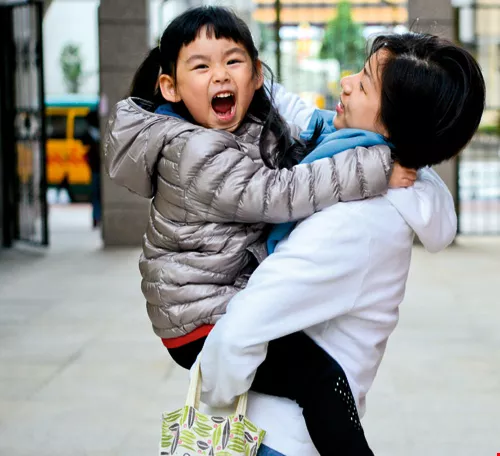
The new rent-only housing being built by the Taipei City Government will help make the dreams of many young families come true. The photo shows a work called My Home is My Castle, by Li Liang-jen, which sits at the entrance to Dalongdong Public Housing.
In addition, in 2010 the Taipei City Government began a multi-pronged program to increase publicly managed housing. As with the national government’s plan, Taipei City’s places the main emphasis on social housing that is “only rented, not sold.” The main difference is that the intended beneficiaries are more focused: young people with a certain income but no housing of their own.
Kao Wen-ting, chief engineer with the Taipei City Department of Urban Development, says that at the current stage the city’s housing policy will be concentrated on “ensuring a healthy rental market for housing.” Besides creating a rent subsidy mechanism, the city plans to gradually increase the volume of publicly managed housing available for rental. The target is to reach 4808 households by 2014.
Why the focus on young people? Kao explains that Taipei is facing not only a problem of the steady replacement of affordable housing by luxury housing for the rich, but a different problem of the rapid aging of its population. “We need to create an environment in which young people can settle down here in order to upgrade the city’s competitiveness for the future.”
At present, there are 184 units of housing intended for rent by the city government to people in their 20s and 30s that are already in use by renters or on which construction has been completed. This housing has been built under various models, including government development of city-owned land, residential units built into MRT station complexes that go to the city government as part of the deal for allowing private development of the complexes, and residential units that go to the city government for allowing private development of city-owned land.
The earliest project to be completed, and one that still has the greatest importance as a demonstration project, is Dalongdong Public Housing, in Taipei City’s Datong District, which began accepting tenant applications in late 2011.

With more and more people remaining single or having only one child, public housing will have to diversify to meet their needs as well. The photos show a three-bedroom apartment at the Dalongdong public housing project.
Dalongdong Public Housing is located at the intersection of Chengde Road and Kulun Street, a short seven-minute walk from the Yuanshan MRT Station. The comfortable garden courtyard is broad and gives a feeling of openness, and visitors are surprised to see that the hallways on each floor are free of the junk and obstructions that fill the halls and stairwells of so many apartment buildings. The overall effect is one of light and cleanliness.
Roger Wu of A-Just International Property Management, which has been contracted to handle management of the complex for the city government, says, “Public housing run in this way, all rentals with a single landlord, is in fact easier to manage and maintain than housing that has been sold off to individual owners.” This is because the rental contracts clearly stipulate the rules for living in the complex. To enforce these rules, the government, drawing on Hong Kong’s public housing experience, has created a “demerit system” for items such as hygiene, cleanliness, and quiet. “So far, however,” concludes Wu, “I’m happy to say that the current residents cooperate well and there is mutual positive reinforcement, so we haven’t yet had to use the demerit system at all.”
It’s worth noting that when Dalongdong began accepting applications, they got 180 applicants for their 80 units of three-bedroom apartments (with living and dining rooms, and two bathrooms, applicants limited to families of three persons or more), but 1080 for their merely 30 smaller one-bedroom units (with living and dining areas and one bathroom). Learning from this, the municipal government has ruled that future public housing should have a ratio of 6:3:1 for one-bedroom, two-bedroom, and three-bedroom units, to better serve the needs of the many single people and small families living in Taipei.

With more and more people remaining single or having only one child, public housing will have to diversify to meet their needs as well. The photos show a three-bedroom apartment at the Dalongdong public housing project.
However, while Taipei City is seen as a pioneer in public housing policy with its rent-only, well-managed model, there is controversy over the possibility that genuinely disadvantaged people may hardly benefit at all. The criteria for applying for a unit are very broad, and the quotas set for underprivileged persons are very low—in fact, in some cases there is no quota for them at all, as in the case of Dalongdong and also of the Wanlong MRT station public housing project, which recently held a lottery for deciding who will be allowed to move in. In sum, the compaints are about the fact that while the city is building “social housing,” it is not building any “social welfare housing.”
The city government has established the following financial conditions for applicants: That they do not personally own a home of their own and that their household income be below the median income for the city. Based on Taipei City household income levels in 2012, this would mean below NT$1.48 million in annual household income for a couple or family, or below NT$880,000 for a single-person household. Considering that a typical young office worker makes roughly NT$400–600,000 per year, this means that many people with above-average and even high salaries are eligible to apply.
Kao Wen-ting says that the reason for this is to allow people of different social strata to mix in the projects, to avoid the stereotype that “public housing = poverty housing.” Naturally, households with low socioeconomic status are also welcome to apply.
Peng Yang-kae, convener of the Social Housing Advocacy Consortium and secretary-general of the Organization of Urban Re-’s, remains unimpressed by such logic. He points out that the Housing Act’s requirement that 10% of social housing be reserved for disadvantaged persons is a minimum requirement to protect the weak, but “right now local governments treat this number as their upper limit, or even disregard it altogether.”
Tsui Mama Foundation secretary-general Lu Ping-yi, who has enormous experience helping society’s underprivileged, emphasizes that the whole purpose underlying social housing is to care for those who are “disadvantaged in an absolute sense,” such as the physically or mentally handicapped and elderly persons living alone, because these are the people who are most often discriminated against by landlords in the private rental market, and they are also the ones most in need of buildings specially designed for accessibility. Young people and single families, in contrast, are merely “disadvantaged at their current stage of life,” and a policy of temporary rent subsidies would be enough to help them find suitable private housing.
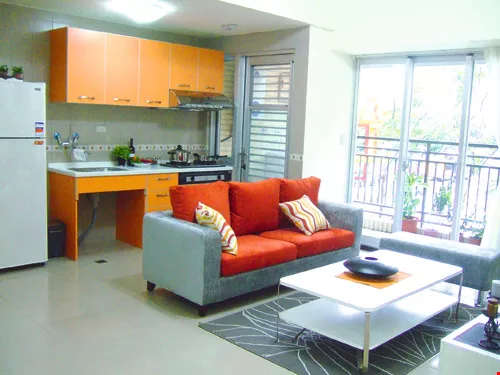
With more and more people remaining single or having only one child, public housing will have to diversify to meet their needs as well. The photos show a three-bedroom apartment at the Dalongdong public housing project.
Unfortunately, the public feels generally negatively about Taiwan’s experience thus far with public housing because it has been invariably associated with the lowest strata of society—those who, in the eyes of many citizens, make undesirable neighbors. Even the new Taipei program to build more rental housing for people in their 20s and 30s, which actually reverses this stereotype by reserving only a small percentage of the units for the disadvantaged (or none at all!), has met a lot of resistance from neighborhoods where the city government proposes to build. This is perhaps why the city government is moving so cautiously and is emphasizing the discourse of young, middle-class people.
Over the past year, both officialdom and non-governmental groups have held forums about social housing, and many decisionmakers and lobbyists have traveled abroad to see how public housing is handled in other lands, seeking to find a solution to the current conflicts of interest. The experience of Korea, whose development path has been similar to Taiwan’s, may be the most instructive.
Lu Ping-yi notes that starting in the 1970s, Korea—like Taiwan and other newly industrializing countries in Asia—faced rapid increases in urban population and a corresponding shortage of housing. Then, when Korea hosted the Olympics in 1988, the Seoul municipal authorities tore down huge numbers of illegal structures, eliminating the informal housing that was so essential to the lower-income strata of society, and so leading to serious social conflict.
In response, the Korean government announced a policy of “permanent rental housing.” The government puts up the capital to build social housing, and it is rented cheaply to economically and socially disadvantaged people without homes of their own. Over time, the amount of social housing has steadily increased, so that today there is a stock of 1 million state-owned units. On top of this, current president Lee Myung-bak has proposed raising the quantity of social housing to 12% of all households (about 1.8 million units) by the year 2018, and the opposition has upped the ante further, calling for a level of 15%.
Lu Ping-yi says that we know from the Korean experience that an adequate supply of social housing can stabilize the national housing system, and make society much more resilient when economic hard times strike.
The creation of novel new public policies requires vision and dynamism from political leaders, as well as the patient building of consensus and breaking down of prejudices. Only when citizens can go through their lives without anxiety about having a roof over their heads can the economy and society continuously mature, and only then can we have sustainably developing cities where citizens feel a genuine sense of well-being.
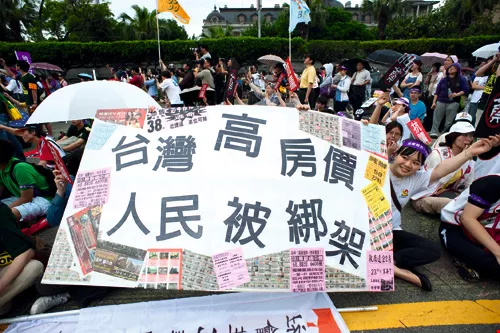
The Social Housing Advocacy Consortium, formed by more than 10 social welfare and housing NGOs, is an important force behind social housing policy. The photo shows a demonstration held by SHAC in May of 2011. The sign reads: “High housing prices are holding the people to ransom!”
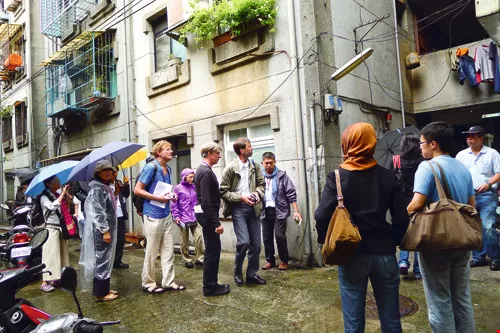
In 2012, the Social Housing Advocacy Consortium asked foreign experts to evaluate the Ankang public housing project for the poor. The experts offered a number of ideas for long-term improvements.
@List.JPG?w=522&h=410&mode=crop&format=webp&quality=80)


