You Should Treat Me Like an Animal!The Pingtung Wildlife Rescue Center
Kuo Li-chuan / photos Jimmy Lin / tr. by Phil Newell
March 2008


Taiwan was once infamous for illegal trafficking in protected animal species, but after 20 years of education and law enforcement, that blot has been cleaned away. Yet there remain animals in need of help. Where can they find new homes? And who will look after them?
It's about 8 a.m., and as we walk into the Pingtung Rescue Center for Endangered Wild Animals, on the campus of National Pingtung University of Science and Technology (NPUST), feeding time has just begun. We see staff placing vegetables and fruits one by one in the nooks and crannies of trees in the outdoor activity area of the Formosan black bear and placing wrapped parcels out in the Formosan macaque viewing area.
"We put the food in gaps or holes in the trees so that the bears will have to spend more time to find it. This helps prevent them from falling into stereotyped behaviors like sitting motionlessly in a daze, rocking back and forth, or pacing up and down anxiously," says Lin Ching-fang of the Research and Education Division. Members of the families Ursidae (bears) and Canidae (such as foxes and wolves) are active over very wide areas when living in the wild. Once they are in captivity, it is like putting a person in a prison cell-they easily become anxious and then all kinds of "stereotyped behaviors" appear, and the animals can even engage in self-mutilation.
Then why do the staff package the food they feed to the Formosan macaques? According to keeper Linda Tseng, "This is a new idea we are trying out to make life more fun for them!" The staff first mix various kinds of nuts and biscuits that the monkeys like in with shredded paper, then put the mixture into recycled cardboard boxes, which they then tie up before putting them into the enclosures. This forces the macaques to do some "digging for buried treasure" to get to the food inside.
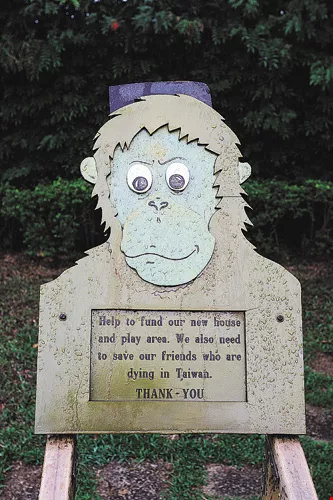
This orangutan-shaped sign, brought over from Monkey World in the UK, lets people know that Taiwan was once infamous for illegal trafficking in orangutans, badly damaging the country's international reputation.
Suffering in silence
A pig-tailed macaque is munching in a leisurely way on an onion-pungent to the taste buds but providing lots of water-and you realize that you are standing in front of the primate enclosure. The famous orangutan Foster strolls over next to the bars of his living space, and it looks like a pair of slightly melancholy eyes are embedded against the wide-open floor space. Then you find out that he has been suffering from depression for a long time.
Foster was abandoned by his original owner in 1993, and was then sent to the Shoushan Zoo in Kaohsiung. But because he spat at visitors, he was confined in a cellar alone, where he ended up staying for over ten years. During those years Foster lived in a cramped, dirty concrete box, only able to get a glimpse of the sun through a small barred window. Foster was eventually sent to the rescue center, but because of his previous terrible living environment, by then he was already very depressed.
Keeper Liu Tsu-yuan says that four years ago when Foster first arrived, he would cover himself completely in hempen bags, and habitually spent all day staring at the wall, unwilling to make any contact with the outside world. The keepers thoughtfully put wooden boards over the outside bars of the cage so that he could temporarily be shielded from seeing anything that could unsettle him. The veterinarian also prescribed two weeks of the anti-depressant Prozac.
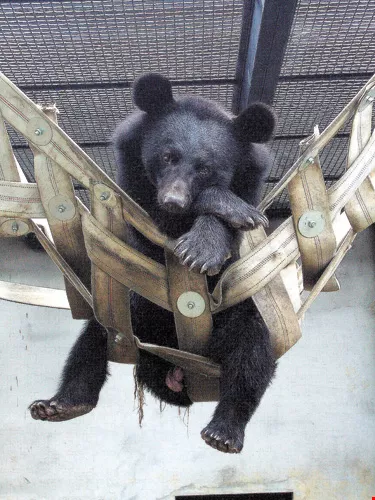
The Formosan black bear likes climbing trees, so the staff put out a hammock made of fire hoses to climb around on. Heipi, shown in the photo, appears to be having a good time.
After a few months, Foster began to turn around, literally and figuratively. Through cracks between the wooden boards he could peer out at the outside world. To accustom him to the sound of human voices, they tried playing a radio for him, and then they allowed him into an outdoors enclosure to exercise. Today his depression has improved, although he still sometimes picks up and throws stones if he feels angry or stressed out.
Another heart-rending tale is that of a macaw named Popo. This mixed-blood large blue-gold macaw was originally kept as a pet, but at about age four or five, one day Popo-for no apparent reason-bit to death another blue-gold macaw that had lived with him since he was small, and also started to engage in self-mutilation, even gnawing off his own claws. The owner had no choice but to seek help from the rescue center.
Keeper Kimi Chang relates that when Popo was brought to the center five years ago, the first claw on his right foot had been chewed all the way off to the first joint. So that he would stop the self-mutilation and adapt to his new environment as quickly as possible, staff took turns each day diverting him with play, and also introduced him to a new friend. Over the course of half a year of intensive care, Popo gradually stabilized, and now has a mate with whom he gets along quite well.
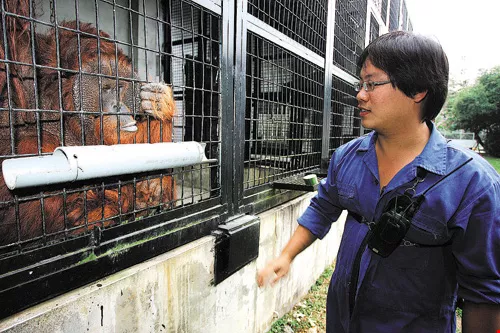
Orangutans are important member of the rescue center community. Besides Foster, they also have "Chiachi," who came after being taken in by a theme park and zoo of the same name. He has also had a rough time of it. The photo above shows Chiachi interacting with a center caretaker.
Stereotyped behavior
Then there's "Hsiao Pa," who mumbles to herself whenever she feels emotionally unsettled. She is a salmon-crested cockatoo who has lost the ability to fly. Her former owner kept her in a cage that was too small, so that her muscles atrophied and her spine became misshapen. "Any bird that doesn't have an environment in which it can learn to fly when it is small will lose the ability to fly," explains Kimi Chang.
Even more outrageous is that a lot of owners teach their parrots-popular as pets because all members of the macaw family have the ability to speak-"inappropriately," shall we say, so that when they get to the rescue center a lot of these creatures know a full range of foul language. Hsiao Pa was this way when she first arrived, uttering a steady stream of curses, which was both funny and infuriating. Fortunately, thanks to the patient efforts of the staff, today this bird has a lot more class.
Kurtis Pei, a professor in the Institute of Wildlife Conservation at NPUST and also director of the rescue center, says: "Nearly all the animals are injured, sick, or malnourished, or are stressed out or fearful or acting aberrantly when they first come to the center. All need urgent medical attention and psychological rehabilitation. Bringing behavior back to normal is the most difficult and time-consuming task of all, and in some cases the animals will never return to normal."
When animals in captivity display stereotyped behavior, this usually indicates that they feel spatial or psychological stress, and have some profound anxiety, repressed feeling, or unmet need that they need to release. Therefore they engage in obsessive, repetitive behaviors as a way to seek "peace of mind." "Some animals," says Kurtis Pei, "even go so far as to precisely place their feet in exactly the same spots every time."
The staff invest a lot of thought into coming up with ways to improve the quality of the animals' lives in captivity and to make their days less monotonous. For example, water hoses double as "vines" to create a 3-D space for primate activity. Fire hoses-safe and durable-have been used to create a macaque maze so they have some place to play. And wooden branches have been erected for parrots (whose native habitat is the canopy of the jungles of Latin America) so that they can feel the texture and flexibility of real trees when they rest or walk around....
As much as possible, the center also helps the animals get reaccustomed to communal life. Different species are often mixed together in the same space to enrich the creatures' lives through interactions with others.
"Usually, through these kinds of efforts most individuals can return to the normal behaviors they have by nature, and regain their psychological health," concludes Kurtis Pei.
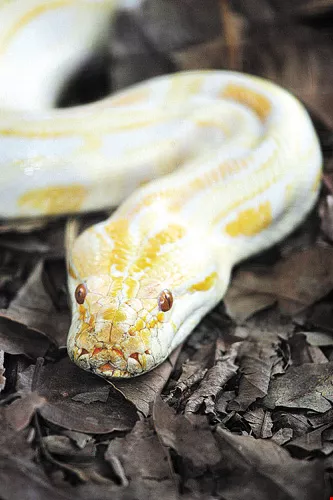
Owners buy the golden Burmese python for its beautiful cool exterior and noble air, but once it grows up its three-meter long body can be too scary, and many of them are abandoned.
Sign language
Founded in 1992, the Pingtung Rescue Center for Endangered Wild Animals now occupies about 2.5 hectares. Originally a fruit orchard, after 16 years of careful management, the compound is now a multi-functional shelter, including an administrative center, a medical center, and 20 enclosures of various sizes, with linked indoor and outdoor spaces. Usually they have 800-900 animals at any given time.
Standing right inside the main entrance to the rescue center is a donation box and a sign. The sign, colored bright orange and shaped playfully like an orangutan's head, appeals to visitors: "Help to fund our new house and play area. We also need to save our friends who are dying in Taiwan."
A lot of people are probably curious as to why the sign is written in English. In fact was a "souvenir" that the center acquired from "Monkey World" in the UK.
Back in 1999, the Monkey World primate refuge invited Kurtis Pei to the UK for a tour of their facility. Just as Monkey World's Jim Cronin was showing his guests into the orangutan enclosure, they stumbled upon the above sign. Suddenly, host and guest were both deeply embarrassed, and Kurtis Pei felt a sense of shame.
Pei says that every year Monkey World has 3-500,000 visitors from around the globe. Since the sign had been up for more than ten years, at least 3 million people saw it. "Do those visitors all think that Taiwan is the kind of country where people smuggle animals for profit, but are irresponsible and don't know how to care for animals? Do all Taiwanese really want to get their hands on rare creatures but don't care about the fate of endangered species?"
In fact, Monkey World was making no mistake in singling out Taiwan for blame. When the sign went up in 1987, orangutan fever in Taiwan's pet market was at its peak. Like all just recently wealthy countries, Taiwan has experienced an increasing demand for pets. Around 1980, a small number of people imported orangutans, gibbons, and other primates through various channels and got very high prices for them. But what really triggered the orangutan fad was the media, and they are really to blame for Taiwan's becoming infamous as a "killer of wild animals."
In 1988, the China Television System (CTS) program Playful Clan added a segment in cooperation with the Leofoo Village theme park which featured the orangutan Hsiao Li working with program host Chang Hsiao-yen. The segment was a big hit, and the show's ratings climbed. Some pet shops then jumped on the bandwagon and made orangutans out to be like naive little children who would be fun to look after. They dressed them up in diapers, fed them with baby bottles, and carried them around all day in baby slings, and showed them eating and even sleeping together with people. This anthropomorphic packaging made the creatures irresistible to that certain section of the public that thinks having a fashionable pet will be all fun and games.
But behind all the laughs few people were aware that in each link of the supply chain-from capture in the jungle, to transport to Taiwan, to sale in the marketplace, to circulation among owners-many orangutans would die. Kurtis Pei says that for every baby orangutan captured in the wild, it is necessary to kill two or three protective adult females around it, and on average only one of every four baby orangutans survive transport. That is to say, there were at least seven dead animals behind every primate that reached the consumer's hands, and perhaps even an entire family would be wiped out.
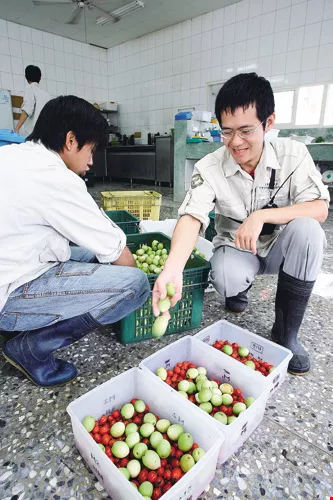
So that animals get a balanced diet, the Pingtung Rescue Center for Endangered Wild Animals divides up the food according to the number of animals in each area. Each day each animal gets at least four kinds of fruit and vegetables, as well as grains. The animals eat healthier than a lot of people do!
Helping enforcement
Taiwan's first animal conservation law was passed, better late than never, by the Legislative Yuan in 1989. It clearly set out rules banning certain kinds of trade in wild animals. Thereafter local governments, police, and customs officials joined hands to find and confiscate local wild animals that had been caught or sold through unlawful means, and endangered species smuggled in from other countries.
Kurtis Pei states that because the authorities lacked the facilities to shelter animals, many confiscated creatures could not receive appropriate treatment during the lengthy process of evidence collection, trial, and repatriation. At that time, he even saw cases of animals of this or that protected species tied up to the leg of a desk in the office of a county or city bureau of agriculture.
Once the Council of Agriculture realized the importance of having units that could care for animals, it began to establish wildlife shelters. In 1992 the COA commissioned NPUST, Ilan University, and the Taipei and Kaohsiung municipal zoos to establish government-managed centers to provide confiscated animals with emergency medical care, rehabilitation, and a temporary place to live.
Kurtis Pei says with a rueful laugh: "At that time when the COA budgeted funding for the shelters, they assumed that once the law enforcement agencies knew that they could confiscate animals without any worries, perhaps within ten or 15 years Taiwan could completely eradicate animal smuggling, and the centers could retire from the field."
Unfortunately, as Taiwan's pet market hit upon one new novelty after another, and increased wealth allowed people to indulge in owning or showing off rare pets, illegal trafficking only got worse. To put a stop to it, the Wildlife Conservation Act was amended in 1994 to create stricter rules than in most other countries in the world, and penalties for violators were also sharply increased. Law enforcement agencies also took a hard-line stance, and suddenly protected animal species became hot potatoes in the hands of pet owners operating outside the law.
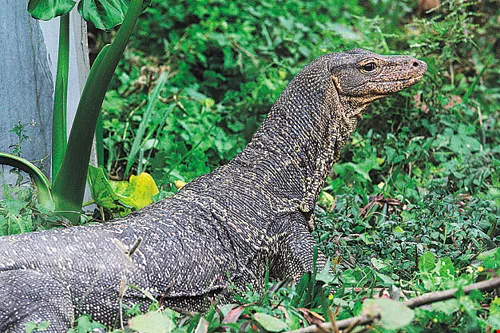
Taiwanese buy a lot of lumber from Southeast Asia, and many non-native species come along to Taiwan for the ride. The photo shows a water monitor lizard.
Besides coming to fear heavy civil and criminal penalties, pet owners also discovered that their once adorable little baby creatures turned into troublesome, even dangerous, adults. For example, the cuddly baby orangutan turns into an adult that can lift 250 kilos with one arm; the kitten-like baby Bengal tiger becomes an enormous beast of several hundred kilos in weight; the easily manageable little gibbon suddenly begins attacking and biting people. When these things happen, pet owners with no specialized knowledge, having neither the commitment nor the resources to carry on, just stick these powerful animals, still wild at heart, in a cage.
Sometimes the creatures are even abandoned outright. That's why over the last several years there have been occasional stories of the odd orangutan or Malayan sun bear getting loose and injuring someone. There was even a story about a lesser panda-listed in Appendix 2 of the Convention on International Trade in Endangered Species (CITES)-wandering around the streets of Kaohsiung County.
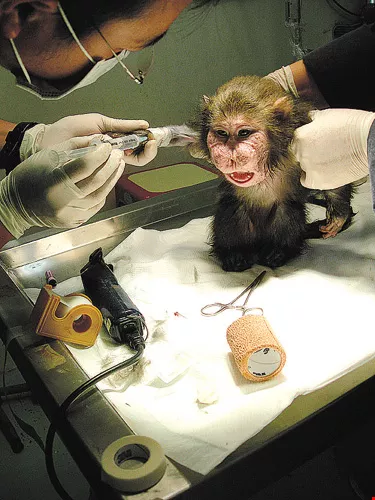
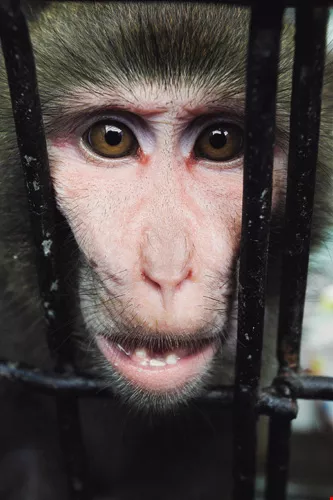
(left) The calcium-deprived Formosan macaque Kuyi was terribly thin when she first arrived at the center. The photo shows how terrified she was when getting a nutrition shot from the veterinarian.
Ignorant and heartless owners
It is estimated that there are more than 100 animals of four imported endangered groups-gibbons, orangutans, tigers, and sun bears-being illegally raised in Taiwan. That's more than 100 of each. As of the end of 2007, the rescue center had taken in 844 individuals, including primates, carnivores, avians, amphibians, and reptiles. And behind each one there is untold suffering.
Kurtis Pei tells us, "Normally people raise pets in search of some emotional connection, and even treat them as friends or family. But most wildlife are not capable of forming such intimate bonds with their owners. When you also consider that care and feeding is very difficult, and that a lot of owners neglect them or even treat them as 'wild beasts,' the death rate is very high. That leads to market supply being unable to keep up with demand, so that wild animals' right to life is even less respected."
A case study of a victim of the ignorance of owners is the Formosan macaque Kuyi. She was abandoned last March, but fortunately crossed paths with a kind-hearted foreign student who brought her to the rescue center. She was diagnosed with polyostotic fibrous dysplasia (in which normal bone is replaced by fibrous matter), a condition resulting from long-term deprivation of calcium.
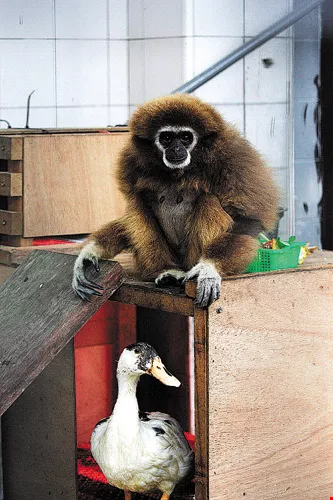
So that animals can enjoy interaction that will enrich their lives, the center often mixes species. The photo shows an abandoned elderly white-handed gibbon named Ah Lu observing a duck companion.
"A lot of owners think that monkeys just eat bananas, but in fact in the wild the Formosan macaque eats a wide variety of foods, including nuts, fruit, flowers, and insects." Kuyi had to be given injections every day for a week to supplement her calcium level. Keeper Linda Tseng felt heartbroken watching Kuyi, with a physique only half the size of a normal Formosan macaque, go through the injections. Because her skull and face are deformed and her body is so small, the other macaques have never accepted her as one of their own, so the frail Kuyi must live all alone.
Another case involving a Formosan macaque that defies belief is that of Nungshih. The one-year-old was found stuck in a birdcage with all the accoutrements of an abandoned baby, complete with towel, dog clothes, baby bottle, and milk powder. The only thing missing was the note pleading for some compassionate person to "look after my child"!
"When he first got to the center, he would still wrap himself up in clothes, and then rock his head back and forth in circles, just like the lion in a lion dance troupe." That's why the keepers decided to give him his name, which in Taiwanese means "playing the part of a lion."
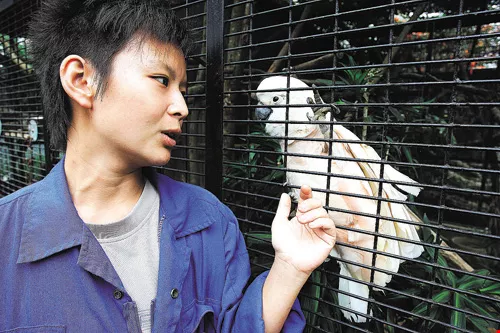
The salmon-crested cockatoo named Hsiao Pa lived in such a confined space when she was small that she never learned to fly, and can only hop about slowly.
Take the lead!
What is most regrettable is that these two Formosan macaque cases occurred just last year. Obviously, even after many years of conservation education, Taiwanese still only half understand the nature of animals, and still have a lot of misunderstandings and fanciful beliefs. Kurtis Pei ruefully recalls how early this year, a reporter present at the release into the wild of an osprey told her public that she was hiding herself a long distance away out of fear that the osprey might have a "sudden violent urge" and "chomp her to death."
Yet these misconceptions do not necessarily stop with the common man. Even some so-called professionals at zoos or parks fail to respect or understand wild animals, so that you see strange things like staff tossing food into animal cages from outside because they don't dare enter the cages at feeding time. And then there was the case of the zoo veterinarian who had his arm bitten off by a saltwater crocodile. (Even more ridiculous is that the creature had long been considered to be a Nile croc, and it was only after the incident occurred that experts corrected the misnomer.)
In recent years, besides working to back up enforcement of the Wildlife Conservation Act, the center has done even more to actively keep tabs on those endangered species now in Taiwan that in the early days had been legally imported as pets or for exhibition. The center arranges to visit them to check out their living conditions and health, and provides substantive assistance to improve their well-being.
Besides its care functions, between 1990 and 1995 the center, working in cooperation with the Taipei City Zoo, helped the Taipei branch of the World Primate Fund to repatriate three groups of orangutans. A total of 33 immature orangutans were brought from Taiwan to the Kalimantan Orangutan Rehabilitation Center on the east coast of Borneo in Indonesia.
The center has also been working with Monkey World and the Cat Tien National Park in Vietnam to establish an endangered primate species center on a small island in the national park. The groundbreaking ceremony was held last November. This center will help the Vietnamese government to give shelter to endangered species like the golden-cheeked gibbon, the silvered leaf monkey, the grey-shanked douc langur, and the slow loris, which have long been illegally captured and sold. In this way Taiwan hopes to make its own contribution to global animal conservation.
In 2005, when the Council of Agriculture was reorganized, the center was taken over from the Forestry Bureau. Besides receiving a greatly increased budget (reaching NT$60 million per year), the center also added a new aquarium and a research and conservation facility for species unique to Taiwan. In addition, an emergency rescue station was set up at National Chung Hsing University in Taichung.
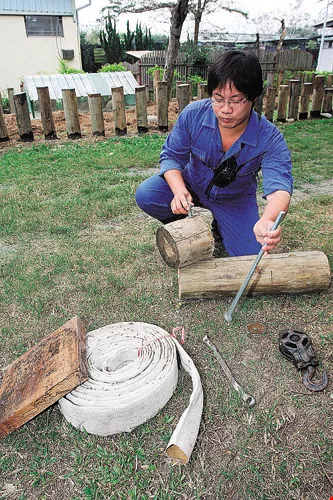
One adult orangutan could take on seven to ten adult men. Their living space has to be made of durable materials like fire hoses and wooden telephone poles so that it cannot be easily torn up by these masters of destruction.
Individuals, not property
Looking back to 16 years ago, when the "center" was nothing but a big dog cage in a laboratory, to today when it has developed into an institution that looks after animal welfare, actively seeks outside cooperation, provides specialized services to the public, and also is involved in education, professional training, scientific research, and species conservation, Kurtis Pei has come to feel deeply: "Illegal trafficking in wildlife is not merely the responsibility of the individual supplier nation or consumer nation; rather, the difficult problem of animal conservation can only be solved with effective and in-depth international cooperation."
"We also hope that people will not acquire pets without thinking carefully first. And if you already have a pet, please love it and don't abandon it. Finally, each animal is an independent individual with its own dignity, all feel happiness and sadness, anger and joy, and each one should be treasured." Moreover, "if there is no demand there will be no killing." Wild animals will no longer be forced thousands of miles from home and live tragically lonely lives if people do not buy them.
"After all, we all live on the same planet! People like to flatter themselves that we are the only living things with souls, but if we're so spiritual why can't we learn to love every living thing on the earth?" says Kurtis Pei with heartfelt anguish as he looks one by one at the rescued animals around him.
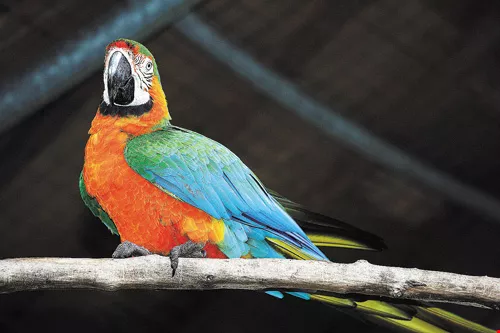
The macaw Popo was so depressed and anxious he chewed off three claws on his right foot right down to the first joint.
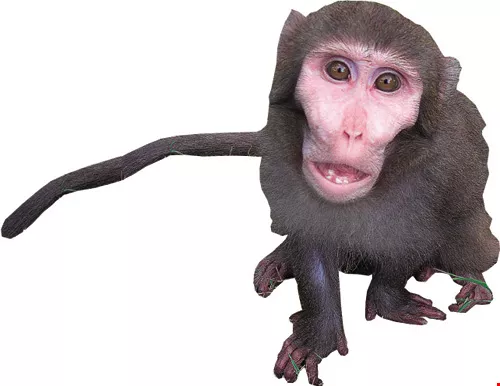
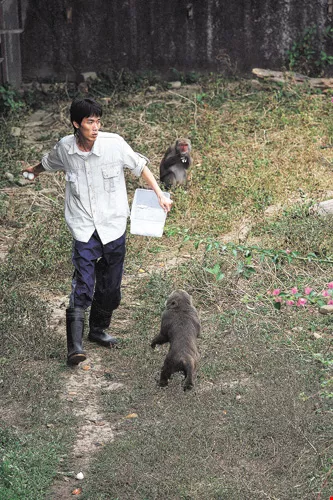
In a monkey troupe the "capo" always get to eat first. So that the smaller animals hiding in the corners can get their share, the feeders have to spread the food evenly around the enclosure. In the photo the man is tossing out boiled eggs.
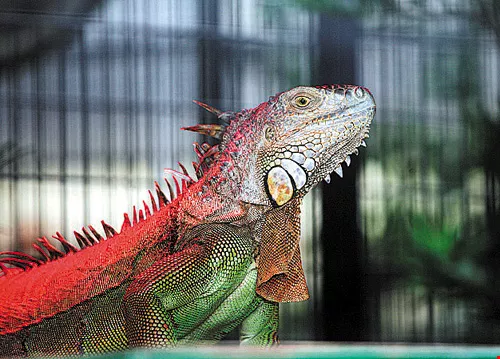
The colorful and highly popular iguana is poised to because the most abandoned species in the next few years. The spread of non-native animals is a problem that deserves greater attention.
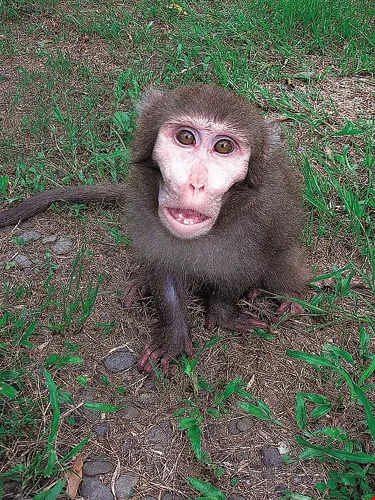
(right) Six months later, Kuyi had partly recovered her natural appearance thanks to calcium shots and plenty of sunshine.
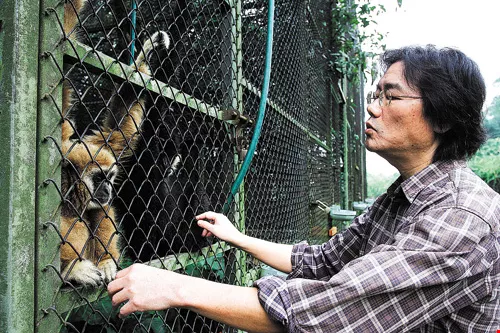
Center director Kurtis Pei, already a legend in Taiwan's conservation community, gives these tough-luck animals unlimited compassion. The photo shows him monkeying around with Toutou, a white-handed gibbon (on the left with brown hair) and Ah Tan (a young white-cheeked gibbon).
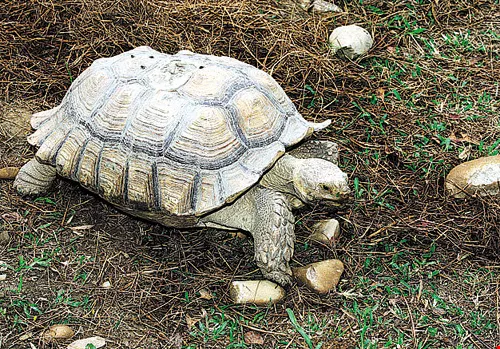
The Sulcata tortoise, which originates in Africa, is the third largest land tortoise on the planet, and its shell can reach a meter across. It is one of the most popular tortoise species among smugglers.
The colorful and highly popular iguana is poised to become the most abandoned species in the next few years. The spread of non-native animals is a problem that deserves greater attention.
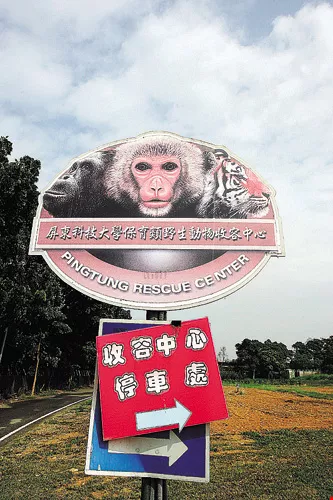
On the parking meadow at the gate you can see the rescue center's trademark image.
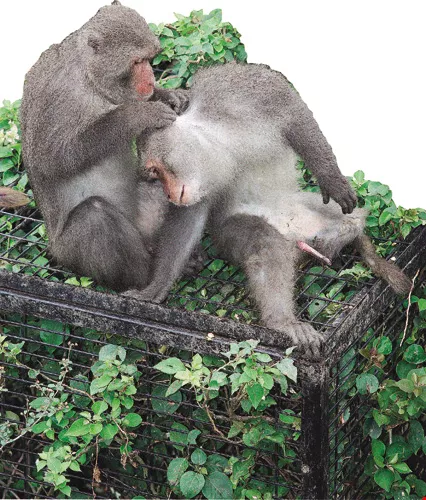
Primates are social animals, and mutual grooming of fur is an important social behavior. Unfortunately, Kuyi is so frail and disfigured that the other Formosan macaques have not accepted her into their group.

@List.jpg?w=522&h=410&mode=crop&format=webp&quality=80)


@List.jpg?w=522&h=410&mode=crop&format=webp&quality=80)
@List.jpg?w=522&h=410&mode=crop&format=webp&quality=80)
