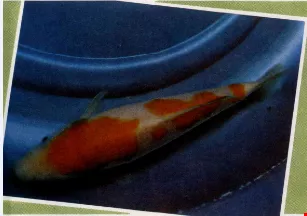
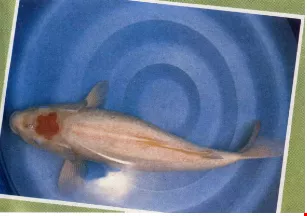
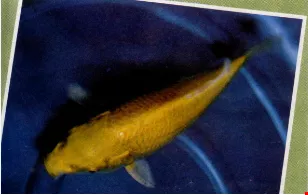
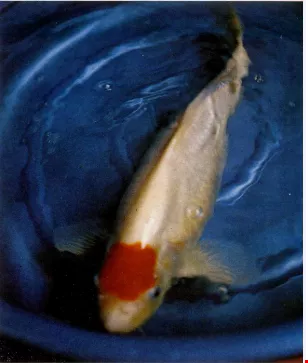
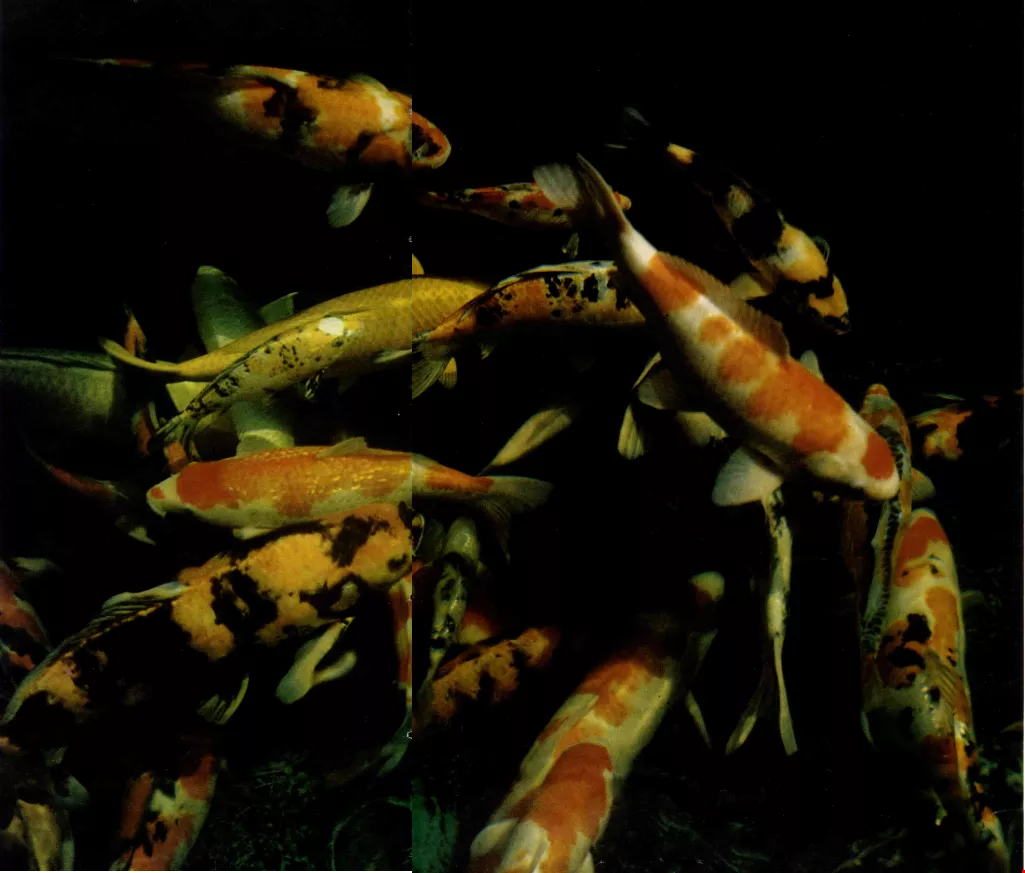
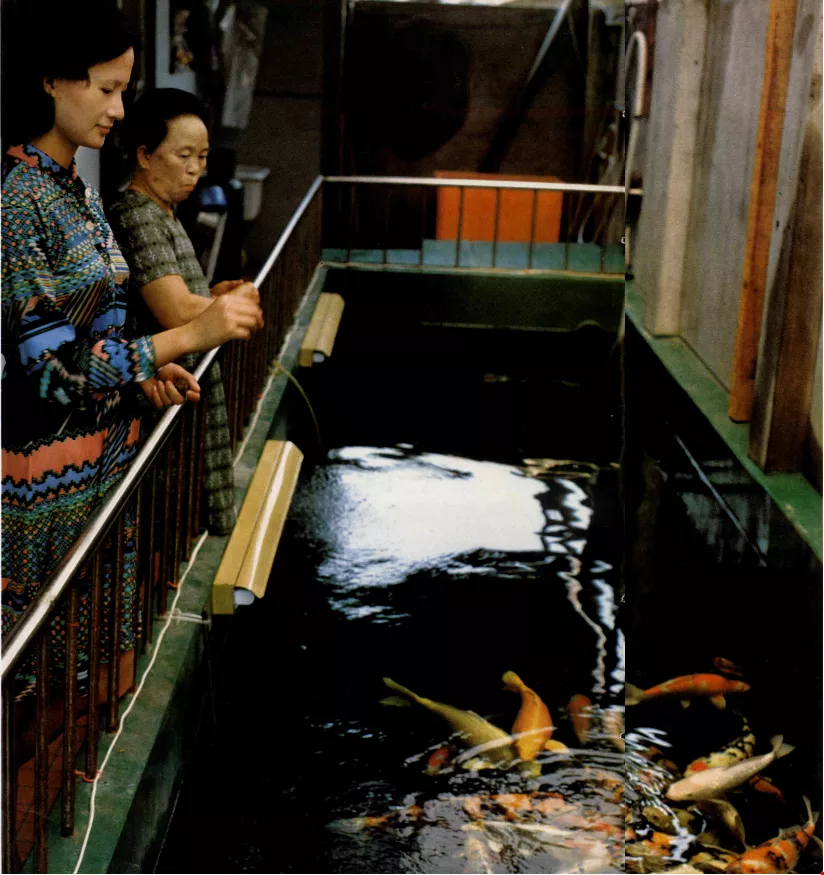
Carp, an indigenous fish of Persia, was introduced to China some 2,500 year ago. At about that time, a Chinese sage known as Tao Ju-kung included carp in a book he wrote on how to raise fish. Since then, the carp has been regarded by the Chinese as a symbol of good luck, and the proverb "The carp jumps over the dragon's gate" has been used to symbolize someone passing a civil examination. Because of its dignified and graceful appearance in the water, the carp has also been a favorite subject for Chinese painters. Introduced some seven years ago by Tai Kuang-yung, manager of the Tacheng Medicine Co., the colored carp is today proving the most popular type of the fish in Taiwan. The colored carp is the same species as the drab-looking fish introduced to China in the past. But by careful and inspired in-breeding with selected specimens, the colored carp comes in a range of hues from pure white through gold, red and black, and often in a brindled mixture of two or more of these colors. Although the colored carp is as delicious to eat as the ordinary fish, it is never raised as food. Because of its rarity and its beauty, the colored carp is kept in artificial lakes and tanks, and is esteemed as a pet. Carps can live to a great age, 60 or 70 years being common and 100 years not unknown. Their age can be told by a close observation of the scales. In cold climates, carp go into hibernation in the winter, and their growth is correspondingly slow. But in Taiwan, with its sub-tropical climate, growth is fast and continuous, enabling specimens to attain a length of 50 to 60 centimeters in three years. The colored carp is not only able to adjust to different water temperatures and climates, but it also enjoys a variety of foods including cooked rice, noodles, beans, fish and vegetables. But it is not immune to diseases, in particular those associated with the skin and digestive tract. A sick fish can be easily spotted because it forsakes the normal gregariousness of carp to take up a solitary existence in one corner, often with its head drooping. Intensive medical attention is needed to save it. One of the leading breeders of colored carp in Taiwan is Lin Chen-tsai, who keeps about 100 of the fish in his backyard. He recently turned down an offer of US $5,500 from a foreigner for one of his most precious specimens which has a plum flower pattern on its head. Lin explained that the pleasure his fish give him after a hard day's work cannot be substituted. "If the most beautiful one goes, the value of all the fish is reduced. The fish is a greater treasure than any money I could get for it" he say.