The 70th Anniversary of the Cairo Declaration and its Historical Significance
Teng Sue-feng / photos Jimmy Lin / tr. by David Smith
January 2014


Seventy years ago, as the fires of World War II raged, China found itself in mortal combat with Japan. Over the course of the war, Japan gradually began to lose more and more battles throughout the Pacific Ocean.
From November 22 to 26 of 1943, the leaders of the US, the UK and China met secretly in the Egyptian capital of Cairo to adopt a strategy in the war against Japan and discuss postwar arrangements for East Asia. The Cairo Declaration issued after the Cairo Conference was a solemn vow that eventually led to Japan’s unconditional surrender, and provided the basis in international law for the postwar return of Taiwan and its appurtenant islands to the Republic of China.
To mark the 70th anniversary of the Cairo Declaration, the Ministry of Foreign Affairs and the Academia Historica collected photos and other source materials from the period, and invited scholars from Taiwan, the US, South Korea, and Japan to take part in the International Conference on the 70th Anniversary of the Cairo Declaration, where they took a look back—from the perspectives of history, international law, and diplomacy—at how the Allied Powers used the Cairo Declaration as the launch pad for their step-by-step march to terminate Japan’s 50-year hegemony in East Asia and lay the foundation for a new postwar international order in Asia and the Pacific.
It is the purpose of the three Allies, states the declaration, “that Japan shall be stripped of all the islands in the Pacific which she has seized or occupied since the beginning of the first World War in 1914, and that all the territories Japan has stolen from the Chinese, such as Manchuria, Formosa, and The Pescadores, shall be restored to the Republic of China. Japan will also be expelled from all other territories which she has taken by violence and greed. The aforesaid three great powers, mindful of the enslavement of the people of Korea, are determined that in due course Korea shall become free and independent.”
On December 1, 1943 the leaders of the US, China, and the UK released the Cairo Declaration in Washington, DC, Chongqing, and London. Numbering a total of 251 English words, the declaration discusses Allied strategy in the war against Japan and the handling of Japanese territory after the war. And more importantly, it sets forth the consensus that Japan would have to restore Manchuria, Taiwan, and the Penghu Islands to the Republic of China. The declaration was brief, but its few words carried great weight.
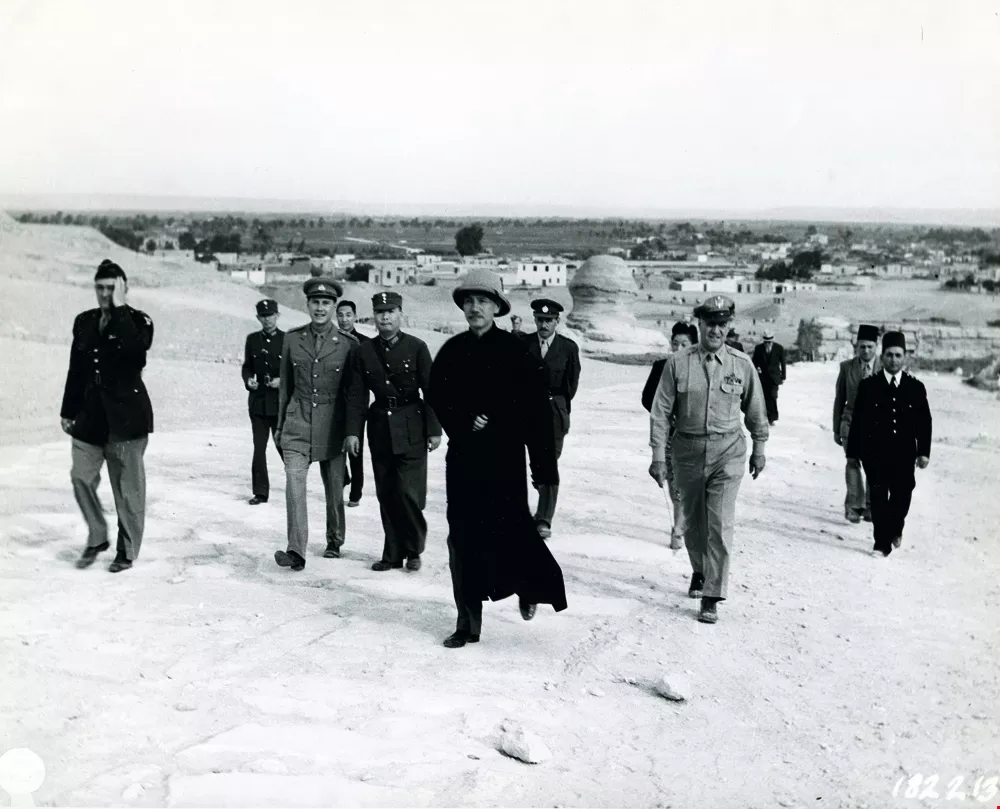
Chiang Kai-shek (wearing a traditional changshan) is shown here touring the Great Pyramids of Egypt at the time of the Cairo Conference.
President Ma Ying-jeou attended the 70th anniversary conference and delivered an address in which he stated: “The Cairo Conference was the first time for the ROC to take part as one of the world’s four major powers in an international summit, and it determined what the map of East Asia would look like after the conclusion of the war. The ROC recovered the lost territories of Manchuria, Taiwan, and the Penghu Islands, and stated its support for the independence of Korea and Vietnam. It was an epochal event, and had a decisive impact on the subsequent state of East Asia.”
In response to some who describe the Cairo Declaration as a simple press release rather than a binding treaty, and who point out that the three heads of state didn’t sign it, President Ma stated that such critics are greatly mistaken, because any substantive pledge made by a head of state while in office and within his or her authority is still legally binding. He added that the declaration was always treated during the war as part of the body of wartime documents, which indicates its importance.
For example, President Ma noted, the Potsdam Declaration, signed by the Allies in July 1945 after Germany surrendered, expressly states: “The terms of the Cairo Declaration shall be carried out.” The Japanese Instrument of Surrender of that same year indicated that Japan was willing to accept the Potsdam Declaration, and the San Francisco Peace Treaty of 1951 provides: “Japan has renounced all right, title, and claim to Taiwan (Formosa) and Penghu (the Pescadores),” while Article 10 of the Sino-Japanese Peace Treaty of 1952 states: “[N]ationals of the Republic of China shall be deemed to include all the inhabitants and former inhabitants of Taiwan (Formosa) and Penghu (the Pescadores).”
Said the president: “All of these documents combine to form an interlocking whole, and they all lead back to the Cairo Declaration. This amply demonstrates that the Cairo Declaration carries the binding force of international law.”
Professor Rao Geping of Peking University’s School of Law expressed agreement, pointing out that Oppenheimer’s International Law, when discussing the diverse terminology applied to treaties, states that that international agreements can go by all sorts of names—treaty, agreement, covenant, declaration, or protocol, for example. Thus the name and format of the Cairo Declaration do not affect the document’s binding legal force. Said the professor: “Controversy has swirled around the Cairo Declaration for 70 years now, so there is still a need for us today to speak out in its defense and reaffirm its authority.”
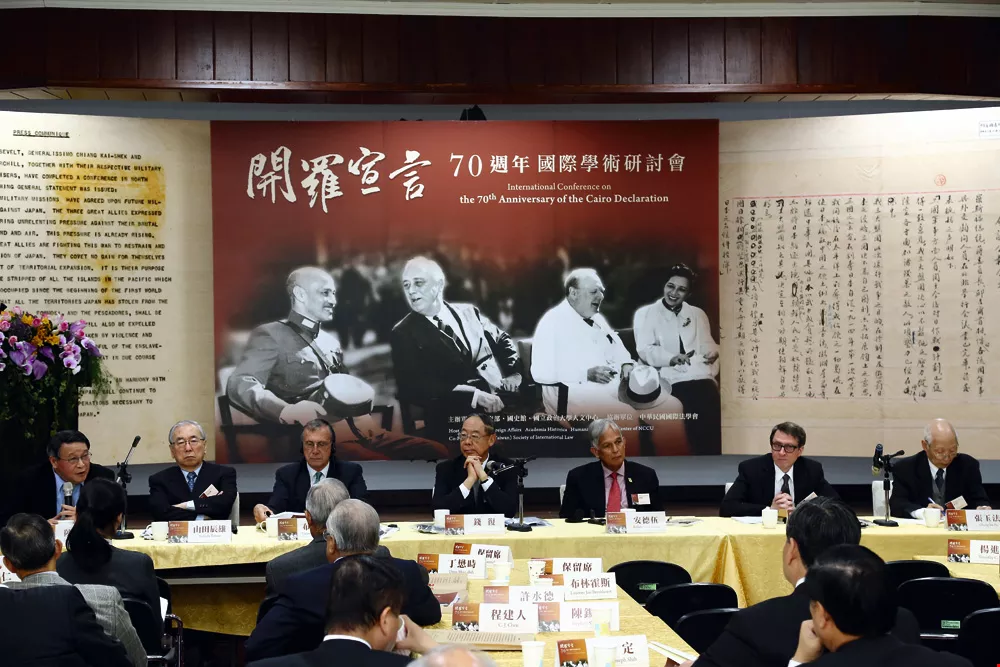
Scholars from around the world attended the conference marking the 70th anniversary of the Cairo Declaration. They discussed the significance of the document in order to learn the lessons of war.
International politics, to put it plainly, is a chess match between the major powers. For a weaker nation, there is nothing but to be moved about the board as someone else’s pawn. Japan, as a wealthy and powerful nation, took its cues from Western imperialism and moved aggressively to expand its territory through invasion. Feeble China fell victim.
China sank into ignominy in the late Qing Dynasty after it was first forced to cede national territory following defeat in war. But when it took to the international stage 100 years later with the drafting and release of the Cairo Declaration, the nation scored its biggest diplomatic victory in a century.
Academia Historica director Lu Fang-shang has used the diaries of Chiang Kai-shek to shed light on the complex mix of respect and contempt in Chiang’s relationships with President Roosevelt and Prime Minister Churchill.
“Chiang Kai-shek had an ‘Asian complex.’ He was at once thrilled and intimidated to be included among the leaders of the four major powers. He was opposed to imperialism, yet dependent upon the imperialists. He felt a sense of mission to support independence for the nations of Asia, yet did not see himself as the leader of Asia.”
According to Lu, Chiang felt that Roosevelt sincerely wanted to help China achieve independence and parity, but Chiang and Churchill were at odds with regard to sovereignty over Hong Kong and strategy for an offensive in Burma. Chiang strongly felt that the British attitude was unfriendly.
When ROC representative Wang Chung-hui was working with Anthony Eden (the UK foreign minister) and W. Averell Harriman (the US ambassador to the Soviet Union) to draft the Cairo Declaration, the UK opposed calling explicitly for Manchuria, Taiwan, and the Penghu Islands to be returned to the ROC, and suggested instead stating merely that these territories “will of course be given up by Japan.” But Wang insisted that the ROC would not accept such “equivocal” wording. In the end, his position carried the day.
Prelude to the UN CharterMost participants at the recent academic conference in Taipei were in agreement that the Cairo Conference was the high point of Chiang Kai-shek’s diplomatic career. But the UK and the Soviet Union were opposed to Chiang’s participation. China was able to join the ranks of the four major powers only at the strong insistence of the US.
According to Harvard University history professor Erez Manela, a foremost authority on the history of US diplomacy, for a century following the First Opium War, China was marginalized in the international community and did not qualify as a major power; but in order to include China among the “four policemen” of the world, the US actually threatened the Soviet Union, saying it might divert some of its aid to Chongqing. It was only then that the Soviet attitude softened just a bit. US insistence on this point stemmed in large part from Roosevelt’s vision for the postwar world order.
Roosevelt’s vision, says Professor Manela, embraced the anti-colonialism of President Woodrow Wilson. Roosevelt felt that the people in colonies were robbed of their right to self-government, and that this was the main cause of continual conflict between colonies and the countries ruling over them. He therefore reasoned that the British and French empires would have to be dismantled for the sake of lasting world peace. China and India, the most populous “non-white nations” at the time, would have to take a place on the world stage. With their participation and support for US-led international bodies, there would be a chance for world peace. The Charter of the United Nations is the product of this thought process.
Also in attendance at the commemorative conference was Laurens Jan Brinkhorst, former deputy prime minister of the Netherlands, who stated: “The 21st century is the Asian century. We must rely on leaders to push the process of change. Asian nations today are still dealing with disputes from the past that refuse to go away because, just like 19th-century Europe, they lack mutual trust.” He further opined that Taiwan, as a model Asian economy, has—despite various diplomatic setbacks—achieved a great accomplishment by moving from standoff to reconciliation and cooperation in the cross-strait relationship. In today’s highly interdependent world, he said, all nations must learn the lessons of war, and the East China Sea Peace Initiative put forward by President Ma provides a good way to resolve conflicts among the nations of Asia.
Seventy years on, an assessment of the legal validity and historic significance of the Cairo Declaration reveals that it is the foundation for the continued survival and prosperity of the Republic of China on Taiwan, Penghu, Kinmen, and Matsu. And beyond that, it is the fruit of victory in the international community’s struggle against war and oppression.

@List.jpg?w=522&h=410&mode=crop&format=webp&quality=80)


@List.jpg?w=522&h=410&mode=crop&format=webp&quality=80)
@List.jpg?w=522&h=410&mode=crop&format=webp&quality=80)
