

An i-kuei from the Western Chou Dynasty. (photo courtesy of the National PalaceMuseum)
"Food is the religion of the people," the Chinese saying goes. True today as ever.
But do you know which food-related customs and practices have been passed on, generation to generation, for some 3,000 years?
Chang Kwang-chih, a professor at Harvard University noted for his research into Chinese archaeology, has made a special study of eating and drinking in ancient China and edited and compiled a book called Food in Chinese Culture. Let's hear him relate some of the interesting discoveries he has made.
I started studying food and drink in ancient China more or less as a matter of necessity.
The bronzeware of the Hsia, Shang and Chou dynasties (21 st century B.C to 221 B.C.) consists mainly of weapons and ritual vessels, and many rites and ceremonies were integrally tied to food and drink. In the course of my studies, I gradually came to realize that if I wanted to understand more about bronze ritual vessels I had to learn something about the food and drink that they were used for.
Tripods a symbol of power: The importance of food and drink in ancient China can be illustrated by an example: According to the Chou li (Ritual of Chou), over 60 percent of the staff in the imperial palace--which numbered 4,000 in all--belonged to the kitchens. Now those 2,500 specialists weren't there solely to please the palate of the emperor, of course. It was because food and drink were a very serious business related to many rites and ceremonies.
Many food vessels acquired a symbolic significance as a result. Ting tripods, for instance, used for cooking and serving, became a symbol of political power in the Chou dynasty (11 th century to 221 B.C.). When the kingdom of Chu achieved a great victory in its northern expedition during the Spring and Autumn Period (770 to 476 B.C.), the king went to the dynastic capital of Loyang to review his troops. The Chou emperor sent an official to extend his respects, and the king asked him how heavy the emperor's tripod was, revealing his ambition to occupy the imperial throne. That is the origin of the expression wen-ting (to ask about the tripod, or express political ambitions), which is still used in the same sense today. Ting-tso (the blessings of the tripod) refers to the fortunes of the nation, and ting-nai (two kinds of tripod) means a premier or prime minister.
The Analects records that when Confucius was asked about military affairs, he replied, "I have indeed heard something about the use of sacrificial vessels, but I have never learned anything about armies and campaigns." In fact, an important qualification of the ruling class at the time was their knowledge and skills related to food and drink. According to the Shih-chi (Records of the Grand Historian) and Mo-tzu (The Book of Mo-tzu), I Yin, the premier of the emperor Tang of the Shang dynasty (16th to 11th centuries B.C.), was originally a chef. It was his skill at cooking, records show, that first won him imperial recognition.
Ancient cooking methods: A common Chinese greeting is, "Have you eaten yet?" I haven't discovered when that custom arose, but it would probably be safe to say that eating was a focus of general attention in ancient China just as it is today.
There are at least four areas of customs and practices related to food and drink that have been passed on down to the present day and make up the special characteristics of Chinese cuisine.
First are serving principles: One of the characteristics of Chinese cuisine is the combination of various flavors, of chopping meat and vegetables and the art of mixing them together, unlike the "big chunk" approach in the West. This fundamental principle of Chinese cooking had already taken shape before the Chou dynasty, and eating implements were produced accordingly. The ladles used in earliest times were replaced by chopsticks during the first three dynasties.
Second are cooking methods: Steaming appeared way back in the neolithic period, which began in 6,000 B.C., and remained an important cooking method right through the three dynasties. The pot they used, which was called a yen-tzu, operated on the same principle as steamers do today. It was divided into two layers. The outer layer held water, and the inner layer had holes and held the grain.
In addition to steaming, Chou dynasty documents also refer to boiling, roasting, stewing, pickling and curing. But the most important method of Chinese cooking today--stir frying--only appeared later.
Table manners still the same: Many types of food have been passed on for millennia. Grains and cereals such as rice, wheat and barley; fruits and vegetables such as soybeans, Chinese cabbage, leaf mustard, amaranth, pears, peaches, plums and Chinese dates; and common domesticated animals such as cattle, sheep, pigs and chickens were all eaten three or four thousand years ago, just as they are today. It's worth noting that, judging from Chou documents, dogs made it on the menu, too.
Another feature of Chinese food was in existence as well: the division of foods into grains and cereals as opposed to meats and vegetables. Meats and vegetables are eaten with rice, unlike in the West. I once asked my American students what the difference is between staple foods and non-staple foods, and they said that staples are the main courses and non-staples are the side dishes. They didn't realize that the staple foods of the Chinese are carbohydrates like rice or noodles and not a big hunk of meat or fish like in the West.
Lastly come table manners. The Li-chi (Record of Ritual) says to let elders eat first, not to overeat and not to talk and eat at the same time ... Sound familiar? Aren't these ancient precepts the same things parents tell their children today?
[Picture Caption]
An i-kuei from the Western Chou Dynasty. (photo courtesy of the National PalaceMuseum)
A sung-hu from the Western Chou Dynasty. (photo courtesy of the National Palace Museum)
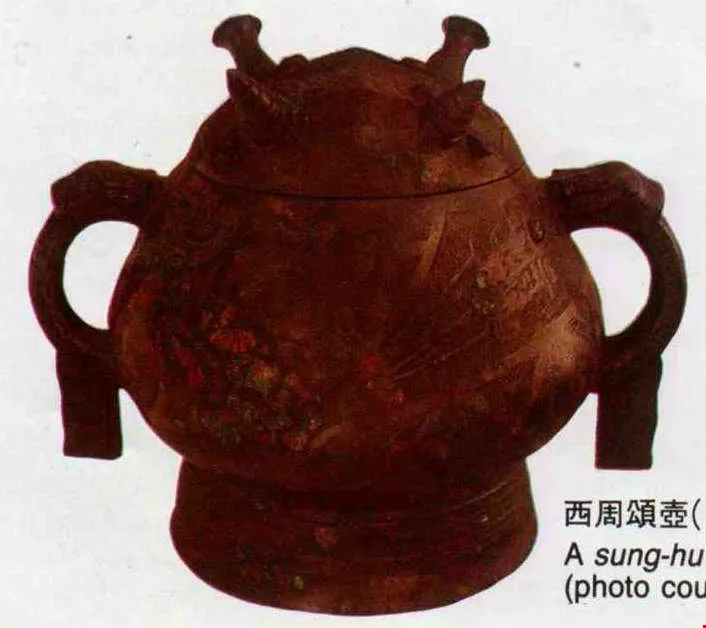
A sung-hu from the Western Chou Dynasty. (photo courtesy of the National Palace Museum)

_DSC2938@List.jpg?w=522&h=410&mode=crop&format=webp&quality=80)


