Attack of the Nerds!Cyber-Activism Comes of Age
Lin Hsin-ching / photos Jimmy Lin / tr. by Phil Newell
January 2010


For a number of recent protest ac-tivities-such as those connected with the Lo Sheng Sanatorium, the Su'ao to Hualien highway, the Wild Strawberries movement, the proposed gambling zone in Penghu, Phase IV of the Central Taiwan Science Park, and construction of the Eighth Naphtha Cracker-the Internet has been a critical platform for spreading information. Through one link after another, a new generation of young people who are versed in the manipulation of new technology are gathering from every corner of Taiwan into a powerful force capable of affecting important policy decisions.
But they do not confine themselves to protest and opposition. When there are natural disasters or emergencies, these Internet-savvy youths can make timely use of their skills to effectively compensate for the gaps in the overwhelmed government information network. Whatever you may think of the stereotypical "homebody nerd" online addicts of today, the new generation of cyber-activists has been having an impact on Taiwan's politics, society, and media environment that cannot be ignored.
At two in the afternoon on September 24, 2009, nearly 30 members of Taiwan's most important media-related NGOs-including Mediawatch, the Association of Taiwan Journalists, and the Campaign for Media Reform-as well as the Taiwan Labor Front, gathered in front of the Taipei District Court. They were all there to support two former staff people of the ERA television network who had been fired from their jobs and sued for defamation for stating on their personal blogs that the network had failed to pass along emergency information to the authorities during the Typhoon Morakot disaster.

The Puncar Action project brought "homebody nerds" to other people's homes!
This David vs. Goliath incident was just another of the many minor controversies of the world obscured by the daily mass-media diet of celebrity gossip and partisan abuse that passes for political commentary, and had little chance of attracting the attention of the man in the street. But it is interesting that through Plurk, blogs, BBS, Facebook, and other Internet tools, in the short span of two weeks this movement backing the fired journalists attracted more than 20 NGOs and nearly 500 citizens to sign a petition in support, constituting a balancing force not to be ignored against ERA's domineering behavior.
In fact it is not completely novel for online activists to use blogs, microblogs, web badges, social bookmarking websites, Google Groups, and other innovative Internet tools to draw attention to issues or set the stage for political or social action. Back during the 2006 elections for the Taipei City Council, bloggers such as Zhu Xiao Cao and Portnoy who supported the pro-environment stance of the Green Party launched an online petition to get people to commit to "vote green." Within a few days several hundred other blogs had set up links, and the movement even caught the attention of mainstream media like the China Times and Liberty Times. Although the action didn't succeed in getting its favored candidates elected, it set a model for other bloggers to follow in getting involved in democratic elections.
The Wild Strawberries student movement which flourished for a time in 2008 provides a classic example of how capabilities can be concentrated through the Internet. At that time Taiwanese students in faraway France, Germany, the UK, and the US, acting via Yahoo's "Y! Live" free web broadcasting platform, were simultaneously staging sit-ins in support of the local students braving the elements in Liberty Square. All you needed was a notebook computer and a 3.5G wireless Internet adapter and you could dialogue in real time with cybercomrades anywhere on the planet-from Taipei to Paris, from Tokyo to New York-who similarly sympathized with the student protesters.
The broadcast power of the Internet, deriving from the high quality of the sound and visual images and its geographically limitless reach, has overturned the traditional model of social movements. In the past it was necessary to invest a great deal of effort in spreading information, personal networking, and staff training to prepare for any action. But cyber-advocates need only know their respective niche audiences, proactively manage the websites that cater to each, and provide timely information, to have an opportunity to broaden the impact of their appeals. Activists no longer need to take to the streets every day and shout themselves hoarse just to get their opinions heard by more and more people.
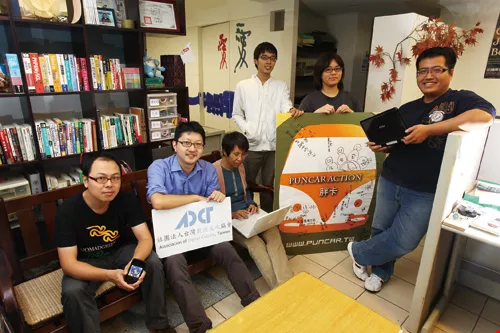
The Association of Digital Culture, Taiwan (ADCT), formed by a number of famous bloggers, has made quite an impact in recent years, using both real and virtual connections to show how the Internet can play a positive role in public affairs. Second at left is founder Tim Shyu.
The perspective of the cyber-activist generation is not, however, limited to linking up organizations for protest movements. The other side of the coin is their ability to use their Internet skills to provide information that government agencies unfamiliar with up-to-date technology may miss. One of the most prominent examples of this in recent years is the Association of Digital Culture, Taiwan (ADCT).
This group was formed three years ago by several dozen well-known bloggers and online groups, with the avowed goal of making a positive contribution through the Internet and thereby dispel the widely held stereotype of "homebody nerds" and "NEETs" detached from reality and living in a fantasy world.
One of their ideas was to hold regular "punch parties," where bloggers who had long been following each others' work could meet face to face and build up personal friendships. More importantly, each fall the group organizes a large scale event using conference and seminar formats to introduce and analyze the pros and cons of new digital concepts like Web 2.0, People Post (a news exchange platform), blogs, and microblogging, as well as to showcase successful examples of the use of these Internet tools in public service activities. These meetings have been quite well received, and to date more than 1000 netizens have taken part.
Besides regular activities to bring together the blogging community, the association also brings the power of these new technologies to the corners of Taiwan that need them.
For example, in mid-2008 they launched the "Puncar Action" project, providing computer education to over 100 remote communities in southern and central Taiwan. Traveling in an old minibus that was on the verge of being junked, dedicated young bloggers taught digitally marginal people like grandparents, small children, and foreign spouses how to use computers-from turning them on, to typing practice, to getting online, to surfing for information, and even to setting up web pages.
ADCT founder Tim Shyu, whose online handle is "Slime," notes that although the government and some foundations also offer courses to people in rural areas in an effort to close the digital gap, these are generally pre-packaged with prescribed steps that prove both boring and difficult. People have to start from learning word processing software like MS Office, "so a lot of people can't even sit through the first class before they scurry away."
Shyu says that Puncar Action, though relatively resource-poor, starts by getting people interested in learning, and instruction is largely customized to the individual, which means that the teachers teach what the students want to learn most. For example, Grandma might want to go online to check out the stock market, or send pictures of her adorable grandchild to her son who is working in mainland China, Grandpa might want to start a blog to market agricultural products, and a foreign spouse might want to learn how to use Skype to call home to Vietnam. These are the kinds of course contents that really get people excited.
Shyu concludes: "Because these things are closely connected to their daily needs, people won't forget once they learn how to do them, which is the only real way of achieving the objective of using computers to improve the lives of people in remote areas."
Filling in the gapsThis "homebody-nerd direct delivery" service to remote areas really bore fruit when Typhoon Morakot hit in 2009. On August 9, local staffers from the Puncar Action project-which was focused on Tainan County, one of the three hardest hit counties, from the start-happened to see appeals for help being left on the Plurk account of the county executive, Su Huan-jhih. It was thanks to the emergency notifications sent by these local staff that the county government was able to rescue more than 10 disaster victims who were without any outside aid.
Having had this initial success with monitoring the disaster situation, these cyber-experts won the trust of government officials at all levels, and were invited to post staff members in Tainan, Kaohsiung, and Pingtung counties, and even in the Central Disaster Response Center, with the ADCT being directly responsible for broadcasting real-time information on what disaster assistance was being tendered by various government agencies, how disaster relief was progressing, and on how and where emergency supplies were being distributed. They also established a non-governmental version of the disaster response center, collating reports from netizens all over, and serving as a platform for the exchange and comparison of information from government and non-governmental sources during the disaster period.
Lou Cheng-yi, vice CEO of the ADCT, points out that the greatest result of the involvement of netizens on this occasion was "to create a new way of thinking about providing those implementing policy with new information."
Such data sharing naturally also benefits the public. Lou recalls that information like which bridges were out, which roads were cut, where rescue helicopters were operating, and where food and water were being distributed were tucked into some hard-to-find corner of a complicated ministry webpage packed with scads of unrelated information, or even was considered "internal" and not released at all! "But this was the information that disaster victims and their friends and family, who were so worried about the situation on the ground, really thirsted for. So our volunteers lobbied government officials directly for such data and used web search tools to comb out useful information, organize it, and get it out there in a timely fashion."
A poor substitute for reality?From spreading slogans of social movements and linking appeals of different groups to participating in government action and filling in the spaces missed by government and the mainstream media, the Internet has become an important means by which young people can participate in public affairs. However, water can not only float a boat, it can also sink one. Some scholars are concerned that the "virtual reality" provided by the web may actually be trimming off the practical impact of social movements in real reality.
Kuan Chung-hsiang, an assistant professor in the Department of Communication and Graduate Institute of Telecommunications at National Chung Cheng University, offers the following example: The speed and convenience of the Internet, although helpful in getting more people in touch with public affairs, may also mislead a netizen into thinking that by simply entering into a "package for the lazy" (links to background information and media reports about controversial topics or social movements organized for easy perusal), clicking "enter" to sign some online petition, or by tuning into a real-time broadcast from some protest scene, he or she is "already doing my part in the movement."
Kuan notes that the genuine impact of social movements comes from their real presence on the streets, because that is the only way to effectively challenge the status quo. But the "surrogate participation" provided by the Internet may cause people who might otherwise go to the site of a protest in person to stay home and be mere onlookers, thereby in fact weakening the action's possibilities for striking a blow against the system. "For example, during the Wild Strawberries student movement, many people chose to do their 'sit-in' protesting at home in front of the computer. This kind of 'moral support' can be of only limited help to the real keys to the success or failure of any social movement-mass participation and vocal demands."
Furthermore, notes Kuan, in order to have real impact, any social movement has to have a social base and face-to-face trust developed in the course of interpersonal interactions.
The Youth Alliance for Lo Sheng is one example of a social movement that was able to carry its struggle on for a long period of time. The main reason was not simply that they agreed with the general idea of saving Lo Sheng, but that they identified with a real-life organization, built up strong interpersonal sympathy with the old people still living in the sanatorium, did countless on-the-spot surveys and investigations, and put their own bodies on the line in the protests. "This kind of commitment, developed through participating on the scene and sharing hardship with comrades, is far beyond what can be attained by those who just sit in front of their computers 'putting in their two cents' or 'blowing off steam.'"
People Post reporter Chiang Yi-hau, who was once nominated for a prize for outstanding journalism as a result of his series of reports on "The Story of Man and the Land" on Coolloud.org, believes that you could say that cyber-activism "cannot scratch where it really itches," and in fact its impact in terms of securing the rights of the wronged has been limited.
Take for example the way he began to participate in issues related to indigenous people after seeing coverage about resistance by Sanying Village residents to their forced relocation. "If I had just sent along reports over the Internet and then patted myself on the back and walked away, even if I had gotten a prize anyway it would have been like the effect of a boat passing over water-a brief wake and then total disappearance of any sign of its having been there-and would have changed nothing." Chiang says that the reason he decided to set up in the locality, and even shave his head alongside the residents of the indigenous community to show their determination to defend and rebuild their community, was because only by personal involvement was there any hope of helping these Aborigines, who had lost all they had, change their destiny.
While providing new platforms for the distribution of information and the mobilization of people, cyber-activism's ability to have a practical impact is not yet clear, and those involved are still just groping their way into new territory. But no matter what, as new technologies and tools constantly become available, the "activism at a keystroke" model is sure to become important to social movements in the 21st century. Young activists of today now have to figure out how to get past the negative impact of this "substitute reality" and bring fully into play the potential of the "Internet army."
@List.JPG?w=522&h=410&mode=crop&format=webp&quality=80)


