Bridge Over Troubled Waters: Kinmen Links Up with Its Future
Eric Lin / photos Hsueh Chi-kuang / tr. by Phil Newell
August 2000


Since the retreat of the ROC govern-ment to Taiwan in 1949, the island of Kinmen-only 2000 meters from the city of Xiamen in the PRC-has been the first line of defense against the military threat from mainland China. Echoes of gunfire, from the repulsing of a Communist attempt to take the island at Kuningtou in 1949 and from the artillery duels of the 1950s, still resonate. But suddenly, Kinmen finds itself at the center of a new opportunity for improved communication between Taiwan and mainland China: the so-called "little three links."
"The three links" is shorthand for direct postal services, commerce, and transportation (air and sea) across the Taiwan Strait. These are currently banned by the ROC government. The "little three links" means the opening of such contacts between Taiwan's "offshore islands," especially Kinmen, and the mainland.
On the day after his inauguration, President Chen Shui-bian, making a visit to Kinmen, declared that eliminating restrictions on the three links would be helpful to reducing cross-strait tensions, and that Taiwan would make the first gesture by opening the "little three links." After this declaration, the Mainland Affairs Council announced the beginning of a six month preparation period. When the time is right, the little three links will begin.
Though the PRC-ROC "confrontation" of the past has given way to a more "communicative" kind of relationship nowadays, Kinmen remains in the forefront either way you look at it. But as the island makes the transition from barricade to bridge, will military security be compromised by commercial links? What are the expected benefits of the little three links? Why do the people of Kinmen have such high expectations for this policy? How would the little three links fit into cross-strait relations in the future?
Kinmen is even today the front line for military security in the Taiwan Strait. On the weekend, the streets of the towns are filled with soldiers who have the day off. But the owners of the shops serving the soldiers are more interested in talking about the commercial opportunities that are expected to follow the implementation of the little three links.
Meanwhile, in the bunkers hidden in the wooded areas around the coast, on-duty troops still stand vigilant with live ammunition, and warn curious tourists not to get too close or take photographs. But not far off at sea, mainland Chinese fishing boats wait for high tide so they can approach the island for "petty trade" (a.k.a. smuggling).
Chen Tsang-chiang, a commissioner of the ROC's Fujian provincial council, standing in the rooftop office in a building he constructed in the town of Chincheng, points to Xiamen over the water and states: "For a long time, it has been our aspiration to get there. It's just that in the past, this aspiration was based on a feeling of longing for the mother country, whereas now it is based on finding opportunities to promote commercial development in Kinmen." Looking at Xiamen from this place is no different from looking at Taipei from the Kuantu Plain-the distance is about the same and you can see the skyline just as plainly.
However times may have changed, the patriotic slogans on the walls are reminders of the outer dress of military khakis that Kinmen cannot shed. But now that cross-strait relations are in an era of han
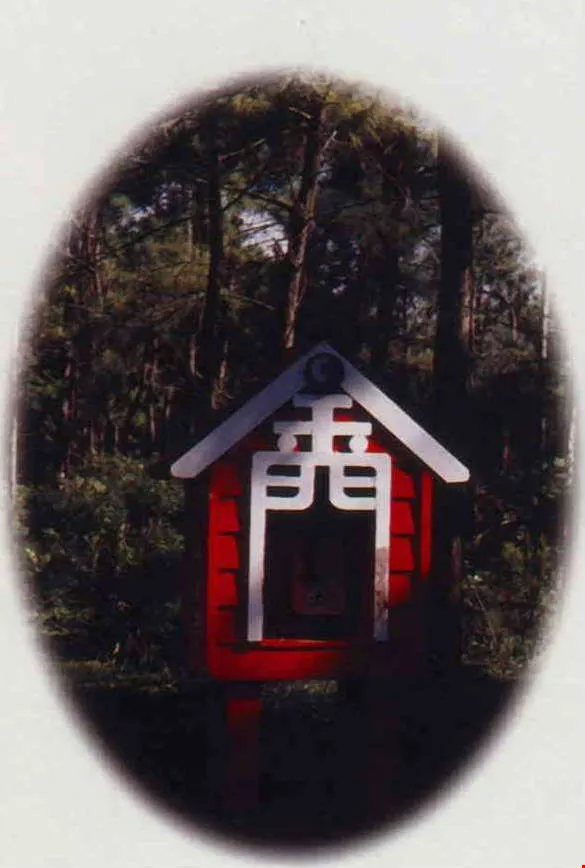
After the lifting of martial law in Kinmen, the Council for Cultural Affairs created the first "cultural" national park. The photo shows one of the park's specially designed telephone boxes.
The little three links
Kung Peng-cheng, currently president of Fo Kuang University and a scholar of culture by trade, has had this to say about the history and culture of Kinmen: "This little island, suspended in the ocean just off of Xiamen, has been a way station for pirates, but also home to great Confucian thinkers. The land is rugged and harsh, and farming is difficult, yet here culture has flourished. It is located in southern China, but sorghum-a crop of northern China-grows there. It has often been a battlefield, but is today a charming seaside park. Contradictions are piled one on top of another, and therein lies the special appeal of Kinmen."
The people of Kinmen have long been accustomed to playing the dual roles of war and peace, and, though steadfast, they are also flexible.
After 50 years of being "the front," Kinmen is more than ready for a change. When the Regulations for Development of the Offshore Islands were passed early this year, active lobbying by Kinmen and two other offshore islands, Matsu and Penghu, got the legal framework for the little three links inserted in the legislation. The Regulations permit the offshore islands to begin direct commerce and direct transportation with the mainland prior to opening of the big three links.
And when President Chen declared his desire to open the little three links as soon as practicable, this pushed the mood in Kinmen-which because of its proximity to the port of Xiamen stands to gain the most from this policy-to a new high. The Kinmen County government even moved to have Kinmen designated as port of exit and entry for the "direct religious links" proposed by Chen Lan Temple in Tachia Township, a town in Taichung County, which was hoping to have a pilgrimage for the goddess Matsu go directly from Taiwan to the PRC.
Mainland Affairs Council chairperson Tsai Ying-wen tried to put a damper on this enthusiasm. After making a visit to Kinmen to check on conditions on the ground, she called for a six month preparation period. But "little three links fever" is far from subsiding. A private-sector association of the tourist industry in Kinmen, staying a step ahead of the government, plans to sponsor an "ice-breaking journey" to the PRC on August 23 (the anniversary of the outbreak in 1958 of a long-running cross-strait artillery duel); there they will discuss future cooperation in tourism.
Why are Kinmen folks champing at the bit this way?
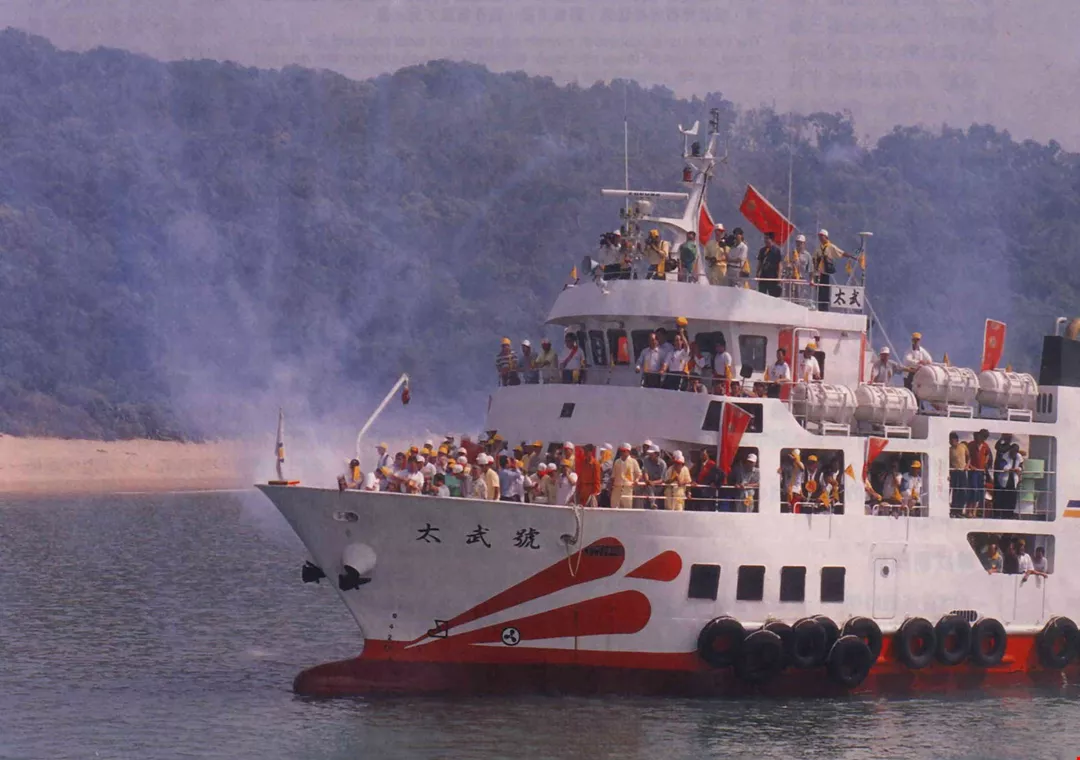
(opposite) Tourism-after a brief heyday following the lifting of martial law-is now languishing. The Kinmen County government sponsors events to lure back visitors, like this one for the Cheng Huang Temple in Chincheng.
New opportunities
During the martial law era, Kinmen maintained a garrison of more than 100,000 troops, or twice the number of local residents. Soldiers were everywhere, and the Kinmen-born singer Ah-teh says that he virtually grew up with a family of soldiers as older brothers. Consumer demand from this huge garrison provided the foundation of the economy for local residents. Shops offering recreation, dry goods, laundry services and the like served this market, and soldiers returning to Taiwan from duty in Kinmen brought back souvenirs of special local products like peanut "tribute candy," kitchen knives made from artillery casings and shrapnel, and kaoliang liquor.
After the lifting of martial law in Kinmen and the opening of the island to tourism, the veil of mystery that long shrouded this bastion began to be lifted. For a time, tourists poured in, their numbers further swelled by family members visiting their sons on duty on Kinmen (which had been forbidden in the past). Hotels sprang up like mushrooms after a spring rain, and there was unprecedented prosperity. Hsieh Yu-chen, who runs Hsia Hsing homestay, recollects that for a time the hotels couldn't hold all the guests, and tour groups were brought en masse to homestays. "For a year there wasn't even a space to sit down," she recalls.
But the tourism wave quickly receded, and a military streamlining plan has left the island with a garrison of only 10,000 or so troops. Local businesses have shriveled and many hotels have closed their doors.
Kinmen County executive Chen Shui-tsai says: "The per capita income in Kinmen was originally only two-thirds that in Taiwan, and now that the garrison has been substantially reduced and the tourism industry is still in the doldrums, things are even tougher."
Moreover, Kinmen's economy has been hit by blows other than those that are so visible on the surface. In particular, smuggling from mainland China has affected the normal operations of the local fishing industry.
"Kuningtou, Chiunglin... wherever it is possible to come ashore, mainland fishing boats come to engage in 'petty trade.' At high tide along the coast, they are there to sell everything-rice, fish, vegetables, peanuts.... It is at the point now where mainland fishing boats block Kinmen fishing boats from going out to sea. They don't let the Kinmen boats catch fish, but only let them buy fish. Since this works out economically for the Kinmen fishermen as well, this kind of smuggling has been going on for years," says Weng Ming-chih, head of the Kinmen branch of the Democratic Progressive Party. There are far too many smugglers to catch them all.
Here too help is expected from the little three links. If this policy were adopted, the petty trading would be decriminalized, and could then be brought within legal norms, so the government could manage it better to reduce any negative side-effects on the Kinmen economy.

The traditional industries of Kinmen are based on local products like "tribute candy." However, fewer and fewer tourists have been coming, and demand for traditional products has suffered as a consequence.
Three links touchstone
But smuggling is not the main issue. Rather, people in Kinmen look to the little three links as the fastest way to resuscitate local businesses that have lost their markets.
Lee Juh-feng, a New Party legislator from Kinmen, says that the little three links is a once-in-a-lifetime opportunity. If business partners and cheap raw materials can be accessed directly from the PRC, then Kinmen can escape from its backwardness. Commissioner Chen Tsang-chiang avers that Kinmen has the advantages over Xiamen of the more creative entrepreneurship that exists under a free market economy and the legal guarantees of a democratic system. Today Xiamen is doing very well, he says, but Kinmen could, with access to the same hinterland, do even better.
"Even if you don't look that far into the future, even if just tourists could visit from mainland China, that would at least give the tourism industry a new lease on life," comments Chen Shui-tsai. Moreover, until the big three links are opened, Taiwan business people and travelers can travel or transship goods through Kinmen, which would be a further shot in the arm to the local economy.
Moreover, argues legislator Lee: "The little three links policy will be decisive for the future of our kinsmen on Kinmen, but they will not be the only ones to benefit." He says that the little three links could bring cross-strait relations out of their current mire and back to the negotiating table. The little three links would, in addition, be a trial run for the big three links, offering invaluable lessons. Finally, both the ROC and PRC are actively preparing to enter the World Trade Organization, which requires that its members have direct commercial exchanges. If it proves impossible to resolve the big three links issue quickly, the ROC can defend its position in the WTO by pointing to the little three links as evidence of already existing direct trade.
But the Mainland Affairs Council (MAC) does not share these views. MAC vice-chairman John C.C. Deng emphasizes that the little three links and the big three links are not parallel, nor are they similar in terms of the policy structures under which they are being considered. The big three links are part of the larger cross-strait relationship, and progress on these should depend on the overall relationship. The little three links, on the other hand, are part of a package of policies under the Regulations for Development of the Offshore Islands designed to encourage economic progress in those islands.
Leaving aside these economic and political issues for the moment, it appears that the most important sticking point holding up the little three links is the question of military security.
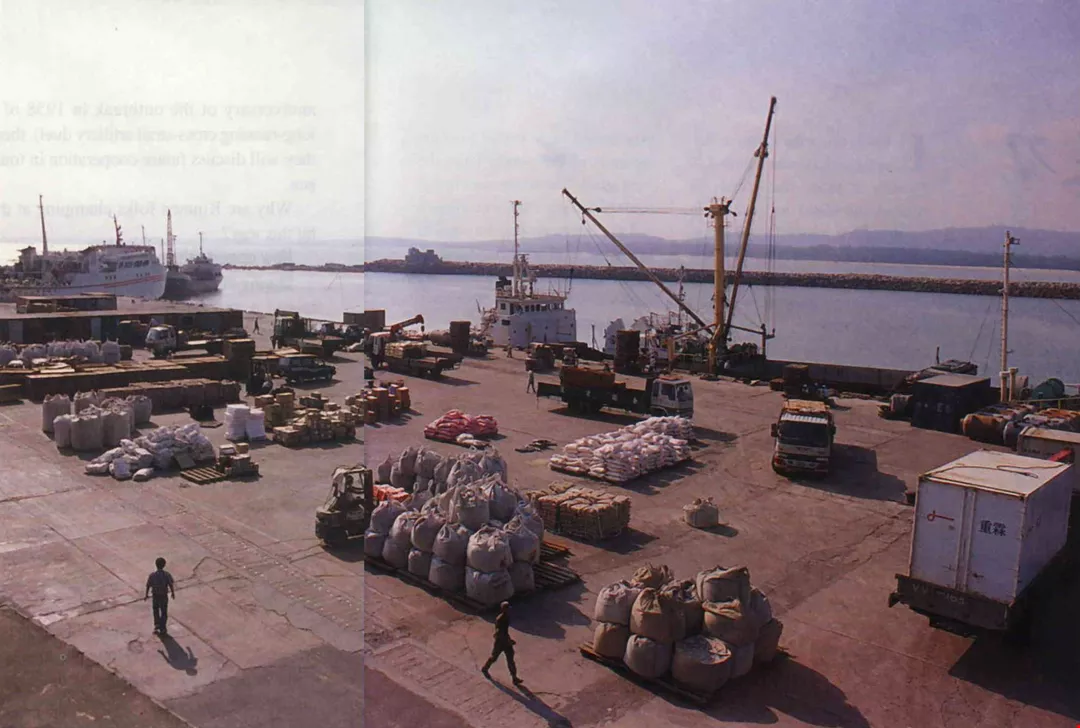
People in Kinmen hope that the little three links will stimulate the local economy. The county government has been pushing ahead with many infrastructure projects to handle future transportation needs. The photo shows work going on at Liaoluo Harbor.
The lion and the rabbit
Despite the high expectations people in Kinmen have for the little three links, there are widespread concerns about how Kinmen would maintain its role as military bastion. Lin Jhy-ming, deputy superintendent of the Kinmen National Park Headquarters, says that lately rumors have been circulating that the MAC will soon apply the brakes hard to the little three links. This is said, by the same rumors, to be a result of discussions MAC chairperson Tsai Ying-wen had with the commander of the Kinmen military district during her visit there.
Across the water from Kinmen, military construction has been going on for decades in the Xiamen area, and there are still frequent Chinese Communist military exercises. Sudden adoption of the little three links would certainly be unsettling to the military system that has dominated Kinmen. Lin Pao-pao, a photographer who has long lived in and photographed this highly militarized zone, says that being in Kinmen is like being a rabbit next to a sleeping lion. Nobody knows when the lion will wake up.
But county executive Chen Shui-tsai, who was in the military for decades and maintains close contacts with the local defense command, says that while he understands the importance of military security, people must recognize that Kinmen's role has changed from that of defender to communicator. The military, he says, will simply have to make the necessary adjustments to coordinate with the implementation of the little three links. "The security-related measures chosen by the Ministry of Defense will be key to the smooth implementation of the little three links."
Lee Juh-feng agrees. Starting from the larger point that the purpose of a military is to assert sovereignty and defend the nation's territory, he notes that the 10,000 or so troops on Kinmen-not even enough to stop smuggling-are no longer particularly important in terms of national defense. This is especially so when you consider that under conditions of modern warfare, there is no clear division between the front lines and the rear areas. So there is no need to exaggerate national security concerns to hold up the little three links.
Moreover, says Lee, were the PRC to ever take military action against Kinmen, it would have to consider Kinmen's ability to retaliate against the prosperous city of Xiamen. The PRC would not find it necessary in the least to take the risk of attacking Kinmen, but would more probably launch missiles at Taiwan proper. Evidence for this line of thinking is provided by the 1996 missile crisis.
However, the MAC's John Deng says that Kinmen has been considered a vitally important strategic base for more then 50 years, and it is going to take the Ministry of Defense considerable time to adjust to the policy of the little three links. "We respect the expertise of the Ministry of Defense," he says. All the more so as military considerations are not the only reason for the MAC's proposed six-month preparation period. Time is also needed to put civil legal structures-such as regulations covering flag-registration of commercial ships, customs and quarantine, and so on-into place.
"I know that everyone is anxious to get started, but we would rather be better prepared up front than rush into opening up and then have to watch problems pop up one after another," argues Deng. The local government also needs time, he says, to make appropriate plans for things like traffic and administration under the little three links.
In our own hands
But Kinmen county executive Chen Shui-tsai is confident that his administration won't need very much time at all. Over the past decade or so, he relates, the county government has completed much basic infrastructure for maritime, overland, and air transportation. For example, Kinmen airport now has a capacity of 1.5 million passengers per year. Also, Liaoluo Harbor is already served by 31 commercial ships which run regularly between Taiwan and Kinmen, and it should be no problem to handle anything up to 50 million tons of cargo. Work is moving along on docks and warehouses at the harbor, and should be completed before any announcement of the little three links. The relevant quarantine and customs systems are also in the pipeline.
Chen concludes: "When you also consider the fact that the Regulations for Development of the Offshore Islands create a construction fund of NT$30 billion over a period of 10 years, then you can see that it should be no problem for Kinmen to have its infrastructure ready within a short time."
Lee Juh-feng makes the further important observation that the little three links would not by any means require an immediate and comprehensive opening of commerce between Kinmen and PRC. Rather, Taipei could start with actions completely within the ROC's control, such as the decriminalization of what is currently considered smuggling.
For example, he notes that the PRC has long had regulations on trade and shipping in place that would allow small scale trade with Taiwan. So the ROC only has to eliminate existing regulatory provisions that make small-scale trading illegal, and establish parallel regulations to those of mainland China governing shipping, and direct links can begin without any formal negotiations at all.
He adds, You could even start with things like letting people from Kinmen and Matsu go to Xiamen for emergency medical treatment, or bringing in water and electricity from the PRC to reduce costs in Kinmen. As the two sides steadily build up a pattern of tacit cooperation, then you can discuss issues related to air and sea navigational rights."
A shock, or a stimulus?
Chen Shui-tsai estimates that more than 80% of the people of Kinmen support the little three links. But some people still have reservations. Daphne Lee, head of the Department of Business Administration at the Kinmen campus of the National Kaohsiung Institute of Technology, who has been doing long-term surveys of local industries in Kinmen, suspects that if direct trade were opened with the mainland without any plan to assist local businesses, there could be a serious adverse impact on local firms. She points out that virtually all of the industries in Kinmen are traditional, whether these be in agriculture, fishing, or small industry. Inevitably, these would be affected by the sudden influx of low-price products from mainland China that would occur under the little three links.
Against this view is the one held by Wu Tseng-tung, the owner of Chin Ho Li, which makes artillery-shell kitchen knives, one of the special traditional industries of Kinmen. He points out that most Kinmen products are unique to the island, so would not face direct price competition from imports. The little three links would, on the contrary, stimulate local industry by opening up the huge mainland market.
Anyway, Wu says, Kinmen is not very suited by nature to agriculture; large-scale smuggling has been going on for a long time; and most fishermen have been buying seafood directly from Xiamen rather than catching it themselves. Under these conditions, he concludes, it is the so-called traditional farmers and fishermen who have in fact "been at the forefront of transshipment trade in Kinmen."
In fact, then, people in Kinmen do not seem very worried about any adverse side-effects from the little three links. They are worried, however, by the possibility that the big three links will be implemented shortly after the little three links. If that were to be the case, then the little three links would bring only a short-lived prosperity, a repeat of the sad lesson learned after the tourism bubble burst. Maybe this is the problem that deserves particular attention in discussions of the impact of the little three links on Kinmen.
Chen Shui-tsai declares: "People in Kinmen want to see 'where's the beef,' and not just accept fairy tales from the legislative or executive branches." Chen is expecting that the MAC and the Legislative Yuan will, in drafting the relevant legislation for the little three links, prepare a long-term program for Kinmen's future.
With regard to this expectation, John Deng of the MAC says that is also up to the local government, not just the central government, to create business opportunities. In any case, he says, business people are much faster on their feet then any civil servant: "It's up to business people to figure out how to make money, while the job of civil servants is to provide information and a legal framework."
Deng frankly warns the Kinmen local government and business people that if they position themselves only as a transshipment point between the two sides of the strait, inevitably their prosperity will end when the big three links are initiated. Kinmen itself must have a more practical and long-term plan.
Free trade zone
So what is being done about long-term planning for Kinmen? Weng Ming-chih says that the DPP adopted a "Kinmen and Matsu Economic White Paper" several years ago, which focused on finding new markets for products for which Kinmen already has a comparative advantage, such as liquor and tourism.
As Weng explains, "During the white paper discussion process, participants frequently raised the idea of a free trade zone linking Kinmen to Xiamen. It is possible for the mainland to establish such special zones, like Hong Kong, anywhere along the coast, and many already exist. With the economic strength of Taiwan behind it, and the broad hinterland of Xiamen in front, Kinmen could one day find itself not much behind places like Hong Kong." By seeing Kinmen and Xiamen as an integrated whole, there is much more room for imagination about the future of Kinmen.
The idea of a free trade zone is appealing, but it would require the agreement of the PRC. John Deng says that the DPP does want to keep its promises, but that the establishment of a free trade area would go well beyond the little three links, to touch on larger issues of cooperation between the two sides. Today, when even basic cross-strait communication is irregular, it's much too early to be talking about a free trade zone.
It is commonly argued that many of the reasons given for holding up on the little three links are moot, since entry into the World Trade Organization should make the big three links inevitable. But here too the MAC is reserved.
John Deng suggests that even after Taiwan enters the WTO, it would be possible to get around the requirement for direct trade between WTO members by asking for an exemption for this particular case. However, WTO regulations require that exemptions be declared prior to application for entry. Given Taiwan's current weak diplomatic position, unless the PRC agrees to the exemption, it will be difficult for Taiwan to get the required support of two-thirds of the 137 WTO member states for this escape clause.
In sum, Kinmen people remain optimistic that the arguments in favor of the little three links will win out. Although the MAC argues that a six-month preparation period is not unreasonable, people in Kinmen are anxious to get started. As Lee Chu-feng says, "Each day sooner that the links are opened is one more day of opportunity for us."
The zone of peace
In thinking about the issue of the little three links, it is of course not necessary to look at everything from an economic point of view. Hsueh Cheng-tai, a native of Kinmen and currently a professor of sociology at National Taiwan University, says that discussion of the little three links should not only be about goods, but also about people.
Hsueh explains that historically Kinmen has been a way station for immigrants from mainland China to Taiwan, and has close cultural links to both Taiwan and Xiamen. Although it has been cut off from Xiamen by the cross-strait confrontation, so that the fate of Kinmen is now intertwined with that of Taiwan, you cannot treat the people of Kinmen, who are caught in the middle, merely as pawns in the cross-strait struggle. In discussing the little three links, it is necessary to consider the needs of those people.
In other words, if you think of the little three links only as an economic policy, for Taiwan it simply means saving some time or money in buying goods from mainland China, but it cannot change the PRC's haughty attitude nor cause it to abandon the threat of armed force against Taiwan. But if, through the little three links, Kinmen can become an educational and cultural zone of peace, and serve as a bridge between the two sides, perhaps some day "one China" can be something other than a debating point.
From its role as a fortress to its role as a communications bridge, Kinmen remains in the front line for the ROC. The importance of the little three links has always been more than merely economic or military, but symbolizes the ability of the two sides to reach a win-win outcome.
Could Kinmen-whose name means "golden gate" in Chinese-become the portal for the revival of communication between the two sides?

@List.jpg?w=522&h=410&mode=crop&format=webp&quality=80)


@List.jpg?w=522&h=410&mode=crop&format=webp&quality=80)
@List.jpg?w=522&h=410&mode=crop&format=webp&quality=80)
