Dennis Huang on Fatherhood
Liu Yingfeng / photos courtesy of Eurasian Publishing Group / tr. by Geof Aberhart
February 2015


After swapping his press credentials for diapers and formula, veteran journalist Dennis Huang has written a book, On Fatherhood: Shock and Surprise, telling the tale of his transition from son to father.
While at first glance the book may seem to be about Huang’s experiences as a father, as it progresses it becomes as much about his own childhood and how his mother raised him. It is a tale of two generations of family, full of memory and recollection.
In 2005, a 40-year-old Huang was preparing for married life. Still worried whether or not he would be able to adjust to living with someone else, an unexpected bundle of joy joined the couple, and seemingly in a flash Huang went from bachelor to family man. “Fortunately I not only have adjusted to family life, but actually enjoy it,” says Huang, now nine years into fatherhood. Where his old college classmates saw a “bad boy” and his wife, Yuan Yingshan, sees someone “dashing, debonair, and fierce,” that first child set Dennis Huang on a fantastical, surprising journey to becoming a model househusband.
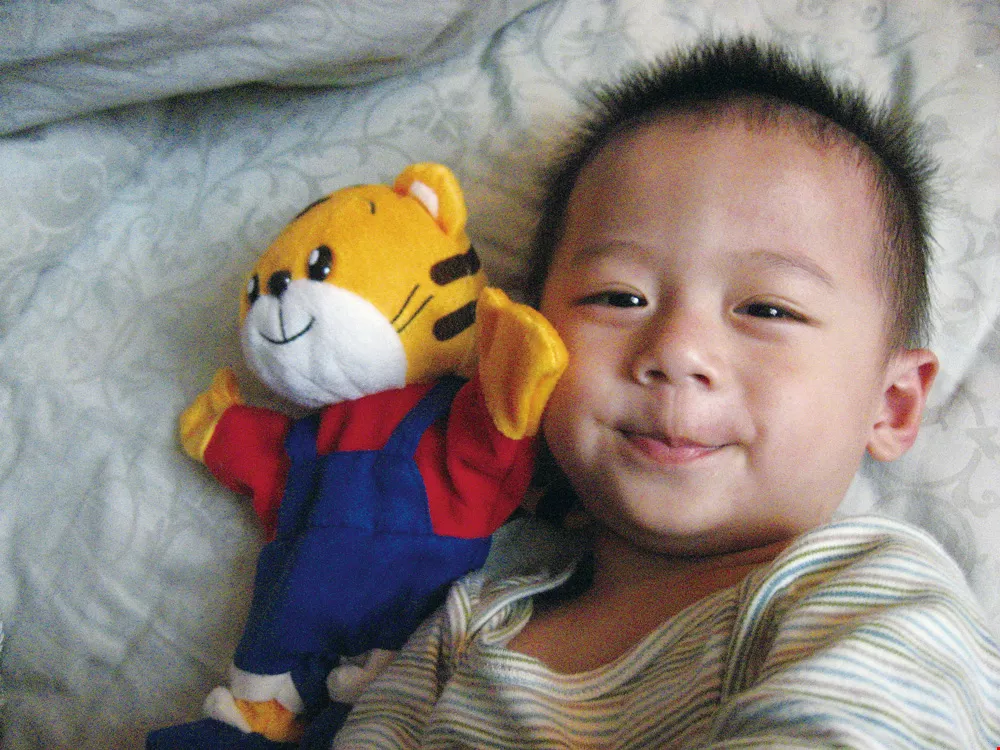
Dennis Huang sees a lot of his youth in his children. Becoming a parent has helped him better understand his mother, inspiring him to write the book On Fatherhood. The photo on the facing page shows Huang’s eldest son.
“This downy-soft little creature that lies in front of me, constantly frothing and foaming at the mouth, seems like an alien. Having to drag myself out of bed every three hours for midnight feedings almost reminds me of standing guard back during my military service.” In every entry in his “Daddy Diary” blog, Huang’s weird and wonderful experiences combine laughter and melancholy.
Starting out as a bumbling first-time father, Huang was reminded of his own childhood, and of how much he wanted to get away from his mother and the rest of his family as a child.
While Huang’s first son grew older, so too did his mother, and after she suffered a stroke in 1995, her two sons—Huang and his younger brother—became keenly aware that their mother may not be much longer for this world. After years away from home, becoming “unexpected, involuntary caregivers” brought the brothers closer again to their mother. Once she became a grandmother, she was happy to start sharing stories about her own youth, including many aspects of her past that Huang had never heard.
Inspired by past books, like Hsia Juei-hung’s on her grandmother, Yang Sol’s on her father, and Chen Roujin’s Everyone in Their Time, Huang set about writing his mother’s tale, a story of family interactions that reflected a period in time and a sort of generational collective memory. After writing articles on the Academia Sinica Digital Archive, which is full of old films and photographs, Huang was inspired to document his own mother and her era. While at first he had been intending to write about his children growing up, as he connected more with his mother’s remembrances, the book gradually evolved into a cross-generational story of childrearing and family.
“The appearance of a new life is always a catalyst for huge changes,” says Huang. If his son hadn’t been born, the book would never have existed, or maybe it would have been some other kind of book. Since becoming a father, Huang has constantly been given glimpses of himself as a child through his own children, and of himself now through his parents. “A family is like a house of mirrors, with you, your kids, and your parents constantly reflecting each other and being reflected.” By learning to put himself in his parents’ shoes, and with some distance from his own childhood, Huang began to look anew at his childhood relationship with his parents, gaining new understanding of his mother’s approach to raising him.
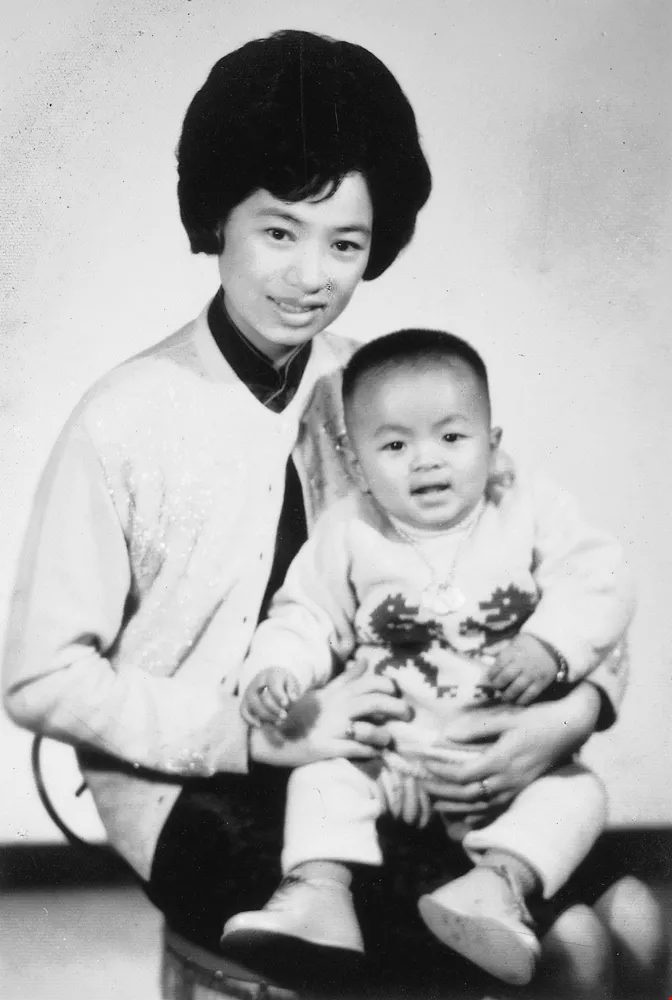
Faced with the births of his children and the aging of his mother, Dennis Huang has been able to stand in the middle and get both a glimpse of the future and an insight into his past and his relationship with his mother. This photo shows a young Huang sitting on his mother’s lap.
Huang grew up around Dihua Street in Taipei’s Dadaocheng area. At the behest of his traditionally minded maternal grandfather, who had no sons, he was charged with carrying on his mother’s family line, being given their surname at birth. This led to his being pampered by his mother’s side of the family, who placed great expectations in him. However, in essays like “The Silent Wife” and “Apache Attack Helicopter” Huang reveals, in his own witty way, his feelings of frustration under his mother’s strict rules.
This frustration turned into rebelliousness when Huang reached senior high, as he began sneaking banned books, cheating, lying, and even running away. His mother had hoped for him to follow in his father’s footsteps and become a doctor, but Huang made his position on the matter known through failing the Joint College Entrance Examinations two times. When his mother forced an end to a blossoming relationship he was beginning, Huang’s rebellion became a more conscious act of opposition to authority. This would later be reflected in his staunch support of freedom of information and net neutrality during his career as a journalist. Even as he became a father, Huang stood his ground—while his son was learning to walk and talk (what Huang jokingly refers to as the “monster period”), Huang and his wife both strove to bear in mind that children are independent individuals and to avoid forcing their ideas on their children.
Growing up under the “unbearable love” of his parents, Huang has been careful not to make the same mistakes they did, while at the same time hoping to continue the good traditions that they passed on to him. “The majority of parents are, to some degree, basically ‘revisionists.’”
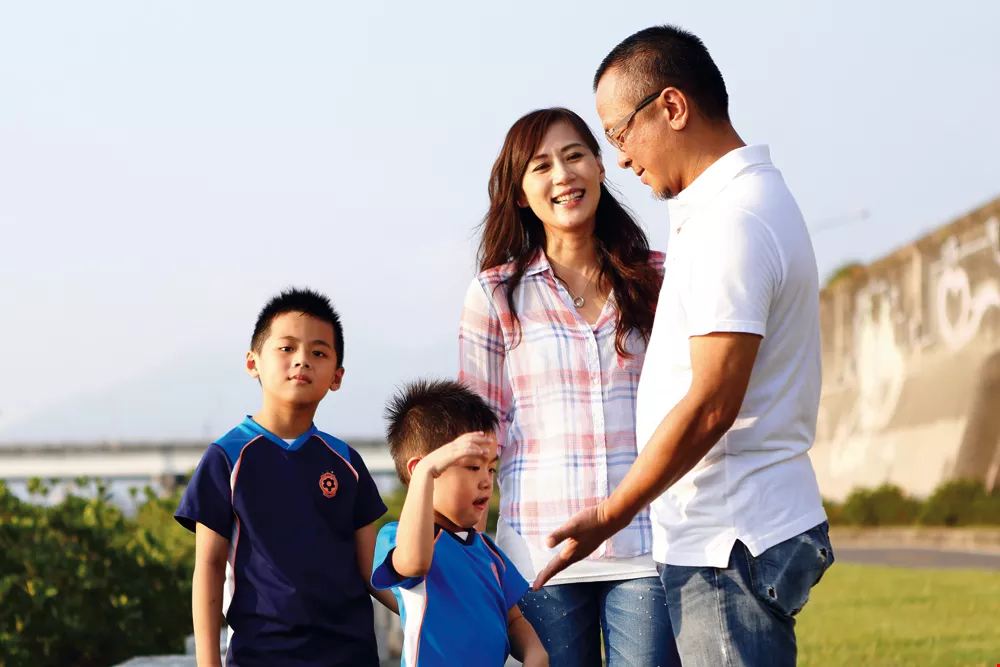
As he plays and laughs with his children, Dennis Huang is attempting to forge a parenting style that suits his generation of parents. Pictured here are Huang, his wife Yuan Yingshan and their two sons.
Being stuck between the previous and next generations, a position he describes as being like groping through thick fog, Huang hopes that he and fathers in his generation will figure out for themselves what kind of parents and men they are.
The traditional image of families, with fathers working long hours outside the home and mothers taking care of the household, was very clear and easy to figure out. Times have changed, though, and the role of fathers has changed with them. After becoming a father himself, Huang began to wonder about what it means to be a middle-aged father today.
Making use of his journalistic experience, he set about talking to others around his age, like author Luo Yijun, Buffalo Bookstore owner Luo Wenjia, and Yan Mingxin, operator of Petite Jasmine Parent–Child Reading Group, to create a composite image of a Generation X father.
Huang remarks that the authoritarian style adopted by the older generation’s fathers was really just a result of their being busy with work and having little time to spend with their children. “Since they didn’t spend time with their children, they didn’t understand how to get along with them,” he says. Because of that, they never really even hugged, let alone sitting down and talking with one another. By way of example, Luo Yijun explained that he and his father barely had any physical contact, barring spankings when the younger Luo was naughty; the next time they really had contact was when Luo had to give his bedridden father sponge baths after he suffered a stroke. Huang’s wife Yuan Yingshan had a much closer relationship with her father, but even she had little memory of hugging her father until she did so out of a fear of heights when traveling with him as an adult.
Fathers of the newer generation, though, are different. They’re more willing to express their emotions both verbally and physically, sometimes to an embarrassing degree. “Underneath all this is a desire by fathers of my generation to not be as traditionalist as our own fathers were, to not treat childrearing like a production line. Instead, we are more ‘client-oriented,’ running a ‘service’ to satisfy our children’s needs,” explains Huang.
Those older parents were used to trying to force their children into particular molds—Huang, being a strong student, was slotted into the “doctor” category, while his brother, who was more hands-on by nature, was assigned the future job of “engineer” by their parents. The new generation of parents no longer try to choose their children’s futures, and instead try to encourage the children to find their own passions.
And with women increasingly becoming the breadwinner, more fathers are spending time with their children, which is, in Huang’s opinion, unquestionably a positive trend. The old days of “her indoors,” when the husband made the money and the wife ran the home, may be on the way out, but as Huang says, his decision to leave work and take care of his children resulted in many a raised eyebrow.
As material conditions in Taiwan have improved over recent decades and double-income families have become more common, society’s expectations of fatherhood have also begun to change. “These changes don’t have to mean that both parents are always busy with work, though. They also create the possibility of fathers and mothers sharing the household workload,” says Huang. “If gender equality is an indicator of a civilized society, this can only be a good thing.”
Throughout his reflections on his childhood and familial past, the main focus was always on the real head of the house, his mother. With his father rarely around even before he left without a word, Huang has relished even more the opportunity to be a father. “Parenthood has a clear shelf life.”
Huang readily admits he has no firm methodology for childrearing, and doesn’t presume to have written a guidebook for parenting. Writing the book was more about looking back over his first half-century, as well as a way of saving something of his mother. “If reading this book makes readers think about the people in their own lives, then that’s good enough for me.”


@List.jpg?w=522&h=410&mode=crop&format=webp&quality=80)


