Windstar:Back to Nature in a Hand-Built House
Wang Wan-chia / photos Jimmy Lin / tr. by Phil Newell
December 2010


Does it sound impossible that someone could live in a semi-transparent greenhouse, with the earth as their pillow and the stars as their companions, in the middle of the urban jungle? Yet you will find a farm close by the high-speed railway tracks in Taoyuan County, less than 20 minutes from downtown by car, where there is a secret world with its own unique aesthetic combining the natural and the handmade.
The"net-greenhouse home"as it appears to this reporter on my first visit is 2.5 meters tall at its highest point, and the main framework is made from metal tubing. Separating the interior from the outside is a two-layered wall, with both the exterior and interior layers having a wooden structure, while discarded wooden boards have been used to divide the interior space. The arched roof is made from black netting and plastic sheeting, while the exterior walls are covered by climbing wood-rose shrubs, which shield the building from the sun and give it a natural green color scheme. Structurally it differs little from a typical net-greenhouse used to grow flowers, but this one is not for horticulture-it is the home where the wife-and-husband team of Li Daixian and Li Zhongren have been living for three years.
Both natives of Taoyuan, Li Daixian and Li Zhongren, who was born in 1978 and is five years younger than his wife, met"as if by destiny"on a train returning from Tainan to Taoyuan nine years ago, and married after dating for six years.
Li Daixian has her university degree in industrial design and has been a teacher of fine arts, while Li Zhongren worked from the time he was small in his family's business specializing in construction formwork, learning all the tricks of the trade. Bringing together their talents in woodworking and the arts, they decided to open a workshop that they call Windstar, specializing in design projects that have a natural wood feel, and also producing custom-made furniture. When they first got started, however, they lived in an apartment that was too small for their woodworking, and, anyway both preferred a rural lifestyle, so they always kept their eyes open for a stretch of land where they could settle.
Then three years ago they were commissioned to do a major project at a farm in Zhongli, and as they happened one day to be chatting with the owner about their aspirations, he generously offered to let them have about 200 ping of land (660 square meters) on the border of his 5000-ping farm. Rent was set at less than NT$20,000 a month.
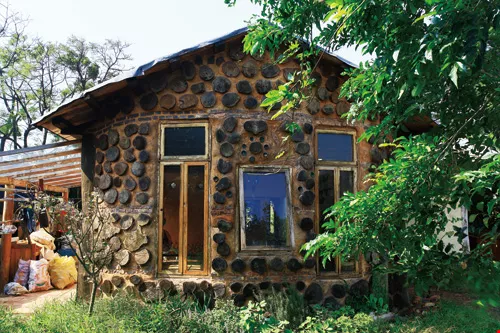
The"cordwood construction"of the east side of Li Daixian's future home has an appealing antiquated air.
At the beginning, because they were anxious to move in as quickly as possible, they wanted to figure out the cheapest and fastest way to set up house. Around that time Zhongren took notice of a horticulture greenhouse on the farm that had been standing for 10 years and still looked very sturdy, and he had a flash of inspiration. Spending only six months and NT$400,000, they constructed their own green-house of 30 ping (about 100 square meters).
Everywhere their home has that hand-made, ingenious feeling of DIY improvisation, from the counters made of wood and the juniper bathroom sink to the houseleek planted in old sneakers and flooring at the door that consists of a layer of concrete on which a pattern was drawn using a piece of bamboo before the concrete had set. The green surroundings and sunlight from outside percolate right through the black netting onto the ground, creating a beautiful interplay of shadow and light.
But aren't they afraid of high winds and storms? And isn't it awfully hot living in a greenhouse? Li laughs, being asked questions like these for the nth time. Over the last three years they have been through more than 10 typhoons large and small, she explains, not to mention earthquakes, and the structure is still sound. The pores of the greenhouse nets allow air to pass through, so that their home is no worse than any other in terms of heat except at mid-afternoon at the height of summer, when it does indeed get broiling. However, they always leave the front and back doors open, so that breezes pass through the interior. In winter, they keep warm with a fireplace they made themselves.
Right next to the greenhouse is a "natural building" whose basic structure is wood and clay-this is their future home, which is still under construction. This couple has gone about building their own home without any formal training, and they let their passion and imagination run wild. For example, the four walls are each made of a different material, partly as an experiment in the effects you can get from different materials and partly "just for fun."
The east side is made from cut logs and earth, known as cordwood construction. It marks a preliminary attempt based on information the couple have found in foreign magazines on natural buildings. They collected driftwood from beaches and, after cutting it into small logs, built the wall partly by stacking this cordwood and partly by filling space with earth packed with wood chips. The visual effect is arresting, and you can feel the wood breathing. The main materials for the other three faces are "burnt bricks" (bricks that are near the source of the fire in the kiln, emerging with uneven coloring), unbaked clay bricks, and rounded stones.
Because they don't want to see all the small factories just outside the farm when they open their door, they didn't set the house facing southwest, which is commonly done to avoid looking straight into the northeast monsoons winds in winter, but rather northeast. On the southern and western sides, they have used brick and earth respectively, which absorb heat so that in winter the house will keep warm, but which can also rapidly dissipate heat in the summer. Most of their materials are taken from nature-just for the wood and stone, they spent nearly a year collecting all they needed.
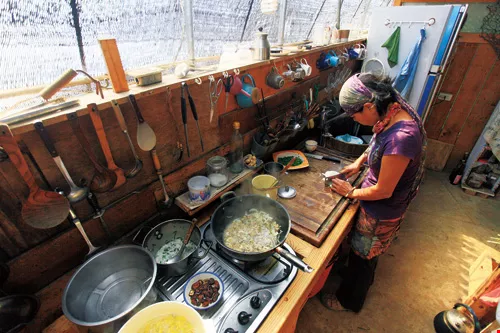
In their breezy and sunny"net-greenhouse home,"Li Daixian and her husband practice a natural, simple lifestyle. Pictured below are the kitchen and living areas.
This house of 30 ping in floor space and two meters in height is still not finished, though work was begun in 2007. The main reason is that once word started to get around about the couple's building their own home and they gained a measure of fame, they got a lot more projects for their workshop. Aside from giving their customers top priority, these two are believers in "the slow life"-they relish leisure and a measured pace-so they have only completed 70% of their future home so far. When they have finished it, besides filling it with furniture in a hand-made style, they will also install an eco-toilet, which composts waste into fertilizer, and in the kitchen they will put in an old-fashioned wood stove for cooking.
Meanwhile, in late October of 2010, Li Daixian and her older sister opened up a vegetarian cafe with a cultured ambience called the Light Woven Sea Cafe at the beach in Fangliao in Pingtung County. (Naturally, Windstar workshop designed and built the structure.). Li hopes that in the future Light Woven Sea can become a base for promoting natural eating and simple lifestyles, and also offer a space where small-scale organic farmers in Pingtung can sell their crops.
Having for many years been keeping up with the organization called "Lapis Lazuli Light," founded by natural therapy expert Lei Jiunan, and having taken many courses in the New-Age vein, Li feels that the world has already entered an "age of light." She hopes to be able to influence even more people to look after each other with light and love, and become mutual givers and work together to give something back to the world.
As if that weren't ambitious enough, Li Daixian has an even more far-reaching dream. She wants to get together with some like-minded friends and return to a Native-American-style tribal way of life, which is to say self-sufficiency, sharing surplus in common, and looking after the earth. She wants to recover the lost sense that was once had that the land is something to be treasured and respected.
From time to time these friends will hold gatherings next to the green-house, swapping home-grown foods and New Age ideas. Looking back over how life has evolved from her unpretentious desire to "get back to nature and have a simple lifestyle" to the fame and influence of the present, Daixian and her husband are sincerely grateful for the relationships and shared affinities they have found. And through encounters with all the people who come uninvited to see them, they discover ever more opportunities to share.
"Few things in life can be achieved just by an act of will, but I think that if you stay focused and keep the faith," she says with an easy smile, "in the end beautiful flowers will blossom!
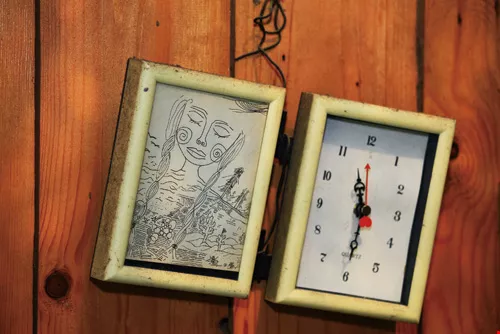
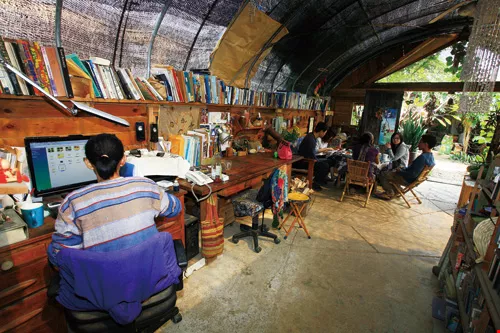
In their breezy and sunny"net-greenhouse home,"Li Daixian and her husband practice a natural, simple lifestyle. Pictured below are the kitchen and living areas.
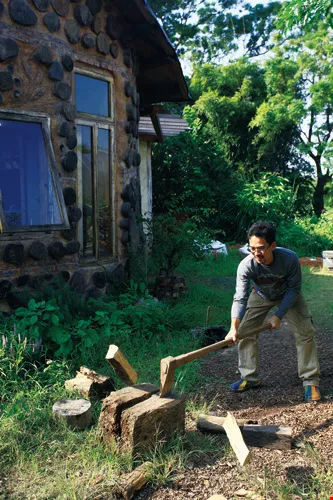
With winter approaching, Li Zhongren splits wood for the fireplace.
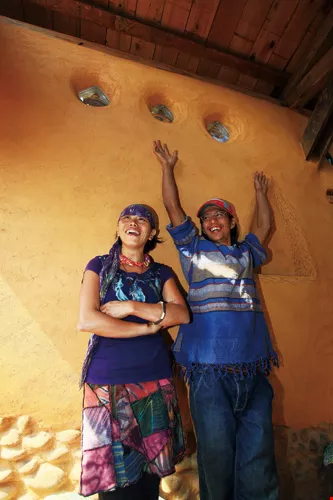
Li Daixian (left) and Waiji, a 27-year Bunun man who signed himself up to help Li construct her home, both see house-building as being like a game in which you never stop having fun.
@List.JPG?w=522&h=410&mode=crop&format=webp&quality=80)


