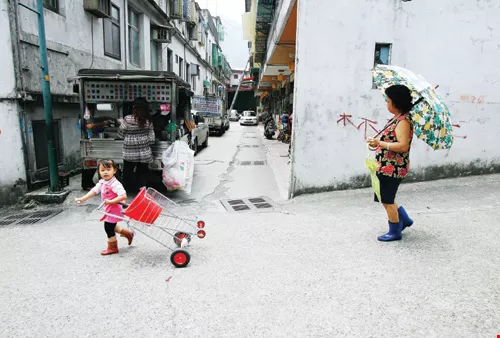
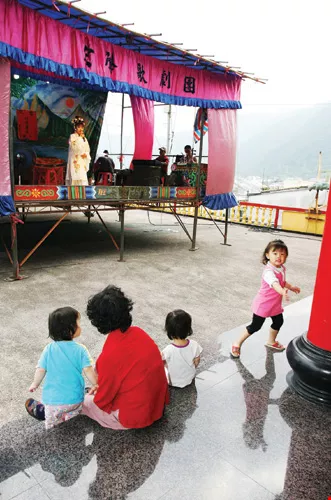
"30 years have passed since we moved away from Kueishan Island, but every night I still dream about our life there."--An old lady's nostalgia.
If the Taipei 101 building is the symbol of Taipei City, then Kueishan Island, located off the northeast coast of Taiwan, is the spiritual symbol of the people of Ilan. Writer Huang Chun-ming captures this feeling in verse:
"Kueishan Island, / Every time when the children of Lanyang leave on the train / They look at you through the windows. / It's always hard to know whether the sadness in the air / Is yours or theirs."
These few lines portray the deep affection for Kueishan Island of the Ilan people, many of whom have left their hometowns to go to the big city. For those who once lived on the island itself, the memories are of course much deeper. The ocean forms an invisible but unbreakable bond between the island and its original residents, who were moved to Tahsi fishing port in Toucheng, Ilan County, some 30 years ago.

Remembering
"The people of Kueishan Island can't live without it!" Huang Chen yu, a 68-year-old Toucheng resident who moved off the island at age 33, says firmly. "I was reluctant to leave, but at that time there was no water or electricity, and there was some strange problem causing babies to die. So we had to move away for the good of our families. I've been living on mainland Taiwan for over three decades, but every night I dream about our life on Kueishan Island," says Huang emotionally.
"In 1974, we had to leave our home for the sake of our children's education. Who would have dreamed that the following year it would be re-zoned as a restricted military base. I couldn't go back to the island for 20 years," says Chien Ying-chun, the head of Kueishan Village. After complaining at length about government fisheries policies, when Kueishan Island is mentioned by some of the former residents, the 56-year-old Chien's stern expression relaxes into softness.
Many people moved out to provide a more secure future and better marriage prospects for the younger generation. Because the island lacked medical facilities, when someone was seriously ill and the weather was bad, it was impossible to get to the mainland, so there was nothing to be done for the patient. In addition, there was only an elementary school, so for high-school education and above, people had to leave home and cross the sea to Toucheng. This was a big financial burden. Some of the young women went to Toucheng to study, and then stayed to work and eventually to marry. As a result, the young men had little opportunity to meet women and begin a family. This was another reason why the whole village moved out.


Moving an entire community
However, the overwhelming reason that forced the residents of Kueishan Island to make up their minds to leave their native home was the uncontrollable force of nature. In 1970, Kueishan Island was hit by a number of big typhoons. The entire population was cut off and had no food supplies for two weeks. And then in 1972, there was a huge fire that left 56 people homeless.
After this series of natural disasters, it was suggested that it might be better for all if the whole village was moved away. Following negotiations with the authorities, in 1977 the Provincial Department of Civil Affairs granted loans for the residents, and built 106 apartments in Tahsi for the more than 700 people to live in. It was originally called the Jentse Community, but in 2001, the name was changed to Kueishan Village.

The residents of Kueishan Village have lived in the fishing port of Tahsi for 30 years since the entire population of the island moved to Toucheng, Ilan. The original number of some 700 residents has increased to more than 200 households with over 1000 people, 96% of whom are still fishing for a living.
Tahsi--a new home
Tashi is located in northern Ilan, ten kilometers from the northwest corner of Kueishan Island. On the right side is the old port, and on the left is the new. The new port was built only two years before the entire population of Kueishan Island moved in. The new arrivals contributed their skills to the local fishing industry and helped to make the new port the best place in Toucheng to find fresh fish. The old port came to be used for repairing the fishing fleet.
Today, 30 years after the move, the population of Kueishan Village has grown to more than 200 households and over 1000 people. Ninety-six percent of the residents are still fishing for a living. In fact, it is the only place among the fishing villages of the northeastern coast that still has a high percentage of fishermen in the population. Since 2000, Kueishan Island's tourist industry has developed, and a number of the old Kueishan Island fishermen now run the tourist boats to go whale watching or take visitors to the island. The tale of Kueishan Island has spread to fascinate visitors from all over mainland Taiwan.
The call of the sea
Kueishan Village is not difficult to find. Traveling along the coastal highway in Tahsi, there are fields as far as the eye can see, then we notice a sign pointing to the fishing port. Turning into a side road and passing under a ceremonial arch, we find our goal. From the entry, we drive uphill alongside gardens and carved walls on both sides. One side depicts dolphins swimming freely in the waters about Kueishan Island, and the other shows fishing boats working at sea. These reliefs are to ensure that the descendants of the island people never forget where they came from.
On a clear day, the residents of this community can clearly see the entire shape of Kueishan Island from the front of Chenglan Temple. And the sight of it makes them so homesick that they feel a pounding in their hearts like the breaking of the sea on the shore.