Fourteen Years of Destruction--How Mainland Chinese Experienced the War
Jackie Chen / tr. by Phil Newell
October 1995


September 18, 1995. In Taiwan it is the time of year when Mid-Autumn Festival has just gone by and the summer heat is giving way to fall. September 18, 1931. In mainland China, it was also just past Mid-Autumn Festival. But the Chinese people were facing an unprecedented crisis. Japan's aggression, which would bring on fourteen years of war, had begun.
Coming back to September 18, 1995, the papers for that day have only a few scattered articles about the "September 18 Incident" which marked the Japanese occupation of Manchuria. (This is known to Chinese as the 918 incident.) It seems all that has faded like the mist.
Are those memories really flying away? Looking back at those days, perhaps we can use media accounts and interviews to imagine the wartime experience of blood and tears that mainland Chinese endured.
On October 2, 1931, in a report filed from Wuhan, where there had just been a flood, the Dagong Bao of Tianjin described Mid-Autumn Festival in the wake of the 918 Incident: "The streets present a desolate picture. Refugees are everywhere, and coffins can be seen all around. The government has no money, and the people have no money, so even the problem of food has been left unsolved. Who has the time or the money to even think about moon cakes or entertainment this holiday? And on top of it all, the news has arrived that Japan has occupied Shenyang. Patriotic citizens feel as though they have been slapped in the face. People believe that this is not the time to seek personal happiness, and they are running here and there calling on one another to act to save the country. As for the government, it ordered that all entertainment cease for three days beginning on the 19th, that all flags be flown at half mast, and that local military forces organize themselves and march through the streets...."
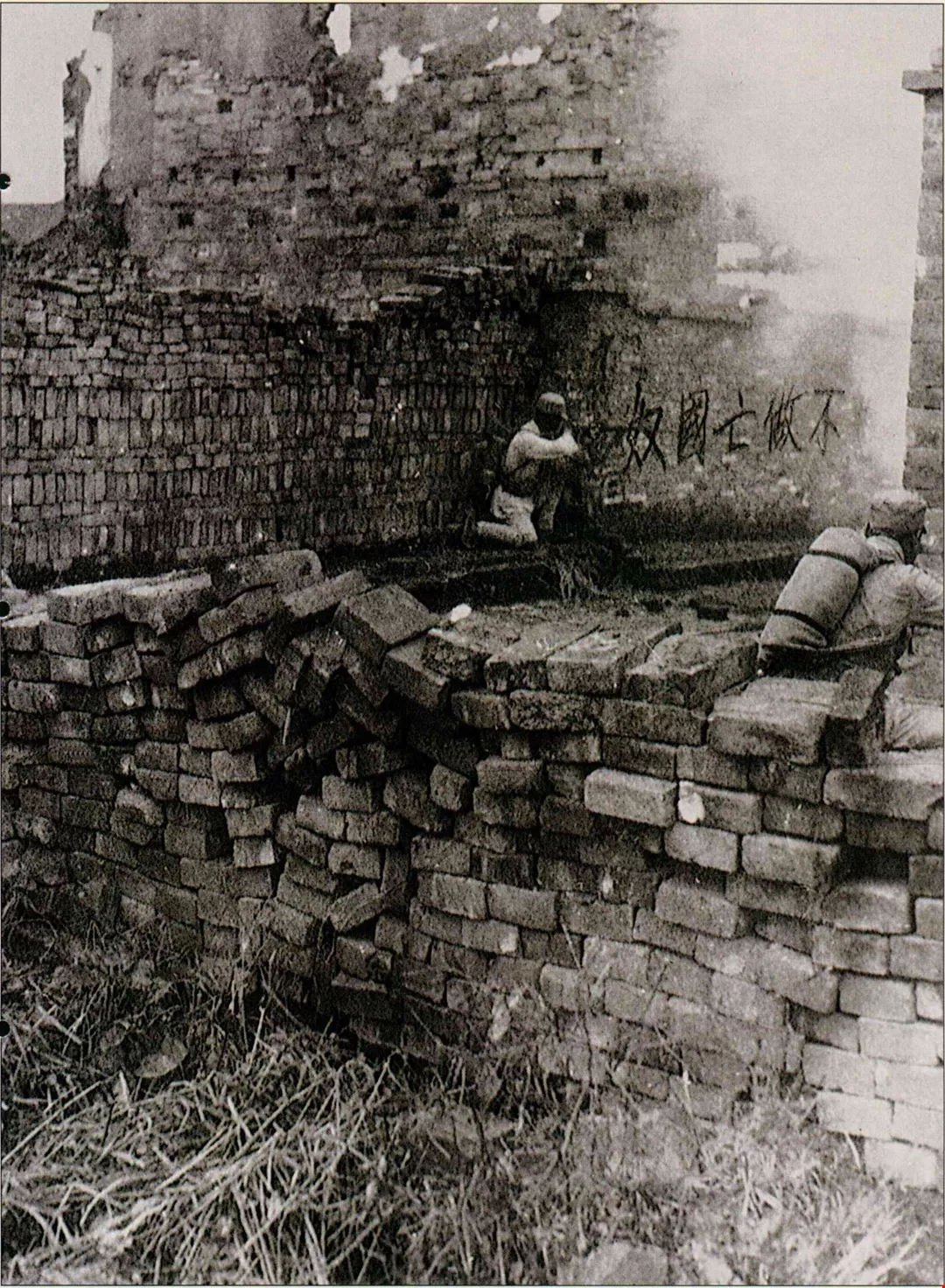
The photo, from December 22, 1939, shows house-to-house fighting during the Japanese advance in northern Hunan. The characters on the wall say "Refuse to Be a Slave from a Destroyed Nation." (photo courtesy of Echo magazine)
A slap in the face
"A Mid-Autumn Festival Amidst Disaster" is how newspaper headlines described China's tribulations. On September 18 of that year, the Japanese occupied Shenyang and then proceeded to take Changchun, Yingkou, Andong, Jilin, and other places. By February of the next year all Manchuria was under their control. In March, the puppet state of "Manchukuo" was established. These events marked the first phase of 14 years of Japanese aggression against China.
Reporters from Peking and Tianjin who traveled to Shenyang filed reports like this one: "The train arrives in Huanggutun in the afternoon. There is no Japanese military presence at the station. Refugees crowd the station inside and out. Many are small business people with children in tow. The most pitiful sight is small schoolchildren, unaccustomed to being out in public, huddled against the walls, crying. Most of those fleeing are alone. They are unable to take their property with them. The rail cars that stop in the station are quickly jammed with people, regardless of whether or not the cars are scheduled to leave the station right away. Most people put their hopes in the rail cars, thinking that each step further from Shenyang marks one step further away from danger...."
From September 20 to the end of the month, the newspapers were filled with illustrations of the "refugee areas," depicting the destruction along the roads, which were now lined with beggars. Other stories told of refugees being robbed, of people killed for refusing to give Japanese troops a ride, and of old women and young girls shot by the Japanese. There were also photographs testifying to the tragedy--a bombed-out Chinese military encampment, surrendered Chinese rifles being collected by the Japanese, Japanese patrols opening the gates into a newly-conquered city, and so on. One newspaper carried a "Joint Tearful Pledge to Our Fellow Countrymen" placed by an alliance of schools.
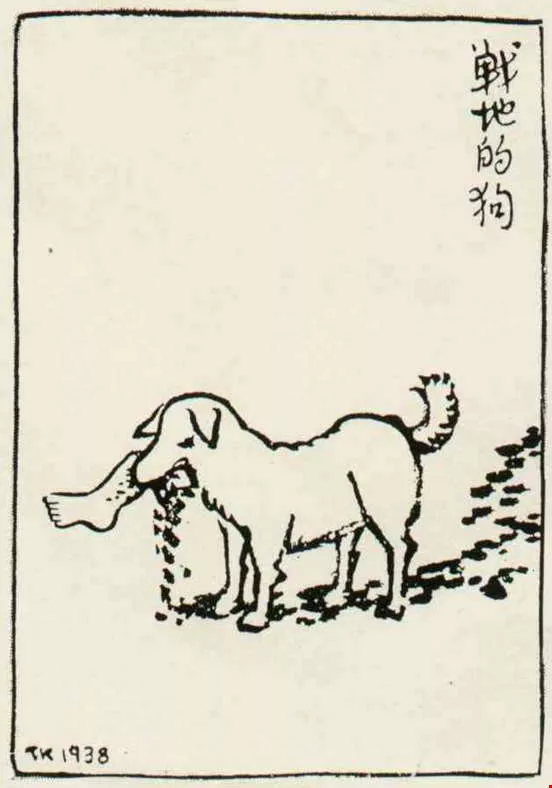
A front line dog--Feng Tzu-kai.
Japan's intentions become clear
With the three provinces of Manchuria digested, in 1932 Japan proceeded to threaten Shanghai, provoking the January 28 Incident. Japan then swallowed up Rehe (Jehol) and encroached into northern China proper. Between the 918 Incident of 1931 and the outbreak of full-scale war after the Marco Polo Bridge Incident in 1937, Japan occupied an area of China equivalent to the combined areas of England, France, Germany, Holland, and Belgium. Japan was chewing up China chunk by chunk. Finally, by 1937, the Chinese people could stand no more, and were left no choice but to fight.
The Tianjin Dagong Bao for July 9, 1937, had huge banner headlines reading "Chinese and Japanese forces clash at the Marco Polo Bridge; Japanese forces launch ferocious assault; Our forces meet them; No conclusive outcome as of last evening; Japan sending in reinforcements; Our forces vow to resist to the death." These headlines explain, in measured tones, the origins of the incident and its development.
An accompanying editorial on the same page refutes the Japanese claim that its forces were merely seeking out a missing soldier lost while "on maneuvers" and that the fighting started when Chinese forces "illegally" fired on Japanese forces.
"At this time," the editorial read, "the highest military official for Hebei was absent. Civil and military officials at all levels had been ordered to just stay in their positions, so they were even more cautious and restrained than usual. It is inconceivable that the local Chinese forces would have dared to spark an incident during the night maneuvers by the Japanese forces. In sum, this incident is due entirely to the recklessness of the Japanese military, which deliberately provoked a fight."
Headlines between July 10 and 14 declared, "Japanese forces ferociously assault the Marco Polo Bridge; Agreement broken, Japan escalates; Our forces heroically resist; Situation takes dramatic change this morning," and "Japanese military scheme now very clear; Full scale war appears inevitable." The tone of the news reports became increasingly assertive and gradually moved from measured description of events to the undisguised statement of the fact of Japan's "pre-meditated aggression."
There were also reports of the situation in the battle for the bridge. "(Central News Agency, July 10, Peking) Local residences are locked up tight as people hunker down. Japanese forces have launched an artillery barrage; they are targeting the seat of the county government. Altogether the Japanese have shelled Wanping County three times. Japanese losses are not clear, but have been about the same as on our side. People are terrified, and are unwilling to talk with anyone from outside the county."
"Special Supplement: What It's Like to Be There" sections of newspapers focused on things like the county government offices (destroyed by the Japanese), the happenings inside police headquarters, boarded-up Peking Street, wounded soldiers, Red Cross workers comforting troops at the front, and primary school children soliciting donations for the army.
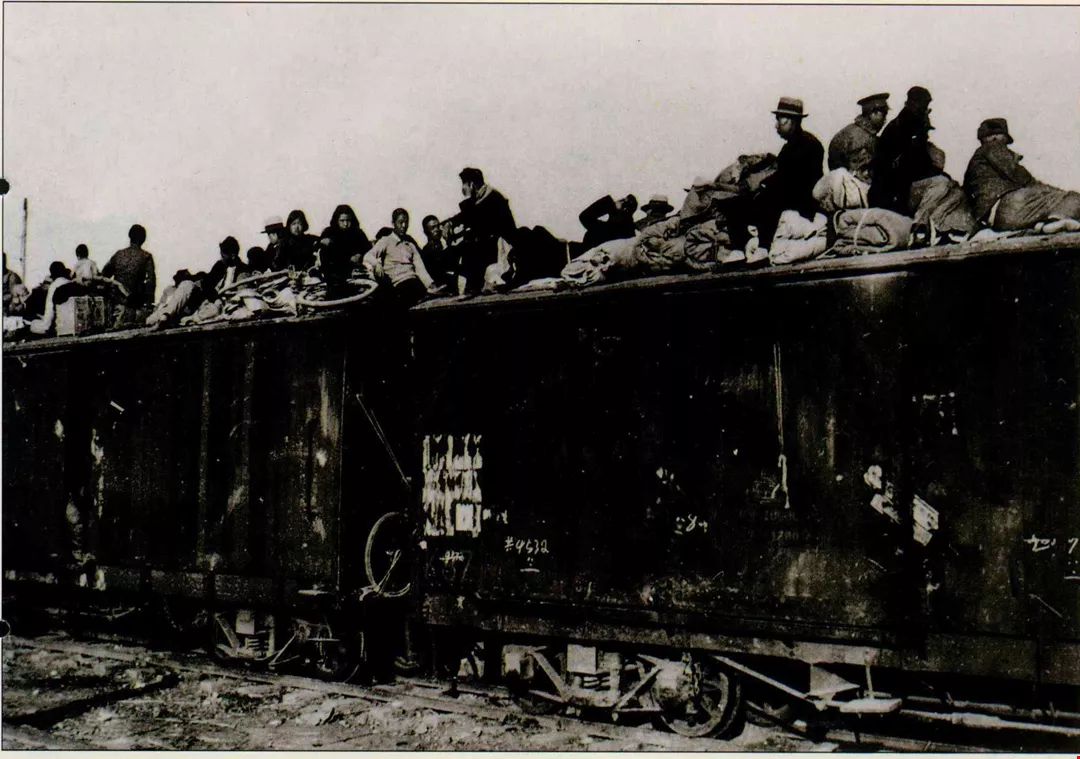
Almost all Chinese during the war had the experience of being forced to flee destruction. (photo courtesy of the Kuomintang Department of Party History)
An inescapable war
After the Marco Polo Bridge Incident, Japanese forces took several lines of advance, striking into the heart of China from the north as well as through Shanghai, Nanjing, and Hangzhou. From the second half of 1937 up until the Battle of Nanchang in April of 1939 was the most difficult period of the war for Chinese. "The Japanese took whatever they wanted, and kept it," explains the renowned historian Li Tung-fang.
Studies done since the war have shown that there was a huge disparity in military capabilities between the two sides. "It was like a match between a heavyweight and a featherweight," is the metaphor adopted by Li. One side had a navy approaching two million tons, an air force of 2,700 aircraft, and a well-trained and well-equipped army. The other side had only 59,00O tons of fighting ships, 305 aircraft, and an army without tanks, hand grenades, or heavy artillery. "It is very obvious that China was not prepared to fight this war, and should not have fought it. But it could not avoid a fight, because Japan gave China no choice." Li concludes.
Skimming through the media from those days, one can feel the manifest anger of Chinese at having been forced into war. Dongfang Magazine, a journal founded in Shanghai and aimed mainly at intellectuals, specially began publishing Dongfang Pictorial after the Marco Polo Bridge Incident to carry photographs of the war.
For example, one issue was devoted to "The Battle of Shanghai One Month On," which covered the ongoing fighting in August of 1937. "This month, the enemy deployed more than 200 aircraft and 70,000 crack troops, boasting that they would scatter our units in a few days. But the Japanese have thus far suffered 30,000 killed and wounded, and have advanced only 12 kilometers." So ran the text of the magazine, while the photos either emphasized the heroism of the Chinese forces ("Our troops shooting down an enemy plane" or "A heavy machine gun in action") or else depicted military leaders weighing strategy ("The general staff discusses battle plans with division commanders").
Looked at from the point of view of the present day, the reports in Dongfang Pictorial were clearly aimed at stirring up nationalist feeling and hatred for the enemy, with the evident goal being to appeal to people's loyalty and to bolster morale.
Take for example "The trauma for Chinese children" published in October of 1937. The central photo was of a young girl whose arm had been blown off in a bombing raid, while the caption read, "Today, who-knows-how-many otherwise happy and adorable Chinese children will be bombed by the Japanese... The Japanese have gone insane, and are slaughtering defenseless women and children... Mothers of the world arise! Everyone arise and put a check to this inhumane, barbaric hand of slaughter." The devastating photo below the text shows another young girl, also a victim of bombing, with cerebral fluid flowing out of her head.
Even Dagong Bao, which had always spoken in a prudent, cautious tone, was moved to extreme language. After the occupation of Nanjing, when Japanese forces wantonly slaughtered civilians, the paper ran an editorial entitled "Take Revenge for Our People!" "After the enemy occupied Nanjing, they began slaughtering refugees and raping women. Japan wears the mask of a great nation, and says that it is at war only with the anti-Japanese Chinese government, and not with the Chinese people. Yet such slaughter and abuse of innocent women, from a modern civilized point of view, can only be called wanton murder and barbarity. What should our government, indeed what should all of us, do to take revenge for our people?"
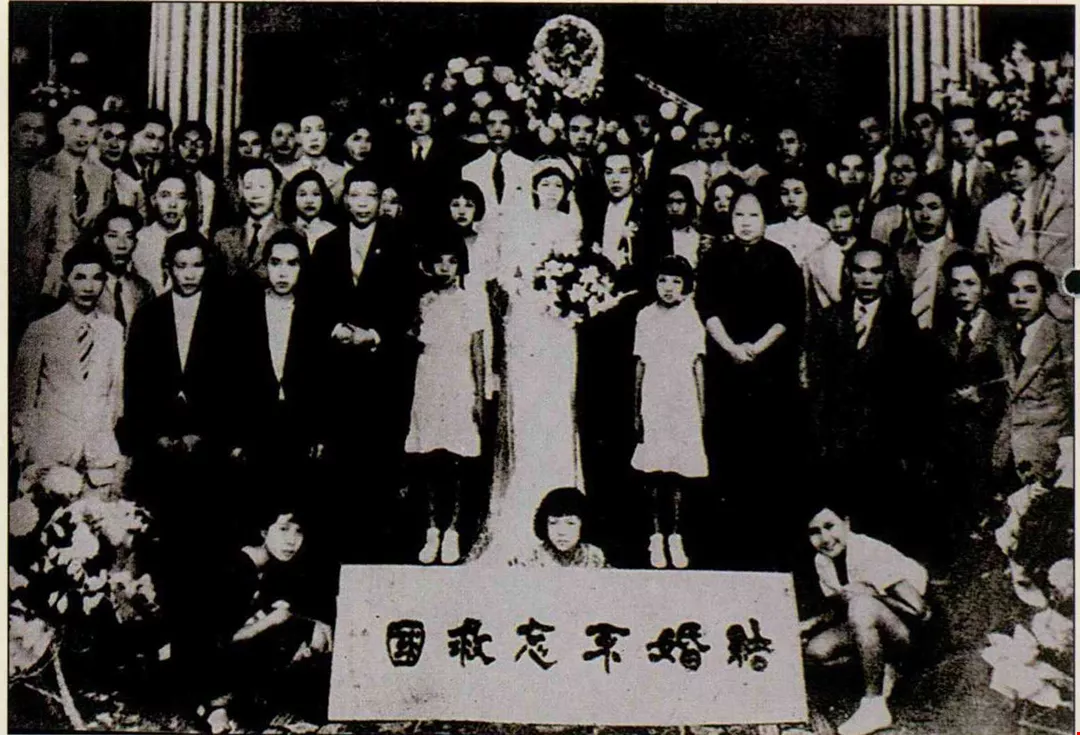
Even at weddings people did not forget the nation, and often donated their wedding gifts to the country. (photo courtesy of Echo magazine)
Relying on heaven and earth
Life is priceless, but war is ruthless. These stories may look sensationalist today. But for the people who went through those events, they are simply statements of fact.
"If it weren't for the Japanese, we wouldn't have spent the last four decades away from our homes," says 72-year-old Lin Chao-hsien, a veteran who now drives a cab for a living. He lived through the Changsha and Changde campaigns, personally witnessing Japanese troops rape and murder Chinese women. "They didn't let a single one go, from 11 years old to 71," he says, grinding his teeth in anger. So pained is he by these experiences that even today when someone gets in his cab and speaks Japanese, he asks them to please get out of the taxi. "It's not that I want some kind of revenge. It's that it reminds me of those days and tears at my heart," he explains.
Chang Ming-hai, now living in a veterans' home in Panchiao, was a guerrilla fighter in Henan. When you mention the harshness of the war and the cruelty of the Japanese, he is overcome by tears. "We had no overcoats in the winter, and we went off to fight wrapped in old rugs. Often by the time winter supplies arrived it was summertime," he recalls. They frequently didn't sleep at night, either because they were on an operation or on patrol. They ate what they wryly called "eight treasures congee" [a popular Chinese dish with eight ingredients], which in fact was just a soup made from unhusked rice and contaminated with all kinds of dirt and grime. "We didn't even have time to sit; we had to eat on the run all the time." He says that this kind of life was really brutal.
With bitterness in his voice, Chang Ming-hai relates that each time the Japanese left after being stationed in a village, "the rice grinding wheel was always filled with human excrement the Japanese deliberately left there."
The author Chang Fang has written that the war was everywhere. Those living in the countryside had only to hear the bark of a dog and they would get dressed, sling their belongings over their shoulders, and flee. The Japanese often launched night raids in an attempt to catch armed bands of Chinese. "A Japanese military sweep through the countryside is composed of bayonets, a Japanese flag, military dogs, searchlights, vehicles, and the constant sound of bitter cursing," he wrote. Years later, Chang was still frightened when he saw such images in anti-Japanese posters from the war.
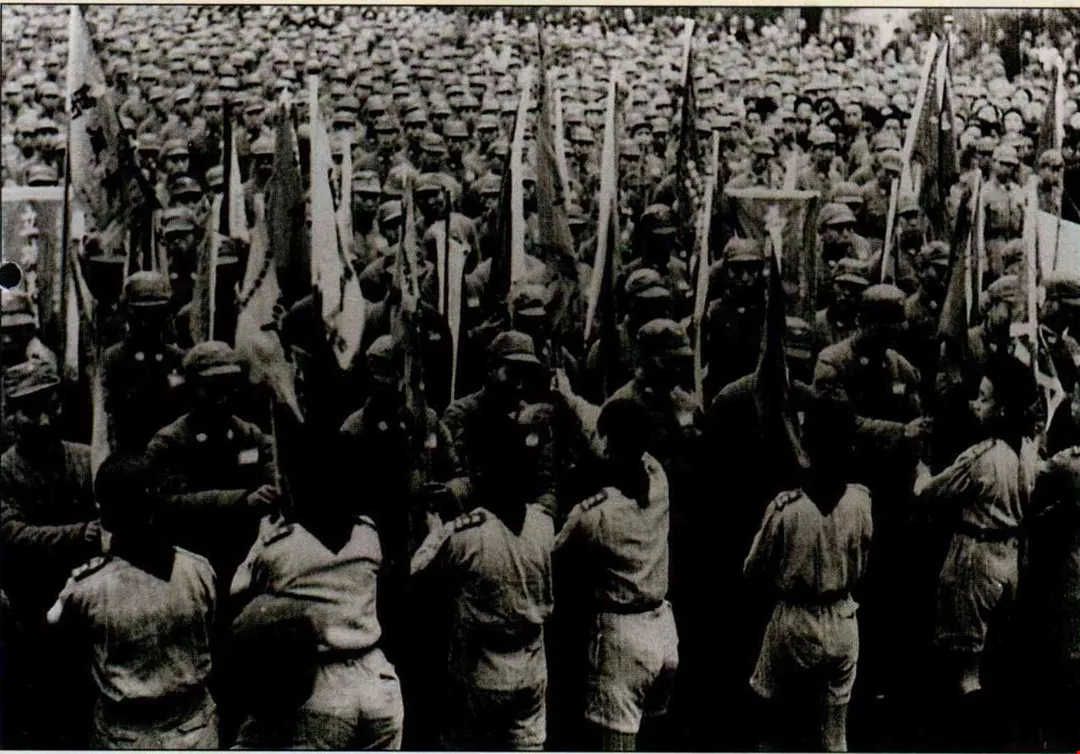
Near the end of the war Chiang Kai-shek raised the slogan "100,000 youths make 100,000 soldiers," and many young people responded by throwing down their pens and taking up swords. (photo courtesy of the Kuomintang Department of Party History)
No distinctions
The second stage of China's War of Resistance Against Japan stretched from the Suizao Campaign of May 1939 to the Changde Campaign of March 1944. In this stage, the Chinese strategy to "trade space for time" began to take effect, drawing Japan into a quagmire. It was in these years that the capital shifted from Nanjing to Wuhan and finally to Chongqing (Chungking), in the rear area.
In those days, there was no distinction made by place or age--everyone was in the war together. From the cities to the villages, the whole of society was mobilized. Flipping through the advertising pages of those days, most of the ads are for military academies and cadre schools recruiting personnel. There are virtually no commercial adverts. What ads there are often include patriotic sentiments even as they push essential wares for the war effort: "The nation is in peril; our shoes will be specially priced." On one front page, right next to the newspaper name, is an advertisement calling on everyone to participate in "A Mass to commemorate the soldiers and civilians who have given their lives."
In that era when the nation's existence was at stake, newspapers could no longer simply be tools for the transmission of information. They also took on the responsibility of spurring loyalty and sacrifice for the nation.
Take for example the editorial "Calling on intellectuals to go into the countryside" in the Central Daily News: "In the countryside are countless millions of peasants waiting for us to give them some knowledge. There are countless millions of children waiting for our instruction and guidance. And there are great numbers of young people who have left school and are drifting and need education, and of drifting university students who need leadership. Let us go down to the countryside in an organized way. Anytime and anyplace, we can lecture, put on performances, sing, run popular schools, issue mimeographed news sheets, and stimulate the patriotism of our rural citizens."
Or take this editorial, entitled "Respect wounded soldiers," from Dagong Bao: "Everyone in the rear areas should be doing something to help the resistance. And the simplest, easiest thing to do is to give money. Of course, giving money away has never been seen as easy, but today, in the face of a violent, unrestrained enemy, who really has the right to personal property, the right to say that this money belongs to him? To put things in the most humiliating, harsh way, should someone unable to protect his beloved wife or sisters be thinking about property?"
Historian Hsu Chuo-yun has written that the War of Resistance Against Japan was an important stage in "the molding of the Chinese people into a coherent whole." "The nationalism of the Chinese people is not constructed on theories; it came out of the mouths of Japanese artillery pieces, and was congealed by the blood of Chinese. The viciousness of the Japanese military, battlefield artillery barrages, bombs dropped by planes, sweeping hunger and disease, death.... these are the experiences that have made Chinese nationalism strong."
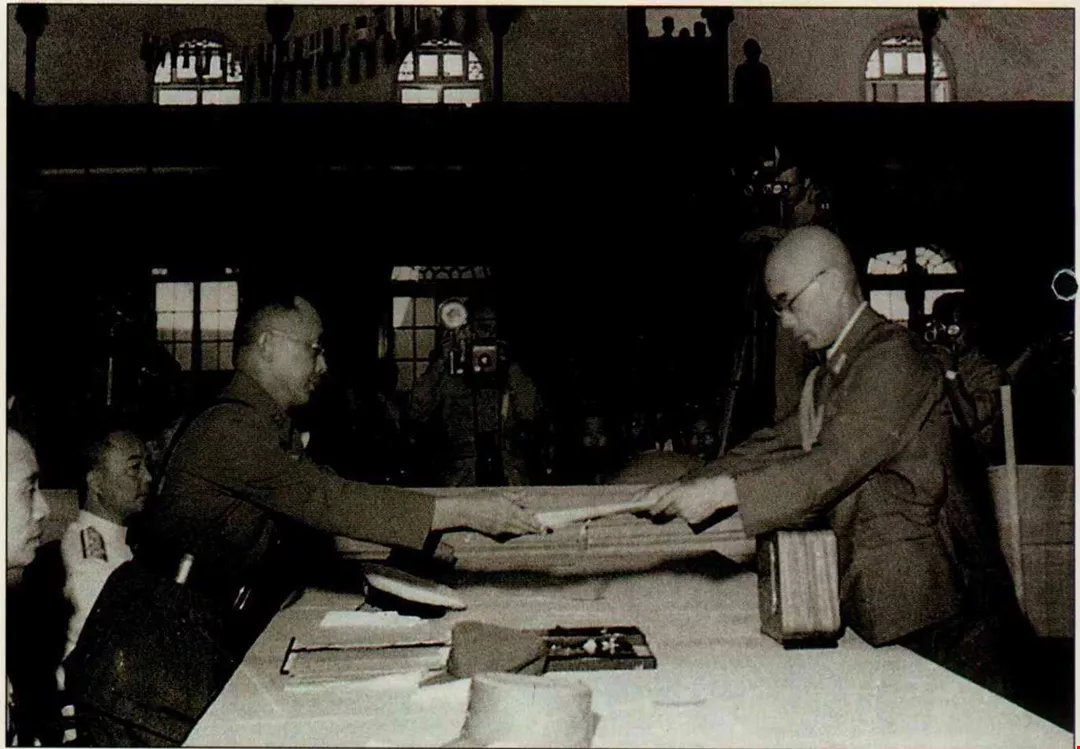
1945: The chief of staff of Japanese forces in China surrenders to Ho Ying-chin, representing the Commander in Chief of the China Theater. (photo courtesy of the Kuomintang Department of Party History)
A few good men
In those days it was also popular to sing resistance songs, like "The Flag is Flying": "The flag is flying, the horse is snorting, gun on my shoulder, knife in my belt, blood boiling like a crazy tide... A good man will pay his dues to his country this morning...." The lyrics and music were published in the newspaper for everyone to learn.
Drawings were another common form of expression. A publication called Collected Illustrations of the War of Resistance, devoted to drawings and cartoons, includes pictures like "Bombing only makes us more angry, not despondent!" and "The tyrants have eradicated our hometown!"
Some literary works also reflected the times. Take for instance the poem Fight Our Way Back Home: "Under a crescent-shaped moon, the girls are out strolling together/ You go to Manchuria, I'll go to Hunan/ Sorghum covers the fields, the grains shine like gold/ When the war is won, we will be filled with joy."
Or read "Deep Melancholy--After Visiting Orphanage Number 2." "The fields are covered with rapeseed flowers like a yellow carpet. As I am chatting and smiling, I am startled by a cry of 'Attention!' amongst the children. Who can tell the girls from the boys? They all look equally tough. But in their little hearts is branded a deep vengefulness. They cannot forget the love of their parents, or their parents' voices that no amount of money can bring back. Their mother's touch is now but a fantasy, something they can only experience in dreams.... I ask you Japanese, is it possible you have no fathers and mothers?"
This type of material resonates deeply with many people who went through those days. An old gentleman named Mr. Kao, who lives in housing for families of the military and veterans in Taoyuan, is a Han Chinese from Xinjiang. He saw young intellectuals marching and giving speeches in the streets of Dihua (Urumqi). He remembers how beautiful the students at the girls' school looked as they called on everyone to boycott Japanese goods and kill the enemy. Then only a primary school student, he was deeply impressed with their determined and firm tone of voice. At many gatherings of old veterans, the old songs like "The Flag is Flying" are sung again; amidst the singing, something of the old spirit lives again.
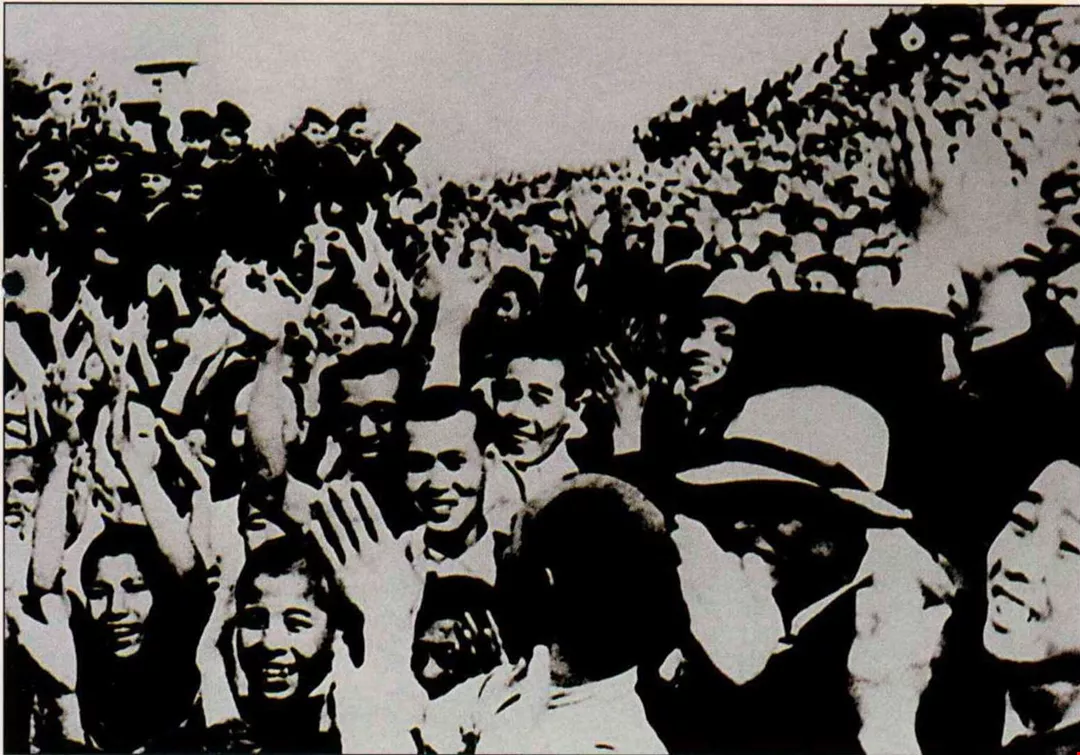
Residents of Manchuria celebrate victory over Japan in August 1945. (photo courtesy of Echo magazine)
War without victory?
In April of 1944, the war was already in its last phase, but Chinese soldiers still faced a hard fight. In August of the same year, Chiang Kai-shek raised the slogan "100,000 youths make 100,000 soldiers." At that time, a large group of students in high school and college put down their pens and raised up rifles, changing the Chinese tradition that "a man of quality is not used as a soldier just as the best iron is not used for nails." "That was definitely a radical shift in old customs," says Fu Tsung-mao, one of those young men and formerly political vice minister of the Ministry of Examination.
So many people left their homes and families. One of those was Chu Chien-chang, now head of academic affairs at National Chengchih University. He remembers that when he decided to join the army he asked his mother if she would object. She replied, "Why should I object? You can't stay with me forever." In those days, it seems, loyalty to the country was always the first priority.
From May to August 1945, China recalled its elite troops from Burma and began a general counteroffensive aimed at Guangzhou, Shanghai, and Peking. China's military was stronger and morale was high. Chinese forces had retaken Cangwu and were preparing to advance toward Guangzhou when the United States suddenly dropped the atomic bombs on Hiroshima and Nagasaki. Japan surrendered on August 15. The Second World War and the War of Resistance Against Japan ended simultaneously.
When the atomic bomb was dropped, Dagong Bao welcomed the American decision with an editorial entitled "A new era has begun." It said in part, "The atomic bomb has greatly shortened the war and greatly reduced the loss of human life. Although the bomb is a killer, it is also a blessing that ensures peace among mankind." When Japan formally capitulated, Dagong Bao used extra-large bold print to announce "Japan Has Finally Surrendered," bringing the good news for which people had waited for so long.
Ironically, the news traveled more slowly to Japanese-occupied areas than to Chongqing. The August 15 edition of Shanghai's Shen Bao had as its lead a story from the Japanese military claiming success for a commando raid. It was only the next day that the headline had suddenly become, "Emperor Announces Peace Proclamation." The story mentioned nothing about surrender. However, the editorial cautioned the people, "In times of great change, it is necessary to remain calm and tranquil."
With the victorious ending to the War of Resistance Against Japan, the 14 years of bitter struggle that had begun with the 918 Incident of 1931 seemed to be at an end. Newspapers were suddenly filled with announcements of marriages and engagements to celebrate victory. There were advertisements declaring "Cheer the Victory and Welcome Our Veterans Back Home."
But amidst all the joy and tears, few would have guessed that China had not yet escaped from turmoil. The Chinese, unified in the war against Japan, would soon turn against each other. And many people, after a short breathing spell, would again find themselves displaced into another era of hardship.
[Picture Caption]
p.22
This 15-year-old Chinese boy left his schooling and took up arms just prior to the Battle of Wuhan in March of 1938. This photo, taken by Robert Capa, was the cover of the May issue of Life magazine. The cover story was "Defending China." (photo taken from Life magazine)
p.23
The photo, from December 22, 1939, shows house-to-house fighting during the Japanese advance in northern Hunan. The characters on the wall say "Refuse to Be a Slave from a Destroyed Nation." (photo courtesy of Echo magazine)
p.24
A front line dog--Feng Tzu-kai
p.25
Almost all Chinese during the war had the experience of being forced to flee destruction. (photo courtesy of the Kuomintang Department of Party History)
p.26
Even at weddings people did not forget the nation, and often donated their wedding gifts to the country. (photo courtesy of Echo magazine)
p.27
Near the end of the war Chiang Kai-shek raised the slogan "100,000 youths make 100,000 soldiers," and many young people responded by throwing down their pens and taking up swords. (photo courtesy of the Kuomintang Department of Party History)
p.28
1945: The chief of staff of Japanese forces in China surrenders to Ho Ying-chin, representing the Commander in Chief of the China Theater. (photo courtesy of the Kuomintang Department of Party History)
p.29
Residents of Manchuria celebrate victory over Japan in August 1945. (photo courtesy of Echo magazine)


@List.jpg?w=522&h=410&mode=crop&format=webp&quality=80)


