

Aaron Kwok and Faye Wong, known respectively in the Chinese pop world as the King and Queen of Heaven, each recently raised a stir when they arrived in Taiwan to promote new albums. However, what hit the headlines was not titillating details of their private lives, but the fact that the first thing they wanted to do in Taiwan was to eat mala hotpot.
Just what attraction does mala hotpot hold? As the cold of winter draws in, what better time to fathom the mysteries that lurk in the depths of the hotpot. . . .
Over the last decade or so, hotpot has taken Taiwan by storm. Hotpot eateries have sprung up everywhere, and the styles and flavors available have grown ever more diverse. All kinds of hotpot-style dishes have grown popular in Taiwan, from traditional Beijing mutton hotpot and northeastern Chinese pickled cabbage and pork hotpot, to mala hotpot, Japanese shabu-shabu, Korean spicy pickled cabbage hotpot, Southeast-Asian hotpots from Vietnam and Thailand, and even European cheese or chocolate fondues.
But why has only mala hotpot-with its flavor which combines the ma or numbing effect of Sichuan peppercorns with the la or spicy taste of chilli-found such remarkable favor with today's glitterati?
Looking at today's fashion trends, it doesn't seem hard to find an answer. Not only do stars up on stage do everything they can to make their performances "spicy," but guys and gals in the street also dress, talk and act spicily, and of course have to eat spicily too. Naturally mala hotpot, with its power to make brows tingle and mouths blaze, is the only hotpot to fit the bill.
But do they realize that fashionable mala hotpot is an old downhome dish from Sichuan in mainland China? Tracing back its history, we find that mala hotpot was once called "tripe hotpot," and developed from the mutton hotpot of north China, in which thin slices of mutton are quick-boiled at the table by dipping them into the simmering stock in a "hotpot."
KMT candidates Lien Chan and Vincent Siew have a lot of experience in government and enjoy powerful backing. The Lien-Siew ticket is among the leaders in public opinion polls. (photo by Diago Chiu)
Author Li Chieh-jen describes: "Water-buffalo tripe hotpot originated in Jiangbei, across the river from Chongqing. Hawkers bought water-buffalo offal such as liver and tripe, which they cut into small pieces. On clay stoves on their stalls, they heated a bubbling sauce of chillies and Sichuan peppercorns in galvanized steel basins divided into several compartments. Laborers working near the end of the river bridge would gather round the stalls to eat, each picking a compartment in which to scald the slices of offal before eating them. . . . It wasn't until 1934 that this dish appeared in a more upmarket form in a small restaurant in Chongqing itself." However, roadside mala stalls remained very popular with ordinary people, and are still widespread today in southwestern Chinese provinces such as Sichuan and Yunnan.
Why water-buffalo offal? "The reason was very simple," says TV chef Liang You-hsiang: "Nobody wanted it, so it was dirt cheap!" Liang, who often travels to mainland China to conduct interviews, has tried the street-stall version of mala hotpot sold in Sichuan. "The stalls are similar to the ones in Taiwan selling salted crispy chicken. They're very common all year round. The prices vary according to the ingredients, but they're mostly very cheap-for between RMB10 and 20 you can really eat your fill."
Liang says that what makes these stalls special is that the vendors do not change the soup between customers. As all kinds of different meats and vegetables are scalded in the mala stock, it becomes ever more flavorsome. Thus experienced eaters do not go to a stall when it has just started up, but wait until the stock has become rich and thick before savoring the exquisite mixture of flavors.
After mala hotpot made the leap from the street to the restaurant table, it gained great popularity there too. In WWII, Sichuan was the base from which China's struggle against Japan was conducted. Many people from other provinces got to know Sichuan cooking, and thus it was elevated to the status of one of China's four leading cuisines. Mala hotpot made a particularly strong impression on people. Legend has it that the KMT intelligence chief, General Dai Li, once threw a 1,000-table tripe hotpot banquet as a reward for his officers and men.
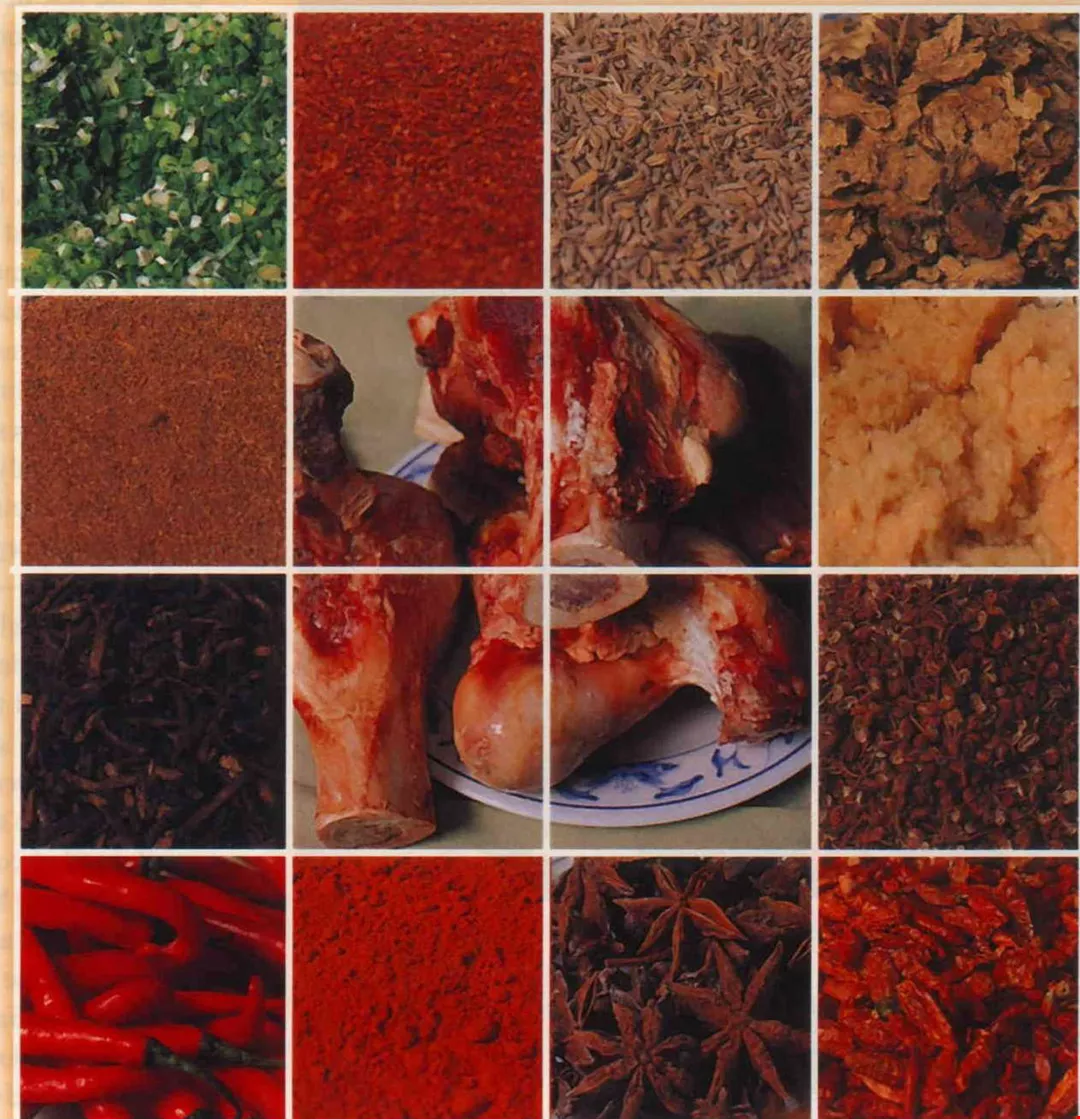
The art of making good mala hotpot lies in the elaborate preparation of the richly spiced stock. Each restaurant has its own recipe, and each is a closely guarded secret.
The husband of author Cheng Pao-chuan, who lives in France, is from Sichuan. On a family trip a few years ago, she first got to know the status mala hotpot enjoys there.
"The Sichuanese just love to eat hotpot-not only in the depths of winter, but even at the height of summer when everyone is pouring with sweat. Chongqing's famous tripe hotpot has become a high-class dish, with prices of RMB100 per person nothing out of the ordinary!" she says.
The Sichuanese passion for spicy food may be partly explained by geography, avers Cheng. In most of Sichuan the hours of sunshine are short and atmospheric humidity is high, so that even when the sun does come out, it is hard to get laundry dry in a day. "All four of us in my family have got used to the cool, dry climate of Europe, and before we'd been in Sichuan a week we all came out with eczema. Our hands and feet swelled up and were covered in tiny blisters. They didn't hurt or itch, but they were still very bothersome. But this problem quickly went away without any treatment, thanks to all the chilli-laden foods we were eating three meals a day, because [according to traditional Chinese medicine] chilli drives out 'dampness.'"
Cheng notes that "the fiery nature of Sichuanese cuisine depends on the 'three peppers'-Sichuan peppercorns, black pepper and chillies." But these are not the only spicy plants used, for ginger, spring onions, garlic, mustard and cloves all have their own individual pungent flavors, and even rakkyo and some kinds of Chinese white radish have a somewhat spicy flavor. The Sichuanese incorporate all these into their recipes, "so that although Sichuanese food is hot, its spiciness is neither 'dry' nor 'stagnant' [in TCM terms], but is stratified and harmonious; it not only arouses your tastebuds, but also stimulates the nerve cells of your whole body, in an all-round mobilization of the senses of heat, pain and taste!" The local tripe hotpot is based on a mala stock; the meat ingredients used are water-buffalo tripe, liver, kidney and tenderloin, along with chicken blood, duck blood, pig brains and pig liver; the vegetables are wood ear fungus, sliced lotus tuber, leeks and spring onions. "A thick layer of red oil floats on top of the soup, and in the bottom of everybody's bowl there is a pool of bright red chilli sauce. Eat that for lunch on an August day, and you sweat enough water to wash your face several times over," describes Cheng.
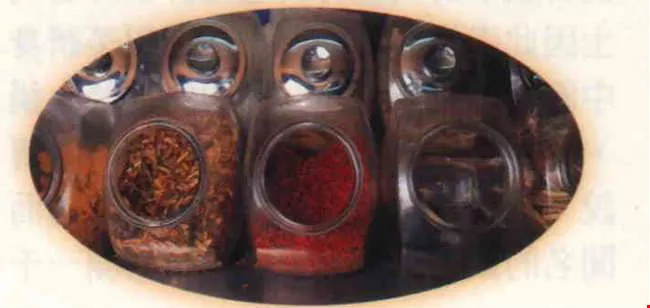
The ingredients to be scalded may vary, but the secret of mala hotpot is in the stock itself. Every restaurateur relies on his or her own "exclusive" recipe to attract clientele.
The preparation of the soup for mala hotpot has all the makings of a black art. The basic stock is produced by boiling beef bones for anything from 12 hours to two days to get out all the marrow. But the most important element is the way the spices are mixed to create the mala flavor. "The spices used in Sichuan include many pungent, aromatic and herbal ingredients, and each restaurant uses a different mixture, according to its own exclusive, secret recipe," says Liang You-hsiang, who notes that the number of spices may range from around seven to more than 20.
In Taiwan, mala hotpot with an authentic Sichuanese flavor is regarded as the best. One long-established restaurant, Ning Chi, now has 30 branches islandwide. Its founder Chiang Ning-ling hailed from Sichuan. When he started up in 1973, he sold Sichuanese beef noodle soup. But in his spare time he cooked up the hotpot he had often eaten back home, to serve to his homesick Sichuanese friends. Full of praise, they urged him to go over to selling hotpot instead of noodles. These friends and relations not only became his faithful customers, but by spreading the word to others, also brought in a larger clientele. Of course, the rich aroma which wafted through the neighborhood whenever the mala hotpot was cooking also attracted many patrons. Chiang's clientele expanded from his old customers, most of whom were mainlanders, to include many Taiwanese who had no tradition of eating spicy-hot food, but were attracted by curiosity.
Ning Chi Food Company general manager Liu Yun-chung, who went from regular customer to second-generation manager, still remembers how Ning Chi's fame spread far and wide in those early days. "Some customers even came up from southern Taiwan to taste mala hotpot, and because the premises were small, with only ten tables, and the opening hours were short-only six hours lunchtime and evening-there were almost always long queues, like the ticket queue outside a cinema. It was an extraordinary sight."
In those days many government officials and film and TV actors were mainlanders, and many had vivid memories of eating mala hotpot back in Sichuan. They became the main clientele of mala hotpot eateries, and their most efficient promoters. This may be why there is such a close affinity between mala hotpot and the entertainment world. Not only do many performers love hotpot, but many have even become hotpot entrepreneurs. The well-known hotpot restaurants Tianlazi and Lan Baobao are examples.
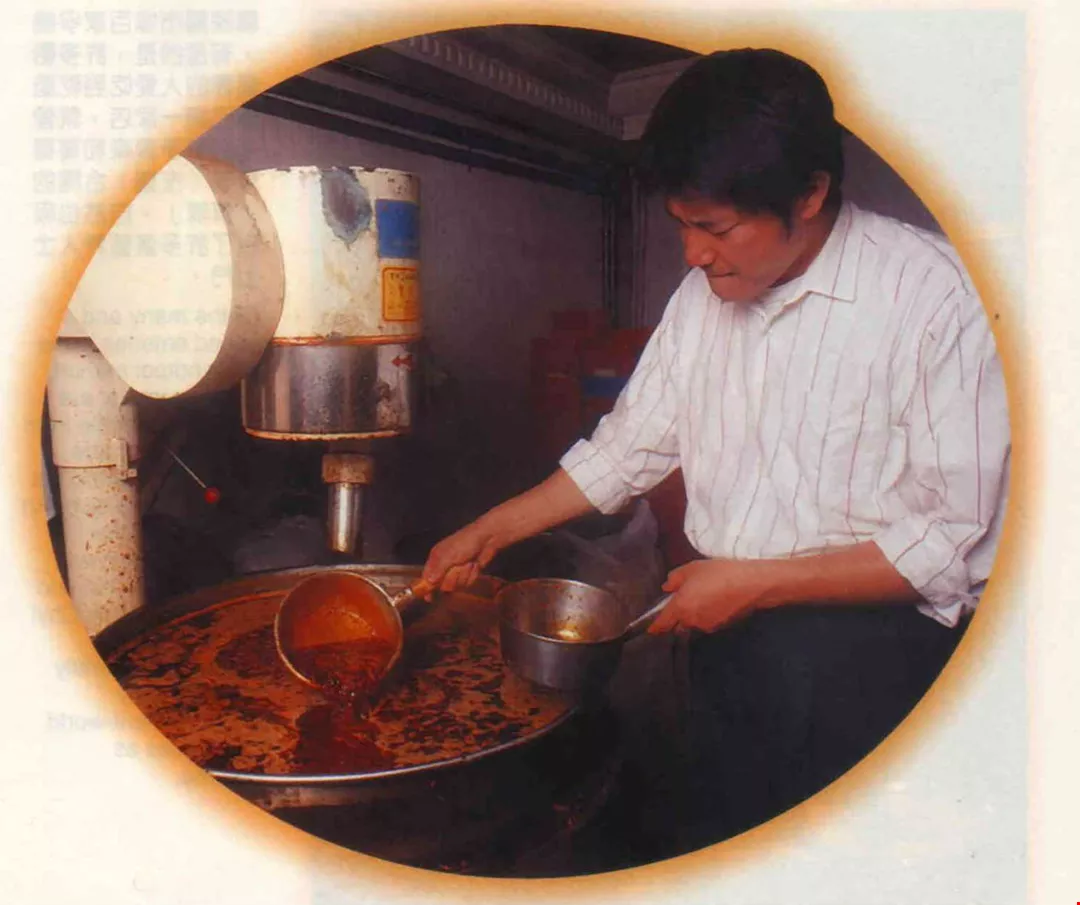
Of the many and varied eateries in the mala hotpot market, quite a number are owned by people from the entertainment world who started out as fans of the dish. An example is Chyi La.
In the analysis of Hsiung Nai-kang, a radio producer who once ran a mala hotpot restaurant herself, in 20 years of development in Taiwan mala hotpot has undergone continuous improvements and innovations to adapt it to changing local tastes, and the market has reached a state of stability and saturation.
"Among the old-established mala hotpot restaurants, Ning Chi has a rather savory taste, Shen Chi is on the sweet side, and Wu Chi has a balanced flavor," says Hsiung. "The better known newer establishments seek to attract patrons with more diverse ingredients, a milder or more innovative taste, or a one-price, all-you-can-eat buffet setup. Examples would be Dujiare Penjing, Fuqi Feipian, Tianlazi and Hongjiujiu. As for places like Taihedian and Zhiweiguan which are so popular with Hong Kong entertainment stars, they attract consumers more on the strength of their swanky interior design and service."
Though the exact recipe of each restaurant's mala stock is a closely guarded secret, the main ingredients are generally chillies, Sichuan peppercorns, fermented soya beans, chilli-and-bean sauce, ginger, and garlic.
"The same flavorings may be used in different ways," says Liu Yun-chung. "Dried chillies are very strong and are used to make chilli oil; powdered chilli dissolves easily, so it is used in soup; while fresh chillies have a natural aroma which enhances other flavors." He reveals that at Ning Chi Sichuan peppercorns are fried in oil to flavor it, then discarded, leaving the oil. Other ingredients include star anise, fennel, dried tangerine peel, chuanxiong, sugar cane heads and sorghum spirit.
The parents of singer Chyi Chin are from Harbin in northeastern China, and all his family love spicy food. The restaurant which he owns with his elder brother Chyi Lu makes spiciness its main selling point: its name, Chyi La, means "Chyi Hot." Chyi Lu, who does the cooking, says that using spices requires sensitivity and creativity: "If you want a more 'ma' taste, add more Sichuan peppercorns; if you want it hotter, add more chillies. But what matters is a full flavor, and that depends on your skill in making the chilli and Sichuan peppercorn oils, and combining the spices." As well as chillies, Sichuan peppercorns and pepper, Chyi keeps over 20 different Chinese medicinal herbs at the ready. "Chillies and Sichuan peppercorns go well with red meats like beef and pork; pepper goes better with seafood." For seafood such as fresh prawns, sashimi and shellfish, he produces a white mala hotpot stock with black and white pepper as the main spices which has become one of Chyi La's most popular specialities.
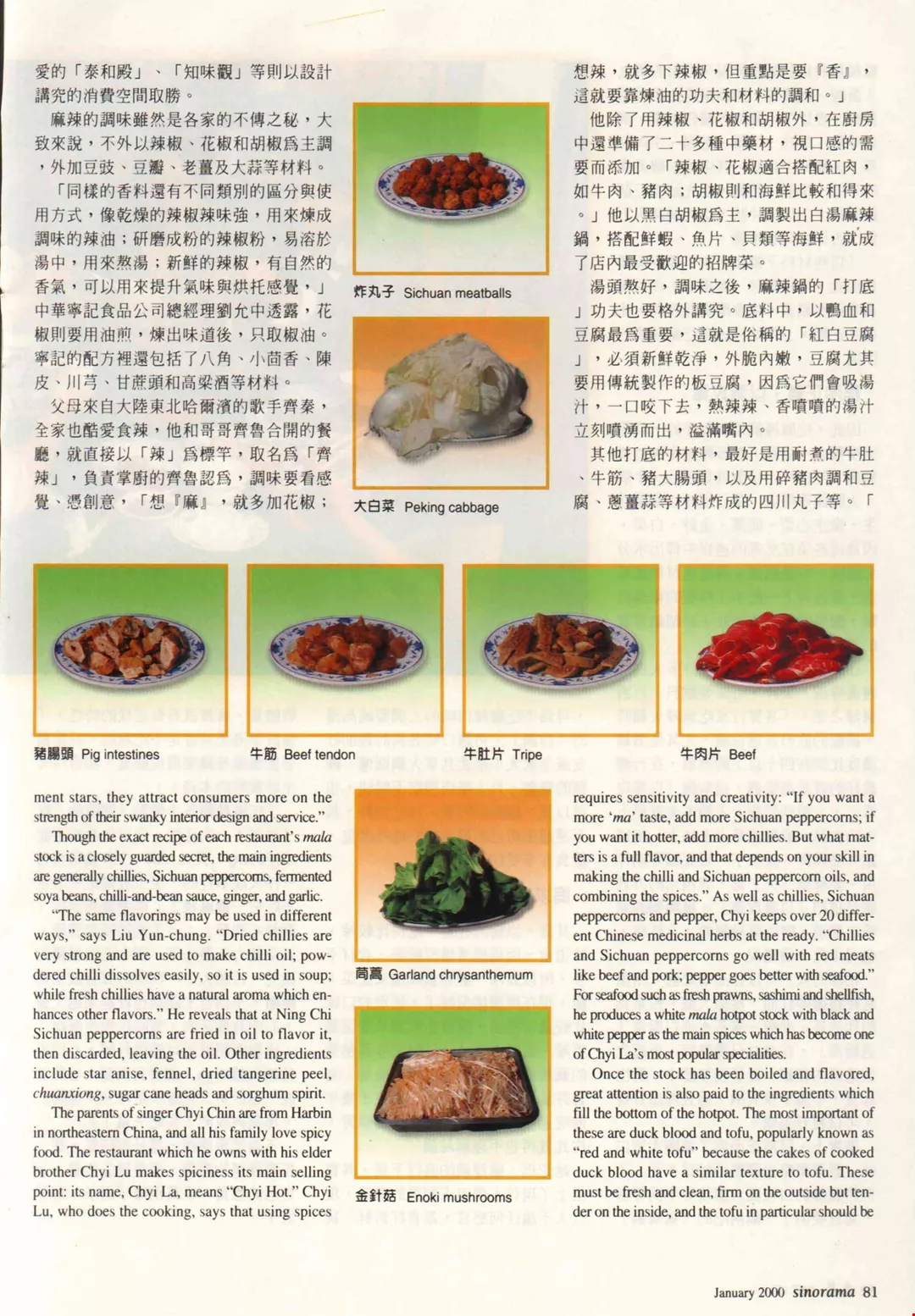
Once the stock has been boiled and flavored, great attention is also paid to the ingredients which fill the bottom of the hotpot. The most important of these are duck blood and tofu, popularly known as "red and white tofu" because the cakes of cooked duck blood have a similar texture to tofu. These must be fresh and clean, firm on the outside but tender on the inside, and the tofu in particular should be slab tofu made in the traditional way, because it absorbs the soup, so that when one bites into it the hot, spicy, flavorsome stock immediately gushes out, filling one's mouth.
As for the other ingredients "for the pot," it is best to use ones which stand boiling, such as tripe, beef tendon and pork intestines, along with deep-fried Sichuan-style meatballs made of ground pork mixed with tofu, spring onions, ginger and garlic. "The worst thing you can do to mala hotpot is to put in the fish balls, egg dumplings, seafood and so on which are often used in hotpot today. The stock is made with beef bones, so the main ingredients should be beef and pork offal, such as tripe, beef tendon, lungs and fatty intestines." Liu Yun-chung feels that those ingredients which take a long time to boil tender should first be simmered for three hours or more in a savory stewing broth before being sliced and added to the hotpot at the start of the meal, or they will be far too tough.
"After these ingredients go in the pot, don't fish them out immediately-wait until you have finished quick-boiling and eating the sliced beef. Only then will the slower-cooking ingredients be soft, succulent and full of flavor," says Liang You-hsiang, explaining the proper way to eat mala hotpot.
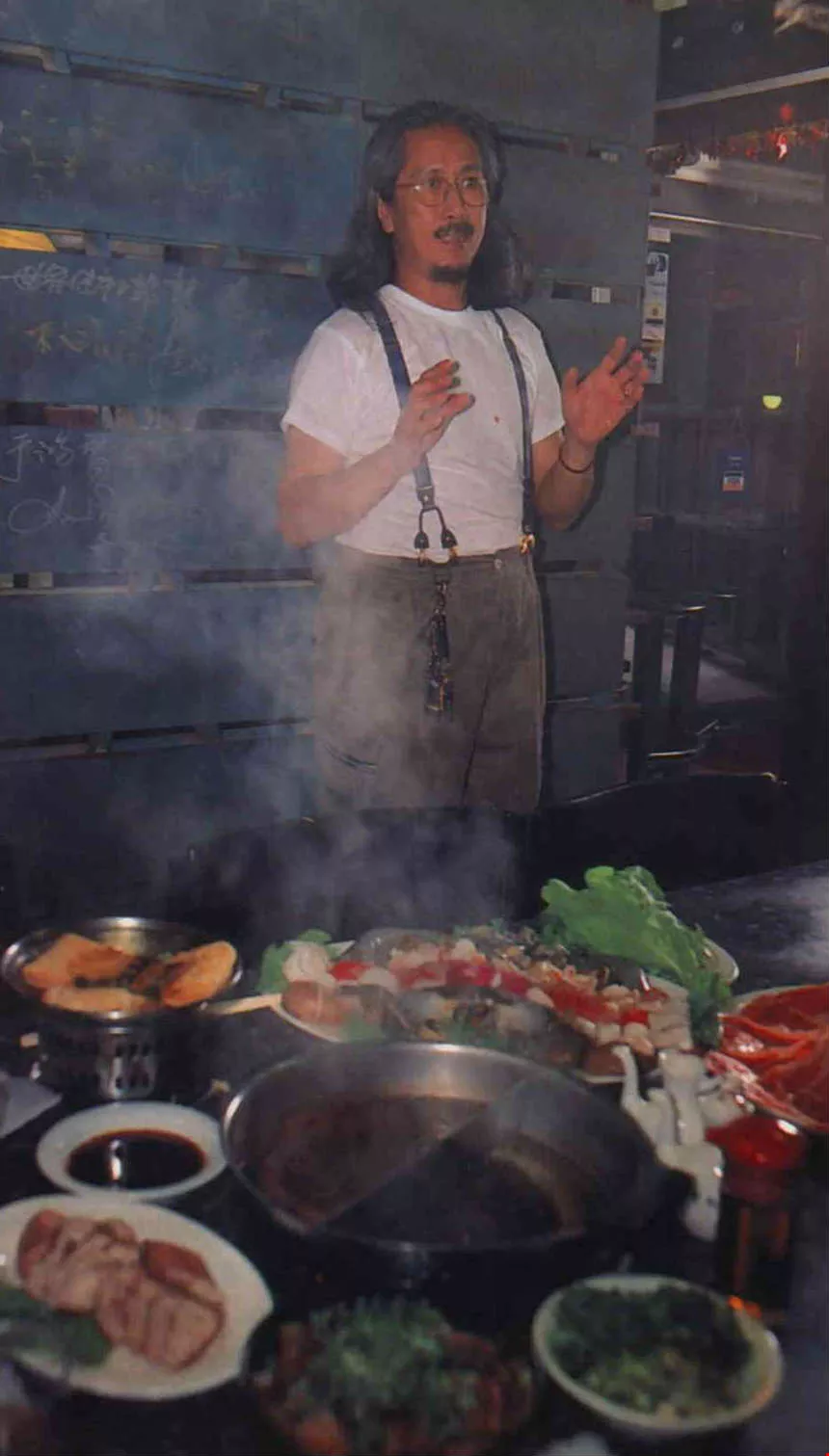
run by well-known singer Chyi Chin and his elder brother Chyi Lu (left). Their restaurant naturally attracts many entertainment-world colleagues as patrons.
Thus there is a correct sequence to mala hotpot. First eat the duck blood and tofu, then instant-boil the thinly-sliced raw beef, pork or mutton. Next come the tripe, beef tendon, intestines and other "pot-bottom" ingredients. Only then is it time for the third course, comprising mainly vegetables such as water spinach, garland chrysanthemum, enoki mushrooms and Peking cabbage, because as these sweet-tasting ingredients cook they release water, diluting the soup in the pot. Once the vegetables have all been eaten up, one can add thick, handmade noodles to eat with the soup. Then at last one is really replete.
In mala hotpot restaurants, one sees many people gulping down large quantities of beer, fruit juice or cola as they eat, to combat the mala taste. But, says Liang You-hsiang, "When connoisseurs eat mala hotpot, their first choice of drink to accompany it is spirits, especially those which are more than 40% proof. In Taiwan, the best choice is gaoliang-sorghum spirit. That's what we call 'fighting fire with fire.'" Liang notes that according to traditional Chinese medicine, hotpot is a dish which generates "fire" in the body. The mala spices add fuel to the flames, producing such side-effects as indigestion, diarrhoea and "afterburn." The way our ancestors traditionally combated this was to "fight fire with fire." This gives us an idea of the overpowering nature of the mala hotpot taste, and of the character of its devotees.
People who are not fond of chilli can use a spoon to lightly scrape the chilli oil off each piece of food before eating it, and this greatly reduces its fieriness. Another common method is to set a bowl of tea or white broth in front of one, and after picking a piece of food out of the hotpot, to first dunk it in the broth and then dip it in vinegar before eating it. This not only greatly reduces the spiciness, but also brings out the sweetness and aroma.
In fact, to cater to a wider range of palates, a common strategy in the market today is to offer more diversity, not only by distinguishing different strength grades of mala, but also by introducing innovations such as the "double hotpot," which is divided into two sections so that people who prefer not to eat mala can enjoy a "white" stock on the other side of the pot. Thus friends or family with different tastes and of all ages can still have the pleasure of sitting around the hotpot together. Those who don't feel at ease eating in a restaurant can buy a portion of stock to take home, and some supermarkets even offer frozen packs of mala soup.
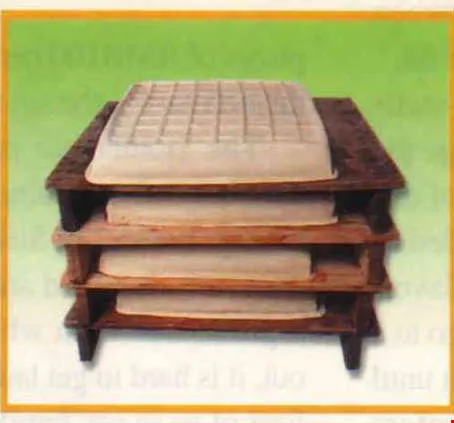
In fact, in former days people tended to eat spicier and more strongly flavored food than today, because when incomes were lower, strong spices could be used to stretch a little meat and vegetable to accompany a lot of rice. Now that economic conditions are better, people tend to prefer lighter flavors, and their stomachs cannot cope with the abundance of strong chilli, salt, oil and calories typical of mala hotpot. Food critic Weng Yun-hsia says that when she ate this dish once over ten years ago it upset her stomach so badly that she has never touched it again.
In her view, the undying popularity of mala hotpot in fact has to do with modern people's passion for seeking excitement. Whichever of the senses is concerned, people today love to try new things and test their courage, and mala hotpot fits this trend. "For instance, many Hong Kong singing stars actually aren't used to eating spicy food, but they take on the challenge of eating mala hotpot to show their courage."
"Eating mala hotpot always involves something of a devil-may-care attitude. It's a way of giving vent emotionally to things which are outside one's control, like natural disasters or the way people behave towards one at work," says Hsiung Nai-kang, who analyzes her own "mala psychology" thus: "When the chilli has made my tongue swell up, my hearing has gone dull, and a film of tears is swimming in front of my eyes, then I can't help starting to speak louder and louder, and anything painful in my life seems to fade away for the time being. A bellyful of grievances melt away, and my mood gets higher and higher. It really does raise my spirits, and as for whether I'll get the 'trots' next day, I'll worry about that later. For now, 'who eats wins'!"
Whether you prefer tradition or fashion, if you want to try the world of mala hotpot, you would do well to first consider whether your own constitution is up to it: don't wreck your own health just for the sake of "face"!
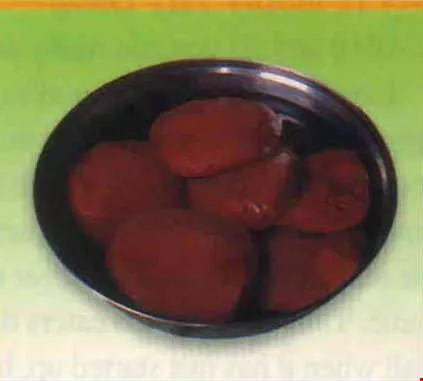
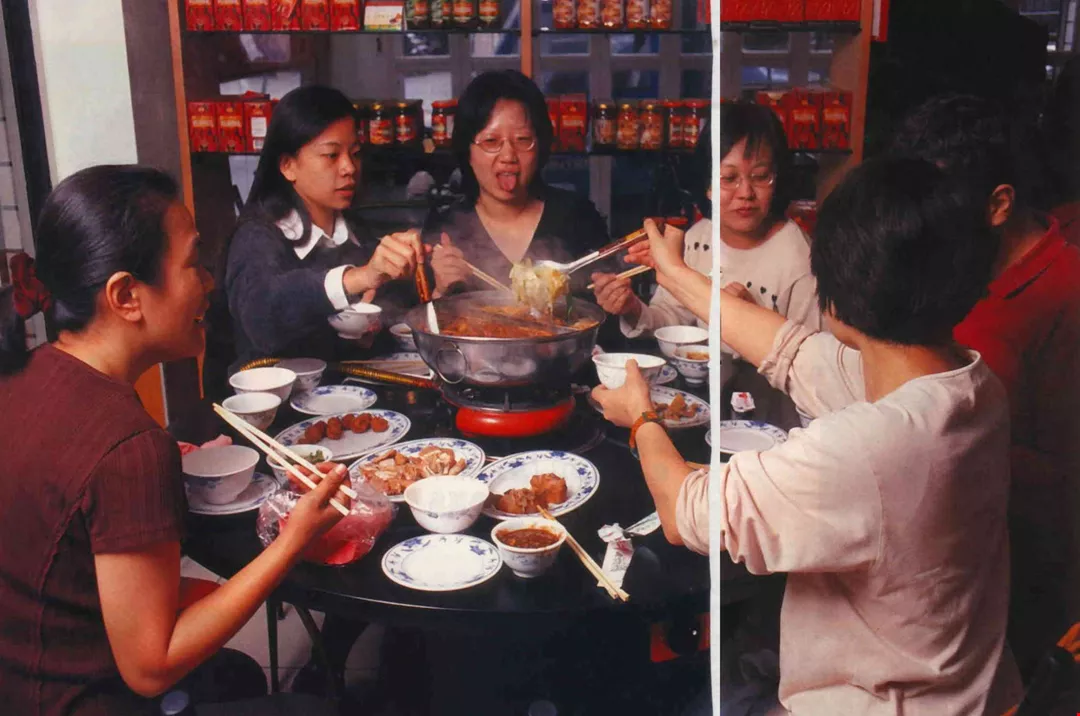
Mala hotpot, laced with fiery spices and bursting with calories, presents no small challenge to both the digestive system and the waistline. Gorge yourself if you will, but watch out for the after-effects!

@List.jpg?w=522&h=410&mode=crop&format=webp&quality=80)


