Making a Racket on the Way to Success
—Badminton Player Chou Tien-chen
Esther Tseng / photos by Kent Chuang / tr. by Phil Newell
July 2024


In February of 2024, badminton player Chou Tien-chen announced that in early 2023 he had been diagnosed with early-stage colon cancer. After undergoing surgery, he began competing in numerous events and not only qualified for the Olympics, but came to understand, in the course of his training, how improved nerve conduction could bring back his “feel” for the game. Chou, called “Little Tien” by badminton fans, says: “I’m an athlete who performs best when the chips are down. The greater the obstacles, the stronger I get.”
At this year’s Thomas Cup, a competition among men’s national badminton teams, Chou took on Viktor Axelson, currently the world number one in men’s singles. At match point in the three-set contest, Axelson attacked ferociously while Chou jumped about smashing the shuttlecock, at which point Axelson quickly swooped in and made retrieving shots. After many volleys back and forth, Chou repeatedly blocked a number of high-quality shots, and finally defeated Axelson with a cross-court smash. By coming out on top he inspired the whole team, and ultimately the squad made it into the semifinals, in Taiwan’s best-ever Thomas Cup performance.
On a 13.4 by 6.1-meter badminton court, Chou flashes his racket and makes shots with practiced ease, with a precision of just millimeters to spare. It’s hard to imagine that only last year Chou underwent surgery to remove a colon tumor and experienced half a year of down time.
A trial set by God
Before heading to Paris for the Olympics, Chou gave an exclusive interview to Taiwan Panorama, in which he talked about his post-surgery mood over the first half of 2023.
The tumor was discovered during Chou’s health check-up for the Olympics, when his level of carcinoembryonic antigen was found to be high, and he immediately underwent emergency surgery. “During the first part of my recovery, I was unable to focus on competitions. I discovered that partway through the contests my competitive focus and spirit would decline,” he says.
Mystified as to why his physical condition remained poor, he continued training intensively and attending practice sessions. However, he often lost in the first round of events. Unable to play well, the only alternative he saw was to enroll in even more competitions.
“It was only later that I came to realize that the body needs time to recover,” says Chou. “Although I was at a low point, I still felt grateful to God and my mind remained at ease. God opened the door for me to walk in a positive direction, and I competed hard to ensure I would be able to qualify for the Olympics.” He ended up winning gold medals at the Hylo Open in Germany in November of 2023 and the Princess Sirivannavari Thailand Masters event in February of 2024.
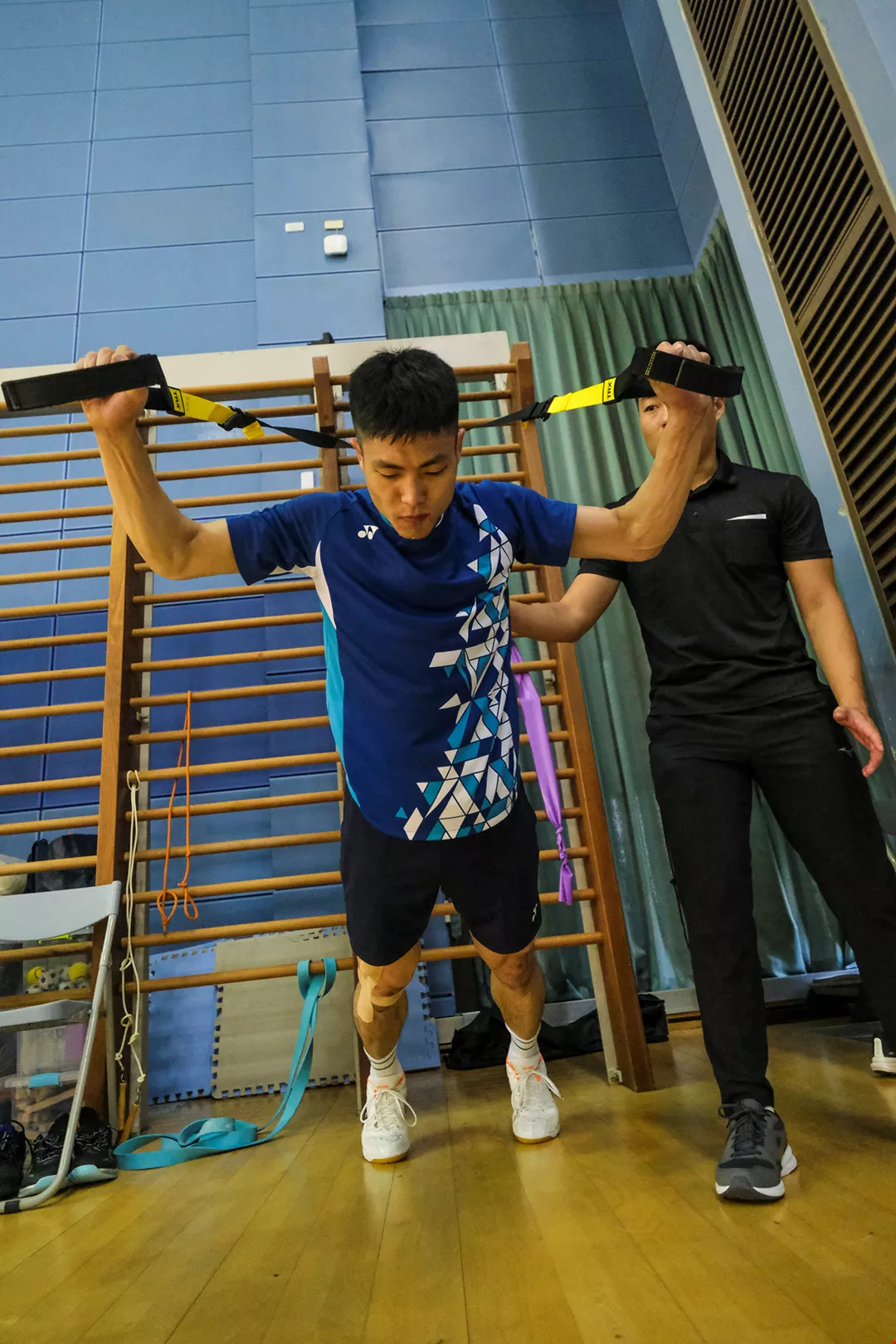
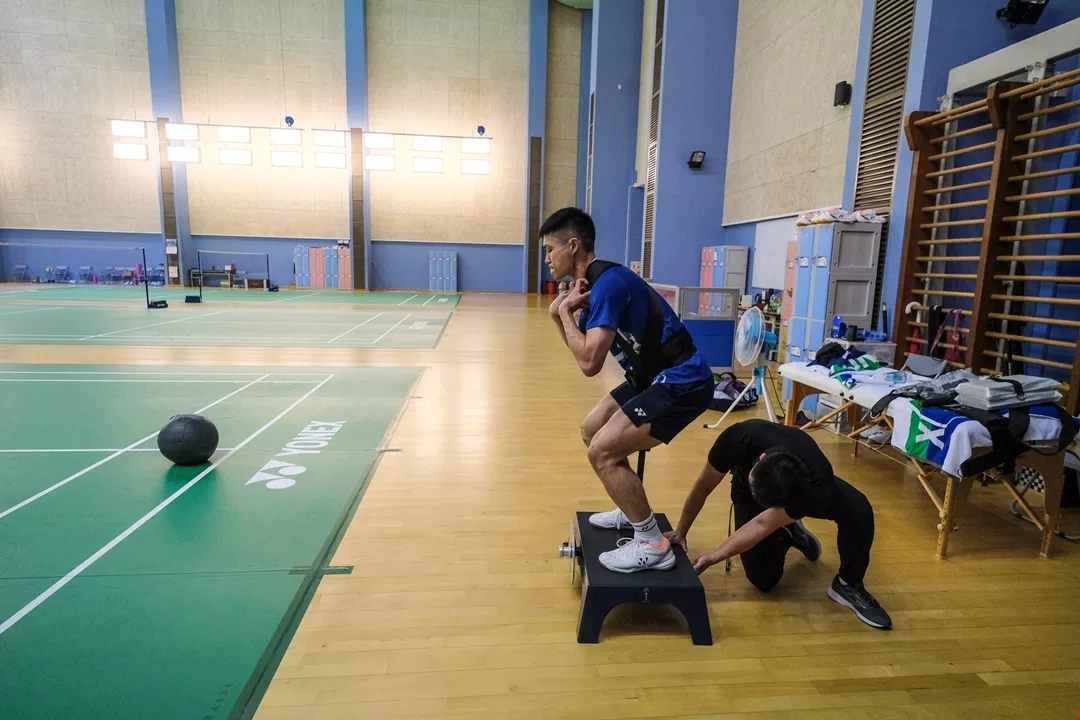
Chou Tien-chen undergoes training to increase his muscle strength and explosiveness.
Regaining his feel
Chou says he is very grateful to many people for their help. The NSTC and the Taiwan Institute of Sports Science discussed his case and created an integrated program for him, including physical conditioning, breathing training, and a nutrition plan.
Particularly important was the gradual restoration of his speed and power though neural network connections. The concepts and training methods developed by a Japanese expert named Sato provoked neural reactions in his body so that after training, the speed of information from his brain to his arms, pelvis, and feet was increased. Most importantly, he got back his old “feel” for the sport.
In 2014, Chou won the French Open, a Badminton World Federation (BWF) Superseries event, becoming the first Taiwanese to win the men’s singles title in a BWF Superseries tournament. After winning the men’s singles title at the 2019 Indonesia Open, a Super 1000 event on the BWF World Tour, his points total made him the world’s number-two ranked player, causing fans to give him Chinese nicknames such as “Taiwan’s top badminton bro” and “the Badminton God.”
He shares one of the crucial turning points in his rise to excellence—his introduction to proprioceptive neuromuscular facilitation training by physical therapist Kao Min-shan. “It turned out I could make a lot of movements that I was unable to do before. It was like going from 2D to 3D, and I could also save a lot of energy on the court.”
In 2019 Chou did not extend his contract with his coach, and became more independent in his thinking. “God is my trainer,” says Chou. He adds that he studied the playing styles of Lee Chong Wei, a former world number one from Malaysia, and the great Lin Dan from China, especially their backswings and sideways motions, and imitated these moves until they became second nature to him.
Showing the world his character and skill
Chou believes the most important goal on the court is not to win. Rather, “Each and every move I make is a testament to God. Winning or losing can be decided in an instant, but personal character and skills can only be gradually built up over time.”
When competing in international tournaments, Chou hopes that on the court people will see his sportsmanship and skill, while off the court they will feel how very friendly Taiwanese athletes are. He says that Taiwan has cultivated many outstanding international athletes who can hold their own with the world’s best.
Chou says that in addition to raising Taiwan’s international profile, an even more important job is people-to-people diplomacy. This is because on tour a player will interact with his opponents even more than he does with his own family. He reveals that he always carries gift items with him, such as copies of his book But One Thing I Do or electrical massage rollers, to give away. These are not only tokens of friendship, they also encourage international players to come and compete in tournaments in Taiwan, where they can enjoy Taiwan’s high-quality cuisine and its people’s warmth and kindness.
.jpg?w=1080&mode=crop&format=webp&quality=80)
(courtesy of Li Tianzhu)
Olympic values
The Olympic spirit is one of mutual respect. “Before every match I not only pray for myself, I also pray for my opponent and ask that whoever wins and whoever loses, we both put on an excellent performance,” says Chou, adding that this is what he felt about the match with Viktor Axelson, which was very intensely contested and enabled everyone to feel the spirit of sportsmanship.
Having been knocked out in the quarterfinals in both the 2016 Rio Olympics and the 2020 Tokyo Olympics, Chou says that after such a long period of preparation, he will feel sad if he doesn’t at least make it to the semifinals. “But I will always believe that things even better than winning a medal will happen for me.”
Chou believes that his two previous Olympic experiences have given him a strong foundation for the 2024 Paris Games. “My biggest advantage is that I have a great deal of experience and I will do better in terms of preparation,” he states with confidence.
He adds earnestly: “I can’t decide who will win and who will lose, but I can decide my attitude.” With such a positive outlook, he is already a winner.
@List.jpg?w=522&h=410&mode=crop&format=webp&quality=80)
@List.jpg?w=522&h=410&mode=crop&format=webp&quality=80)


