

Ocean Taiwan: Landscapes and Paintings
Taiwan, set amidst the azure expanse of the western Pacific, rises like a great whale guarding the seas. During the 17th century, European navigators dubbed it Ilha Formosa, meaning “beautiful island” in Portuguese. The ocean has shaped not only Taiwan’s climate and ecology, but also the spirit of its people, nurturing a culture defined by openness, diversity and enduring vitality.
Formosa: An Island of Beauty Throughout the Tides of Time
Taiwan is the ancestral homeland of the Austronesian peoples, and Indigenous communities have long safeguarded the land under the blessing of ancestral spirits. In the 17th century, the Dutch and the Spanish established footholds in the south and north of the island, opening the first chapter of exchanges with Europe. Taiwan was subsequently ruled by Koxinga and the Qing dynasty, during which time Austronesian traditions, Chinese culture and European influences interwove. From 1895 to 1945 Taiwan was a Japanese colony, and modern institutions and infrastructure were established.
After 1945 Taiwan emerged as the seat of the Republic of China . Though the country endured a prolonged martial law era, the forbearance and resilience of its people paved the way for democratic transformation. Today Taiwan is recognized worldwide not only for its technological prowess but also for its vibrant pluralism. It stands as a free nation, blessed with magnificent seas, fertile land and diligent, openhearted people.
From Realism to Abstraction: Seascapes Across Time
Cradled by water on all sides, Taiwan has long drawn its most striking and timeless image from the ocean. Throughout history the sea has provided a constant source of artistic and literary inspiration and contemplation. The recorded history of painting extends back more than 350 years to the Qing dynasty and encompasses ink, watercolor, oil, and mixed media. Across this continuum, from classical to modern to contemporary art, modes of expression have expanded from realism to abstract expression and conceptual experimentation.
As a central motif in Taiwanese art, seascapes have continually evolved in form and meaning, reflecting shifts in technique, style and sensibility. Through these transformations, the ocean emerges as a prism through which artistic imagination reveals Taiwan’s depth and diversity.
Origins of the Exhibition
Marking the 400th anniversary of Europe’s first encounter with Taiwan, “Ocean Taiwan: Landscapes and Paintings” also comes at a moment when Europe is rediscovering Taiwan as a vibrant democracy and land of freedom. In conjunction with the Ministry of Foreign Affairs’ 2025 Taiwan Culture in Europe initiative, the exhibition has been specially conceived to bring Taiwan’s shores to Europe. For this project, distinguished contemporary painters were invited to create new works in ink, watercolor and oil to transport viewers to iconic coastal sites.
Held in the ocean’s embrace, Taiwan in turn holds the sea close. This body of work invites audiences to experience coastal landscapes and contemplate artistic perspectives and cultural horizons. The collection reveals Taiwan as a pluralistic island nation defined by the resilience, humility and courage of its people and their enduring commitment to peace.
Works on View
Chao Kuo-tsung—“Yehliu Geopark”
The fantastical rock formations of Yehliu resemble nature’s own sculpture gallery, a vast open-air museum carved by wind and sea. In his work “Yehliu Geopark,” artist Chao Kuo-tsung renders this extraordinary landscape with bright, spirited colors to capture both the texture and individuality of the stones. Shades of violet and blue delicately articulate the rocky surfaces, set in striking contrast against the golden hues of the earth, so that each formation stands as a masterpiece in stone. The painting is a meditation on the marvels of the natural world and an homage born of the artist’s deep reverence for nature’s mystery and beauty.
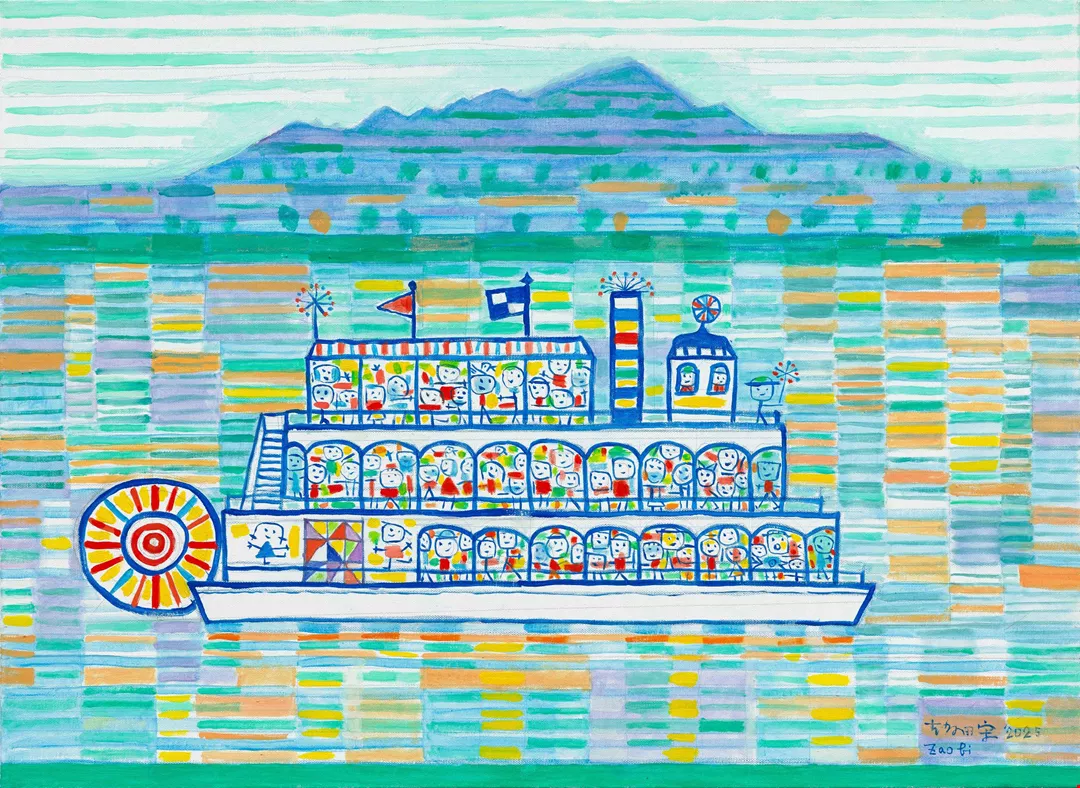
Chao Kuo-tsung—“Guanyinshan”
Through the eyes of Chao Kuo-tsung, mists drifting over mountain ridges and peaks dissolving seamlessly into the sky are transformed into visions of purity and childlike wonder. His composition brims with color, with parallel bands of vivid hues evoking the undulation of the river. A riverboat, propelled by a great turning wheel, glides steadily across the surface. The Tamsui River and grand silhouette of Guanyin Mountain alike are rendered with bold, unadorned strokes. In this rhythm of line and color, beauty takes on a lyrical cadence suffused with joy and serenity, inviting viewers to share in the emotion that radiates from the canvas.
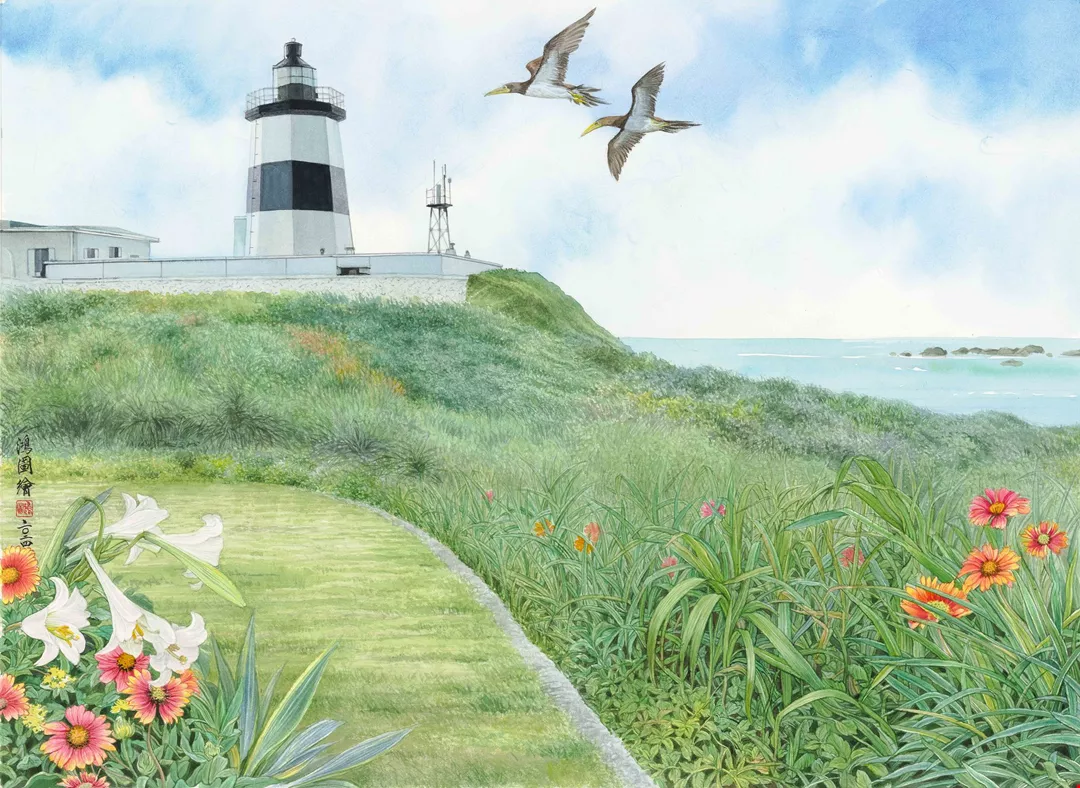
Ko Hung-tu—"Fugui Cape Lighthouse”
A lighthouse stands as a faithful sentinel guiding voyagers home. In “Fugui Cape Lighthouse,” Ko Hung-tu depicts the structure’s bold black and white stripes rising in solemn tranquility beneath a gentle sun and serene sky. Around its base bloom gaillardia and delicate Taiwan lilies, which symbolize vitality and natural beauty, while white-bellied boobies soar gracefully overhead and infuse the scene with a sense of motion and freedom. Through harmonious colors and fluid brushwork, the painter unites ecology and artistry, balancing the splendor of the landscape with the intellectual resonance of beauty.
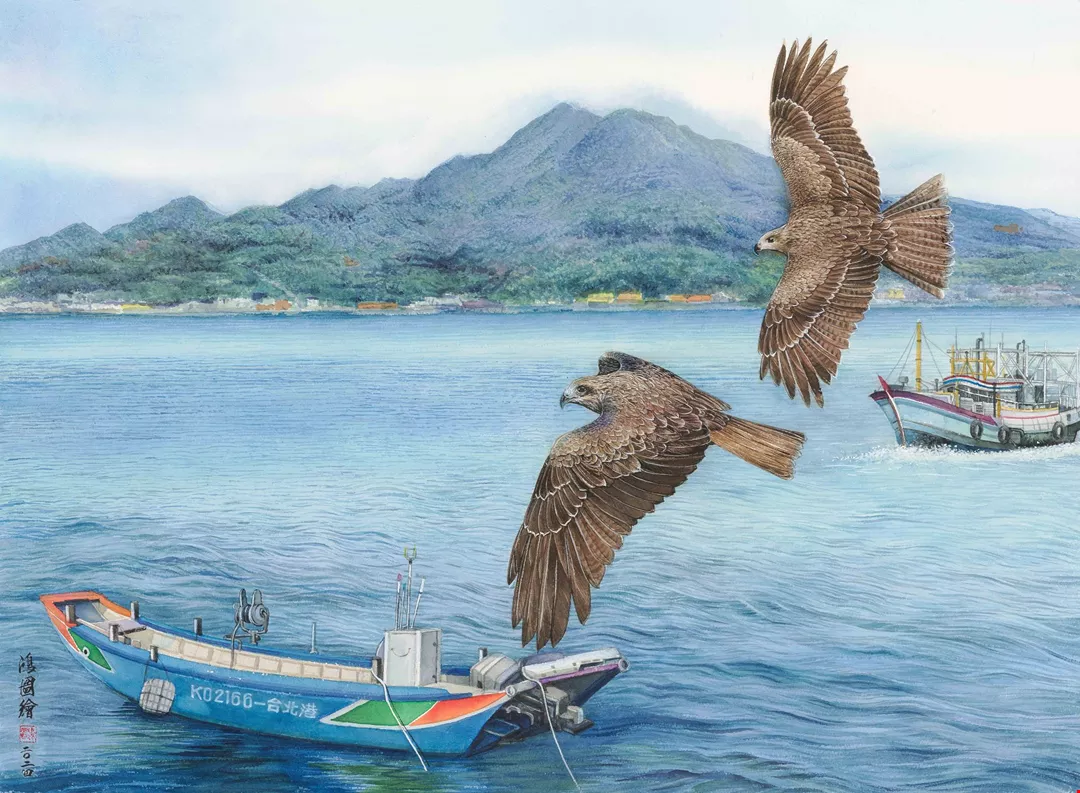
Ko Hung-tu—"Eagle Flapping Its Wings”
With wings spread wide, eagles glide through the vast heavens with commanding grace. Mountains rise in layered ridges along the distant horizon, their quiet majesty guarded by the humble dwellings nestled at their base. Ko Hung-tu captures this harmonious coexistence of human presence and natural power with a painter’s keen eye. A small boat chugs steadily across the calm sea as though merging with the rhythms of the earth and sky.
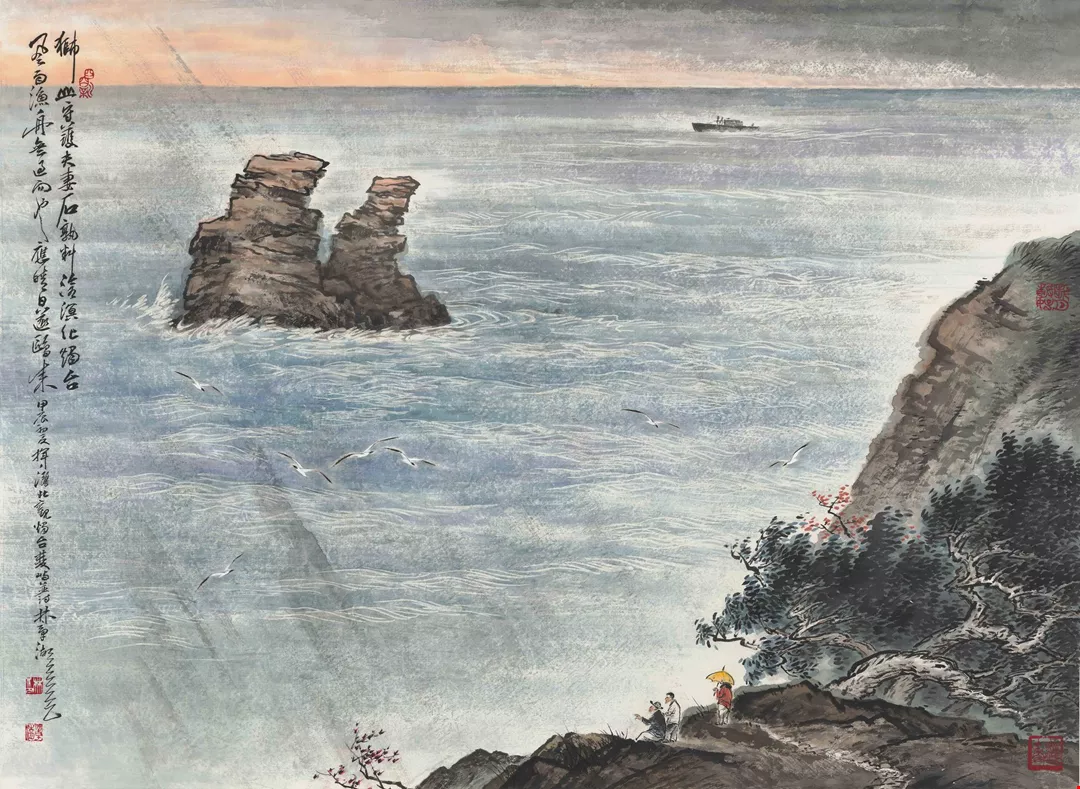
Lin Chang-hu—"Twin Candlestick Islets”
The Twin Candlestick Islets, also known as the Couple Rocks, rise from the northern sea as emblems of steadfast love. Painting from life at Shitoushan, Lin Chang-hu envisions these twin formations as eternal beacons for passing fishing boats, their presence constant through shifting skies and seasons and often ringed by circling seagulls. Inspired, he inscribed his painting with the verse:
“Shitoushan stands guard over the Couple Rocks,
who would have thought the vast sea would shape them into candlesticks?
The fishing boats pay no heed to storm and wind,
yet they chase the gulls on sunny days.”
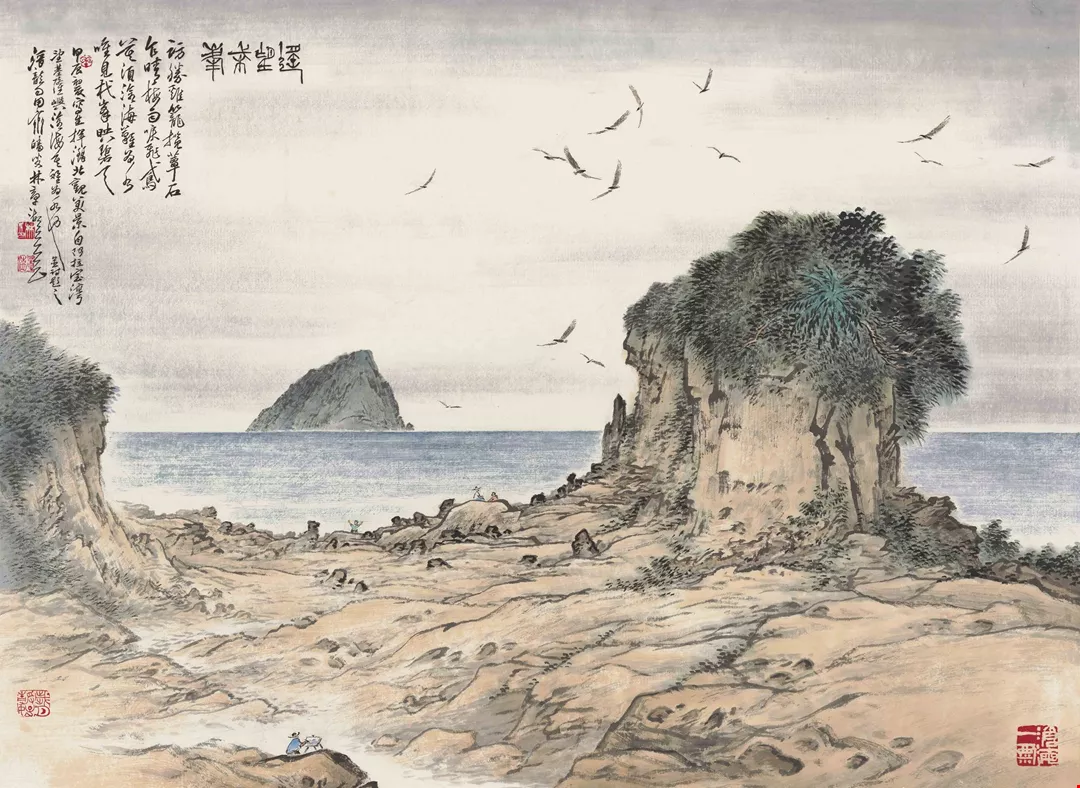
Lin Chang-hu—"Looking out at Yì Mountain Heping Island Geopark”
At Heping Island Geopark, Lin Chang-hu sketched the jagged rock formations that stand like sculptures carved by wind and sea. After the rain, kites soar across a brightening sky, while in the distance Keelung Islet, known in antiquity as Yì Mountain, rises to meet the heavens. Moved by the majesty before him, Lin inscribed his painting with the verse:
“At Keelung’s wondrous site I gaze on mushroom rocks.
After the plum rains break, the kites cry as they rise in sudden flight.
No other waters can rival the vastness of the sea.
Only Yì Mountain remains, mirrored in the azure sky.”
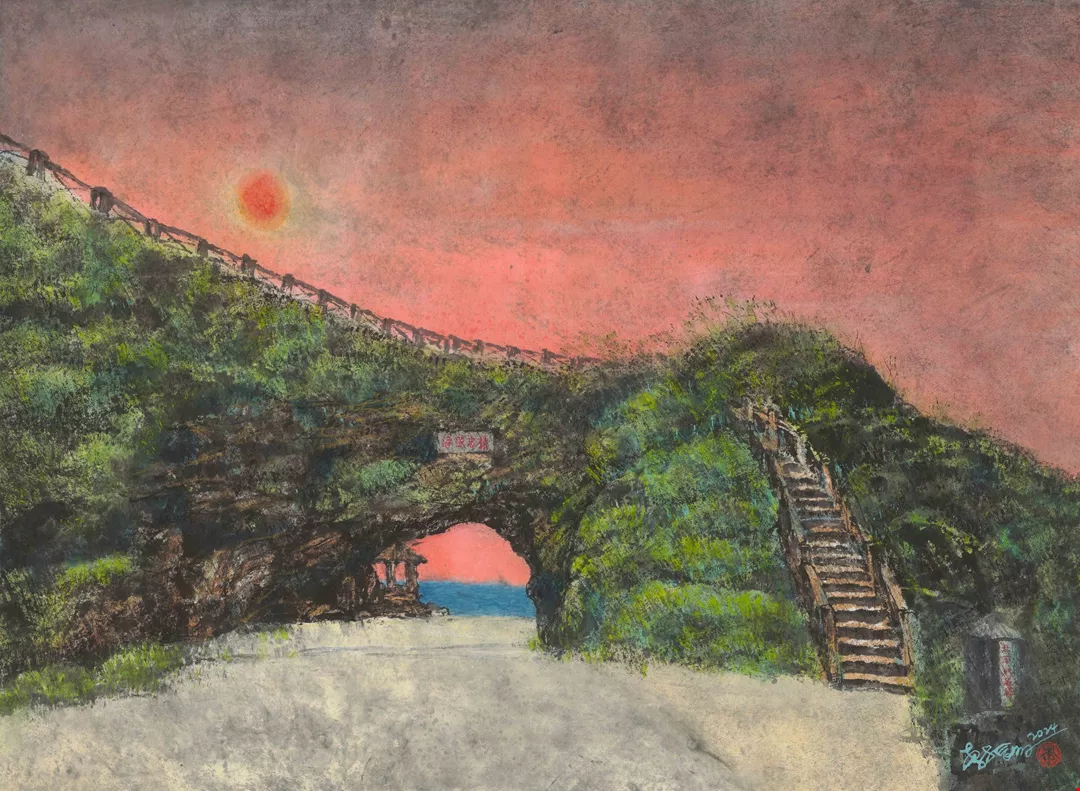
Lee Cheng-ming—“Shimen (Stone) Arch”
Over countless years relentless waves have eroded the coastal strata, and with the gradual exposure of rock, nature has sculpted this magnificent sea arch. In his painting, Lee Cheng-ming employs delicate tones to portray the scene, framing the vast expanse of sea and sky through the arch. A winding stairway threads across the composition, drawing the viewer inward to witness firsthand the interplay of stone and water, stillness and motion. The work reveals not only the grandeur of geological transformation but also the profound artistry of nature.
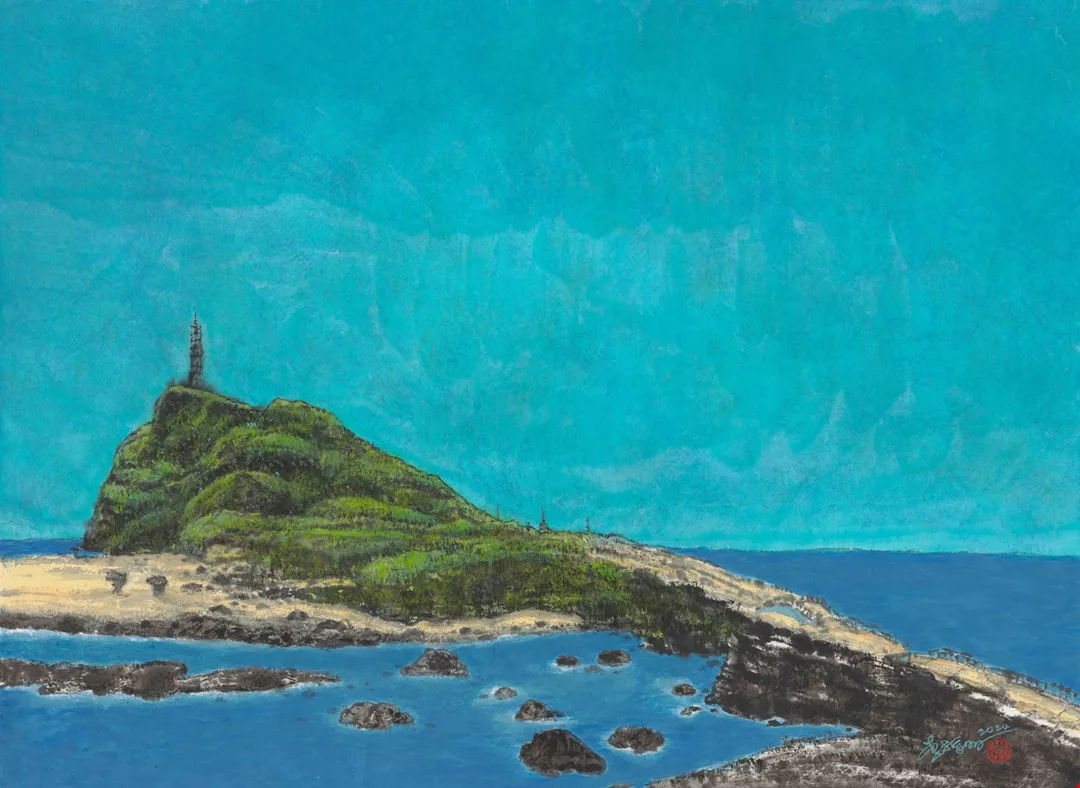
Lee Cheng-ming—"Yehliu Geopark”
At Yehliu, the headland extends into the sea, its contours carved by the forces of nature into a cuesta, or sloping ridge, that shapes the cape’s singular profile. At its summit stands a solitary iron tower, anchoring the dramatic coastal vista that makes Yehliu so distinctive. In this work, Lee Cheng-ming employs an innovative approach to ink painting, with his refined brushwork tracing the sandstone’s shifting forms with delicacy and precision. Through this union of technique and vision, he reveals the ceaseless transformation of earth and sea as a masterpiece beyond compare.
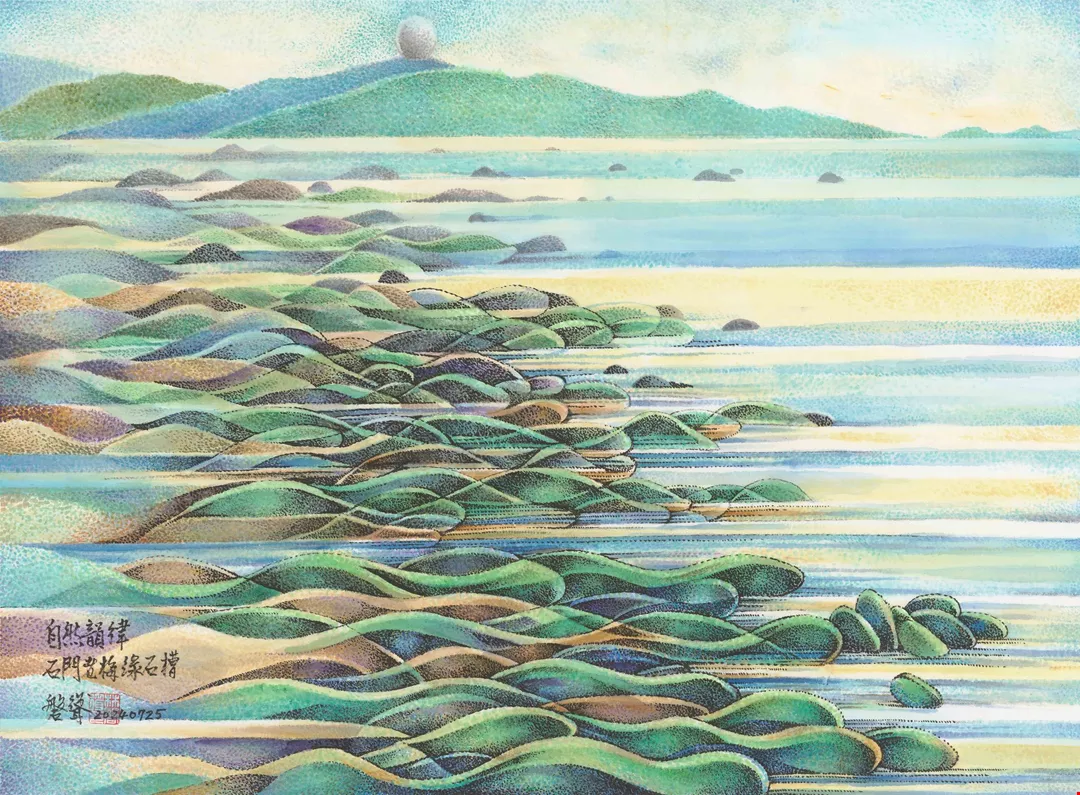
Apex Pang-soong Li —"Rhythms of Nature,
Laomei Green Reef (Stone Troughs) at Shimen”
Each year from February to May, Laomei Green Reef emerges as a fleeting marvel along Taiwan’s northern shore. Draped in lush green algae against the backdrop of sapphire waters, the reef becomes a dreamlike ribbon of color at the ocean’s edge. Waves continuously washing over the stone trenches nurture the algae until the vivid carpet transforms the coastline into a living tapestry.
In his work, Apex Pang-soong Lin renders this spectacle with exquisite pointillist technique, composing the scene from countless ink dots no larger than the tip of a needle. With this meticulous method, he captures the contours and textures of the reef, recording its transient beauty in a vision both precise and poetic.
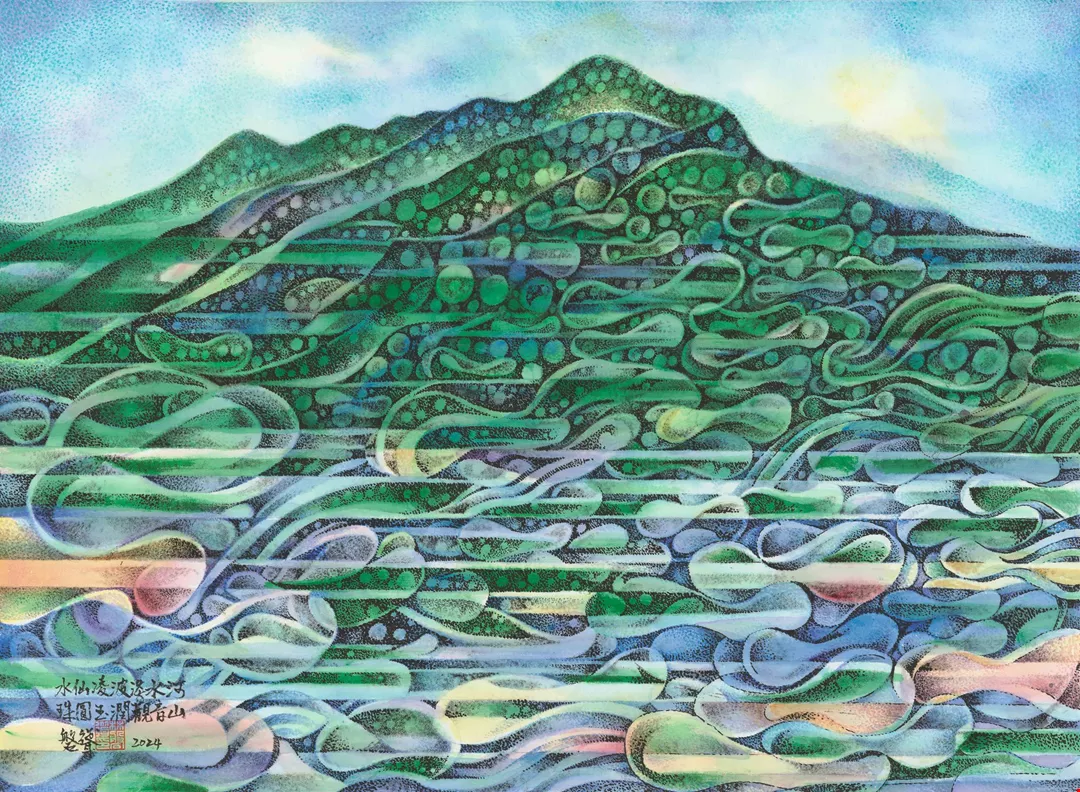
Apex Pang-soong Lin —"Water Fairies Casting Waves, the Tamsui River
Round and Glossy Like a Pearl, Guanyinshan”
One of the famed eight views of Tamsui, Guanyinshan stretches along the riverbank in a form long likened to the reclining figure of its namesake bodhisattva. From afar its majestic ridges rise in successive layers, their colors shifting as veils of mist and clouds coil around the peaks in an ever-changing spectacle.
In this work, Apex Pang-soong Lin employs his masterful pointillist technique to patiently build the scene dot by dot. He infuses the landscape with both texture and feeling, immortalizing Guanyinshan and the Tamsui River as enduring reservoirs of emotion.
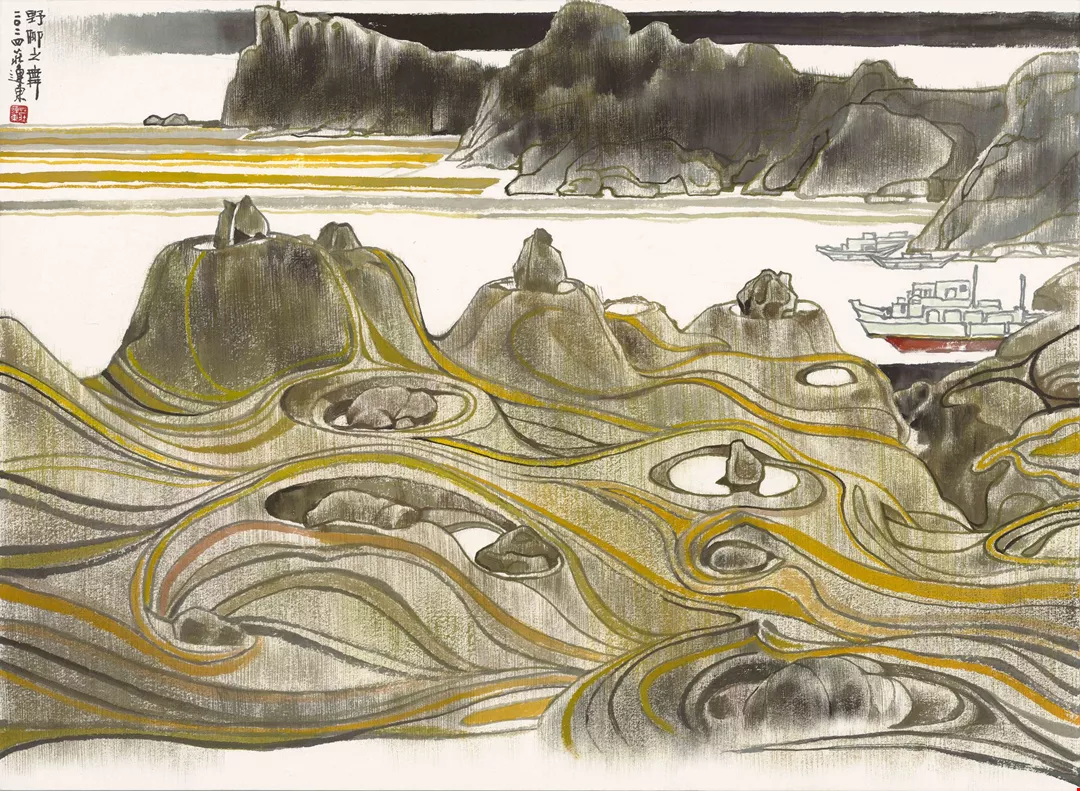
Chuang Lien-tung—"Yehliu Geopark”
Renowned worldwide for its extraordinary formations, Yehliu Geopark offers a panorama of fantastical rocks shaped by nature’s chisel. Traversing its winding paths, artist Chuang Lien-tung arrived at a unique vista from which he gazed upon candlestick-shaped rocks. In his painting, Chuang renders the marvelous contours of these formations and the surrounding seascape with flowing lines and gentle hues, woven together in a harmonious symphony of earth and sea.
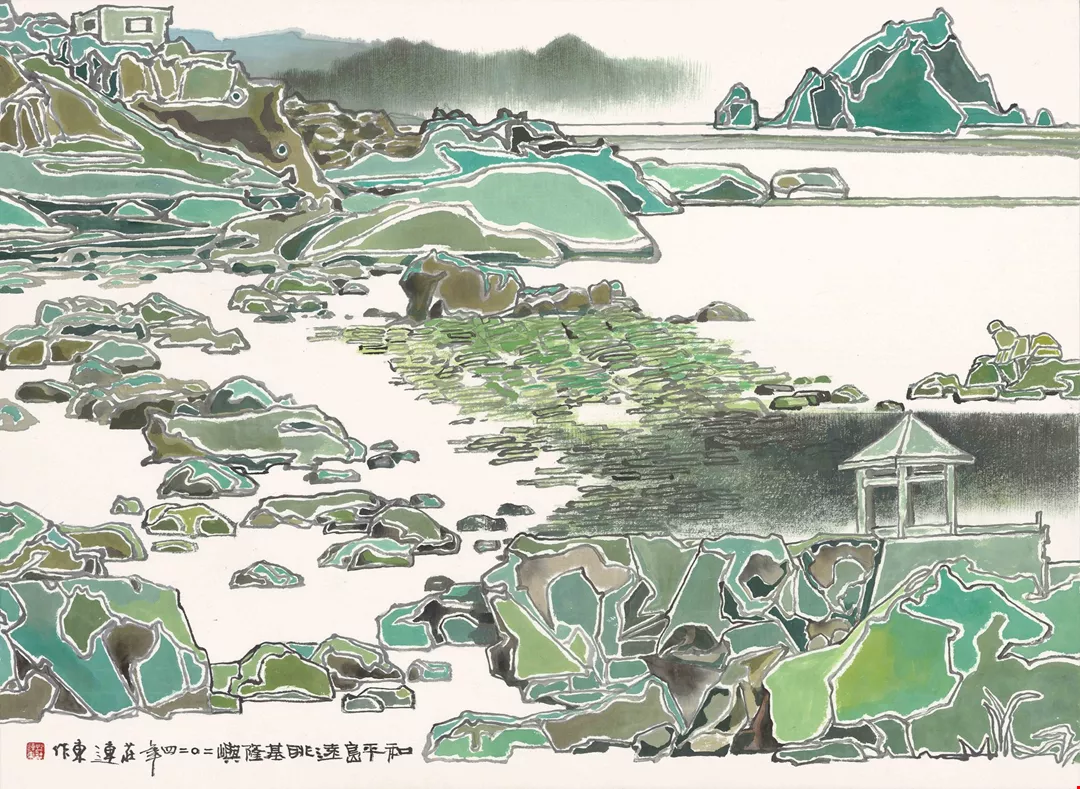
Chuang Lien-tung—"Heping Island Geopark”
The distinctive “island-within-an-island” terrain of Heping Island, crowned by the graceful Dengyu Pavilion atop its rocky heights, unfolds in layers of stone stretching toward the horizon. Shaped over centuries by the ceaseless wash of waves, these formations reveal nature at its most captivating. In Chuang Lien-tung’s work, the interwoven rock formations and verdant hues are at once majestic, lyrical and profoundly alive.


@List.jpg?w=522&h=410&mode=crop&format=webp&quality=80)

