Keys: Wide angle and localization
Launched in 2022, the BURSTT project is sponsored by the Academia Sinica’s Institute of Astronomy and Astrophysics (ASIAA), which is overseeing the joint efforts of National Taiwan University, National Tsing Hua University, National Chung Hsing University, and National Changhua University of Education to build a new-generation wide-angle radio telescope specifically designed to survey FRBs and achieve precise localization.
Traditional dish telescopes are built to reach into deepest space, but the BURSTT project is based on different thinking. BURSTT relies on an automated wide-angle antenna array that continuously monitors one-quarter of the sky in search of sudden FRBs.
At the same time, by setting up a number of outrigger arrays around Taiwan and offshore, the BURSTT team is able to carry out very long baseline interferometry (VLBI) localization. The idea is to identify the galactic source of an FRB at the moment it is detected.
In addition to the main array within the Fushan Botanical Garden, which straddles the boundary between New Taipei City and Yilan County, the BURSTT project has domestic outrigger arrays in Green Island, Nantou, and Kinmen, and is arranging international sites for outrigger arrays in Japan, South Korea, Hawaii, and India. Starting off in Taiwan and its offshore islands, the BURSTT project aims to build a cosmic radio telescope that spans much of the globe.
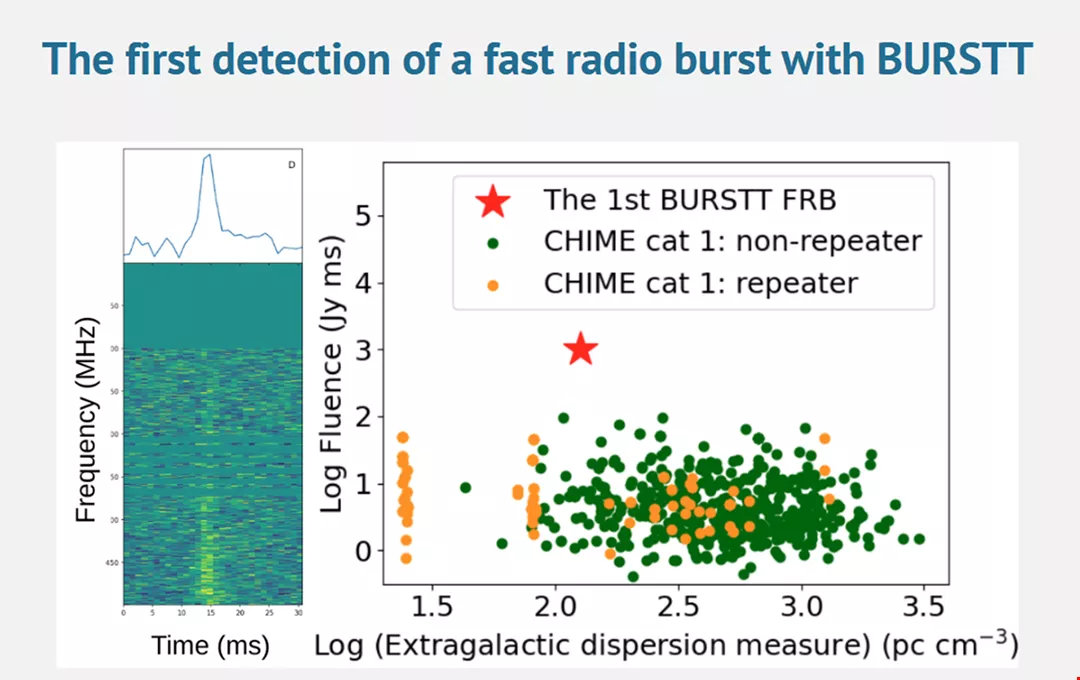
BURSST’s first FRB detection: The left image shows the frequency characteristics. The red star in the right image represents the first FRB detected by BURSTT, which is contrasted with FRBs logged by Canada’s CHIME radio telescope. (screenshot from BURSTT website)








@List.jpg?w=522&h=410&mode=crop&format=webp&quality=80)


@List.jpg?w=522&h=410&mode=crop&format=webp&quality=80)
@List.jpg?w=522&h=410&mode=crop&format=webp&quality=80)