The cradle of Taipei’s modern water system
The facility’s giant water pumps still stand on the site, a symbol of industrial civilization. During the period of Japanese rule, water drawn from the Xindian River was purified here, and pumped up into a reservoir partway up Mt. Guanyin (a nearby hill, also called “Little Mt. Guanyin” in deference to its larger namesake in New Taipei’s Bali District). From there, gravity carried it back downhill to old downtown Taipei (the area within the former city walls), and to Dadaocheng and Bangka (Monga). The waterworks was retired in 1977 and designated a municipal heritage site in 2002.
Visitors who climb the footpath eventually reach a grassy field covering the underground reservoir for purified water. Of the 60 iron ventilation shafts that once rose up through the reservoir’s roof to dot the field, only four remain. Various other installations including a purification chamber and pipework are connected to the reservoir.
At 55 meters long, 30 meters wide and five meters deep, the reservoir has been compared to Tokyo’s Metropolitan Area Outer Underground Discharge Channel and Istanbul’s Basilica Cistern.

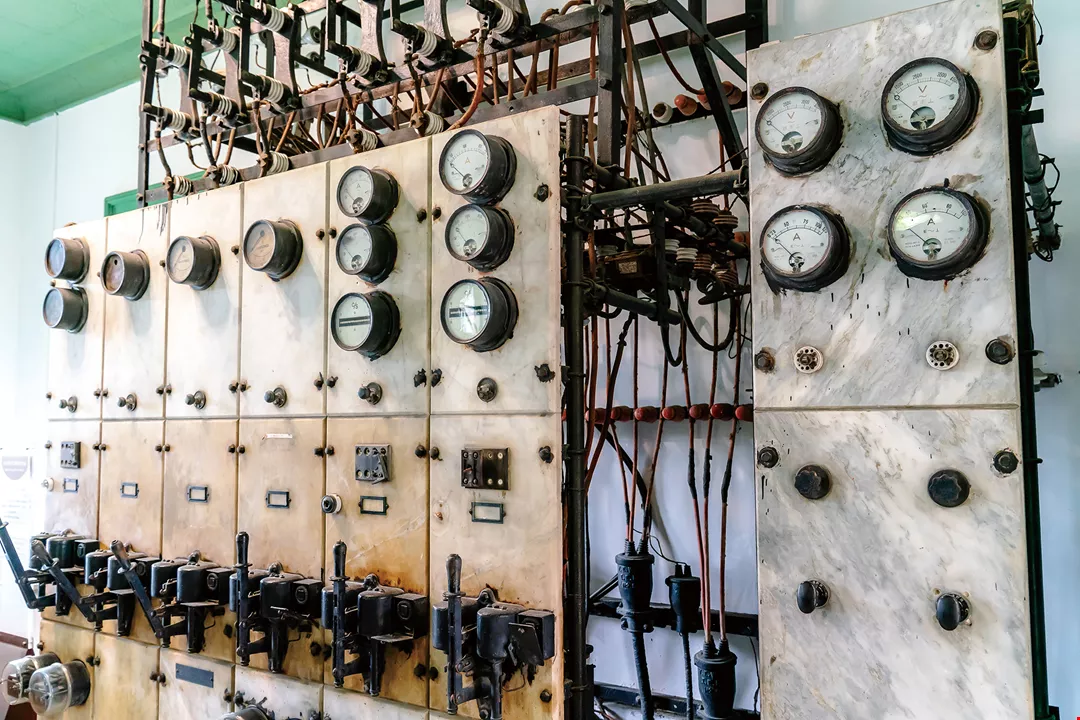
Each pump has a control panel mounted on insulating stone sheets that were imported from Italy.