Scarred for Life: Burn Victims' Long, Hard Struggles
Chen Hsin-yi / photos Chuang Kung-ju / tr. by Jonathan Barnard
June 2011


Last October the Taiwanese entertainer Selina was injured in Shang-hai during filming of a scene that involved an explosion. Burns covered 54% of her body surface, including severe third-degree burns across 41%. In January of this year, after 88 days in the hospital, she was finally released. Her smiles through tears and determination to push on with her life deeply moved people.
Because skin grafts were required from her scalp, she now sports a crew cut. Her limbs move slowly and -stiffly due to fibrosis stemming from her injuries. And she will have to wear pressure garments for at least a year to reduce scarring. Her experiences have given many people an understanding about the length and difficulty of the burn recovery process.
Indeed, the sudden accidents that cause burns and scalds almost always catch victims unprepared. But the scars that remain can change the course of their lives.
In an ordinary high rise on Taipei's Nan-jing East Road, an unusual atmosphere prevails on one floor. In the corner of a bright and open space, a stereo plays soft music while air conditioning maintains the temperature at a comfortable 25°C. Ranging in age from five to 60, some two dozen patients-or "classmates," as they call each other-are concentrating on doing exercises that would be simple for most people. When you look carefully, you see that some classmates have fingers that can't grasp or arms that can't extend straight. Others have great difficulty walking.
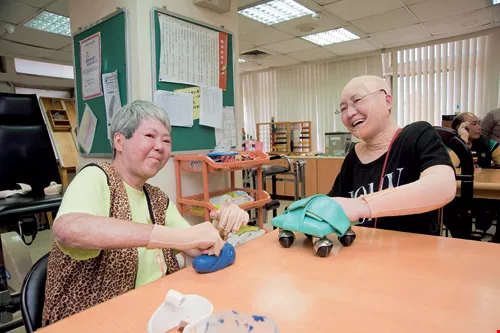
Zhang Zhengyu practices moving her elbow, while alongside her Granny Bizhu strengthens her grip by grasping modeling clay. Sunshine gave Granny Bizhu an award in recognition of her efforts at rehabilitation. She has come a long way, but the only demand she makes of herself is "to pass every day happily."
This is the Sunshine Rehabilitation Center, the only one of its kind in Taiwan. Established 19 years ago by the Sunshine Social Welfare Foundation, it provides a variety of specialized rehabilitative services for burn victims, including physical and occupational therapy. Every year about 60 patients receive therapy here before going back out into society.
Zhang Zhengyu, aged 39, has been here for nine months. "When I first came, the scars over my entire body were very tight, and I walked like the hunchback of Notre Dame. I didn't want strangers to see me." Zhang Zhengyu had second- and third-degree burns covering 70% of her body. Wearing tight pressure garments for her chest, back, elbows and thighs, she is covered with bumpy bright red scars, which need time to heal. Because the wounds are serious, it is hard for her to live on her own. Consequently, she applied to live at Sunshine's halfway house in Xindian.
Battling with her scars for about eight hours a day-at the center in the morning and afternoon and then back at the halfway house in the evening-she's now recovered about 70% of the range of motion in her limbs. Yet whether by pulling her elbows back to stretch her chest, lifting her arms, or bending her body at the waist, the effort from holding a pose for 30 seconds near the limit of her range of motion brings sweat to her brow and convulses her face with pain.
"It's feels like I'm tearing at it," she says. "It's extremely painful. But to get results, you've got to stretch until it hurts." Already an "old hand" at physical therapy, she quickly adds: "But you can't overextend either. You've got to control it so it's just right. Otherwise, the scars can tear open, and you'll have new wounds!"
In February, Zhang, accompanied by family members, went to the hospital for her umpteenth surgical procedure. Although she had to spend five days in bed without moving after the operation, the surgery resulted in welcome progress. After her first skin grafting procedure, because she slept without a cock-up splint (which helps to maintain proper positioning), the scar tissue under her right arm had "stuck to-gether," making it impossible for her to pull her arm away from her body. Now, after her latest skin-graft procedure, her right arm can move forward 110 degrees. "I can touch my cheeks," she says joyously.
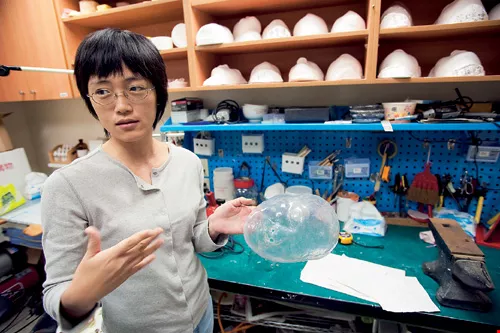
Equipment used by burn victims varies depending on what part of the body requires therapy. Therapist Song Youli explains that patients with severe facial burns need to wear transparent masks with inner layers made from silicon gel. Only these will generate enough pressure to keep the scars from deforming facial organs as they heal.
The accident that totally changed the trajectory of Zhang's life occurred in February of 2010. She was working in a soymilk shop at a particularly busy moment when she tripped on a gas pipe. Instantly, a vat of boiling soymilk was upset over her. Before the ambulance came, she rinsed herself off with water, but her long sleeves were stuck to her body, which was enduring tremendous pain.
When she arrived at the hospital, the doctor cut away her clothing to examine her wounds. But the damage to extensive areas of the skin made her body temperature crash, which in turn caused her to lose consciousness. "By the time I woke up, Chinese New Year's had already passed," she recalls. For about three weeks, she was tube fed, and she underwent a series of wound-cleaning and skin-graft procedures. In a daze, she only remembers hearing indistinct human voices. She lacked the energy to open her eyes.
In the hospital for six months, she endured repeated surgical debridement and skin grafting procedures, averaging one operation per week. Virtually every area of the skin that hadn't been burned was used as a source for skin grafts for large burns. Smaller burns were allowed to heal on their own. At one point she needed emergency surgery because of infection. Fortunately, she didn't suffer complications such as septicemia.
After a long period of suffering in a hospital room, where she was unable to move, with aches and itches all over her body that made it difficult to sleep, she began to feel that the surgical procedures would never end. At a particularly low moment, she even wondered if she wouldn't be better off dead. Fortunately, with the support of her attending physician and the encouragement and accompaniment of her husband, she was ultimately able to find the determination to make it through that critical period.
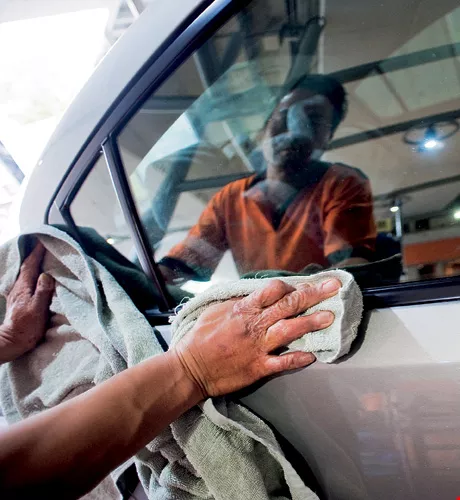
Sunshine's auto body shop gives burn victims jobs. It also gives regular people a chance at seeing complete transformations in appearance.
Like many burn patients, Zhang initially thought that she would quickly be able to return to life as it had been once her wounds had healed and she had been released from the hospital. She was quite wrong about that.
Tu Yu-hsien, an occupational therapist who is director of the Sunshine Rehabilitation Center, says that the time required for rehabilitation varies according to the severity of each patient's wounds and physical condition. Among those who have been treated at the center with moderate to severe wounds, the average time of rehabilitation is 9.7 months. But it can extend to three years.
Tu explains that second-degree burns (when there is damage to the deep layers of the dermis) and third-degree burns (when there is damage to subcutaneous tissue) result in permanent scarring. When these scars are new, they are red and bumpy and feel hard and inflexible.
In comparison to normal skin, scar tissue has more collagen fiber, which can clump together to form myofibroblasts, which are cells that promote shrinkage in connective tissue.
Contraction is characteristic of the scar formation period. The skin over patients' joints pulls taut, which causes pain and irritation. Excessive scar tissue over a joint can limit its range of motion.
Tu stresses that making the most of the golden period of rehabilitation (the first three to six months after wounds begin to heal) is extremely important. When patients are released from the hospital with wounds that are smooth and soft, they often ignorantly delay seeking treatment, and some avoid rehabilitation because they are scared of pain. "But the less they move, the more limited becomes their range of movement-to the point where limbs can even end up becoming deformed. Waiting until that point to pursue rehabilitation or corrective surgery accomplishes half the results with twice the effort.
Pressure garmentsApart from causing patients to endure pain, the rehabilitation process requires pressure therapy. Patients typically wear elastic pressure garments for one to three years.
Tu explains that the principle behind pressure garments is to apply "sustained and uniform" pressure to wounds where the scarring is not mature. That allows the collagen in the fibrous tissue to arrange itself in a more parallel manner, so the scar becomes "smoother, shallower and softer." Wearing pressure garments not only promotes the maturation of scars but also supports rehabilitative efforts aimed at getting patients to recover their range of motion. On the other hand, treating severe burns without pressure therapy often pushes back the time of full healing to four years. What's more, it results in a much more uneven scar surface.
"The golden period of rehabilitation is indeed exhausting, because this is when the scars have not fully healed, and the newly grown scar tissue is very weak. If one isn't careful, the pulling can result in skin breaks or blisters." Tu cites the example of bathing: "The whole process, from removing the pressure garments and the gauze and cleaning the body, to changing the topical medicine and dressing on the wounds, to getting back into the pressure garments, can take as long as three hours. And it puts greater physical and psychological pressure on the caregiver."
Marshalling courageFor many years, Sunshine has maintained close ties to large hospitals and sends staff members to convey their sympathies to burn patients in them. The hospitals also actively provide introductions to Sunshine, facilitating easier access to therapeutic services after release. Sunshine also hires therapists to make visits to the homes of patients who live in remote areas of central and southern Taiwan. Every year its therapists make about 800 home visits. "The hope is that everyone will receive timely and supportive rehabilitation," says Lin Jui-chiao, Sunshine's deputy CEO.
With access to comprehensive and professional therapeutic resources, says Lin, "It's key that patients feel motivated. All professionals can do is to stand alongside and offer a hand." Consequently, burn victims who come to Sunshine are required to participate in eight group-therapy sessions. "After they hear from peers and start encouraging each other, they find the energy to press ahead."
Luo Yiqin, a former patient at Sunshine, recalls that when her situation was no longer critical and she needed to start rehabilitation, she lacked the necessary motivation. She complained to her father, who had been very attentive to her needs: "Why do you want me to live? You never got my permission to save me. Why can't you understand that I'm in so much pain I'd rather die? I don't want to live like this. Everything's totally different!"
Her father replied: "I'm willing to share the pressure and suffering. Seeing you in such pain pains me inside too. Yet we've got to face what has happened. We can't just keep complaining. I believe that you can move beyond this!"
Zhang Zhengyu notes that during her own rehabilitation she grew so melancholic she was near the point of clinical depression. "I'd follow my therapists' instructions, suffering the pain. With great difficulty I'd do some stretches, and then 10 minutes later the scars would be just as tight as ever!" Even her husband couldn't help but nag: "Have you been slack about your stretching routine? How is it that you're not making any progress?" Such comments left her speechless.
She would frequently get halfway through her routine and then burst into tears. Partly it was a result of the pain, and partly it was because she had always been so strong minded and independent that she found it hard to accept that she had to "rely on others just to change my clothes or pick something up." She worried that she would never get better.
Fortunately, experienced patients at the center encouraged her, and Sunshine staff spoke earnestly with her husband. Those efforts dispelled misunderstandings and reduced the psychological pressure, and she pulled out of her funk to untiringly apply herself to rehabilitation.
A friendly environmentAs they walk down the long path of rehabilitation and gaze toward their futures, burn victims need more support from society.
Lin Jui-chiao points out that the number of people in Taiwan suffering from extensive burns has been on the decline, which demonstrates that prevention efforts are succeeding. But according to statistics kept by Sunshine about burn cases of medium to high severity, most burn victims (45%) in 2010 suffered their injuries as a result of household accidents (such as explosions caused by gas leaks). These were followed by industrial accidents (30%); accidents in public spaces, including fires ignited by cigarette butts (13%); and burns resulting from violence (12%), including domestic violence. The statistics suggest that a lot of work remains to be done in preventing domestic accidents.
Lin also stresses that burn victims have always been mostly working class, since accidents causing burns are more likely to happen in blue-collar work environments. And because scar tissue doesn't sweat, rehabilitated burn patients are more prone to heat exhaustion. That in turn reduces their already limited job opportunities. These workers often encounter difficulties embarking on new careers.
People with facial scars have to deal with particularly harsh social discrimination. Anyone with a highly visible scar has to endure uncomfortable stares from strangers, but those with facial scars are susceptible to even more bizarre forms of revulsion. Some people may refuse to eat at the same table with them. Parents will use them as negative examples when scolding their children: "If you don't behave, you'll end up looking like him." Or at work they'll be told by coworkers to sit facing the wall. In response, Sunshine is launching a "facial equality" campaign this year, hoping the public will start to treat victims of facial burns fairly and give them the respect they deserve.

@List.jpg?w=522&h=410&mode=crop&format=webp&quality=80)

@List.jpg?w=522&h=410&mode=crop&format=webp&quality=80)


