Tsai Chuen-horng: At the Atomic Energy Council, Safety Is Job One
interview by Coral Lee / photos Chuang Kung-ju / tr. by Scott Williams
September 2011


"No nuclear power without nuclear safety" is one of the government's highest principles. As minister of the Atomic Energy Council, Tsai Chuen-horng is charged with monitoring the safety of Taiwan's nuclear power plants. Tsai is also a professor with the Institute of Nuclear Engineering and Science at National Tsinghua University. Below, he discusses the stringent demands the AEC has made of Taipower in the context of international nuclear power management practices.
Q: Can you first discuss the comprehensive review of our nuclear power plants?
A: Our comprehensive review is drawing on the lessons of the Fukushima accident and looking to cure any ills of our own. It has two parts. The first is taking place inside the plants themselves, checking that safety systems are adequate to respond to a beyond-design-basis accident. The second is external to the plants, examining our radiation protection capabilities and the emergency response measures we'd implement in the event of a radiation leak.
Q: Since the Fukushima accident, Taipower has stressed that our domestic nuclear power plants have one more layer of supplemental power and water supplies than the Japanese plants. Is that the case?
A: People outside the industry tend to think that Japan has a high level of nuclear technology, that there's no way Taiwan's plants could be better than Japan's, but that's unfair to Taiwan. Taiwan's nuclear power plants include a fifth diesel generator, two gas turbine generators, and water storage pools that the Japanese plants don't have. The AEC requested Taipower install these to address potential weaknesses that we identified through probabilistic risk assessments. Taiwan's power grid is relatively fragile. Once a nuclear plant shuts down, we need a power source to restart it. We also had Taipower install 50,000-ton water storage pools at each plant because Taiwan lacks water in the dry season. They're built on mountainsides, enabling gravity to deliver water to the plants when the power is out.
But these items aren't part of standard safety systems, and they therefore weren't originally built to high standards of earthquake resistance. When we conducted the most recent comprehensive review, we incorporated them into the beyond-design-basis accident response measures, so they'll be strengthened.
Also, laymen aren't aware of the excessively fine division of labor in the Japanese nuclear power industry. Plant maintenance is contracted out to firms like Toshiba. As a result, there are very few maintenance personnel on staff, and plants don't have the ability to respond to crises. For example, if you want to vent pressure from the containment vessel and an electrically powered valve won't open, you need a maintenance worker. But if the roads are blocked, your contractors and the power you need aren't going to be able to get to you. Because all of our plants are maintained by Taipower personnel, we are more able to respond to crises.
Q: But the public has doubts about the efficacy of Taipower's management. How can we improve it?
A: While professionals certainly shouldn't become complacent, we seem culturally predisposed to lack self-confidence. The fact is that Taiwan's nuclear power plants actually perform very well, and a number of metrics prove it. The World Association of Nuclear Operators (WANO) utilizes a number of power-plant performance and safety indicators, things like number of unplanned SCRAMs, capacity factor, collective radiation exposure, chemistry performance (a water quality criterion), and so on. Taiwan's plants used to rank low among the world's more than 400 nuclear power plants, but in recent years we've improved to be among the top 100 in nearly every category.
WANO's evaluations are for industry professionals; they aren't made public. But annual capacity factor rankings are published. Last year, Taiwan's six reactors had an average capacity factor of 92.3% (Japan's average was only 60-something), ranking us second in the world among the 31 nations that operate nuclear power plants.
The capacity factor is a plant's actual power output over the course of a year divided by its faceplate capacity. The higher the number, the more efficient the facility, and the better its operations and maintenance.
We also participate in the culture of safety that the IAEA promotes, which covers both normal operations and responses to abnormal events. All workers must follow set procedures for the everyday operation and maintenance of plants, and their actions are verified by other workers. Workers who discover problems are obliged to report them. If we need to revise our procedures, we have prescribed steps for doing so, in which communication between staff and management plays a very important role.
In the wake of the Fukushima accident, the AEC has requested that Taipower assess and review its personnel requirements, such as how many firefighters it would need to deal with a complex disaster given its new equipment.
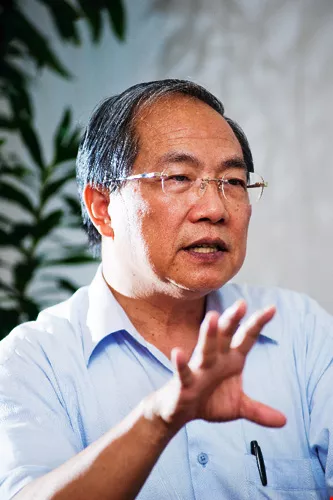
Tsai Chuen-horng, minister of the Atomic Energy Council, says that Taiwan will ask nuclear power experts from abroad to ensure that Taiwan's plants operate in accordance with the highest safety standards.
A: The first is the importance of being able to respond to a complex disaster. In the past, nuclear power plant emergency measures were predicated on a single incident or single reactor. Now we know we must be able to respond to multiple natural or nuclear disasters; we need to have the capability to address incidents at several reactors and to mount a large-scale response. This year's nuclear safety drills therefore used a complex disaster scenario and drilled the Central Emergency Operations Center and National Nuclear Emergency Response Center together.
When the drills were over, we discovered that the relevant departments had inadequate radiation inspection capabilities. These capabilities have several dimensions. Frontline detection, such as border control, requires that the Directorate-General of Customs or the Bureau of Standards, Metrology, and Inspection have basic detection equipment. The transportation and interior ministries also need basic detection capabilities to ensure that radiation has not affected their areas of responsibility. In the event of a complex disaster, there's simply no way the AEC could handle every issue, large or small, that would arise. We also need expert analysis to determine things like whether agricultural products have been contaminated. We plan to build a mechanism whereby the AEC can have universities with the appropriate analytical capabilities handle this.
The technical term for what happened at Fukushima is a "common-cause failure"-all of the safety systems were destroyed by the tsunami. The multiple layers, diverse approaches, and deep protections approach to design, an approach which the nuclear engineering community had been quite proud of for years, has now been seriously challenged. Moving forward, the international nuclear engineering community will certainly seek to determine whether the approach can be revised. But until such time as the approach is changed, we will have to protect ourselves by anticipating beyond-design-basis disasters and implementing comprehensive emergency responses. The design of Taipower's proposed "extreme measures" ensures that should a Fukushima-type natural disaster strike Taiwan, we won't find ourselves in the same straits.
Finally, international reporting and support are crucial. In the case of the Fukushima accident, the Japanese government initially declined international assistance, but the US got involved anyway and showed that it has some very advanced rescue equipment. So it's necessary to get international support mechanisms established in advance of a crisis.
Q: What sort of emergency evacuation plans does Taiwan have in the event of a nuclear accident?
A: In the event of a complete loss of power at a plant, Taipower has 15 minutes to notify the AEC, which would immediately convene the Central Emergency Operations Center to bring the situation under control. The Radiation Monitoring Center would also immediately initiate testing and sampling, and announce the results at regular intervals to keep decision-making centers and the public informed of developments and help them take appropriate defensive actions.
Nuclear events have varying degrees of severity, ranging from plant-area anomalies to major accidents. If an incident worsens to the point that safety systems fail or containment loses its integrity, it becomes a major accident that requires intensive monitoring of radiation levels.
Officials determine whether a radiation leak requires the evacuation of a given area based on forecasts about how the accident will progress and by entering various parameters and measurements into a dose-estimation system. If the estimated two-day dose exceeded two millisieverts, people would be urged to take cover in their homes. If the seven-day dose reached 50-100 mSv, they would be evacuated.
Taiwan's original five-kilometer emergency response zone was determined based on the size of reactors, their type, the climate, and the topography. A computer program calculated the distance using these parameters, but assumed an accident involving a single reactor. In the wake of Fukushima, we made new estimates based on the simultaneous meltdown of two reactors at a single plant. At the No. 1 and 2 plants in northern Taiwan, the new calculations yielded a radius of less than 5 km (only one tsunami has ever struck the Keelung area), but at the No. 3 plant in Ken-ding, the new calculations yielded a radius of 7.5 km (history records three tsunamis striking southwestern Taiwan). We have therefore tentatively extended this facility's emergency response zone to 8 km.
Taiwan's No. 2 Nuclear Power Plant isn't far from Taipei City. Parts of Neihu and Nangang are within 10 km of the plant. The No. 1 plant is a bit further away, roughly 20 km from Taipei Railway Station as the crow flies. What worries everyone is the possibility of an earthquake along the Shanjiao Fault between the Nos. 1 and 2 plants. The National Science Council is currently conducting a geological survey [to assess the likelihood and impact of a major earthquake]. If its results indicate that the current safety systems are inadequate and cannot be sufficiently strengthened, the plants will be shut down. The AEC puts safety above all else. After all, an ounce of prevention is better than a pound of cure, and public safety trumps power generation.

@List.jpg?w=522&h=410&mode=crop&format=webp&quality=80)

@List.jpg?w=522&h=410&mode=crop&format=webp&quality=80)


