Taiwanese Pearls Glitter at Shanghai's Expo 2010
Lin Hsin-ching / photos Jimmy Lin / tr. by Jonathan Barnard
May 2010


In 1970, for the first time ever, a World Expo was held in a city outside of the advanced nations of Europe and the Americas. Japan, which had been experiencing rapid economic growth in the post-war era, had won the right to play host that year. With the theme of "progress and harmony for mankind," the Osaka Expo '70 attracted some 64.22 million visitors, making it the best-attended World Expo in history.
The event held special historical significance for Taiwan too, because the Republic of China would soon leave the United Nations. Osaka ended up being the last time that Taiwan could formally participate in a World Expo as the ROC. The ROC Pavilion was designed by the internationally famous architect I.M. Pei, whose trademark triangular geometries were plainly visible on its design, both inside and out. The pavilion was one of the Osaka Expo's most eye-catching structures.
Beginning in 1970, Taiwan began to leave one international organization after another, and consequently it could no longer make a display of national splendor at these events. Now, 40 years later-thanks to growing goodwill across the strait and the hard work of its government and private sector-Taiwan finally has an opportunity to once again participate at a World's Fair: Expo 2010 in Shanghai. Moreover, Taiwan will be represented there by three pavilions: the Taiwan Pavilion, the Taipei Pavilion and a corporate pavilion built by the Aurora Group, which specializes in office supplies.
For this not-to-be-missed gathering, a reporter from Taiwan Panorama went to Shanghai in late March with two goals: to report on the remarkable transformation of Shanghai and to delve into the negotiations that took place to bring the three Taiwanese pavilions into being. In our next issue we will feature reports on other pavilions, including China's. Be sure not to miss it!
At 6:00 a.m. on March 28, 2010, when most people in Taiwan were in their beds taking in their last hours of slumber, across the Taiwan Strait in Shanghai thousands upon thousands of people were gathering amid the cold wind on the banks of the Huangpu River to have an early look at the glories of the "Oriental Wall Street" and "Shanghai's Champs Elysees."
It was a big day: The ribbon was being cut on the reconstructed Bund. Shanghai residents had endured nearly three years of din and dust and daily traffic jams, awaiting that moment's arrival.
The new Bund was complete: A 3.7-kilometer double-deck underground roadway, with three lanes to each deck, was opening. Meanwhile, the 11 original lanes of above-ground traffic had been cut to four, so that the pedestrian promenade could be expanded. Strollers would be able to survey the distant congregation of office towers across the river in the financial district of Lujiazui. In the foreground, they could watch the boats on the river and examine details on the Bund's 52 works of outstanding classical architecture.
In order to expand the public space here, the Shanghai city government tore down the walls around Huangpu Park and connected it to preexisting green areas of the Bund to create an "urban ecological park." It will give future visitors a greater intimacy with nature as they immerse themselves in the Bund's charms. The Bund, the most famous of the British concessions during the early ROC era, has witnessed so much history, so much pleasure-seeking and debauchery. And no other place is so representative of the intertwining of Chinese and Western culture.
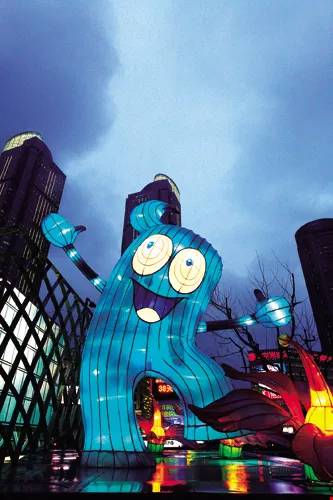
On Shanghai's avenues, alleyways and metro stations, you can find images of Expo 2010's mascot Haibao. With expo slogans emblazoned everywhere and all manner of promotional activities, it's hard for tourists and residents alike not to be continually aware of Expo 2010.
"The Bund symbolizes Shanghai, encapsulating a century of political, economic and cultural change in China. The new Bund not only carries on the historic and cultural legacy of the Bund; it will also be instrumental in transforming the functions of areas along both banks." Those were the heartfelt words of Shanghai mayor Han Zheng at the reopening of the Bund.
Shanghai had indeed gone all out, spending US$700 million (about NT$22.2 billion) on this major renovation. Apart from aiming to facilitate general tourism and transportation, the Bund renovations were explicitly made with an eye toward Expo 2010, which starts on May 1.
According to estimates by the mainland Chinese government, some 70-100 million tourists will be flocking to Shanghai for Expo 2010. How could the mainland Chinese not want to spruce up the Bund so that it might better play host to the city's numerous visitors? It is after all the city's most famous attraction.
In fact, since winning its bid in 2002 to host Expo 2010, Shanghai has been pushing public infrastructure projects of all types and sizes. For instance, the Shanghai Metro, which eases traffic congestion in an environmentally friendly manner, is being expanded from three to 11 lines. It is estimated that those new lines will bring its total track length to 420 kilometers, surpassing the London Underground (408 kilometers) as the largest subway system in the world.
What's more, Shanghai is working hard to make Hongqiao Station on the west side of Hongqiao Airport the world's largest passenger transport node. It will become a giant transit hub that combines air travel with high-speed rail, regular rail, the metro system, above-ground mass transit (buses), taxis and maglev trains. It's estimated that the Hongqiao Hub will accommodate at least 1.1 million passenger journeys a day, roughly 2.8 times the 400,000 passenger journeys that the Taipei Train Station (with high-speed rail, regular rail and metro lines) accommodates daily.
The core attractions of the expo will be found on both sides of the Huangpu River and encompass a total area of more than 5.28 square kilometers. In addition to constructing the Expo Park's basic infrastructure, which involved tearing down numerous buildings and moving 18,000 residents and 272 factories, the authorities also ordered facelifts for several hundred buildings. A motley collection of apartment buildings of varying conditions and appearances had their walls scrubbed and their roofs repaired. One and all, they ended up with clean white walls and either red or blue roofs.
Expo 2010's promotional campaign is ubiquitous. There's the wavelike mascot "Haibao," which means both "treasure of the sea" and "treasure of Shanghai." And slogans such as "A City of Harmony-It's Everyone's Expo" can be found at every metro station and shopping center. Even taxicabs feature touch screens with animated promotional videos providing information about tickets and "highlights" of various pavilions. With support from the central government, Shanghai has spared no expense and gotten the whole city involved in preparations. Its goal has been to give itself a full makeover before the expo, so that it can rise into the ranks of the world's leading cities.
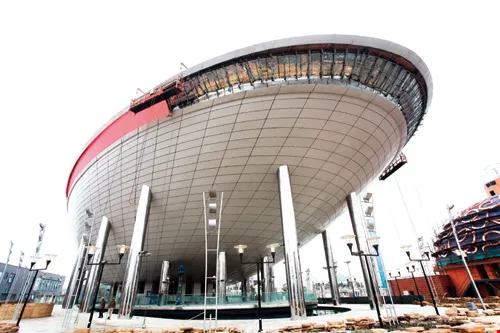
The "moon boat" Saudi Arabian Pavilion cost NT$4.8 billion to build. The world's largest 3D movie theater inside has a screen the size of two football fields. The pavilion aims to allow visitors to gain an understanding of Arabian classical culture and handicrafts-as much as if they had actually gone to the country itself.
According to foreign reporters based in mainland China, over the past six years the mainland government has spent RMB400 billion (about NT$2 trillion) on Expo 2010 and accompanying urban infrastructure. Although the mainland authorities deny this figure, in light of the extensive construction endlessly taking place in Shanghai in recent years, it can't be too far off.
There are of course economic and political calculations behind China's willingness to spend so much.
Huang Jenn-jia, an assistant professor of mass communications at Taiwan's Tamkang University who has studied fairs and exhibitions for several years, points out that there have already been 159 "universal exhibitions" (World Expos or World's Fairs), which are now held once every five years. They have always been excellent arenas for displaying national strength. And while they may nowadays look like the "world's biggest theme parks," they are always fraught with political symbolism.
By putting on the 2008 Olympics, China had already announced its "rise as a great power." Holding Expo 2010 now has value for China to display its "soft power."
Huang points out that in hosting the Olympics and Expo 2010 to announce its strength and wealth, China is behaving similarly to Japan several decades ago. Japan hosted the Tokyo Olympics in 1964 and Expo '70 in Osaka. Beijing and Shanghai are the political and economic centers of China, much like Tokyo and Osaka were for Japan back then.
By hosting these two major international events, China's government has domestically been able to point to political achievements, foster a patriotic consensus, and reduce internal dissent and opposition when pushing through various infrastructure projects that involve the renewal of old urban districts. In terms of looking outward, they've used these events to increase national visibility and announce their national might.
In order to fully implement their political, economic and diplomatic goals, the Chinese authorities are also setting various "world records" at the Shanghai Expo 2010.
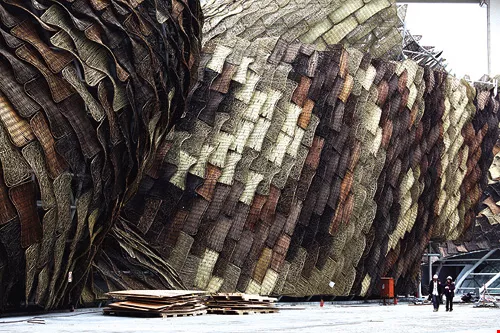
The Spanish Pavilion is made from a steel skeleton covered with 8,524 woven willow wicker panels. The panels are unevenly colored due to the varying times that the willow spent immersed in its own boiling juices.
Apart from hosting the largest number of participating countries (a total of 242 nations and international organizations are exhibiting), it is estimated that the number of visitors will be the largest ever (70-100 million). And Expo 2010 has taken a thematic departure from the environmental emphasis that had prevailed at expos in recent decades. For its expo theme, Shanghai has chosen something that is right there for everyone to see and is closely connected to human culture: the city.
Chen Xianjin, deputy director general of the Shanghai World Expo Coordination Bureau, came to Taiwan in March for the UFI (Global Association of the Exhibition Industry) Open Seminar in Asia. He noted that the "Better City, Better Life" theme was chosen in the hope that the whole world would enjoy China's unique urban development experience: with the reforms that began in the 1980s, some 300 million farmers have gradually moved into cities. Their migration sparked the rapid economic development of Chinese cities, both along the coast and inland, and greatly bettered their individual economic lots.
The largely peacefully integration of these 300 million workers into the urban population, Chen says, is in fact China's greatest contribution to the world.
What's more, under China's strict household registration system, one doesn't see the shocking poverty, crime or mountains of garbage that one can find in third-world cities or America's urban ghettos. Nevertheless, there are serious problems connected to large populations of migrant workers and capitalist economic development has brought growing extremes of wealth and poverty. These issues are all sources of worry for the mainland regime.
"Over the next 30 years, it is predicted that some 300 million more rural residents will move into the cities," says Chen. "So we also hope to learn from the experiences of other cities from around the world!"
In light of these considerations, Expo 2010 has broken with the convention that World Expos only have pavilions belonging to nations, international organizations and corporations. It has additionally incorporated an "Urban Best Practices Area," inviting 80 major cities from around the world to participate, so that they can learn from each other's unique forms of urbanism. Taipei is exhibiting on the themes of "wireless broadband" and "resource recycling." It's the only city with two themes. (See p. 28.)
When Shanghai mayor Han Zheng came to Taiwan in April for the Shanghai-Taipei City Forum, he pointed out that "the course of development in cities encapsulates the development of human civilization." He thus especially hopes that during the period of the expo people from the cities of every nation can exchange ideas about industrial upgrading, lowering unemployment, and resolving traffic congestion and housing shortages, as well as discuss how to guide intensive urban development so as to protect the environment and the natural ecology.
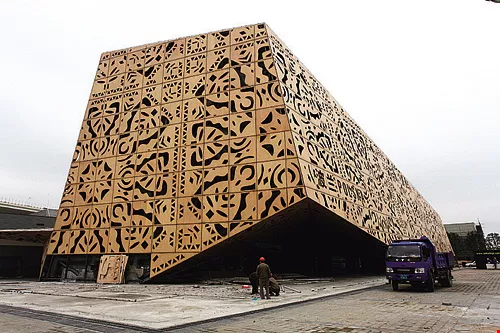
Inspired by traditional paper-cuts, the Polish Pavilion at Expo 2010 will hold daily piano concerts featuring the works of Frederic Chopin, to celebrate the 200th anniversary of the birth of that great Polish composer.
As far as mainland China is concerned, holding the World Expo in Shanghai represents another international "big show" that it is hosting on the heels of the 2008 Summer Olympics in Beijing. The Shanghai Expo is not only a rare opportunity for high-level exposure; it has also established an excellent model for cross-strait negotiation and cooperation. It provides a touchstone for Taiwan to return to the international stage.
Due to the regulations of the Bureau International des Expositions (International Exhibitions Bureau), which is responsible for negotiating and deciding all matters relating to universal exhibitions, an entity must be a formal member state of the organization to participate in a World Expo and to set up a "national pavilion" at the expo. After the ROC participated in the Osaka World Expo in 1970, it gradually left or was removed from various organizations, including the United Nations. Foreign relations grew more and more difficult, and mainland China actively tried to block Taiwanese participation, opposing the issuance of invitations to Taiwan.
Japan has had frequent exchanges with Taiwan, but when it put on the Aichi World Expo in 2005 it was only able to permit "back-door" participation from Taiwan via the "Ilha Formosa" restaurant, which offered various culinary delicacies and produce from the island. A formal pavilion, like those of other nations, was not possible.
But a breakthrough was experienced in Shanghai: After 40 years Taiwan was finally invited to participate once again, with not one, but three pavilions: a Taiwan Pavilion, a Taipei Pavilion, and an Aurora Group Pavilion. How was this change of fortunes accomplished?
Because the theme of this World Expo is "cities," Taipei, as well as other Asian cities such as Osaka and Seoul, were invited by the International Bureau of Exhibitions to participate in the Urban Best Practices Area. That made perfect sense. As for the Aurora Pavilion, it applied for participation as a "Taiwan enterprise." Amid the 18 corporate pavilions in the Puxi Park District, it is the only pavilion sponsored by a company from Taiwan. There was nothing controversial about either the Taipei Pavilion or the Aurora Pavilion.
But the Taiwan Pavilion, with its implications of sovereignty, was another matter altogether. Taiwan couldn't apply as a member state according to the bureau's rules. Nor could it apply as a city or corporation. So under what status could it participate without causing controversy? It was a predicament that once again tested the ingenuity of negotiators from both sides across the Taiwan Strait.
Wang Chih-kang, the Taiwan External Trade Development Council (TAITRA) chairman and the guiding spirit behind establishing the Taiwan Pavilion, points out that China formally invited Taiwan's participation in May of 2009. Because of the serious ramifications, President Ma Ying-jeou consulted first with the National Security Council. That led to the drawing up of four resolutions: "Taiwan will definitely participate"; "TAITRA will participate as a private group"; "All efforts will be taken to ensure that the nation will not be belittled"; and "Because TAITRA is participating as a private organization, the government will provide no funding and TAITRA will have to come up with needed money itself."
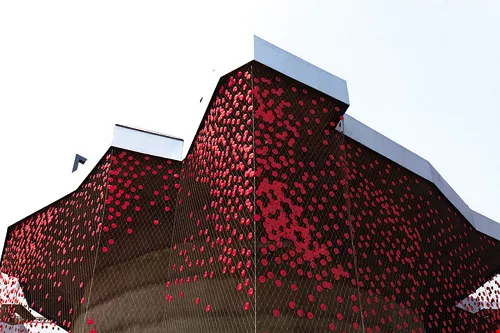
The red curtain exterior of the Swiss Pavilion, made from soybean fiber and birch resin, contains photovoltaic cells and dynamically reactive elements. Visitors can ride the pavilion's cable car to its green roof, which is evocative of the Swiss countryside.
Even if the question of participation had been resolved, other potential sticking points involved the selection of the pavilion's name and its location. In a place under the rule of the Communist Party of China, using the "Republic of China" was of course not possible. Consequently, the two sides settled on "The Taiwan Pavilion Sponsored by the Taipei World Trade Center as a Private Entity." It was sufficiently vague with regard to the question of whether it was a "national pavilion."
With the name decided, the remaining thorny question involved the pavilion's location. The mainland Chinese originally thought of "assigning" Taiwan a spot in the Chinese Pavilion area, like the "special administrative regions" of Hong Kong and Macao. The intention was to suggest an image of unification, which was of course completely unacceptable to Taiwan. TAITRA had to step again to the fore to negotiate. Ultimately, Taiwan was extricated from the area hosting Hong Kong, Macao and the regular Chinese provinces.
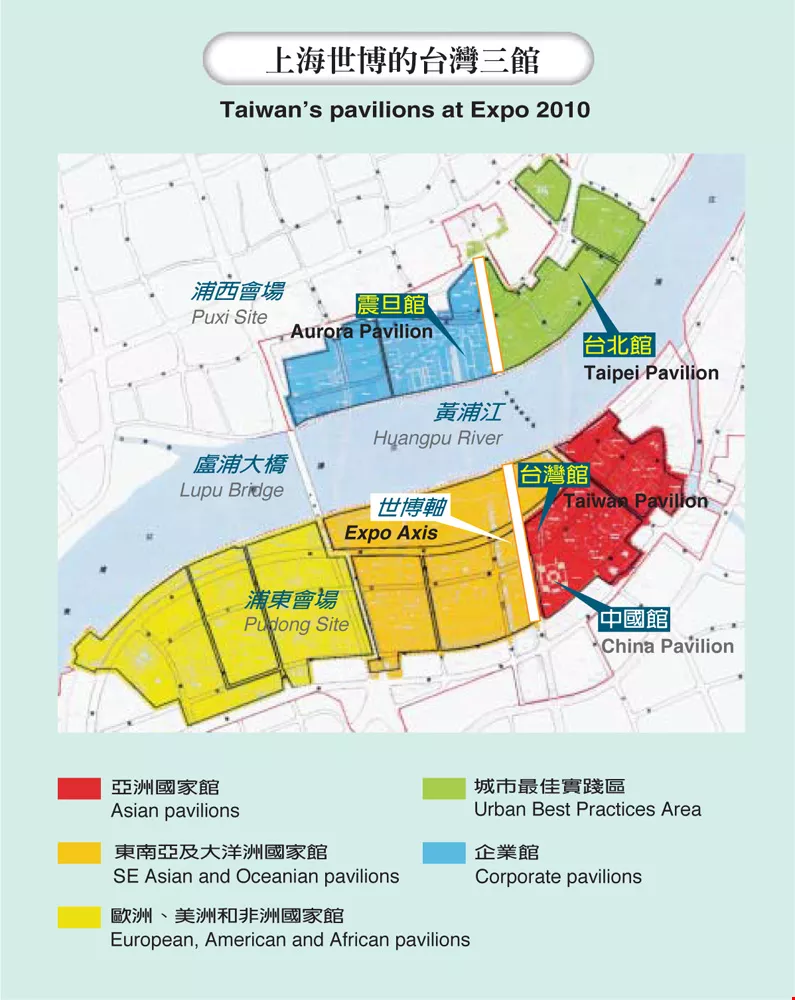
Taiwan ended up being placed in Pudong's Zone A amid the pavilions of Asian nations near the "Expo Axis" (the main axis of the World Expo Park). It is located across a footbridge from the China Pavilion-providing a sense of "closeness yet distance" that matches the current geographic and political situation.
Wang Chih-kang explains that both sides shared a belief that "Taiwan could not be absent" from Expo 2010, and both were actively and positively negotiating. What's more, amid an atmosphere of reconciliation, both sides were willing to give ground on some points that were particularly important to the other side. From the ROC perspective, participating as a private entity is not 100% satisfactory, but it was an unavoidable political necessity in this day and age.
"From another perspective, there is tremendous significance in Taiwan being able to stand on the World Expo stage after so many years," says Wang Chih-kang. "And with this precedent of excellent cross-strait negotiations, Taiwan may be able to follow the same model to attend future World Expos or other international gatherings. It's definitely brought 'extra benefits' to Taiwan."
On July 17, 2009 TAITRA reached an agreement with the Shanghai World Expo. Among all participating nations, it was the last one to do so. It then immediately invited several famous architects in Taiwan to submit architectural drawings for a pavilion design competition. Ultimately C. Y. Lee, the renowned architect of Taipei 101 and the Pangu Plaza residential skyscraper in Beijing, was chosen. Lee, coincidentally enough, had been on the team that designed the ROC Pavilion in Osaka for Expo '70 some four decades before.
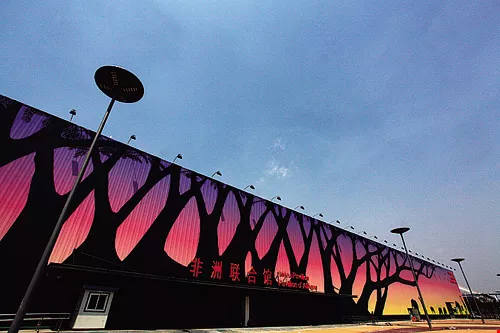
The Joint Africa Pavilion, which was constructed with funding from the Shanghai World Expo Coordination Bureau, is a joint exhibition space where 42 African nations and the African Union are holding their exhibitions under a big tree symbolizing the theme of "a continent full of hope and opportunity."
The popular launching of sky lanterns in Taipei County's Pingxi was the inspiration for the Taiwan Pavilion. Lee chose "mountain, water, and lantern of the heart" as the pavilion's core concept. In its design, the Taiwan Pavilion was modeled after a glass sky lantern, and it was given three main focuses: a lantern-shaped glass screen, an LED globe and a domed theater. Multimedia performances were then commissioned with the aim of turning this "small but bright and expansive" Taiwan Pavilion into an exquisite work of art, offering a novel experience for eyes and ears. (See p. 20.)
The internationally famous director Hou Hsiao-hsien was invited to serve as visual director for the Taipei Pavilion, and he created a 3D multimedia work, hoping to give visitors a sense of both the beauty and friendliness of life in Taipei, via a media experience that is as intimate and close to reality as possible. There's also a film on the Taipei of the future that makes use of advanced projection technologies to convey images in a pyramid-shaped theater that incorporates a model of the Taipei Basin. It describes Taipei's technologically advanced wireless broadband network and comprehensive recycling program. (See p. 28.)
The first Taiwanese corporation to participate in a World Expo, the Aurora Group uses the most advanced techniques in optical holography to display images of more than 40 representative jade artifacts from the Aurora collection, ranging in age from the Hongshan Culture (a Neolithic culture that existed some 6000 years ago in what is now northern China) to the Ming and Qing dynasties. For those who enjoy history and culture, it's well worth a close look. (See p. 32.)
Although very different in their themes, the three pavilions representing Taiwan at the Shanghai Expo 2010 collectively reflect the will and hope of Taiwan's government and people to grab hold of this opportunity to step out again onto the world stage. With regard to cross-strait relations, Expo 2010 has created an excellent platform on which to explore possibilities of future cooperation. In the six-month run of Expo 2010, these three "made-in-Taiwan" pavilions will shine like pearls on both sides of Shanghai's Huangpu River, offering an outstanding display of Taiwan's soft power.
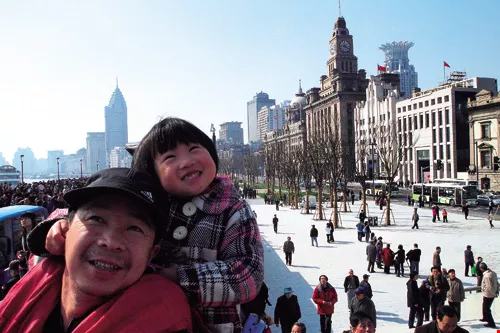
"Development brings a better future." That's the hope that Shanghai residents hold when confronting the expo and the new city skyline. The smiles on the faces of this father and daughter visiting the newly reopened Bund seem to say it all.
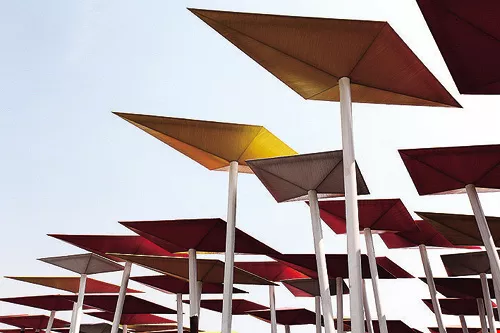
In Mexico kites represent people's hopes for a beautiful future. The design of the Mexican Pavilion as a kite forest made up of many colorful kites and green grass was chosen to convey the ideals of "ecology, environmental protection and peace" that the nation holds for the cities of its future.
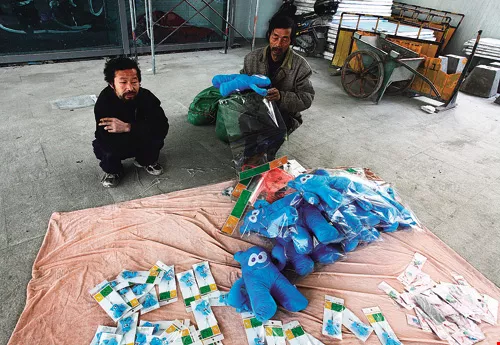
Migrants whose "home" is Shanghai's Lujiazui Metro Station live off several dozen RMB a day by hawking pirated Expo 2010 merchandise. As far as they are concerned, the biggest significance of Expo 2010 lies in the fake Haibao mascots that pass through their hands.
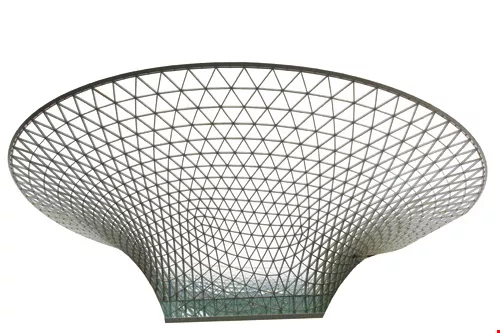
Shanghai's Expo Axis features six "sun valleys," which are made of glass over steel skeletons. These help to bring sunlight and fresh air to underground spaces and also serve to collect rainwater. They will relieve any sense of stuffiness among visitors in the axis' underground passages.
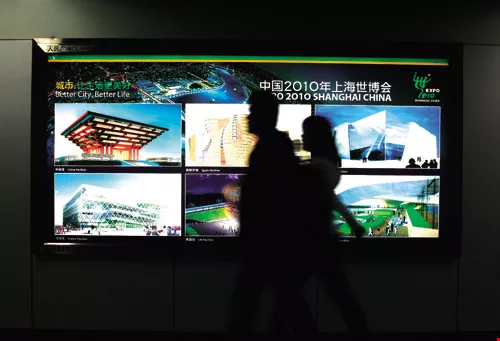
On Shanghai's avenues, alleyways and metro stations, you can find images of Expo 2010's mascot Haibao. With expo slogans emblazoned everywhere and all manner of promotional activities, it's hard for tourists and residents alike not to be continually aware of Expo 2010.
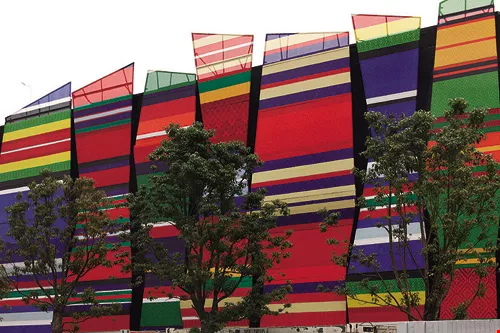
The brightly colored Estonian Pavilion, with its "save city" theme, features 33 large piggy banks in which visitors can place their own ideas about improving cities.
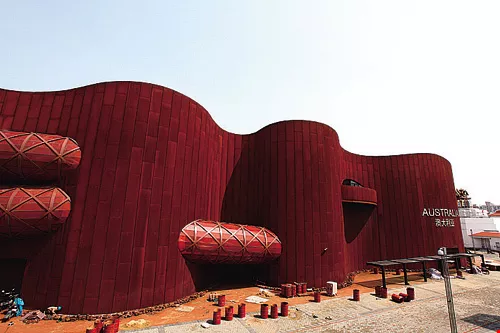
National pavilions provide a way for nations to present a face to the world. They spare no effort in their designs. Take Australia's pavilion, which was inspired by the undulating rocks of the Australian outback. The ocher color symbolizes the red earth of the Australian interior.
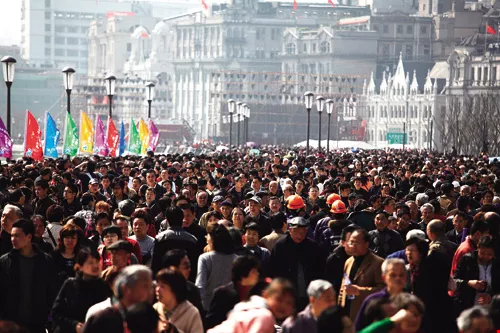
Anyone can see the fruits of China's recent years of economic development, but problems such as bursting cities, extremes of wealth and poverty, and traffic congestion are growing more and more serious. The photo shows the startling sight of crowds pouring into the Bund when it reopened after being reconstructed.
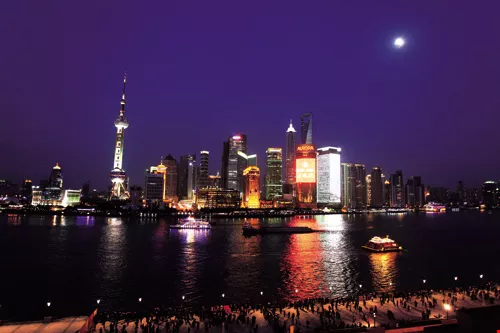
The nighttime view from the Bund, Shanghai's most famous attraction. China is hosting another big international event on the heels of the 2008 Beijing Summer Olympics. Expo 2010 in Shanghai is the largest World Expo in history. By hosting these two major international gatherings, China is demonstrating to the world that it has successfully risen into the ranks of the world's great powers.


@List.jpg?w=522&h=410&mode=crop&format=webp&quality=80)


